
Capstone Problems
Why capstones belong in the toolkit
Section titled “Why capstones belong in the toolkit”AdS/CFT is learned by doing calculations that force the two sides of the dictionary to agree. A slogan can be memorized; a holographic computation cannot. The point of this page is to turn the course into a set of research rehearsals.
Each capstone asks you to start from a boundary observable, choose a bulk dual object, impose the correct boundary and interior conditions, renormalize or extremize the answer, and then check the result in at least two independent ways. This is the rhythm of real holographic work.
The problems below are intentionally not isolated textbook exercises. They are small projects. A good solution should look like a short research note: definitions first, approximation stated clearly, calculation organized cleanly, final answer boxed, and limitations named honestly.
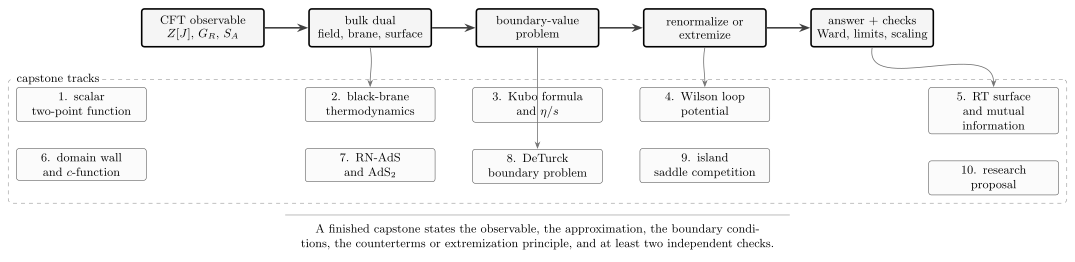
The capstone problems are organized around the same workflow used in research calculations: identify the CFT observable, formulate the bulk problem, impose boundary and interior conditions, renormalize or extremize, and check the answer. The tracks span local correlators, black holes, transport, Wilson loops, RG flows, finite density, entanglement, numerical gravity, and quantum information.
How to use this page
Section titled “How to use this page”There are three good ways to use these problems.
As a final exam. Choose five capstones: one from correlators, one from finite temperature or transport, one from nonlocal observables, one from entanglement or information, and one from the toolkit. Write complete solutions.
As a research preparation sequence. Work through the capstones in order. For each one, write a clean notebook or note that another student could reproduce.
As a self-diagnostic. Pick the capstone closest to your research area. If you cannot state the source, vev, boundary conditions, counterterms, and consistency checks, revisit the relevant course pages.
A complete capstone solution should include the following items.
| Item | What it should contain |
|---|---|
| Observable | The precise CFT quantity: correlator, free energy, entropy, Wilson loop, transport coefficient, or spectral function. |
| State and ensemble | Vacuum, thermal state, grand-canonical ensemble, fixed charge ensemble, TFD state, evaporating setup, or deformed vacuum. |
| Bulk dual | Field, metric perturbation, string worldsheet, brane embedding, extremal surface, or full geometry. |
| Approximation | Large , large , classical supergravity, probe limit, hydrodynamic limit, linear response, or semiclassical gravity. |
| Boundary conditions | Source data at the AdS boundary and regularity, infalling, smoothness, horizon, cap, or DeTurck conditions in the interior. |
| Renormalization | Counterterms, subtractions, contact terms, scheme dependence, or generalized entropy renormalization. |
| Final answer | A result with dimensions, normalizations, and regime of validity stated. |
| Checks | Ward identities, conformal scaling, thermodynamics, limits, positivity, causality, numerical convergence, or known special cases. |
Capstone 1: scalar two-point function from Euclidean AdS
Section titled “Capstone 1: scalar two-point function from Euclidean AdS”Problem
Section titled “Problem”Consider a scalar field in Euclidean AdS with metric
and action
Let
Your task is to compute the separated-point two-point function of the dual scalar primary .
- Derive the near-boundary behavior of .
- Write the bulk-to-boundary solution for boundary source .
- Reduce the on-shell action to a boundary term.
- Explain which terms are contact terms and which term determines the separated-point correlator.
- Obtain the scaling
- State how depends on conventions.
Solution
The scalar equation is
Near , neglecting -derivatives gives
With , this becomes
Thus
where is the source in standard quantization and is proportional to the one-point function.
The normalized Euclidean bulk-to-boundary propagator is conventionally written
with
This choice satisfies
in the distributional sense. The classical solution with source is
Using the equation of motion, the bulk action reduces to the cutoff boundary term
In Euclidean Poincaré AdS, and for the outward normal at the cutoff surface. The expansion contains divergent local terms in , such as powers of multiplying , , and so on. These are removed by local counterterms and affect only contact terms in position space.
The nonlocal finite term gives
up to sign conventions for the Euclidean generating functional and possible local contact terms. Differentiating twice gives
up to the convention for whether or is used.
The universal content is the conformal scaling . The coefficient depends on the normalization of the bulk field, the normalization of , the sign convention for , and possible finite local counterterms. A physical comparison between two calculations must keep these conventions fixed.
Research extension. Repeat the computation in momentum space using the regular solution
and identify how logarithms arise when is an integer.
Capstone 2: black-brane thermodynamics and the plasma
Section titled “Capstone 2: black-brane thermodynamics and the N2N^2N2 plasma”Problem
Section titled “Problem”Consider the planar AdS black brane
Compute its temperature, entropy density, energy density, pressure, and free-energy density. Then specialize to and use
to obtain the thermodynamics of strongly coupled planar SYM.
Solution
Near the horizon, set with small . Since
the Euclidean metric in the plane is smooth only if
The entropy density follows from the Bekenstein-Hawking formula:
Using conformal invariance and the first law,
and , one obtains
and therefore
For ,
The pressure, free energy, and energy density are
The scaling reflects the adjoint degrees of freedom of the deconfined plasma and, in the bulk, the scaling .
Research extension. Add the leading finite-coupling correction schematically controlled by . Explain why it enters as a power of rather than .
Capstone 3: Kubo formula and
Section titled “Capstone 3: Kubo formula and η/s\eta/sη/s”Problem
Section titled “Problem”For a translationally invariant thermal state, the shear viscosity is defined by the Kubo formula
In an Einstein-gravity dual, the source for is a metric perturbation . Show that the transverse graviton mode obeys the same equation as a minimally coupled massless scalar at zero spatial momentum. Use the membrane argument to derive
Solution
Let
For an isotropic black brane governed by two-derivative Einstein gravity, this tensor channel decouples from other perturbations. To quadratic order, its effective action takes the scalar form
The canonical radial momentum is
The retarded function is extracted as
At small , the radial flow of becomes trivial, so it can be evaluated at the horizon. Imposing the infalling condition gives, near the horizon,
Therefore
For the shear graviton in an isotropic metric, this horizon expression is one quarter of the entropy density divided by :
Hence
The result assumes a two-derivative Einstein action, isotropy, a regular horizon, no mixing with additional light tensor-channel fields, and the standard infalling prescription. Higher-derivative terms, anisotropy, or nonminimal couplings can change it.
Research extension. Compare this derivation with the absorption-cross-section argument. Which step fails if the graviton has higher-derivative interactions?
Capstone 4: heavy-quark potential from a U-shaped string
Section titled “Capstone 4: heavy-quark potential from a U-shaped string”Problem
Section titled “Problem”Compute the strong-coupling potential between an external quark and antiquark in the vacuum of planar SYM using a fundamental string in Euclidean AdS.
Use
A rectangular Wilson loop has temporal extent and spatial separation . Use static gauge , , .
- Derive the Nambu-Goto action.
- Find the first integral associated with translation in .
- Express in terms of the turning point .
- Subtract the two straight-string masses.
- Obtain .
Solution
The Nambu-Goto action is
For the static embedding,
The Lagrangian has no explicit dependence, so
where is the maximal depth and . Therefore
The separation is
The regularized energy is obtained from
After subtracting the divergent straight-string masses, the standard result is
for the conventional normalization of the fundamental string action in AdS.
The behavior is required by conformal invariance. The nontrivial result is the strong-coupling coefficient proportional to , reflecting the classical string tension in AdS units.
Research extension. Repeat the analysis in a confining background. Identify the geometric condition under which the large- potential becomes linear.
Capstone 5: RT surfaces and mutual information for two intervals
Section titled “Capstone 5: RT surfaces and mutual information for two intervals”Problem
Section titled “Problem”In the vacuum of a large- holographic CFT, consider two equal intervals
with . Using the RT formula in AdS, determine the mutual information
at leading order in .
Your solution should explain the competition between disconnected and connected RT saddles.
Solution
For a single interval of length in the vacuum CFT,
Thus
For , there are two candidate RT pairings. The disconnected one gives
The connected one gives
RT chooses the smaller value:
Therefore
The phase transition occurs when
Writing , this gives
Thus
At leading classical order, holographic mutual information is either or exactly zero, because only the dominant RT saddle is retained. Subleading bulk quantum corrections smooth the interpretation but not the leading large- phase structure.
Research extension. Add a thermal scale by replacing the vacuum interval entropy with the finite-temperature CFT expression. Track how the transition changes with and .
Capstone 6: relevant deformation, domain wall, and holographic -function
Section titled “Capstone 6: relevant deformation, domain wall, and holographic ccc-function”Problem
Section titled “Problem”Consider a -dimensional Einstein-scalar model
with domain-wall ansatz
Assume the geometry approaches AdS in the UV, where . Show that the null energy condition implies a monotonic holographic -function.
Solution
The Einstein equations for the domain-wall ansatz imply
Thus
For flows with , define
where is a positive normalization chosen so that at an AdS fixed point equals the appropriate central quantity, such as in or in many Einstein-gravity flows.
Differentiating gives
Since , we have
as increases toward the UV. Equivalently, decreases along the RG flow from UV to IR.
At an AdS fixed point with radius ,
The monotonicity is a geometric reflection of the null energy condition. It is not, by itself, a proof that every possible QFT monotone is represented by this particular function; the precise identification depends on dimension, theory, and gravity action.
Research extension. Work out the same monotonicity in coordinates where the metric is written as
Be explicit about how the radial orientation changes the sign of the flow.
Capstone 7: RN-AdS, chemical potential, and the AdS throat
Section titled “Capstone 7: RN-AdS, chemical potential, and the AdS2_22 throat”Problem
Section titled “Problem”Consider a finite-density holographic CFT dual to an Einstein-Maxwell theory admitting a planar charged black brane. Near extremality, the geometry develops a near-horizon region
Your task is to explain how the chemical potential, charge density, and emergent IR scaling appear in the bulk.
- State the source/vev interpretation of the near-boundary gauge field.
- Explain why regularity requires a gauge choice with at the horizon.
- Derive the general form of the near-horizon extremal expansion that produces AdS.
- For a probe scalar of charge and mass , state the form of the IR scaling exponent .
- Explain how violation of the AdS BF bound signals an instability.
Solution
Near the AdS boundary, the bulk gauge field behaves as
or in coordinates as , depending on conventions. The leading coefficient is the chemical potential, while the radial electric flux determines the charge density:
In Euclidean signature, the thermal circle shrinks at the horizon. The one-form is regular there only in a gauge for which
The gauge-invariant chemical potential is therefore the potential difference between boundary and horizon.
At extremality, the blackening factor has a double zero:
After a suitable rescaling of time and radial coordinate, the near-horizon metric becomes
The spatial directions do not scale under the AdS dilatation; this is why the IR is often called semi-local or locally critical.
For a charged scalar mode with boundary spatial momentum , the AdS region sees an effective mass and effective electric field. The IR Green function has scaling
where schematically
The precise normalization of depends on the gauge-field convention and the background dimension. If the expression under the square root becomes negative, the AdS BF bound is violated and the extremal charged black brane is unstable to forming scalar hair or another ordered phase.
Research extension. Perform the matched-asymptotic logic for a neutral scalar and explain how the UV coefficients combine with the IR Green function to produce the full boundary Green function.
Capstone 8: formulate an Einstein-DeTurck boundary value problem
Section titled “Capstone 8: formulate an Einstein-DeTurck boundary value problem”Problem
Section titled “Problem”Formulate a static numerical holography problem using the Einstein-DeTurck method. You do not need to solve it numerically; the goal is to specify the problem so precisely that it could be implemented.
Choose one of the following examples:
- a static inhomogeneous black brane with a periodic boundary source,
- an AdS soliton with a spatially varying boundary metric,
- a static domain-wall geometry with one inhomogeneous spatial direction.
Your task is to write an ansatz, define the DeTurck vector, specify a reference metric, list all boundary conditions, and state the convergence checks.
Solution
A typical static inhomogeneous black-brane ansatz in four bulk dimensions might be
where is the AdS boundary, is the horizon, and is periodic. The functions are the numerical unknowns.
The Einstein-DeTurck equation is
with
The reference metric should have the same asymptotic, horizon, and coordinate structure as the desired solution. A common choice is the homogeneous black brane with the same temperature and boundary metric.
Boundary conditions include:
- at , Dirichlet data fixing the boundary metric and sources;
- at , regularity in Euclidean or ingoing coordinates, including a fixed temperature condition such as ;
- periodicity in ;
- any reflection or parity conditions if the unit cell is reduced;
- regularity at axes or caps, if present.
After solving, one must verify:
with increasing resolution. Additional checks include spectral or finite-difference convergence, residual convergence, Ward identities of the boundary stress tensor, agreement with known homogeneous limits, thermodynamic first-law checks, and independence of the reference metric within the same boundary-value problem.
A solution of the Einstein-DeTurck equation with nonzero is a Ricci soliton, not the desired Einstein solution. Numerically, this is the trap the method forces you to confront rather than hide.
Research extension. Add a Maxwell field and scalar lattice source. State which boundary data correspond to chemical potential, charge density, lattice amplitude, and scalar vev.
Capstone 9: Page curve and island saddle competition
Section titled “Capstone 9: Page curve and island saddle competition”Problem
Section titled “Problem”Consider a simplified evaporating black-hole setup in which the entropy of radiation is computed by minimizing a generalized entropy over candidate quantum extremal surfaces. Suppose the no-island saddle gives
for early and intermediate times, while the island saddle gives approximately
at late times. Use this model to explain the Page transition.
Your answer should connect the toy model to the general formula
Solution
The generalized entropy prescription says that the fine-grained entropy of the radiation region is not computed only by the entropy of quantum fields in . One must allow candidate islands in the gravitating region and extremize
Then one chooses the dominant saddle, meaning the smallest extremized generalized entropy.
In the toy model, the empty-island saddle gives
This is the Hawking-like answer: the radiation entropy grows with time because the emitted quanta appear increasingly entangled with degrees of freedom behind the horizon.
The island saddle gives roughly
where is set by an area term of order the black-hole entropy. The physical entropy is
The transition occurs when
If is small, then
Before this time, the no-island saddle dominates and the entropy grows. After this time, the island saddle dominates and the entropy is bounded by a quantity of order the black-hole entropy. This produces the Page-curve behavior expected from unitary evaporation.
The important lesson is not the linear toy model. The lesson is the saddle competition. The same semiclassical path integral can contain more than one extremal generalized-entropy saddle, and the dominant saddle can change as the radiation region grows.
Research extension. In a two-dimensional JT-gravity-plus-bath model, write the generalized entropy for a candidate island endpoint and solve the extremality condition explicitly in a late-time approximation.
Capstone 10: write a miniature research proposal
Section titled “Capstone 10: write a miniature research proposal”Problem
Section titled “Problem”Choose one topic from the course and write a two-page research proposal. It should be narrow enough that a calculation can begin within a week.
Your proposal must include:
- a boundary observable,
- a bulk dual object,
- a background or class of backgrounds,
- a regime of validity,
- a calculation plan,
- a list of consistency checks,
- one possible failure mode,
- one reason the result would be useful even if it is negative.
Good topics include:
| Direction | Example proposal |
|---|---|
| Correlators | Compute how a scalar two-point function changes under a simple relevant deformation. |
| Transport | Study a low-frequency conductivity in an axion model and compare horizon and Green-function methods. |
| Wilson loops | Compare screening lengths in two finite-temperature backgrounds. |
| Entanglement | Track an RT phase transition in a confining geometry. |
| Finite density | Analyze the onset of an AdS BF-bound instability as a function of momentum. |
| Numerical holography | Formulate and solve a one-dimensional inhomogeneous black-brane DeTurck problem. |
| Black-hole information | Build a toy generalized-entropy model with two competing island saddles. |
Solution
A strong miniature proposal has the following structure.
Title. Make it specific. For example: “Horizon and boundary computations of DC conductivity in a linear-axion black brane.”
Question. State one question, not a field. For example: “How does the DC conductivity depend on the momentum-relaxation scale at fixed charge density and temperature?”
Observable. Define the boundary observable:
Bulk setup. State the action, ansatz, fields, and boundary conditions. For the axion example, one might use fields to break translations homogeneously.
Approximation. State whether the calculation is classical gravity, probe limit, linear response, hydrodynamic, numerical, or perturbative in a small parameter.
Plan. Break the work into reproducible steps:
- solve or quote the background;
- perturb by an electric field;
- construct a radially conserved current;
- evaluate it at the horizon using regularity;
- compare with the small-frequency Green-function extraction.
Checks. Include at least three:
- should recover the translationally invariant divergence or Drude pole;
- Ward identities should hold;
- horizon and boundary methods should agree;
- dimensions and scaling should match;
- known limits in the literature should be reproduced.
Failure mode. For example: “The simple axion model may not capture a realistic lattice; the result may be model-dependent.”
Value. A negative or model-dependent result can still clarify which parts of the conductivity are universal horizon data and which depend on the chosen translation-breaking mechanism.
A grading rubric for yourself
Section titled “A grading rubric for yourself”Use this rubric to evaluate a capstone solution.
| Criterion | Excellent | Needs work |
|---|---|---|
| Dictionary | Source, vev, operator, and bulk dual are all explicit. | The answer jumps between bulk and boundary language without specifying the map. |
| Boundary conditions | Boundary and interior conditions are stated before solving. | Conditions are imposed after the fact or confused with gauge choices. |
| Approximation | Large , large , probe, hydrodynamic, or semiclassical limits are named. | The result is presented as exact when it is not. |
| Renormalization | Divergences, counterterms, subtractions, or contact terms are handled. | Infinite or scheme-dependent quantities are treated as physical. |
| Checks | At least two independent checks are performed. | Only algebraic manipulation is shown. |
| Interpretation | The result is connected to CFT physics. | The calculation remains a bulk exercise with no boundary meaning. |
| Limitations | Model dependence and failure modes are named. | The answer oversells universality. |
Common capstone mistakes
Section titled “Common capstone mistakes”Mistake 1: treating the radial coordinate as literally the RG scale. The radial/scale relation is powerful, but a complete RG statement requires boundary conditions, counterterms, and a definition of sources and vevs.
Mistake 2: forgetting that Euclidean and Lorentzian prescriptions differ. Euclidean regularity computes Euclidean correlators and thermodynamic saddles. Retarded correlators require Lorentzian infalling conditions.
Mistake 3: extracting a vev before renormalizing. Near-boundary coefficients are not automatically expectation values. Counterterms and finite scheme choices matter.
Mistake 4: confusing a saddle with the answer. For Hawking-Page transitions, RT phase transitions, Wilson-loop screening, and island calculations, the physical answer comes from comparing saddles.
Mistake 5: calling every bottom-up result universal. A horizon formula may be robust inside a model class, but changing the matter sector, higher-derivative terms, boundary conditions, or symmetry assumptions can change the result.
Mistake 6: trusting a numerical solution without diagnostics. A plot is not a solution. Residuals, convergence, Ward identities, boundary data, and DeTurck norm checks are part of the calculation.
Suggested capstone sequences
Section titled “Suggested capstone sequences”Different readers should not necessarily do the problems in the same order.
| Goal | Suggested sequence |
|---|---|
| Master the original computational dictionary | 1, 2, 4, 5 |
| Prepare for holographic transport research | 2, 3, 7, 8 |
| Prepare for AdS/QCD or confinement work | 4, 6, 8, 10 |
| Prepare for holographic quantum matter | 3, 7, 8, 10 |
| Prepare for entanglement and information | 5, 9, 10 |
| Prepare for numerical holography | 2, 6, 8, then one original extension |
What mastery looks like
Section titled “What mastery looks like”After completing several capstones, you should be able to look at a new holography paper and identify the calculation almost immediately:
- Which boundary quantity is being computed?
- Which bulk object computes it?
- Which limit makes the computation controllable?
- Which boundary and interior conditions select the answer?
- Which pieces are local scheme-dependent data?
- Which result is universal, and which is model-specific?
- What would you check before believing the result?
That is the practical endpoint of this course. Not “knowing AdS/CFT” as a collection of famous formulas, but being able to formulate, execute, debug, and interpret a holographic calculation.
Further reading
Section titled “Further reading”For the capstones, the most useful references are not new. They are the technical anchors used throughout the course.
| Capstone | Good starting references |
|---|---|
| Scalar correlators | Gubser-Klebanov-Polyakov, Witten, D’Hoker-Freedman lectures, Skenderis |
| Black-brane thermodynamics | Witten on thermal AdS/CFT, Aharony et al. review |
| Real-time response and viscosity | Son-Starinets, Policastro-Son-Starinets, Iqbal-Liu |
| Wilson loops | Maldacena, Rey-Yee |
| Entanglement | Ryu-Takayanagi, Hubeny-Rangamani-Takayanagi, Lewkowycz-Maldacena |
| Numerical holography | Headrick-Kitchen-Wiseman, Dias-Santos-Way |
| Islands and Page curves | Penington, Almheiri et al., Penington-Shenker-Stanford-Yang |