
Shear Viscosity and η/s
The main idea
Section titled “The main idea”Shear viscosity measures how efficiently a thermal state damps transverse momentum gradients. In holography, the cleanest way to compute it is not to push on the plasma with a literal moving plate. Instead, one perturbs the boundary metric by a small shear component and computes the retarded correlator of the stress tensor component .
The dual bulk perturbation is a transverse graviton,
propagating in an AdS black-brane background. For an isotropic two-derivative Einstein-gravity dual, this perturbation obeys the same equation as a minimally coupled massless scalar at zero spatial momentum. The Kubo formula then reduces to a horizon calculation.
The famous result is
in units where .
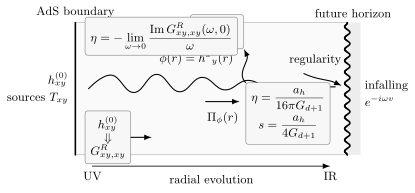
The boundary shear source excites a transverse bulk graviton . At zero spatial momentum and small frequency, the radial response is controlled by the future horizon. The horizon area density gives , while the horizon graviton coupling gives , leading to for two-derivative Einstein gravity.
This page has two goals. The first is to derive the result with enough detail that the numerical coefficient is not a mantra. The second is to state precisely what is universal and what is not. The equality is a theorem inside a large class of classical Einstein gravity duals; it is not an exact theorem of quantum field theory, nor of string theory at finite and finite .
Shear viscosity in hydrodynamics
Section titled “Shear viscosity in hydrodynamics”Consider a relativistic fluid in boundary spacetime dimensions. In the local rest frame and to first order in gradients, the spatial stress tensor contains
Here is the pressure, is the velocity field, is the shear viscosity, and is the bulk viscosity. The shear term is traceless. It damps distortions that change the shape of a fluid element without changing its volume.
For a conformal fluid, the stress tensor is traceless in flat space, so the bulk viscosity vanishes:
The shear viscosity need not vanish. In fact, for strongly coupled large- plasmas with two-derivative gravity duals, it is large in absolute units, scaling like the entropy density,
The dimensionless ratio is small. That is why holographic plasmas are often described as nearly perfect fluids: they have a very short momentum-diffusion time compared with the natural thermal scale.
The Kubo formula
Section titled “The Kubo formula”The clean field-theory definition uses a metric perturbation as the source for the stress tensor. Let the boundary metric be
The stress tensor is defined by
With the above convention, the perturbation couples to . Linear response gives
up to convention-dependent signs associated with whether the source is written in the action or Hamiltonian. The retarded correlator is
The Kubo formula is
Equivalently, the small-frequency expansion has the schematic form
The real constant is sensitive to contact terms and equilibrium thermodynamics. The viscosity is the coefficient of the dissipative imaginary term.
The bulk background
Section titled “The bulk background”Take the planar AdS black brane,
The boundary is at and the horizon is at . The temperature is
The entropy density is the horizon area density divided by :
This is the same area law used in black-hole thermodynamics, now interpreted as the thermal entropy density of the dual CFT state.
For the canonical AdS/CFT example, this gives
at large and strong ‘t Hooft coupling.
The shear-channel graviton
Section titled “The shear-channel graviton”The shear source is represented in the bulk by a metric perturbation
At zero spatial momentum, this perturbation is transverse and traceless. In an isotropic black-brane background governed by the two-derivative Einstein-Hilbert action,
it decouples from the other perturbations. The quadratic action for is
This is the action of a minimally coupled massless scalar with a fixed normalization. The equation of motion is therefore
In the planar black-brane metric, this becomes
This is the same equation encountered for a massless scalar in the real-time correlator chapter. The difference is the overall normalization: because is a graviton component, its coupling is fixed by .
Source, response, and radial momentum
Section titled “Source, response, and radial momentum”The radial canonical momentum conjugate to is
The retarded correlator is obtained from the boundary ratio
again up to the sign convention used for sources. Holographic counterterms change local contact terms but do not change the dissipative coefficient .
At small , the equation of motion implies that is radially conserved to leading order:
Thus the quantity needed for the Kubo formula can be evaluated at any radial slice. The horizon is the best slice, because the infalling condition becomes algebraic there.
This is the membrane-paradigm idea in its most economical form. The boundary viscosity is a low-frequency transport coefficient; low-frequency transport is controlled by horizon regularity.
Infalling regularity at the horizon
Section titled “Infalling regularity at the horizon”Near the horizon, introduce the tortoise coordinate satisfying
Since
near , one has
A retarded correlator is obtained by imposing an infalling condition at the future horizon:
Therefore
To first order in frequency,
The factor in cancels the pole. Substituting into the canonical momentum gives a finite horizon value,
Using the Kubo formula, we find
Comparing with the entropy density,
gives
Notice how little of the geometry was used. The ratio came from the universal graviton kinetic term and the universal horizon area law.
The result for thermal SYM
Section titled “The result for thermal N=4\mathcal N=4N=4 SYM”For the AdS black brane dual to thermal SYM,
Therefore
This is a strong-coupling result. It is not accessible by an ordinary weak-coupling expansion in the gauge theory. At weak coupling, the shear viscosity is parametrically larger because quasiparticles carry momentum for long times between scattering events. Strong coupling destroys long-lived quasiparticles, making the fluid much more efficient at dissipating shear stress.
A useful way to phrase the contrast is:
The small ratio is one of the historical reasons holography became important in the study of strongly coupled plasma.
The absorption-cross-section viewpoint
Section titled “The absorption-cross-section viewpoint”The original calculation can also be expressed in terms of graviton absorption. A shear graviton polarized along the brane is absorbed by the near-extremal black brane. In the low-frequency limit, a universal theorem for minimally coupled modes gives
where is the horizon area.
The Kubo formula relates the imaginary part of the stress-tensor correlator to the absorption probability. With the gravitational normalization, this gives
Since
the same ratio follows immediately.
This absorption argument is physically beautiful: the boundary plasma’s ability to dissipate shear stress is the bulk horizon’s ability to absorb a low-energy transverse graviton.
Why the result is universal in Einstein gravity
Section titled “Why the result is universal in Einstein gravity”The equality follows under a specific set of assumptions:
| Assumption | Why it matters |
|---|---|
| Classical bulk gravity | Suppresses bulk loops, corresponding to large . |
| Two-derivative Einstein action | Fixes the graviton kinetic coupling to . |
| Regular black-brane horizon | Provides the infalling condition and area entropy. |
| Isotropic thermal state | Makes a clean shear mode. |
| Zero spatial momentum and | Makes the radial flux conserved to leading order. |
| No nonminimal tensor couplings | Prevents the shear graviton from acquiring an effective horizon coupling different from . |
The universality is therefore not an accident of AdS. It holds for a broad class of black branes in Einstein gravity, including many finite-density and nonconformal examples, as long as the relevant shear perturbation remains minimally coupled.
In a neutral isotropic CFT, one also gets the shear diffusion constant
For a relativistic thermal state with no charge density,
so Einstein holography gives
This diffusion constant appears in the shear-channel hydrodynamic pole,
The ratio and the diffusion constant are related but not identical. At finite density,
so is not simply even when .
Corrections and violations
Section titled “Corrections and violations”The result is the leading term in a controlled expansion. In the canonical example, the two most important corrections are:
- Stringy corrections, corresponding to finite ‘t Hooft coupling .
- Bulk quantum-loop corrections, corresponding to finite .
Schematic expansion:
for type IIB on AdS, with the leading finite-coupling correction positive in the standard convention.
More generally, higher-derivative gravitational terms change the effective coupling of the transverse graviton at the horizon. In five-dimensional Gauss-Bonnet gravity, for example, one finds schematically
where is the Gauss-Bonnet coupling. Positive lowers the ratio below .
This does not mean every lower value is consistent. Higher-derivative couplings are constrained by causality, positivity, unitarity, and the requirement that the bulk effective theory admit a sensible ultraviolet completion. The modern lesson is subtler than the original slogan:
but it is not an absolute lower bound on all possible quantum field theories.
Relation to the membrane paradigm
Section titled “Relation to the membrane paradigm”The membrane paradigm treats a black-hole horizon as if it carries dissipative transport coefficients. Holography turns this into a precise boundary statement in the hydrodynamic limit.
For a bulk field with canonical momentum , define the radial response function
The equation of motion implies a radial flow equation for . At finite frequency, this flow is nontrivial: the horizon response evolves as one moves to the boundary. But for the shear viscosity, the Kubo limit is special:
In this limit, the imaginary part linear in is radially conserved. Therefore the boundary transport coefficient equals the horizon transport coefficient.
This is why the shear-viscosity calculation is both simple and profound. It is simple because the answer is a local horizon quantity. It is profound because a boundary hydrodynamic coefficient is determined by black-hole regularity.
What changes in anisotropic or translation-breaking systems?
Section titled “What changes in anisotropic or translation-breaking systems?”If the state is anisotropic, different components of the viscosity tensor are no longer equivalent. For example, and can differ. Some shear modes may still be minimally coupled and retain the Einstein value, while others can mix with matter fields or see an effective coupling different from .
If translations are broken explicitly, the interpretation of shear viscosity can become more delicate. Momentum is no longer exactly conserved, and hydrodynamics may contain relaxation terms. Nevertheless, a stress-tensor Kubo formula can still define a viscosity-like coefficient when the long-distance effective description contains a slowly varying strain or velocity field.
The main moral is: once the symmetry structure changes, do not quote blindly. Identify the precise tensor component, the precise Kubo formula, and the precise bulk fluctuation.
A compact derivation in general coordinates
Section titled “A compact derivation in general coordinates”It is useful to see the calculation in a coordinate-independent-looking form. Consider an isotropic black brane with metric
where , , and the horizon is at . The shear perturbation has radial momentum
Near a nonextremal horizon, infalling regularity implies
with the sign depending on the choice of outward radial coordinate. Hence
Therefore
But the entropy density is
The ratio is again
This derivation explains why the final answer is independent of the detailed radial profile of the geometry.
Common mistakes
Section titled “Common mistakes”Mistake 1: Calling “the AdS/CFT prediction”
Section titled “Mistake 1: Calling 1/(4π)1/(4\pi)1/(4π) “the AdS/CFT prediction””It is the leading classical Einstein-gravity prediction. AdS/CFT itself is broader. Stringy corrections, higher-derivative terms, anisotropy, and quantum effects can change the ratio.
Mistake 2: Confusing shear viscosity with bulk viscosity
Section titled “Mistake 2: Confusing shear viscosity with bulk viscosity”The transverse graviton computes shear viscosity. Bulk viscosity is associated with the trace/scalar channel and is zero in conformal theories but generally nonzero in nonconformal holographic models.
Mistake 3: Forgetting the order of limits
Section titled “Mistake 3: Forgetting the order of limits”The viscosity is defined by
Taking hydrodynamic limits in a different order can probe different physics, such as static susceptibilities or diffusion poles.
Mistake 4: Treating contact terms as viscosity
Section titled “Mistake 4: Treating contact terms as viscosity”Counterterms and equilibrium pressure terms can modify the real part of at small frequency. The viscosity is extracted from the coefficient of .
Mistake 5: Forgetting the tensor normalization
Section titled “Mistake 5: Forgetting the tensor normalization”The shear graviton is not an arbitrary scalar with arbitrary coupling. Its normalization is fixed by the Einstein-Hilbert action. Missing a factor of in the quadratic action or source coupling can obscure the numerical coefficient.
Exercises
Section titled “Exercises”Exercise 1: Kubo formula from the constitutive relation
Section titled “Exercise 1: Kubo formula from the constitutive relation”Consider a boundary metric perturbation
Argue that the dissipative part of the stress tensor has the form
Using , derive the Kubo relation
Solution
A time-dependent off-diagonal metric perturbation is a shear strain. The corresponding strain rate is proportional to . The dissipative stress is therefore
For the Fourier convention ,
Thus
Linear response gives, up to the source-sign convention used in the action,
Therefore the retarded function has the dissipative small-frequency term
so
Exercise 2: Shear viscosity of thermal SYM
Section titled “Exercise 2: Shear viscosity of thermal N=4\mathcal N=4N=4 SYM”Use the strong-coupling entropy density
and the Einstein-gravity result to compute .
Solution
The viscosity is
Substituting the entropy density gives
This is the standard large-, large- result for the thermal SYM plasma.
Exercise 3: Horizon derivation for the AdS black brane
Section titled “Exercise 3: Horizon derivation for the AdSd+1_{d+1}d+1 black brane”For
show that the small-frequency infalling solution gives
Solution
The radial momentum for the shear graviton is
For the black brane,
so
Near the horizon,
and the infalling solution behaves as
Therefore
Multiplying by gives
Thus, up to the overall sign fixed by the outward-normal convention,
The Kubo formula identifies this coefficient with .
Exercise 4: Shear diffusion constant
Section titled “Exercise 4: Shear diffusion constant”For a neutral relativistic fluid, the shear diffusion constant is
Use thermodynamics and to show that an Einstein holographic plasma has
Solution
At zero charge density,
Therefore
Using
gives
Exercise 5: A higher-derivative warning
Section titled “Exercise 5: A higher-derivative warning”Suppose a five-dimensional higher-derivative model gives
For what sign of is the Einstein value lowered? Why does this not automatically define a consistent family of CFTs for arbitrarily large ?
Solution
The ratio is below the Einstein value when
so
However, a lower ratio in a classical higher-derivative model does not by itself guarantee that the dual quantum field theory is consistent. Large higher-derivative couplings can lead to causality violations, positivity violations, ghosts, or a breakdown of the effective field theory expansion. A consistent holographic model must satisfy additional constraints beyond the formal Kubo calculation.
Further reading
Section titled “Further reading”- G. Policastro, D. T. Son, and A. O. Starinets, “Shear viscosity of strongly coupled supersymmetric Yang-Mills plasma”, the original holographic computation of .
- P. Kovtun, D. T. Son, and A. O. Starinets, “Viscosity in strongly interacting quantum field theories from black hole physics”, the classic formulation of the universality result and bound conjecture.
- A. Buchel and J. T. Liu, “Universality of the shear viscosity in supergravity”, a general supergravity universality argument.
- D. T. Son and A. O. Starinets, “Minkowski-space correlators in AdS/CFT correspondence”, the real-time prescription used in the Kubo calculation.
- N. Iqbal and H. Liu, “Universality of the hydrodynamic limit in AdS/CFT and the membrane paradigm”, the radial-flow and horizon-membrane derivation of low-frequency transport coefficients.
- A. Buchel, J. T. Liu, and A. O. Starinets, “Coupling constant dependence of the shear viscosity in supersymmetric Yang-Mills theory”, the leading finite- correction in the canonical example.
- M. Brigante, H. Liu, R. C. Myers, S. Shenker, and S. Yaida, “Viscosity Bound and Causality Violation”, a key discussion of higher-derivative violations and causality constraints.