
M-Theory Origin of Type IIA Branes
Type IIA string theory has a remarkable strong-coupling limit. It does not merely become a more strongly interacting ten-dimensional string theory. Instead, an eleventh spacetime dimension opens up. The type IIA coupling is reinterpreted as the radius of a compact circle, and the nonperturbative branes of type IIA become ordinary geometric or membrane/fivebrane objects in eleven dimensions.
This is one of the cleanest places where D-branes stop looking mysterious. Their unusual tensions, Ramond—Ramond charges, and duality properties are not arbitrary features added to perturbative string theory. They are consequences of reducing eleven-dimensional supergravity and its two basic branes on a circle.
We use
and denote the eleven-dimensional Planck length by . The central relations are
Thus weakly coupled type IIA, , is M-theory on a very small circle. Strongly coupled type IIA, , is eleven-dimensional M-theory on a large circle.
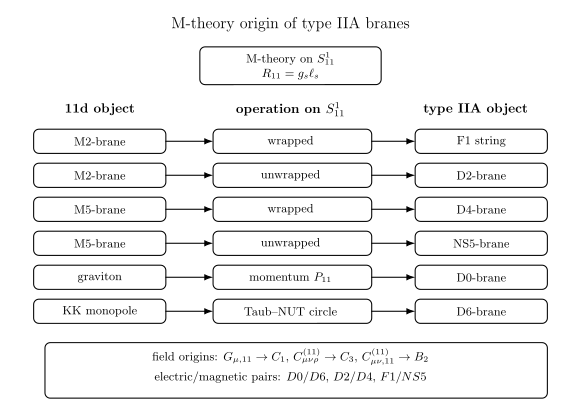
The elementary eleven-dimensional ingredients are the metric, the three-form , the M2-brane, the M5-brane, gravitational waves, and KK monopoles. Compactifying on produces the perturbative and nonperturbative branes of type IIA string theory.
The D0 tower forces an eleventh dimension
Section titled “The D0 tower forces an eleventh dimension”The quickest route to the M-theory circle is the D0-brane. The type IIA D-brane tension is
For this gives a particle of mass
A bound state of D0-branes has BPS mass
This looks exactly like a Kaluza—Klein momentum spectrum on a circle,
provided
This is a sharp argument, not just a mnemonic. The D0-branes are BPS, so their masses are protected. As increases, the whole tower of D0 bound states becomes lighter. A tower of particles with masses is the characteristic signature of a compact extra dimension of radius . The strong-coupling limit of type IIA therefore reveals an eleventh dimension.
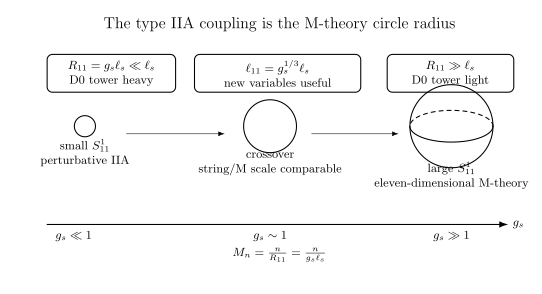
The D0-brane tower has the spectrum of KK momentum along the M-theory circle. As grows, grows and the eleventh dimension becomes macroscopic.
The second relation, , follows from comparing Newton constants. In ten-dimensional string frame,
while in eleven dimensions
Compactifying eleven-dimensional gravity on a circle gives
Substituting yields
So the string length and the eleven-dimensional Planck length are not the same physical scale except at .
Eleven-dimensional supergravity and its reduction
Section titled “Eleven-dimensional supergravity and its reduction”The low-energy limit of M-theory is eleven-dimensional supergravity. Its bosonic fields are just
There is no dilaton in eleven dimensions. The bosonic action is
The absence of a dilaton is conceptually important. The type IIA coupling is not a local scalar that existed independently in eleven dimensions. It is the asymptotic size of the compact circle.
Let be the circle coordinate. A convenient string-frame reduction ansatz is
where
This convention normalizes the circle to have physical radius at infinity. The ten-dimensional fields appearing here are the string-frame metric , the dilaton , and the R—R one-form . Thus the R—R one-form of type IIA is geometrical: it is the Kaluza—Klein gauge field associated with translations around the M-theory circle.
The eleven-dimensional three-form decomposes as
up to the harmless normalization of the circle coordinate. Therefore the type IIA R—R three-form and the NS—NS two-form have a common eleven-dimensional origin.
This already explains a lot:
The full brane dictionary is obtained by asking whether the M-brane wraps the compact circle.
M2-branes: the common parent of F1 and D2
Section titled “M2-branes: the common parent of F1 and D2”The M2-brane is electrically charged under . Its tension is
The corresponding BPS supergravity solution is
with
The transverse space is eight-dimensional, so the harmonic function falls as . The near-horizon geometry of many coincident M2-branes is , but for the present purpose the important fact is simpler: the M2-brane has two possible reductions to ten dimensions.
M2 not wrapped on the circle gives a D2-brane
Section titled “M2 not wrapped on the circle gives a D2-brane”If the M2-brane lies entirely in the ten noncompact directions and the circle is transverse to it, it becomes a D2-brane. This is natural from the coupling. The unwrapped M2 couples to the component of with no leg along , namely the type IIA R—R potential . A D2-brane is precisely the object electrically charged under .
The tension check is exact:
The in the D2-brane tension is therefore not mysterious. It is the statement that the eleven-dimensional Planck length is related to the string length by .
M2 wrapped on the circle gives the fundamental string
Section titled “M2 wrapped on the circle gives the fundamental string”If one spatial direction of the M2-brane wraps , the remaining one spatial direction is a string in ten dimensions. Its coupling comes from the component of with one leg along the circle,
Thus the wrapped M2 couples electrically to , so it is the fundamental type IIA string.
The tension is the wrapped membrane tension:
This is exactly the fundamental string tension. The perturbative string of type IIA is literally an M2-brane wrapped around the eleventh dimension.
M5-branes: the common parent of D4 and NS5
Section titled “M5-branes: the common parent of D4 and NS5”The M5-brane is magnetically charged under . Equivalently, it couples electrically to the dual six-form potential , with
Its tension is
The corresponding BPS solution is
where the transverse space is five-dimensional and
The M5-brane has a chiral two-form gauge field on its worldvolume with self-dual three-form field strength. This is the seed of several deep facts about D4-branes, five-dimensional super-Yang—Mills theory, and the six-dimensional theory.
M5 wrapped on the circle gives a D4-brane
Section titled “M5 wrapped on the circle gives a D4-brane”If the M5-brane wraps , the remaining object has four spatial dimensions in type IIA. It is a D4-brane. Its tension is
The D4-brane is electrically charged under the type IIA R—R five-form potential , or magnetically charged under . This is exactly what one obtains by reducing the M5-brane coupling.
This relation is especially important dynamically. The worldvolume theory on D4-branes is five-dimensional maximally supersymmetric Yang—Mills theory. It is nonrenormalizable by power counting, but its ultraviolet completion is the six-dimensional theory on M5-branes compactified on the M-theory circle.
M5 not wrapped on the circle gives an NS5-brane
Section titled “M5 not wrapped on the circle gives an NS5-brane”If the M5-brane does not wrap the circle, it remains a fivebrane in ten dimensions. It is the type IIA NS5-brane. Its tension is
The scaling is the hallmark of a solitonic NS-sector object. The NS5-brane is magnetic under the NS—NS two-form , just as the unwrapped M5-brane is magnetic under the component of with one leg on the M-theory circle.
This unifies two objects that look very different in perturbative type IIA: the D4-brane with tension and the NS5-brane with tension are simply the wrapped and unwrapped reductions of the same M5-brane.
D0 and D6 are geometry
Section titled “D0 and D6 are geometry”The M2/M5 dictionary accounts for F1, D2, D4, and NS5. The D0 and D6 branes are different: they come from the eleven-dimensional metric itself.
D0-branes are KK momentum
Section titled “D0-branes are KK momentum”A ten-dimensional D0-brane is a particle. In eleven dimensions it is a graviton carrying momentum around the circle. Momentum quantization gives
Thus the -D0 BPS bound state is the th KK momentum mode. This explains why D0 charge is carried by the R—R one-form : the field is the Kaluza—Klein gauge field from the metric component .
The ten-dimensional coupling is
In eleven dimensions this is simply the minimal coupling of a particle to the KK gauge field associated with circle momentum.
D6-branes are KK monopoles
Section titled “D6-branes are KK monopoles”A D6-brane is magnetically charged under the same one-form . Since is a Kaluza—Klein gauge field, its magnetic source is a Kaluza—Klein monopole. The eleven-dimensional geometry is a Taub—NUT space fibered over the three transverse directions to the D6-brane:
with
up to conventional normalizations of the circle coordinate. The circle is nontrivially fibered over the linking two-sphere in the transverse . Its first Chern class is the D6 charge,
For a single D6-brane, the eleven-dimensional Taub—NUT geometry is smooth at the core: the fiber shrinks smoothly, just as the angular circle in polar coordinates shrinks at the origin. The apparent D6-brane singularity in ten-dimensional supergravity is largely an artifact of reducing along a circle whose fiber degenerates.
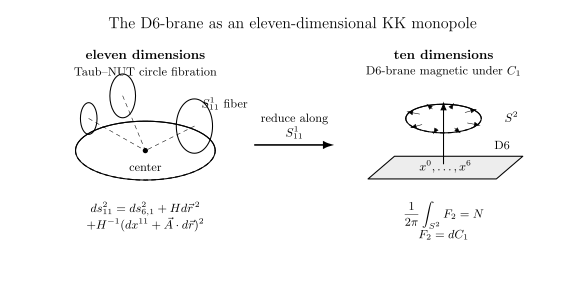
The D6-brane is the magnetic dual of the D0-brane. In eleven dimensions it is a Taub—NUT geometry: the M-theory circle is fibered over the transverse and shrinks at the monopole core.
This geometric interpretation also explains the electric-magnetic pairing
The D0 is electric charge for the KK gauge field , while the D6 is magnetic charge for the same field. In ten dimensions a one-form gauge potential couples electrically to particles and magnetically to sixbranes, exactly as the D-brane charge rule requires.
The complete IIA/M-theory brane dictionary
Section titled “The complete IIA/M-theory brane dictionary”The dictionary can be summarized as follows:
| M-theory object | Relation to | Type IIA object | Ten-dimensional charge |
|---|---|---|---|
| M2 | wrapped | F1 | electric under |
| M2 | unwrapped | D2 | electric under |
| M5 | wrapped | D4 | electric under , magnetic under |
| M5 | unwrapped | NS5 | magnetic under |
| graviton | momentum along | D0 | electric under |
| KK monopole | Taub—NUT circle | D6 | magnetic under |
The pattern is beautifully economical. Eleven-dimensional M-theory has no fundamental string and no D-branes as elementary inputs. After compactification, the wrapped M2 becomes the fundamental string, the unwrapped M2 becomes the D2, the wrapped M5 becomes the D4, the unwrapped M5 becomes the NS5, and pure geometry gives D0/D6.
The type IIA D8-brane is not included in this ordinary circle compactification. D8-branes are domain walls in massive type IIA supergravity, where the Romans mass jumps across the brane. They do not arise from reducing conventional eleven-dimensional supergravity on a smooth circle in the same direct way as the branes above.
How the tension scalings become obvious
Section titled “How the tension scalings become obvious”The different powers of in type IIA are often the first clue that a hidden geometric origin exists. Using
we find
The only entry in this list whose tension is not obtained by simply multiplying by a wrapped length is the D6-brane, because it is not a wrapped M-brane. It is a KK monopole. Its ten-dimensional tension still has the correct D-brane scaling,
but its eleven-dimensional interpretation is gravitational rather than membrane-like.
Local radius and when the M-theory lift is needed
Section titled “Local radius and when the M-theory lift is needed”In backgrounds with a varying dilaton, the M-theory circle has a varying local size. From the metric reduction ansatz,
This is a practical diagnostic. If a type IIA supergravity solution develops strong coupling in some region, , then the M-theory circle becomes large there and the ten-dimensional description is not the right one. The correct weakly curved description may be eleven-dimensional.
This explains several standard lifts:
A good rule of thumb is this: type IIA is a ten-dimensional description only when the M-theory circle is small compared with the scales being probed. When the circle is large, the same physics is better described as eleven-dimensional.
Supersymmetry and chirality
Section titled “Supersymmetry and chirality”Eleven-dimensional supergravity has one Majorana supercharge with real components. Compactification on a circle preserves all of them. In ten dimensions these become the two Majorana—Weyl supercharges of type IIA, which have opposite chirality.
This explains why the strong-coupling limit of type IIA is eleven-dimensional, while type IIB has a different nonperturbative structure. Type IIB has two supercharges of the same chirality and no simple decompactification to eleven-dimensional supergravity on a circle. Instead, its nonperturbative symmetry is the S-duality discussed earlier.
The M2- and M5-branes each preserve half of the eleven-dimensional supersymmetry. Their reductions therefore produce half-BPS type IIA branes. The D0, D2, D4, D6, F1, and NS5 all fit into this same BPS structure, even though perturbatively they look like very different objects.
Exercises
Section titled “Exercises”Exercise 1. D0-branes as KK momentum
Section titled “Exercise 1. D0-branes as KK momentum”Starting from the D0-brane tension , show that a BPS bound state of D0-branes has the spectrum of KK momentum on a circle. What is the radius of that circle?
Solution
The BPS mass of an -D0 bound state is additive in the central charge:
A particle carrying units of momentum on a circle of radius has
Identifying gives
Thus the D0-brane tower is the Kaluza—Klein tower of an eleventh dimension with radius .
Exercise 2. Derive
Section titled “Exercise 2. Derive ℓ113=gsℓs3\ell_{11}^3=g_s\ell_s^3ℓ113=gsℓs3”Use
and the circle reduction relation
to derive the relation between and .
Solution
Substituting the two gravitational couplings gives
Canceling gives
Using ,
Taking the cube root of both sides yields
Exercise 3. M2 reductions
Section titled “Exercise 3. M2 reductions”Using
show that an unwrapped M2-brane is a D2-brane and a wrapped M2-brane is a fundamental string.
Solution
For an unwrapped M2-brane, the ten-dimensional tension is simply
This equals the type IIA D2-brane tension
For an M2-brane wrapped on the circle, the effective string tension is the membrane tension times the circumference:
This is exactly the fundamental string tension .
Exercise 4. M5 reductions
Section titled “Exercise 4. M5 reductions”Show that a wrapped M5-brane gives a D4-brane and an unwrapped M5-brane gives an NS5-brane by comparing tensions.
Solution
The M5-brane tension is
Since , we have
For an unwrapped M5-brane,
For an M5-brane wrapped on the circle,
Thus the wrapped M5 is a D4-brane and the unwrapped M5 is an NS5-brane.
Exercise 5. Field decomposition and brane charges
Section titled “Exercise 5. Field decomposition and brane charges”Use
to explain why the unwrapped M2 is a D2-brane and the wrapped M2 is a fundamental string.
Solution
An M2-brane couples electrically to :
If the M2-brane is unwrapped, its worldvolume has no leg along . It therefore couples to the component , which is the type IIA R—R three-form. The electric source for is a D2-brane.
If the M2-brane wraps the circle, one worldvolume direction is . Pulling back and integrating over the circle leaves a coupling
This is the defining electric coupling of the fundamental string. Hence the wrapped M2 is the type IIA F1 string.
Exercise 6. D0 and D6 as electric and magnetic KK charges
Section titled “Exercise 6. D0 and D6 as electric and magnetic KK charges”Explain why D0- and D6-branes are electric/magnetic duals from the eleven-dimensional viewpoint.
Solution
The type IIA R—R one-form is the Kaluza—Klein gauge field coming from the metric component . Momentum along the circle is electric charge under this KK gauge field. Therefore a D0-brane, which couples to , is an electric KK charge.
The magnetic source for a KK gauge field is a KK monopole. In eleven dimensions the D6-brane is a Taub—NUT geometry in which the M-theory circle is fibered over the transverse . The magnetic charge is the first Chern class of the circle bundle:
Thus D0 and D6 are electric and magnetic objects for the same gauge field .
Exercise 7. The local M-theory radius
Section titled “Exercise 7. The local M-theory radius”Suppose a type IIA background has dilaton with asymptotic value . Use the metric ansatz to argue that the local M-theory circle radius scales as
What happens in a region where becomes large?
Solution
The reduction ansatz is
The proper length of the circle is controlled by the square root of the coefficient of . Therefore the local radius is multiplied by
Thus
If becomes large, then the M-theory circle becomes locally large. A ten-dimensional type IIA description is then no longer the most natural description; the background should be lifted to eleven dimensions.