
String Theory II Introduction
These pages are based on handwritten notes I took during Professor Igor R. Klebanov’s one-semester course, “Strings, Black Holes and Gauge Theories,” in Spring 2011. The initial drafts were prepared with the assistance of AI and have since been reviewed and edited by me. The site is still under construction; although I have tried to ensure accuracy, some errors may remain. If you notice any significant mistakes, I would greatly appreciate your feedback.
String theory is best learned twice. The first time, it is a two-dimensional quantum field theory: one studies maps from a worldsheet into spacetime, imposes conformal invariance, quantizes oscillators, and discovers the Virasoro and super-Virasoro constraints. The second time, it is a spacetime theory: the same worldsheet consistency conditions become gravitons, gauge bosons, Ramond—Ramond fields, D-branes, black branes, dualities, and eventually holography. This course is organized around the translation between those two languages.
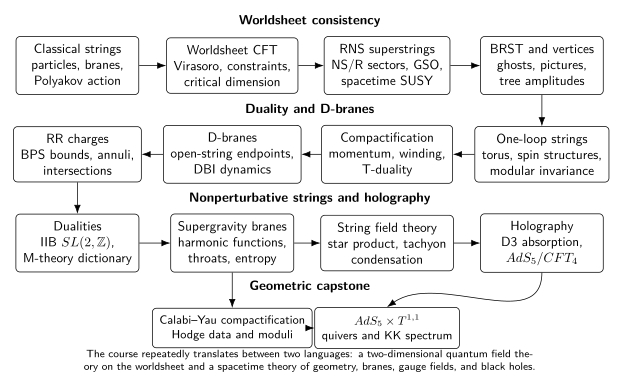
The conceptual flow of the course: worldsheet consistency leads to superstrings; duality turns boundary conditions into D-branes; branes become charged objects of supergravity; black branes and their near-horizon limits lead to holography.
This complete release contains 35 lecture-note pages plus this index. The pages are meant to be read sequentially, but each one is also written as a self-contained reference with conventions, derivations, figures, and exercises.
What this course is about
Section titled “What this course is about”The central question is not merely how to quantize a string, but why quantized strings force together so many structures that usually appear unrelated: gauge symmetry, gravity, supersymmetry, spinors, anomalies, extended objects, black-hole thermodynamics, and large- quantum field theory.
The basic worldsheet starting point is the Polyakov action
with string tension
Classically, the auxiliary metric makes diffeomorphism and Weyl symmetry manifest. Quantum mechanically, those same symmetries become demanding: they select the critical dimension, impose physical-state constraints, and determine which spectra are consistent. When worldsheet supersymmetry is included, the Ramond—Neveu—Schwarz formalism leads to spacetime supersymmetry after the GSO projection. The massless closed-string spectrum then contains the spacetime metric , the antisymmetric field , the dilaton , and Ramond—Ramond gauge potentials.
The second half of the course takes seriously a fact that perturbative strings already know: open strings have endpoints. T-duality turns Neumann and Dirichlet boundary conditions into each other and reveals D-branes as dynamical hypersurfaces. Their low-energy dynamics is governed by the Dirac—Born—Infeld plus Wess—Zumino action,
where denotes pullback to the brane worldvolume. This single formula already contains several ideas that will recur: gauge fields live on branes, transverse coordinates become scalar fields, lower-dimensional brane charge can dissolve into worldvolume flux, and Ramond—Ramond charge is measured by spacetime form fields.
The final arc is holographic. A stack of D3-branes has two complementary descriptions: open strings ending on the branes produce four-dimensional super Yang—Mills theory, while the same branes source a ten-dimensional supergravity geometry. In the decoupling limit this becomes the prototype of gauge/gravity duality,
where is the radius and is the ‘t Hooft coupling.
Prerequisites
Section titled “Prerequisites”The notes are written for graduate students who have seen the basics of quantum field theory and general relativity. The first few pages review the necessary string-theory starting points, but the course quickly uses the following tools.
| Background | Used for | Good working target |
|---|---|---|
| Relativistic quantum field theory | path integrals, propagators, gauge symmetry, Ward identities | Be comfortable deriving equations of motion, conserved currents, and tree-level amplitudes from an action. |
| Two-dimensional conformal field theory | OPEs, Virasoro algebra, radial quantization, vertex operators | Know how the stress tensor determines conformal weights and how contour integrals extract modes. |
| Supersymmetry and spinors | RNS sectors, GSO projection, spacetime supercharges, BPS bounds | Know Clifford algebras, chirality, and the meaning of preserved supercharges. |
| Differential geometry and general relativity | -forms, Hodge duality, brane solutions, near-horizon limits | Be able to manipulate metrics, forms, curvature scalars, and simple black-hole thermodynamics. |
| Lie groups and representation theory | little groups, Chan—Paton factors, triality, quiver symmetries | Know how representations label particles and operators. |
A student who is missing one of these ingredients can still read the notes, but the fastest path is to pause at the first appearance of an unfamiliar tool and work through the corresponding exercise. String theory is unforgiving about hidden gaps: a missed factor in a two-dimensional OPE can later reappear as a wrong spacetime mass, charge, or anomaly coefficient.
Conventions
Section titled “Conventions”Unless stated otherwise, target-space signature is mostly plus,
and natural units are used. Greek indices label spacetime directions. In the superstring part of the course , while earlier bosonic-string formulas are often written for general before the critical value is imposed.
Worldsheet coordinates are
For open strings we usually take . For closed strings, . In Euclidean signature we use complex coordinates and when radial quantization or OPEs are natural.
A common holomorphic normalization is
with an analogous antiholomorphic OPE. Whenever a different open-string or cylinder normalization is more convenient, the page will state it explicitly. This is not cosmetic: many factors of in string theory come from the interval chosen for and from whether one is discussing a holomorphic half of a closed string or a full open-string field.
For D-branes, worldvolume directions are often denoted by , transverse directions by , and worldvolume coordinates by . The pullback of a spacetime tensor to the brane is written .
Roadmap of the lecture notes
Section titled “Roadmap of the lecture notes”The sidebar lists the pages in order. The following roadmap explains the role of each block.
I. From relativistic particles to bosonic strings
Section titled “I. From relativistic particles to bosonic strings”- Relativistic Particles, Branes, and the Birth of the String introduces worldlines, worldsheets, -branes, string tension, open and closed strings, and the Nambu—Goto action.
- The Polyakov Action, Gauge Symmetry, and Virasoro Constraints explains why the auxiliary worldsheet metric is powerful and how conformal gauge leaves behind the constraints .
- Mode Expansions, Regge Trajectories, and Bosonic String Quantization derives oscillator modes, mass formulae, the first spectrum, Regge behavior, and the appearance of the graviton.
II. RNS superstrings and BRST quantization
Section titled “II. RNS superstrings and BRST quantization”- Worldsheet Supersymmetry and the RNS Action adds worldsheet fermions and derives the supercurrent and stress tensor.
- The Superconformal Algebra and NS/R Sectors develops the super-Virasoro algebra, spin structures, Ramond zero modes, and fermion boundary conditions.
- The RNS Spectrum and the GSO Projection explains how the tachyon is removed, why Ramond ground states are spacetime spinors, and how spacetime supersymmetry emerges.
- Bosonization, Spin Fields, and Spacetime Supersymmetry gives the CFT technology behind spin fields and spacetime supercharges.
- Ghosts, Superghosts, and BRST Quantization constructs the ghost systems, picture number, and BRST cohomology.
- Superstring Vertex Operators and Pictures turns physical states into local operators and explains integrated, unintegrated, and picture-changed vertices.
III. Amplitudes, spectra, and one-loop consistency
Section titled “III. Amplitudes, spectra, and one-loop consistency”- Tree Amplitudes, Chan—Paton Factors, and Gauge Theory from Open Strings derives disk amplitudes, color ordering, and the Yang—Mills limit.
- Low-Energy Limits: DBI, Type I, and Type II Supergravity connects string amplitudes to spacetime effective actions.
- Physical States and Type II Superstring Spectra organizes the massless spectra of type IIA and type IIB string theory.
- Unoriented Strings, Orientifolds, and Type I Theory introduces worldsheet parity, orientifold projections, tadpoles, and type I consistency.
- One-Loop Strings, Tori, and Modular Invariance studies the torus, modular transformations, spin-structure sums, and the difference between string and field-theory loops.
IV. Compactification, thermal strings, and D-branes
Section titled “IV. Compactification, thermal strings, and D-branes”- Circle Compactification and T-Duality derives momentum and winding spectra, the self-dual radius, and enhanced symmetry.
- Thermal Strings and the Hagedorn Transition explains the thermal circle, the density of string states, and the Hagedorn instability.
- Open Strings, T-Duality, and the Emergence of D-Branes shows how T-duality converts Neumann boundary conditions into Dirichlet boundary conditions.
- The DBI Action and D-Brane Worldvolume Fields develops the low-energy dynamics of brane gauge fields and transverse scalars.
- Open/Closed Duality and D-Brane Scattering interprets the annulus both as an open-string loop and as closed-string exchange.
- Type II T-Duality and Ramond—Ramond Fields tracks chirality, RR potentials, and the IIA/IIB exchange under T-duality.
V. Charges, BPS branes, and dualities
Section titled “V. Charges, BPS branes, and dualities”- D-Brane Charges, BPS Bounds, and Dirac Quantization explains how D-branes couple to RR potentials and why their tensions equal their charges in BPS units.
- D-Brane Interactions and the Annulus Amplitude derives no-force cancellation and the brane—antibrane potential.
- Intersecting Branes and Preserved Supersymmetry analyzes supercharge projections, ND directions, and spectra of stretched strings.
- Worldvolume Flux, BIons, and F/D Bound States shows how lower-dimensional branes and fundamental strings appear as flux on higher-dimensional branes.
- Type IIB S-Duality, Strings, and the D3-Brane presents the structure of type IIB theory and its action on strings and branes.
- Supergravity -Branes, NS5-Branes, and Throat Geometries derives extremal brane geometries and the physics of harmonic functions and throats.
- M-Theory Origin of Type IIA Branes explains how D0, D2, D4, D6, F1, and NS5 arise from eleven-dimensional objects.
VI. Black branes, string field theory, and holography
Section titled “VI. Black branes, string field theory, and holography”- Near-Extremal D3-Branes and Entropy compares black-brane entropy with the thermodynamics of super Yang—Mills theory.
- Open String Field Theory and Tachyon Condensation introduces Witten’s cubic open string field theory and Sen’s tachyon-condensation conjectures.
- Absorption by D-Branes and Two-Point Functions relates bulk absorption probabilities to field-theory correlators.
- The Decoupling Limit and the AdS/CFT Dictionary derives the near-horizon D3-brane limit and the GKPW prescription.
- Holographic Correlators and the Breitenlohner—Freedman Bound computes scalar falloffs in AdS and relates masses to CFT dimensions.
- Holographic Anomalies and the Central Charge of SYM extracts the Weyl anomaly and the scaling of degrees of freedom.
VII. Compactification and the example
Section titled “VII. Compactification and the T1,1T^{1,1}T1,1 example”- Calabi—Yau Compactification and Hodge Data reviews Kähler geometry, holonomy, Hodge numbers, and type II compactifications.
- and the Klebanov—Witten Spectrum introduces the conifold base , the quiver, and the matching of Kaluza—Klein modes to CFT operators.
How to read these notes
Section titled “How to read these notes”A productive way to use the course is to keep three parallel notebooks.
First, keep a normalization notebook. Record every convention for , the range of , the OPE of , the definition of or , the normalization of D-brane tensions, and the relation between string-frame and Einstein-frame metrics. Many string-theory confusions are not conceptual mistakes; they are silent convention changes.
Second, keep a dictionary notebook. String theory constantly translates between languages:
The important point is not only that these correspondences exist, but that they preserve equations, symmetries, and scaling dimensions.
Third, keep a derivation notebook. Re-derive the main equations without looking: the Virasoro constraints, the NS and R zero-point energies, the GSO projection, the annulus modular transformation, the DBI expansion, the BPS no-force condition, the D3-brane near-horizon limit, and the AdS scalar dimension formula. These derivations form the skeleton of the subject.
References for deeper study
Section titled “References for deeper study”The notes are designed to be readable on their own, but no single source should be the only source for a subject this interconnected. The following references are especially useful companions.
| Reference | Best use |
|---|---|
| M. B. Green, J. H. Schwarz, and E. Witten, Superstring Theory, Vols. 1—2 | Classic treatment of perturbative superstrings and amplitudes. |
| J. Polchinski, String Theory, Vols. 1—2 | Standard reference for worldsheet methods, D-branes, dualities, and effective actions. |
| K. Becker, M. Becker, and J. H. Schwarz, String Theory and M-Theory | Broad modern overview, including compactification and M-theory. |
| B. Zwiebach, A First Course in String Theory | Friendly background review, especially for first exposure to classical and light-cone strings. |
| P. Di Francesco, P. Mathieu, and D. Sénéchal, Conformal Field Theory | Detailed CFT reference for OPEs, Virasoro representation theory, and modular methods. |
| E. Kiritsis, String Theory in a Nutshell | Compact but advanced reference with strong coverage of duality and compactification. |
| O. Aharony, S. Gubser, J. Maldacena, H. Ooguri, and Y. Oz, Large Field Theories, String Theory and Gravity | Foundational review of AdS/CFT and its field-theory interpretation. |
Diagnostic warm-up exercises
Section titled “Diagnostic warm-up exercises”These exercises are not meant to delay the course. They are a quick test of the tools that will be used constantly.
Exercise 1: dimensions of and the string scale
Section titled “Exercise 1: dimensions of α′\alpha'α′ and the string scale”In units , take the worldsheet coordinates to be dimensionless and to have dimensions of length. Use the Polyakov action to determine the dimensions of , the tension , and the string mass scale .
Solution
The action is dimensionless. Since is dimensionless and has dimensions of length, the factor must have dimensions of inverse length squared. Thus
The string tension is
so . This is correct for a tension in natural units: energy per unit length has dimensions . The natural string mass scale is
Some authors include factors of in the definition of the string scale, so it is always safest to state the convention being used.
Exercise 2: electric and magnetic branes
Section titled “Exercise 2: electric and magnetic branes”In spacetime dimensions, a -brane couples electrically to a potential through . What is the dimension of the magnetic dual brane? Specialize to and identify the magnetic dual of a D-brane.
Solution
The electric field strength is
Its Hodge dual has degree
Locally this dual field strength can be written as , so the magnetic dual object couples electrically to the potential . A potential of degree couples to a -brane; therefore
In ten-dimensional type II string theory the magnetic dual of a D-brane is therefore a D-brane. For example, a D1-brane is magnetically dual to a D5-brane, and a D3-brane is self-dual in the sense that .
Exercise 3: conformal weight of an exponential vertex
Section titled “Exercise 3: conformal weight of an exponential vertex”Suppose the holomorphic scalar has OPE
and stress tensor
Show that the holomorphic conformal weight of is .
Solution
Differentiating the scalar OPE gives
Contracting with the exponential gives
The double contraction in is therefore
The single contraction gives the expected derivative term. Hence
so the holomorphic conformal weight is
For a closed-string plane wave the antiholomorphic weight is the same. Physical-state conditions then relate these weights to oscillator contributions and intercepts.
A final orientation
Section titled “A final orientation”The first page begins with the most elementary object in the course: a relativistic particle moving through spacetime. From that worldline action, the notes build up to strings, branes, and eventually holography. That progression is not just historical. It is a useful way to keep the subject honest: every spectacular duality later in the course must still reduce, in the right limit, to a statement about a two-dimensional path integral and its symmetries.