
M5-Branes and Six-Dimensional CFTs
The main idea
Section titled “The main idea”The M5-brane example is the most mysterious member of the original AdS/CFT triad:
The M5-brane duality is
Here is the number of coincident M5-branes, or equivalently the number of four-form flux units through . The interacting boundary theory is not a six-dimensional Yang-Mills theory. It has no known ordinary local Lagrangian, contains tensionless string-like excitations at the conformal point, and has degrees of freedom scaling as , not .
That last fact is the first reason this page belongs in an AdS/CFT course. The D3-brane example might tempt us to equate holography with matrix large- counting. M5-branes say: not so fast. The gravitational measure of degrees of freedom is not always ; for M5-branes it is
The second reason is even more important. The six-dimensional theory is one of the best examples of a quantum field theory whose existence is strongly supported by string/M-theory, supersymmetry, compactification, anomalies, and holography, but whose intrinsic formulation remains highly nontrivial. It is not merely another item in the AdS/CFT zoo; it is a reminder that AdS/CFT often teaches us what quantum field theory itself can be.
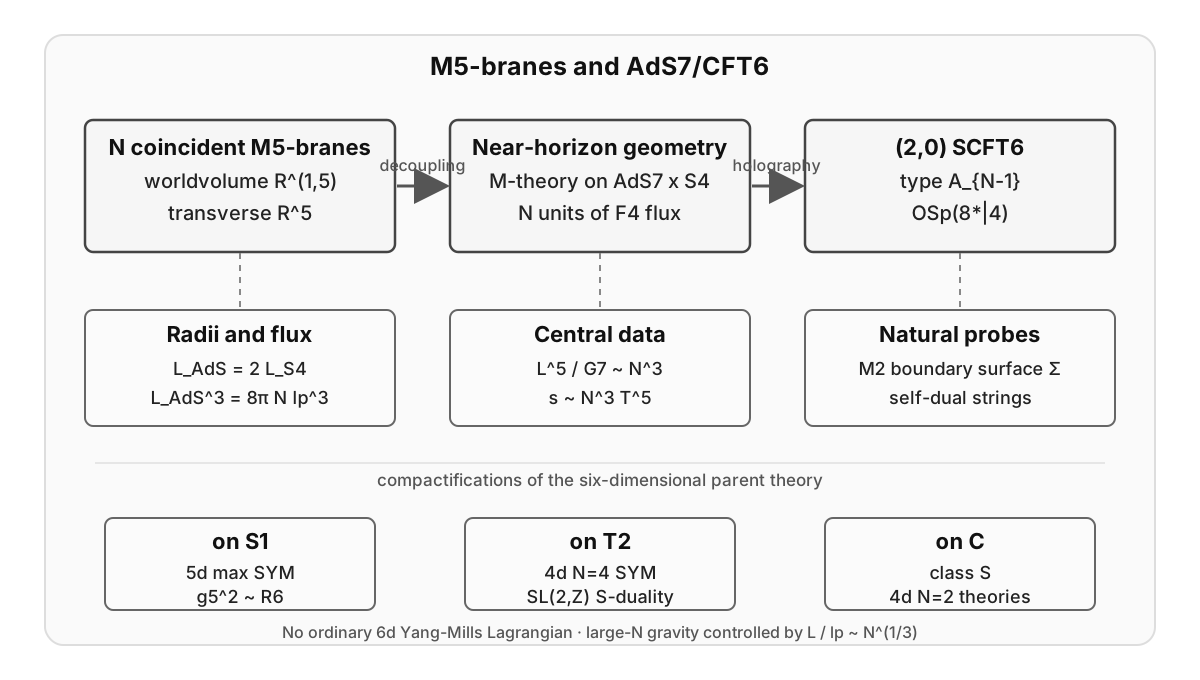
The M5-brane correspondence. The near-horizon geometry of coincident M5-branes is , with units of flux through . The dual CFT is the interacting part of the six-dimensional theory of type . Its compactifications generate many lower-dimensional theories, including five-dimensional maximally supersymmetric Yang-Mills, four-dimensional SYM, and class- theories.
The slogan is:
Four-dimensional SYM, its S-duality, five-dimensional maximally supersymmetric Yang-Mills, and broad families of four-dimensional theories are most naturally understood as compactifications of this six-dimensional object.
An M5-brane is a five-dimensional spatial brane in eleven-dimensional M-theory. Its worldvolume has signature , and its transverse space has dimension five. The single M5-brane worldvolume theory contains a free tensor multiplet:
plus five scalar fields and fermions fixed by supersymmetry. The five scalars describe transverse fluctuations of the brane and transform as a vector of , the rotation group of the transverse space.
For coincident M5-branes, there is an interacting six-dimensional superconformal theory. The center-of-mass motion gives a decoupled free tensor multiplet; the interacting sector is usually called the theory. More generally, SCFTs are labeled by simply laced Lie algebras of ADE type:
The case is the one directly obtained from coincident M5-branes in flat space and is the case dual to the simplest background.
The eleven-dimensional supergravity solution sourced by coincident extremal M5-branes takes the form
with
The solution also carries magnetic four-form flux through the transverse ,
up to the standard convention-dependent normalization of .
In the near-horizon region ,
so the metric becomes
Introduce a Poincare coordinate by
Then
Thus the near-horizon geometry is
Equivalently, if , then
This is the M5-brane analog of the D3-brane derivation of . The structure is the same, but the parameter dependence is different. In type IIB on , the curvature radius is controlled by in string units. In M-theory on , there is no string coupling and no string length. There is only the eleven-dimensional Planck length , and
The classical supergravity limit is therefore
There is no independent ‘t Hooft coupling to tune.
Why the boundary theory is six-dimensional
Section titled “Why the boundary theory is six-dimensional”The conformal boundary of is six-dimensional. In Poincare coordinates,
and the boundary lies at . The boundary theory therefore lives on , or after conformal compactification on
The isometry group of is
which is precisely the conformal group in six spacetime dimensions. The isometry group of the internal sphere is
which becomes the -symmetry group of the SCFT. The full superconformal symmetry is
This symmetry match is one of the cleanest pieces of the dictionary:
| Bulk object | Boundary object |
|---|---|
| isometries | six-dimensional conformal symmetry |
| isometries | symmetry |
| units of flux | rank/type data |
| 11d gravitons on | stress-tensor multiplet and protected operators |
| M2-branes ending on the boundary | surface operators / self-dual strings |
| M5-branes wrapping cycles in or AdS | extended defects and wrapped-brane observables |
Notice the difference from D3-branes. In four-dimensional SYM, the gauge field is one of the elementary degrees of freedom. In the six-dimensional theory, the elementary free tensor multiplet contains a two-form potential , not a one-form gauge field . For the interacting nonabelian theory, even the phrase “elementary field” is dangerous. Many observables are more naturally associated with strings and surfaces than with particles and Wilson lines.
The tensor multiplet and the interacting theory
Section titled “The (2,0)(2,0)(2,0) tensor multiplet and the interacting theory”For a single M5-brane, the free tensor multiplet contains:
| Field | Interpretation | representation |
|---|---|---|
| with | chiral two-form gauge potential | singlet |
| , | transverse fluctuations | vector |
| fermions | supersymmetric partners | spinor of |
The self-duality condition is crucial:
It halves the degrees of freedom of the two-form, much as chirality halves the degrees of freedom of a Weyl fermion. It also makes covariant Lagrangian formulations subtle even for the free theory.
For multiple M5-branes, the interacting theory is not obtained by simply replacing by in a two-form gauge theory. There is no known ordinary nonabelian two-form gauge theory that captures the full interacting theory in a manifestly local six-dimensional Lagrangian. The theory is instead characterized by a network of mutually consistent facts:
- it exists as the low-energy theory of coincident M5-branes;
- it has superconformal symmetry;
- it has ADE classification;
- compactification on gives five-dimensional maximally supersymmetric Yang-Mills;
- compactification on gives four-dimensional SYM with S-duality;
- compactification on Riemann surfaces gives class- theories;
- holography predicts large- observables from M-theory on .
That is why the theory is often treated as a definition by its consequences. This sounds unsatisfying at first, but it is powerful. The theory is overconstrained from many sides.
The degrees of freedom
Section titled “The N3N^3N3 degrees of freedom”The most famous quantitative statement about M5-branes is
Holographically, the reason is short. Reduce eleven-dimensional supergravity on . If is the AdS radius, then the radius is , so
Using
one obtains
This is the six-dimensional analog of the familiar AdS/CFT result
But the physical meaning is more surprising. In ordinary adjoint matrix theories, suggests fields with two color indices. The theory has no conventional adjoint Lagrangian, and the scaling is not explained by a simple matrix count. It is instead a robust gravitational fact.
A clean thermodynamic manifestation comes from the planar AdS black brane:
The temperature is
and the entropy density is
Using the formula above,
The follows from six-dimensional conformal invariance. The is the nontrivial information.
The same scaling appears in the holographic Weyl anomaly of the six-dimensional theory. In even-dimensional CFTs, the trace of the stress tensor on a curved background has local curvature-anomaly terms. For the M5-brane theory, holographic renormalization gives anomaly coefficients that grow as at large .
There are several useful ways to remember this:
The powers are not arbitrary. They come from flux quantization and dimensional reduction of the gravitational action.
The supergravity regime
Section titled “The supergravity regime”For the M5-brane duality, the parameter controlling the classical bulk approximation is
Thus large suppresses eleven-dimensional quantum-gravity corrections and higher-derivative corrections. Schematically,
The familiar eleven-dimensional -type higher-derivative terms are suppressed by powers of
Bulk loops are also suppressed at large . In the boundary theory this corresponds to a large- expansion, but it is not the usual planar expansion of a four-dimensional matrix gauge theory.
A useful comparison is:
| Duality | Curvature control | Loop control | Classical bulk limit |
|---|---|---|---|
| D3 / SYM | , | ||
| M2 / ABJM at fixed | same 11d expansion | ||
| M5 / | same 11d expansion |
For M5-branes there is no parameter analogous to the four-dimensional ‘t Hooft coupling. The strongly coupled nature of the boundary theory is built in.
Operators and Kaluza-Klein modes
Section titled “Operators and Kaluza-Klein modes”Local operators of the six-dimensional SCFT are organized by representations. The best-protected sector consists of half-BPS operators. In the theory, single-particle supergravity modes on map to protected single-trace-like operators with quantum numbers.
A schematic tower is
The multiplet contains the stress tensor, the current, and other protected operators. In the free center-of-mass tensor multiplet one also has fields, but the interacting sector begins differently. As always in holography, one should separate the decoupled center-of-mass sector from the interacting large- theory.
The most important universal dictionary entries are:
| CFT operator/data | Bulk dual |
|---|---|
| stress tensor | AdS graviton |
| current | gauge fields from isometries |
| scalar half-BPS operators | Kaluza-Klein scalar modes on |
| surface operators | M2-branes ending on boundary surfaces |
| codimension defects | probe M2/M5 branes with AdS submanifolds |
| thermal state | AdS black brane |
| , anomaly coefficients |
This dictionary is less elementary-looking than the D3-brane one because the boundary theory lacks a simple Lagrangian. Nevertheless, the protected spectrum, anomalies, correlator normalizations, and thermodynamics are sharply constrained.
Self-dual strings and surface operators
Section titled “Self-dual strings and surface operators”A six-dimensional two-form gauge potential naturally couples to a two-dimensional surface, not to a one-dimensional line. For an abelian tensor multiplet, the analog of a Wilson loop is a Wilson surface:
where is a two-dimensional surface in spacetime. In the interacting theory this formula is only a mnemonic, but the geometry is real: M2-branes can end on M5-branes. The boundary of the M2-brane is a string living on the M5-brane worldvolume. These are the self-dual strings of the theory.
In the holographic description, a surface operator in the boundary CFT is represented semiclassically by an M2-brane whose worldvolume ends on the prescribed boundary surface:
Here
Since
surface-operator exponents often scale like at leading semiclassical order. Wrapped M5-branes give other extended observables whose scaling can be larger. The detailed classification of defects in the theory is a rich subject, but the basic lesson is simple:
This is one reason the theory looks exotic from a four-dimensional gauge-theory viewpoint.
Compactification as a definition machine
Section titled “Compactification as a definition machine”The theory becomes more familiar after compactification. In fact, many of our best definitions of its properties come from asking what it becomes on lower-dimensional spaces.
Compactification on : five-dimensional maximally supersymmetric Yang-Mills
Section titled “Compactification on S1S^1S1: five-dimensional maximally supersymmetric Yang-Mills”Compactify one spatial direction on a circle of radius :
The five-dimensional gauge coupling has dimension of length:
The relation is convention-dependent, but schematically
In a common normalization,
Five-dimensional Yang-Mills is perturbatively nonrenormalizable, so it cannot be a complete UV theory by itself. The theory is its proposed UV completion. A key check is the instanton particle. In five dimensions, an instanton in the spatial becomes a particle with mass
Using , this is
which is exactly the Kaluza-Klein scale of momentum around the compact circle. Thus the tower of instanton particles knows about the sixth dimension.
Compactification on : four-dimensional SYM and S-duality
Section titled “Compactification on T2T^2T2: four-dimensional N=4\mathcal N=4N=4 SYM and S-duality”Compactify the theory on a two-torus:
The complex structure of the torus becomes the complexified Yang-Mills coupling:
The modular group of the torus,
acts on . From the four-dimensional viewpoint this is the S-duality group of SYM. This is one of the most elegant explanations of why electric-magnetic duality in four dimensions should be exact: it is geometry in six dimensions.
Compactification on a Riemann surface: class- theories
Section titled “Compactification on a Riemann surface: class-S\mathcal SS theories”Compactify the theory on a Riemann surface with a partial topological twist:
The complex structure moduli of become exactly marginal couplings of the four-dimensional theory. Degeneration limits of correspond to weakly coupled gauge-theory frames. Punctures on correspond to codimension-two defects of the six-dimensional theory and produce flavor symmetries in four dimensions.
This is far beyond a historical curiosity. It means that many dualities between four-dimensional gauge theories are shadows of the same six-dimensional parent theory viewed through different pair-of-pants decompositions of .
What makes the theory hard?
Section titled “What makes the (2,0)(2,0)(2,0) theory hard?”The theory is difficult for several intertwined reasons.
First, six-dimensional conformal field theories are highly constrained. A Yang-Mills coupling in six dimensions has negative mass dimension:
So ordinary six-dimensional Yang-Mills is not a fundamental conformal theory. The theory is not obtained by tuning a six-dimensional gauge coupling to a fixed point in the usual perturbative way.
Second, the basic tensor multiplet contains a chiral two-form. Even abelian chiral -form theories have subtleties involving self-duality, partition functions, and anomalies. The interacting nonabelian version is much more subtle.
Third, the theory contains string-like excitations. On the Coulomb branch, separated M5-branes allow M2-branes to stretch between them. Their boundaries are strings in the M5 worldvolume, with tension proportional to the brane separation. At the conformal point, where the branes coincide, these strings become tensionless.
Fourth, many observables are naturally extended rather than local. Surface operators, defects, compactification data, and anomaly polynomials are often better handles than elementary fields.
These difficulties should not be mistaken for vagueness. The theory has sharp protected data, a precise holographic dual at large , and numerous compactification checks.
The anomaly viewpoint
Section titled “The anomaly viewpoint”In even-dimensional CFTs, the stress-tensor trace on a curved background has an anomaly:
Here is the six-dimensional Euler density, the are Weyl invariants, and the last term is scheme-dependent. In the theory, supersymmetry relates much of this anomaly data. Holographically, the anomaly is extracted by evaluating the renormalized on-shell action of seven-dimensional asymptotically AdS gravity.
The crucial large- scaling is
More refined formulas include subleading terms and distinguish the interacting theory from the decoupled center-of-mass tensor multiplet. For the purposes of the present course, the main lesson is that anomaly coefficients are the six-dimensional analogs of central charges. They measure the normalization of stress-tensor correlators and therefore the effective inverse Newton constant of the AdS dual.
This is the same logic used throughout AdS/CFT:
For M5-branes, this normalization is order .
Relation to other AdS duals
Section titled “Relation to other AdS7_77 duals”The maximally supersymmetric solution is the cleanest AdS/CFT example, but it is not the only context in which six-dimensional SCFTs appear in holography. Less supersymmetric six-dimensional SCFTs can also have AdS duals in massive type IIA or M-theory constructions. Those theories involve richer flavor symmetries, brane intersections, orientifolds, and anomaly-matching tests.
However, the maximally supersymmetric theory remains the basic reference point because:
- the geometry is simple and explicit;
- the symmetry is maximal;
- the scaling is clean;
- compactifications connect directly to many lower-dimensional dualities;
- the large- supergravity regime is controlled by one parameter, .
The broader AdS/CFT landscape is important for research, but it is best understood after the M5-brane example is mastered.
Common mistakes
Section titled “Common mistakes”Mistake 1: Calling the six-dimensional theory “Yang-Mills”
Section titled “Mistake 1: Calling the six-dimensional theory “Yang-Mills””The theory is not six-dimensional Yang-Mills. Five-dimensional maximally supersymmetric Yang-Mills appears after compactification on and is a low-energy description below the Kaluza-Klein scale.
Mistake 2: Forgetting the free center-of-mass tensor multiplet
Section titled “Mistake 2: Forgetting the free center-of-mass tensor multiplet”The worldvolume theory of M5-branes contains a free center-of-mass tensor multiplet plus the interacting theory. Holographic large- statements usually refer to the interacting sector, where the scaling dominates.
Mistake 3: Treating as ordinary matrix counting
Section titled “Mistake 3: Treating N3N^3N3 as ordinary matrix counting”The scaling is not explained by adjoint fields with two color indices. It is a gravitational result from and is one of the reasons M5-branes are conceptually deeper than ordinary large- gauge theories.
Mistake 4: Looking for a tunable ‘t Hooft coupling
Section titled “Mistake 4: Looking for a tunable ‘t Hooft coupling”There is no analog of in the uncompactified theory. The large- classical bulk limit is controlled by .
Mistake 5: Thinking compactification loses information
Section titled “Mistake 5: Thinking compactification loses information”Compactification is not merely a way to approximate the theory. It is one of the most powerful ways to define and test the theory. The geometry of the compactification manifold becomes duality data of the lower-dimensional theory.
Exercises
Section titled “Exercises”Exercise 1: The M5 near-horizon geometry
Section titled “Exercise 1: The M5 near-horizon geometry”Start from the extremal M5-brane metric
Show that the near-horizon geometry is and determine the ratio of the two radii.
Solution
In the near-horizon region ,
Therefore
The metric becomes
Define
Then
Thus
So
Assume
Show that
Solution
Dimensional reduction gives
Thus
This is proportional to
Since
we have
Therefore
Keeping the stated conventions gives
Exercise 3: Entropy density of the M5 plasma
Section titled “Exercise 3: Entropy density of the M5 plasma”For the planar AdS black brane,
show that the entropy density scales as
Solution
The Hawking temperature of the AdS black brane is
Here , so
The horizon area density is
Therefore
Since ,
With the conventions of Exercise 2,
Exercise 4: Instantons as Kaluza-Klein modes
Section titled “Exercise 4: Instantons as Kaluza-Klein modes”Compactify the theory on a circle of radius . Suppose the low-energy five-dimensional Yang-Mills coupling is normalized as
Show that the five-dimensional instanton-particle mass equals the Kaluza-Klein mass of one unit of momentum around the circle.
Solution
In five-dimensional maximally supersymmetric Yang-Mills, an instanton in the four spatial directions is a particle. Its mass is
Using
we find
A Kaluza-Klein excitation with one unit of momentum around a circle of radius also has mass
Thus instanton number in five dimensions is identified with momentum around the compact sixth dimension.
Exercise 5: Why S-duality becomes geometry
Section titled “Exercise 5: Why S-duality becomes geometry”Explain why compactifying the theory on a two-torus gives a natural origin for the duality of four-dimensional SYM.
Solution
The two-torus has a mapping class group
which acts on its complex structure . Compactification of the theory on gives four-dimensional SYM, and the torus complex structure maps to the complexified gauge coupling,
Therefore the geometric modular transformations of act as duality transformations on . The electric-magnetic S-duality of four-dimensional SYM is reinterpreted as ordinary geometry of the compactification torus.
Further reading
Section titled “Further reading”- J. Maldacena, The Large N Limit of Superconformal Field Theories and Supergravity. The original AdS/CFT paper, including the M2- and M5-brane examples.
- O. Aharony, S. Gubser, J. Maldacena, H. Ooguri, and Y. Oz, Large N Field Theories, String Theory and Gravity. The standard review, with a useful discussion of AdS/CFT.
- M. Henningson and K. Skenderis, The Holographic Weyl Anomaly. The classic holographic computation showing the scaling of the six-dimensional anomaly.
- E. Witten, Some Comments on String Dynamics. Early perspective on fivebranes, tensionless strings, and the six-dimensional theory.
- D. Gaiotto, N=2 Dualities. The class- viewpoint from compactifying the six-dimensional theory on Riemann surfaces.
- D. Gaiotto, G. Moore, and Y. Tachikawa, On 6d N=(2,0) Theory Compactified on a Riemann Surface with Finite Area. A more detailed study of compactification subtleties.