
Worldsheet Supersymmetry and the NSR Action
The bosonic string has two glaring problems if it is meant to describe nature: it has a tachyon, and its perturbative spectrum contains no spacetime fermions. The Neveu-Schwarz-Ramond formulation addresses both issues by adding worldsheet fermions as superpartners of the embedding coordinates .
The central idea is modest but powerful:
Spacetime supersymmetry is not yet manifest in this formulation. It emerges only after the correct projection on the Hilbert space, the GSO projection, which will be discussed later.

The NSR route to superstrings: add worldsheet fermions, impose local worldsheet supersymmetry, quantize NS and R sectors, and finally apply the GSO projection.
Worldsheet spinors
Section titled “Worldsheet spinors”Let be Lorentzian worldsheet coordinates. A two-dimensional Majorana spinor can be written as
where and are right-moving and left-moving components after imposing the equations of motion. The target-space index tells us that for each spacetime coordinate we introduce a worldsheet spinor .
A convenient set of two-dimensional gamma matrices satisfies
The Dirac adjoint is . Since the spinor is a worldsheet spinor but a spacetime vector, the NSR matter fields transform as
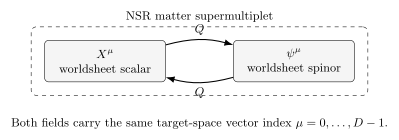
The worldsheet supermultiplet contains a bosonic embedding coordinate and a Majorana fermion . The target-space index is the same on both fields.
The NSR matter action
Section titled “The NSR matter action”In flat target space and conformal gauge, the Lorentzian NSR matter action is
The equations of motion are
The fermion equation splits into chiral components:
Thus, just like the bosonic string coordinate, the fermion decomposes into left- and right-moving pieces:
In Euclidean complex coordinates, the holomorphic fields obey the OPEs
and
The holomorphic and antiholomorphic fermions are independent on the closed-string worldsheet; for open strings they are related at the boundary.
Rigid worldsheet supersymmetry
Section titled “Rigid worldsheet supersymmetry”The action is invariant under the rigid supersymmetry transformations
where is a constant anticommuting Majorana spinor. The transformation says that the bosonic coordinate and the worldsheet fermion are superpartners.
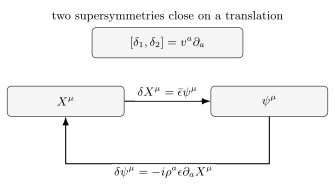
Rigid worldsheet supersymmetry exchanges and . Acting twice gives a translation along the worldsheet.
Indeed, the commutator of two such transformations closes on a worldsheet translation:
and similarly for , up to the equations of motion. This is the characteristic algebra of supersymmetry: the square of a supercharge is a translation.
Local worldsheet supersymmetry and superconformal gauge
Section titled “Local worldsheet supersymmetry and superconformal gauge”The full NSR string is obtained by coupling the matter fields to two-dimensional worldsheet supergravity. In addition to the metric , one introduces a gravitino , the gauge field for local worldsheet supersymmetry.
The local gauge symmetries are the supersymmetric extension of the Polyakov symmetries:
Using these symmetries, one can choose superconformal gauge:
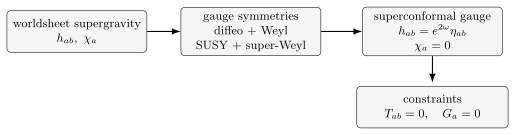
Superconformal gauge fixes the worldsheet metric and gravitino. The residual gauge symmetry becomes the superconformal symmetry generated by and .
The equations obtained by varying and survive as constraints:
In the quantum theory these become the super-Virasoro physical-state conditions.
Stress tensor and supercurrent
Section titled “Stress tensor and supercurrent”In holomorphic language, the matter stress tensor is
The holomorphic supercurrent is
There are analogous antiholomorphic currents and for closed strings.
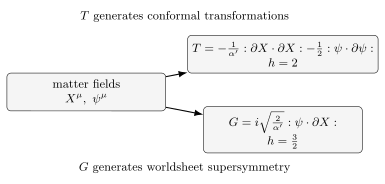
The stress tensor generates conformal transformations, while the supercurrent generates worldsheet supersymmetry transformations in the matter CFT.
The dimensions are
The basic OPEs imply, for example,
so is a primary field of weight . Similarly is a primary of weight .
The next page will organize the OPEs of and into the superconformal algebra.
Critical dimension preview
Section titled “Critical dimension preview”The matter central charge is the sum of the bosonic and fermionic contributions:
Gauge fixing the NSR string also produces two ghost systems:
Thus the total central charge is
Quantum super-Weyl invariance requires , so

The NSR matter fields have central charge . The reparametrization ghosts and superghosts contribute , so criticality requires .
This is the superstring analogue of the bosonic result . The removal of the tachyon and the emergence of spacetime supersymmetry require additional input: the NS/R sectors and the GSO projection.
Exercises
Section titled “Exercises”Exercise 1. Equations of motion of the NSR action
Section titled “Exercise 1. Equations of motion of the NSR action”Starting from
show that the equations of motion are and .
Solution
Varying gives
After integrating by parts and dropping the boundary term, this becomes
so .
For the fermion, varying gives
Thus
Exercise 2. Closure of rigid worldsheet supersymmetry
Section titled “Exercise 2. Closure of rigid worldsheet supersymmetry”Using
show that two supersymmetry transformations close on a translation of .
Solution
Acting twice on gives
Antisymmetrizing the two transformations and using the anticommuting nature of the spinor parameters gives
This is a translation with parameter
Exercise 3. The fermion conformal weight
Section titled “Exercise 3. The fermion conformal weight”Use the OPE
and
to show that has conformal weight .
Solution
In the OPE , there are two contractions. The result is
This is the primary-field OPE with conformal weight
Exercise 4. Matter central charge
Section titled “Exercise 4. Matter central charge”Show that free bosons and free Majorana fermions have matter central charge .
Solution
Each free boson contributes , so bosons contribute
Each real chiral Majorana fermion contributes , so such fermions contribute
Therefore
Exercise 5. Critical dimension of the NSR string
Section titled “Exercise 5. Critical dimension of the NSR string”Using , , and , derive the critical dimension of the NSR string.
Solution
The total central charge is
Quantum super-Weyl invariance requires
Therefore
and hence