
AdS2 Throats and Local Criticality
The main idea
Section titled “The main idea”The planar Reissner-Nordström-AdS black brane has a striking low-temperature feature. As , its horizon becomes extremal, the blackening factor develops a double zero, and the near-horizon geometry approaches
This is much more than a geometric curiosity. In the boundary theory, the AdS factor controls the low-energy response of a finite-density state. The spatial directions do not scale in the same way as time. Under the emergent IR scaling,
where is an AdS radial coordinate. Frequencies scale, but momenta are spectators. This is why the corresponding boundary behavior is often called local criticality or, more accurately, semi-local criticality:
- correlation functions show nontrivial scaling in time or frequency;
- spatial momentum labels different IR operators rather than scaling with frequency;
- equal-time spatial correlations are not forced to become scale invariant;
- the IR theory behaves roughly like a continuum of CFT sectors, one for each momentum .
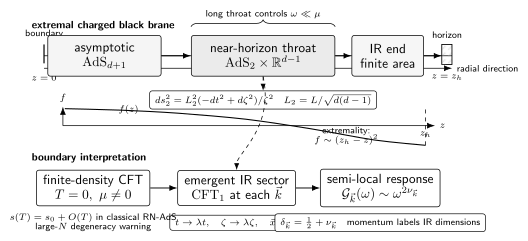
An extremal charged AdS black brane develops a near-horizon throat . The AdS factor rescales time and the throat coordinate, while the transverse directions are spectators. Boundary momenta therefore label different IR scaling dimensions rather than scaling as part of a relativistic -dimensional critical point.
The throat is one of the central mechanisms behind holographic quantum matter. It explains why many finite-density holographic systems have low-energy correlators of the form
at zero temperature, and
at small nonzero temperature. The exponent is determined by an effective mass in the AdS region. This is the technical origin of many non-Fermi-liquid, strange-metal, and quantum-critical phenomena in bottom-up holography.
There is also an important warning. The extremal RN-AdS throat has a finite horizon area at in the classical large- limit. Thus it carries a nonzero entropy density
This is useful because it gives a solvable strongly coupled IR sector, but it is also suspicious as a literal ground state of a finite- theory. In many systems, the extremal throat is unstable to superconducting order, scalar condensation, electron-star formation, lattice effects, higher-derivative corrections, or other low-temperature physics. A good way to think about the RN-AdS throat is therefore:
Extremality and the double zero
Section titled “Extremality and the double zero”Use the planar charged black-brane ansatz from the previous page,
with boundary at and horizon at . For a simple Einstein-Maxwell theory in dimensions, one convenient dimensionless parametrization is
and
The formula for assumes the regular gauge . The temperature is
Extremality means , so
At this value,
The horizon is no longer a simple zero of ; it is a double zero. Expanding near gives
This double zero is the whole story. A simple zero gives Rindler space near the horizon, which is the usual finite-temperature nonextremal behavior. A double zero gives AdS.
| Horizon type | Blackening factor | Near-horizon geometry | Boundary meaning |
|---|---|---|---|
| nonextremal | Rindler | finite thermal dissipation | |
| extremal | AdS | emergent IR scaling |
The extremal limit is therefore singular in a useful way. The geometry develops an infinitely long throat, and low-frequency probes spend a long radial time in this throat before escaping to the asymptotic AdS region.
Deriving the AdS throat
Section titled “Deriving the AdS2×Rd−1_2\times\mathbb R^{d-1}2×Rd−1 throat”Define a near-horizon coordinate
As , keep fixed and use the double-zero expansion of . Since in the overall warp factor,
The time component becomes
The radial component becomes
Thus the near-horizon metric is
where
This is AdS in Poincaré-like coordinates times a flat transverse space. If one defines , the AdS part takes the more familiar form
The gauge field also has a universal near-horizon limit. Expanding
near gives
with
Therefore the AdS region is supported by a constant electric field,
This electric field is not a small perturbation. It is the near-horizon remnant of the charge density of the boundary state. It is also what makes charged probes in the throat interesting: their effective IR dimensions are shifted by the electric field.
The near-extremal throat
Section titled “The near-extremal throat”At exactly , the AdS throat is infinitely long. At small but nonzero temperature, the throat is cut off by an AdS black hole. The near-horizon geometry becomes
with AdS temperature
up to the time normalization already chosen above. The throat is no longer infinite; its proper length is cut off in the deep IR. Parametrically, for , the throat length grows like
This logarithm is useful intuition. As the temperature decreases, there is a wider radial interval in which the geometry is well approximated by AdS. Low-frequency probes with
first see the AdS throat. Probes with
are sensitive to the near-extremal AdS black-hole horizon.
The entropy density of the planar black brane is still the horizon area density,
At extremality, remains finite because it is set by and the charge density. Thus
where is the extremal horizon position. The low-temperature expansion of the classical RN-AdS saddle has the schematic form
The linear-in- term is characteristic of the AdS throat. The constant term is the famous zero-temperature entropy of the extremal black brane. It is both a calculational gift and a conceptual headache.
What does the boundary theory see?
Section titled “What does the boundary theory see?”The throat is a statement about the IR part of the bulk geometry. The boundary theory interpretation is an emergent low-energy sector controlled by the symmetries of AdS.
The AdS metric
is invariant under
But the transverse metric
does not participate in this scaling. Hence
This is very different from an ordinary relativistic critical point, where
It is also different from a Lifshitz critical point with finite dynamical exponent , where
The AdS throat corresponds heuristically to
This does not mean the theory has no spatial structure. It means spatial momentum is an exactly good label of the IR problem, but it does not scale with frequency. A boundary operator at momentum maps in the throat to an AdS field whose effective mass depends on .
The practical dictionary is:
| Bulk throat statement | Boundary finite-density statement |
|---|---|
| AdS factor | emergent low-energy conformal symmetry in time |
| factor | spatial directions are spectators of the IR scaling |
| finite electric field | finite charge density remains in the IR |
| AdS black hole at | universal scaling at low temperature |
| finite horizon area | nonzero large- entropy density at |
| momentum-dependent AdS mass | momentum-dependent IR dimension |
This is why one often says that the extremal charged black brane is dual to a locally critical state. The word local refers to spatial locality: the critical scaling is local in space and extended in time.
Scaling dimensions in the throat
Section titled “Scaling dimensions in the throat”Consider a neutral scalar field in the full AdS geometry,
Fourier decompose along the boundary directions:
In the AdS region, the transverse momentum contributes to the effective AdS mass. Since
the effective mass is
The AdS wave equation then gives the IR scaling dimension
where
Thus every momentum has its own IR exponent. This is the simplest mathematical expression of local criticality.
For a charged scalar or spinor, the near-horizon electric field shifts the exponent. Schematically,
where is the bulk charge and in the throat. The precise coefficient multiplying depends on gauge-field normalization, but the physical point is robust: the electric field can lower the effective AdS mass of charged probes.
At zero temperature, the retarded Green function of the IR CFT has the form
for real , up to normalization and contact-term conventions. At nonzero temperature,
where is determined by solving the field equation in the AdS black hole with electric field.
This is the origin of many unusual finite-density holographic response functions. In ordinary weakly coupled metals, low-energy response is often organized around quasiparticles near a Fermi surface. In the RN-AdS throat, the basic low-energy object is instead an emergent strongly coupled IR operator with momentum-dependent dimension.
Matching the throat to the UV
Section titled “Matching the throat to the UV”The AdS region is not the whole spacetime. A full boundary correlator is obtained by matching two solutions:
- an inner solution in the AdS throat, valid at small and near the horizon;
- an outer solution in the asymptotic AdS region, valid at away from the horizon.
There is an overlap region when
in appropriate throat units. The inner solution encodes the nonanalytic low-frequency dependence. The outer solution encodes UV data such as operator normalization, source/response mixing, and momentum-dependent coefficients.
For a bosonic field, the low-frequency Green function often takes the schematic form
The coefficients and come from the outer region at . The function is the universal AdS IR Green function. This formula separates universal IR scaling from UV matching data.
For holographic fermions, the same logic leads to a famous expression near a Fermi momentum :
where
Depending on , this can describe a Fermi liquid-like quasiparticle, a non-Fermi liquid, or a marginal-Fermi-liquid-like response. The next page will develop this fermionic application more carefully.
The general moral is simple:
Local criticality versus ordinary quantum criticality
Section titled “Local criticality versus ordinary quantum criticality”It is helpful to compare several scaling structures.
| IR geometry | Scaling | Boundary interpretation |
|---|---|---|
| AdS | , | relativistic CFT |
| Lifshitz | , | finite- quantum criticality |
| hyperscaling-violating Lifshitz | finite- plus hyperscaling violation | nontrivial entropy and scaling dimensions |
| AdS | , | local or semi-local criticality |
For AdS, the dispersion relation is not determined by scale invariance in the usual way. Since does not scale, the IR scaling form is not
Instead, one has a family of frequency scalings,
This is why the term semi-local is useful. The state has local critical dynamics in time but retains nontrivial momentum dependence through , , , and possible poles from the UV matching problem.
A common condensed-matter slogan is that AdS describes a critical state with infinite dynamical exponent,
This slogan is helpful, but it hides two subtleties:
- The IR still knows about momentum through effective AdS masses.
- A genuine finite-density holographic ground state may replace the AdS throat with another IR geometry at sufficiently low energy.
Thus AdS is best treated as an exact classical saddle of the minimal model and as a robust organizing principle for intermediate low-energy physics.
The zero-temperature entropy puzzle
Section titled “The zero-temperature entropy puzzle”The extremal black brane has a horizon with nonzero area density. Therefore the classical entropy density remains finite at :
From the boundary viewpoint, this is an enormous ground-state degeneracy of order or . It is not what one expects from a generic isolated finite-density quantum system at finite .
There are several possible interpretations, none of which should be confused with one another.
| Viewpoint | Meaning |
|---|---|
| Classical gravity | the extremal RN-AdS black brane is a legitimate saddle with finite horizon area |
| Large- limit | exponentially many states may remain degenerate at leading order in |
| Finite expectation | degeneracy may be lifted by quantum or stringy corrections |
| Effective-model viewpoint | the throat is a parent IR fixed point, often unstable to lower-temperature order |
| Top-down viewpoint | the final answer depends on the full string compactification and allowed charged fields |
This finite entropy is not a reason to discard the throat. Instead, it is a sign that one should ask a sharper question:
Is the extremal RN-AdS saddle stable in the theory under consideration, and down to what energy scale does it control the physics?
Often the answer is: it controls an important intermediate regime, but not the ultimate ground state.
Instabilities of the AdS throat
Section titled “Instabilities of the AdS2_22 throat”The AdS throat is especially sensitive to charged or light fields. The simplest diagnostic is the AdS Breitenlohner-Freedman bound. For a neutral scalar in AdS,
In the charged case, the electric field lowers the effective mass. Schematically the stability condition becomes
If this inequality is violated for some mode, the AdS region is unstable even if the scalar is perfectly stable in the UV AdS region. This is the mechanism behind many holographic superconducting instabilities: the finite-density electric field makes a charged scalar effectively tachyonic in the near-horizon throat.
The same logic also explains more exotic transitions. If the AdS scaling exponent
becomes imaginary, the two IR fixed points associated with the two AdS quantizations collide and move into the complex plane. This produces oscillatory behavior in frequency and can lead to Berezinskii-Kosterlitz-Thouless-like scaling in certain holographic quantum phase transitions.
Common low-temperature replacements of the RN-AdS throat include:
- charged scalar hair, giving holographic superconductors or superfluids;
- neutral scalar hair, giving density-wave, antiferromagnetic, or other ordered phases in suitable models;
- electron-star geometries, where charged fermion matter carries part of the charge outside the horizon;
- Lifshitz or hyperscaling-violating IR geometries;
- spatially modulated phases;
- stringy or quantum corrections that modify the extremal horizon.
The RN-AdS throat is therefore not a universal final answer. It is a universal starting point in the minimal finite-density Einstein-Maxwell model.
Relation to entropy, fractionalization, and charge behind the horizon
Section titled “Relation to entropy, fractionalization, and charge behind the horizon”A charged black brane carries charge in the bulk electric field, and much of the charge is associated with the horizon in the classical geometry. In the boundary theory, this is often described as a fractionalized phase: the charge is carried by deconfined degrees of freedom not visible as gauge-invariant quasiparticles outside the horizon.
This language is model-dependent, but it is useful. Compare three possibilities:
| Bulk charge distribution | Boundary intuition |
|---|---|
| electric flux enters a horizon | fractionalized charge behind the horizon |
| charged matter outside the horizon | cohesive charge carried by gauge-invariant or quasiparticle-like matter |
| mixed configuration | partially fractionalized phase |
The extremal RN-AdS throat belongs to the first category. It has an electric field in the throat and a charged horizon. Holographic superconductors and electron stars move some charge outside the horizon, changing the deep IR physics.
This distinction is especially important for interpreting Fermi surfaces. A boundary theory can have finite charge density without an obvious gauge-invariant Fermi surface if the charge is hidden behind a horizon. Conversely, holographic fermion probes can show sharp spectral features even when the background charge remains fractionalized. One must carefully distinguish the charge carried by the background geometry from spectral features of a probe operator.
A minimal computational workflow
Section titled “A minimal computational workflow”When using an AdS throat to analyze a holographic observable, the workflow is usually:
- Find the extremal background. Determine , , and the near-horizon electric field.
- Choose the perturbation. Identify the bulk field dual to the boundary operator.
- Reduce to AdS. Fourier transform along so that becomes an effective mass parameter.
- Compute the IR dimension. Extract and .
- Solve the inner problem. Obtain in AdS or the AdS black hole.
- Solve the outer problem. Match to the asymptotic AdS region at .
- Assemble the boundary Green function. Combine UV coefficients with the IR Green function.
- Check for instabilities. Look for imaginary , poles at , or modes violating an IR BF bound.
This workflow appears repeatedly in finite-density holography. It is the backbone of holographic non-Fermi liquids, holographic superconducting instabilities, semi-local critical response, and many quantum phase transitions.
Common mistakes
Section titled “Common mistakes”Mistake 1: Saying the whole bulk becomes AdS.
Only the near-horizon region becomes AdS. The full spacetime still interpolates to AdS near the boundary. Boundary correlators require matching the throat to the UV region.
Mistake 2: Forgetting the transverse .
The transverse space is not decorative. It is why the IR dimensions depend on momentum and why the criticality is semi-local rather than an ordinary CFT completely decoupled from space.
Mistake 3: Treating as automatically physical at finite .
The finite entropy is a classical large- result. It often signals degeneracy, instability, or missing corrections. It is still an extremely useful leading saddle.
Mistake 4: Confusing local criticality with locality of the microscopic Hamiltonian.
The boundary theory can be a perfectly local quantum field theory. “Local criticality” means that the emergent IR scaling is local in space: time scales, but does not.
Mistake 5: Assuming AdS guarantees a stable strange metal.
The throat gives a powerful low-energy sector, but additional fields may condense, translation symmetry may break, fermions may backreact, and the deep IR may be replaced by another geometry.
Mistake 6: Ignoring gauge-field normalization.
The schematic exponent
is convention-dependent in the last term. Physical conclusions are invariant, but numerical formulas require a precise normalization of the Maxwell action and charge .
Exercises
Section titled “Exercises”Exercise 1: The double zero of the extremal blackening factor
Section titled “Exercise 1: The double zero of the extremal blackening factor”For
show that extremality corresponds to
and that near ,
Solution
The horizon is at , and indeed
The derivative is
At the horizon,
Extremality means the horizon is a double zero, so . Therefore
Now compute
At extremality,
Thus
Since ,
Exercise 2: Derive the AdS radius
Section titled “Exercise 2: Derive the AdS2_22 radius”Starting from
and the extremal near-horizon expansion
show that the near-horizon metric is AdS with
Solution
Define
Then
Near the horizon . The time component becomes
The radial component becomes
Therefore
The AdS radius is
Exercise 3: Momentum-dependent IR dimension
Section titled “Exercise 3: Momentum-dependent IR dimension”Consider a neutral scalar of bulk mass in the AdS throat. Show that a mode with boundary spatial momentum has AdS effective mass
and IR exponent
Solution
In the throat,
Thus the inverse transverse metric is
For a Fourier mode
the transverse Laplacian contributes
In the AdS wave equation, this is equivalent to shifting the mass to
For a scalar in AdS, the dimension satisfies
Writing
gives
Exercise 4: Why the criticality is semi-local
Section titled “Exercise 4: Why the criticality is semi-local”Use the AdS metric to explain why scales but does not. Then explain why the low-frequency response can have the form
Solution
The AdS part of the metric is invariant under
Since frequency is conjugate to time,
The transverse part of the metric is
which is invariant only if
Therefore the conjugate momentum also does not scale. Instead, enters the AdS equation as a parameter in the effective mass. The AdS field has dimension
so its retarded Green function scales as
This is semi-local criticality: critical in frequency, with momentum-dependent exponents rather than ordinary momentum scaling.
Exercise 5: The AdS BF instability criterion
Section titled “Exercise 5: The AdS2_22 BF instability criterion”A charged scalar in the throat has schematic exponent
What condition signals an instability of the AdS throat?
Solution
The AdS BF bound requires the effective mass to obey
Equivalently, the exponent should be real:
Using the given expression, stability requires
An instability occurs when
Physically, the electric field lowers the effective mass of a charged scalar in the throat. If the mass falls below the AdS BF bound, the extremal RN-AdS throat is unstable, often toward a charged condensate.
Exercise 6: The matching formula
Section titled “Exercise 6: The matching formula”Suppose the full UV Green function has the schematic low-frequency form
Which part of this expression is universal IR data, and which part depends on the UV completion of the geometry?
Solution
The function
is the IR Green function computed in the AdS throat. Its nonanalytic frequency dependence, such as
is universal for a field with a given IR dimension.
The coefficients
come from solving the outer-region problem in the full asymptotically AdS geometry at . They depend on the UV theory, the operator normalization, the bulk mass and couplings outside the throat, and the boundary conditions.
Thus the formula separates universal IR scaling from UV matching data.
Further reading
Section titled “Further reading”- Thomas Faulkner, Hong Liu, John McGreevy, and David Vegh, “Emergent quantum criticality, Fermi surfaces, and AdS”. The essential paper explaining how the AdS throat controls finite-density low-energy response and holographic Fermi surfaces.
- Sean A. Hartnoll, “Lectures on holographic methods for condensed matter physics”. A standard entry point to RN-AdS black holes, finite-density holography, and holographic superconductors.
- John McGreevy, “Holographic duality with a view toward many-body physics”. A broad and physically motivated discussion of finite-density holographic states.
- Nabil Iqbal, Hong Liu, and Mark Mezei, “Semi-local quantum liquids”. A focused discussion of semi-local criticality, finite spatial correlation length, infinite correlation time, and the interpretation of AdS throats.
- Nabil Iqbal, Hong Liu, and Mark Mezei, “Quantum phase transitions in semi-local quantum liquids”. A useful source for bifurcating, hybridized, and marginal critical points controlled by AdS physics.
- Subir Sachdev, “Holographic metals and the fractionalized Fermi liquid”. Helpful for the fractionalization interpretation of horizon charge and finite-density holographic phases.