A relativistic particle action measures the invariant length of a worldline. A relativistic string action should measure the invariant area of a worldsheet. This gives the Nambu—Goto action, the most geometric form of the classical string action.
For quantization, however, the area action is not the most convenient starting point. Just as the point-particle square root was replaced by an einbein action, the string square root is replaced by an action with an independent worldsheet metric. This is the Polyakov action. Classically it is equivalent to the Nambu—Goto action; quantum mechanically it is the gateway to two-dimensional conformal field theory.
A string moving in D-dimensional spacetime is described by embedding functions
Xμ(τ,σ),μ=0,1,…,D−1.
For an open string, σ runs over an interval. A standard convention is
0≤σ≤π.
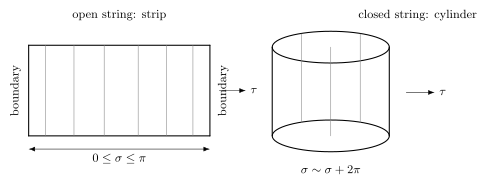
The worldsheet is topologically a strip; its two boundaries are the histories of the two endpoints.
For a closed string, σ is periodic. We often use
Xμ(τ,σ+2π)=Xμ(τ,σ).
The worldsheet is topologically a cylinder.
An open string sweeps out a strip with boundaries. A closed string sweeps out a cylinder with periodic coordinate σ.
The coordinate range of σ is partly conventional. The invariant object is not the coordinate rectangle, strip, or cylinder drawn on paper, but the surface embedded in spacetime.
The target-space metric induces a metric on the worldsheet. In a general background Gμν(X),
γαβ=∂αXμ∂βXνGμν(X).
In flat spacetime,
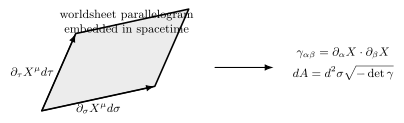
γαβ=∂αX⋅∂βX.
In coordinates (τ,σ),
γαβ=(X˙2X˙⋅X′X˙⋅X′X′2).
The determinant is
γ≡detγαβ=X˙2X′2−(X˙⋅X′)2.
For a physical Lorentzian worldsheet, one tangent direction is timelike and one is spacelike, so γ<0. The invariant area element is
dA=dτdσ−γ=dτdσ(X˙⋅X′)2−X˙2X′2.
The induced metric records the inner products of the tangent vectors ∂τXμ and ∂σXμ. Its determinant gives the invariant area of the infinitesimal parallelogram.
The analogy with the particle is exact at the geometric level:
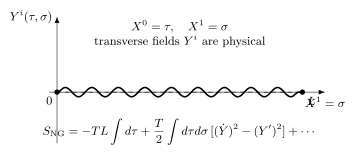
The Nambu—Goto square root is geometrically clear but difficult to quantize directly. To see the physical degrees of freedom, consider a long string stretched along the X1 direction and choose the static gauge
X0=τ,X1=σ,Xi=Yi(τ,σ),i=2,…,D−1.
The Yi are transverse displacements. In this gauge,
γττ=−1+Y˙iY˙i,γσσ=1+Y′iY′i,
and
γτσ=Y˙iY′i.
Therefore
−γ=1+Y′iY′i−Y˙iY˙i−(Y˙iY˙i)(Y′jY′j)+(Y˙iY′i)2.
The last two terms are quartic in the transverse fluctuations. To quadratic order,
−γ=1+21Y′iY′i−21Y˙iY˙i+O(Y4).
Substituting into the Nambu—Goto action gives
SNG=−T∫dτdσ+2T∫dτdσ(Y˙iY˙i−Y′iY′i)+O(Y4).
So the small oscillations of a long string are D−2 massless scalar fields on the worldsheet.
In static gauge the longitudinal directions are identified with worldsheet coordinates. The physical small oscillations are the transverse fields Yi(τ,σ).
This result previews a central fact: a relativistic string does not have independent longitudinal oscillations. In covariant quantization, the Virasoro constraints remove the unphysical timelike and longitudinal excitations.
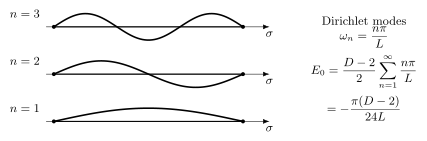
The quadratic transverse action already contains a beautiful universal quantum correction. Take an open string with endpoints fixed a distance L apart. The transverse fields obey Dirichlet boundary conditions,
Yi(τ,0)=Yi(τ,L)=0.
The normal modes are
Yi(τ,σ)∼sin(Lnπσ)e−iωnτ,ωn=Lnπ,n=1,2,….
Each oscillator contributes zero-point energy ωn/2. With D−2 transverse fields,
E0=2D−2n=1∑∞ωn=2D−2Lπn=1∑∞n.
Using zeta-function regularization,
n=1∑∞n=ζ(−1)=−121,
we find
E(L)=TL−24Lπ(D−2)+⋯.
The correction
−24Lπ(D−2)
is the Lüscher term. It is universal for a long open string with fixed endpoints because it depends only on the number of massless transverse fields.
Dirichlet transverse modes have frequencies ωn=nπ/L. Their regulated zero-point energy gives the universal −1/L correction to the long-string energy.
This semiclassical calculation should not be confused with the full quantum spectrum of the free bosonic string. But it foreshadows the normal-ordering constants that appear in exact quantization.
To remove the square root, introduce an independent worldsheet metric
hαβ(τ,σ).
The Polyakov action is
SP[X,h]=−2T∫d2σ−hhαβ∂αXμ∂βXμ.
Using T=1/(2πα′),
SP[X,h]=−4πα′1∫d2σ−hhαβ∂αXμ∂βXμ.
Here
h≡dethαβ.
The metric hαβ is not the induced metric. It is an independent field on the worldsheet. The induced metric is still
γαβ=∂αX⋅∂βX.
Thus
SP[X,h]=−2T∫d2σ−hhαβγαβ.
For fixed hαβ, the Polyakov action is quadratic in Xμ. This is the key technical advantage. Once we gauge fix hαβ, the matter theory becomes a two-dimensional field theory of free scalar fields, supplemented by constraints and eventually ghosts.
For open strings, the variation also produces boundary terms. The systematic discussion of Neumann and Dirichlet boundary conditions is postponed to the next page, where conformal gauge makes them especially transparent.
The variation with respect to the metric gives the worldsheet stress tensor. Using
The Polyakov action appears to contain more fields than the Nambu—Goto action, but hαβ is auxiliary. The equation Tαβm=0 can be written as
γαβ=21hαβhρλγρλ.
Thus the induced metric is proportional to hαβ:
γαβ=Λ(τ,σ)hαβ.
Equivalently,
hαβ=e2ω(τ,σ)γαβ.
The function ω is not fixed because the Polyakov action is classically invariant under Weyl rescalings,
hαβ↦e2ωhαβ.
Choose the Weyl representative hαβ=γαβ. Then
SP[X,γ]=−2T∫d2σ−γγαβγαβ.
In two dimensions,
γαβγαβ=2,
so
SP[X,γ]=−T∫d2σ−γ=SNG[X].
The Polyakov metric equation sets hαβ equal to the induced metric up to a Weyl factor. Substituting back gives the Nambu—Goto area action.
This equivalence is classical. Quantum mechanically, the Polyakov path integral includes a sum over worldsheet metrics modulo gauge equivalences. The survival of Weyl invariance becomes a real dynamical condition, and it is what will eventually select the critical dimension.
The Nambu—Goto action is geometrically direct: it is tension times area. The Polyakov action is technically superior: it is quadratic in Xμ and has local worldsheet diffeomorphism and Weyl gauge symmetries. Varying the auxiliary metric gives Tαβm=0, the classical ancestor of the Virasoro constraints.