
Large-N Gauge Theory
The organizing idea
Section titled “The organizing idea”The previous page explained why gravity suggests an unusual counting of states: black-hole entropy scales like an area in Planck units. The next ingredient is a field-theory mechanism that can produce a controlled expansion looking like quantum gravity. That mechanism is the large- expansion of matrix gauge theories.
The basic observation is simple but deep. In an or gauge theory, fields in the adjoint representation are matrices. Their Feynman diagrams do not merely form ordinary graphs; after color indices are drawn explicitly, they become ribbon graphs. A ribbon graph has a topology. It can be drawn on a sphere, a torus, or a higher-genus surface. The power of carried by the diagram is determined by this topology.
In the large- limit, planar diagrams dominate. Nonplanar diagrams are suppressed by powers of . This is exactly the pattern of a closed-string perturbation expansion, where each additional handle on the worldsheet costs a factor of . Thus large- gauge theory supplies the first structural reason that a gauge theory might have a string description:
This statement is not yet AdS/CFT. It does not say what the target space of the string is, whether the string is weakly curved, or whether the bulk theory is Einstein gravity. But it explains why the gauge-theory parameter is naturally related to the quantum-gravity loop expansion.
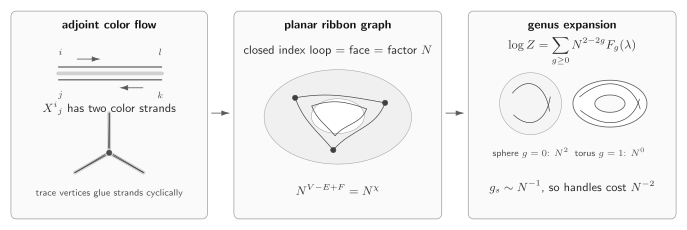
Adjoint fields carry two color indices, so their propagators are double lines. A ribbon graph contributes a power , where is the Euler characteristic of the surface on which the graph is drawn. The expansion of the gauge-theory free energy, , mirrors a closed-string genus expansion with at fixed .
The ‘t Hooft limit
Section titled “The ‘t Hooft limit”Consider a gauge theory with gauge group or and fields in the adjoint representation. The Yang-Mills coupling is , and the natural large- coupling is the ‘t Hooft coupling
The ‘t Hooft limit is
This is the correct limit because a typical color loop gives a factor of , while a gauge interaction brings powers of . Holding fixed would make diagrams blow up with arbitrary powers of . Holding fixed balances the color combinatorics against the coupling constants.
A schematic adjoint gauge-theory action can be written as
where is the trace in the fundamental representation. The precise field content depends on the theory. For example, in super-Yang-Mills there are gauge fields, six adjoint scalars, and four adjoint Weyl fermions. The large- counting, however, is much more general than supersymmetry.
A crucial warning: in the ‘t Hooft limit,
but the theory is not necessarily weakly coupled. The physical interaction strength controlling planar dynamics is , not alone. Planar diagrams with arbitrarily many vertices can survive at . Large is a topological expansion, not automatically a perturbative expansion in .
This distinction is central in AdS/CFT. Classical supergravity usually requires both
The first condition suppresses quantum gravity loops. The second suppresses stringy corrections in powers of .
Matrix fields and double-line notation
Section titled “Matrix fields and double-line notation”An adjoint field is a matrix,
with one fundamental index and one anti-fundamental index. In a theory, the color structure of the free propagator is schematically
This is why one draws the propagator as two oppositely oriented color lines. The first Kronecker delta carries one index along the propagator; the second carries the other index back. Vertices join these strands cyclically because the interactions appear inside traces.
For rather than , the adjoint field is traceless. The propagator contains the projector
The second term subtracts the singlet component. It is suppressed in many leading large- questions, but it matters for exact finite- identities, trace relations, and sometimes for global subtleties. In most AdS/CFT calculations, the distinction between and is invisible at leading order in .
The important point is that every closed color-index loop gives
Therefore the power of in a diagram is found by counting closed color loops, propagators, and vertices.
Topological counting
Section titled “Topological counting”Take a connected vacuum ribbon graph made only of adjoint fields. Let
- be the number of interaction vertices,
- be the number of propagators,
- be the number of closed color-index loops, also called faces.
With the normalization of the action above, a schematic counting gives
Thus
The power of depends on the details of the vertices and on field normalizations. The power of is topological. The quantity
is the Euler characteristic of the two-dimensional surface obtained by thickening the graph into a ribbon graph. For a connected orientable closed surface of genus ,
Therefore a vacuum graph of genus contributes as
The leading diagrams are planar diagrams, , which scale like . Diagrams that require one handle, , scale like . Two handles give , and so on.
Equivalently, the vacuum free energy has the expansion
This is the first major bridge to string theory. A closed-string perturbation expansion has the schematic form
Comparing the two expansions suggests
at fixed . In the canonical AdS/CFT example, the more precise relation includes the ‘t Hooft coupling because , up to convention-dependent numerical factors. For genus counting at fixed , however, the important scaling is .
Boundaries: operator insertions and fundamental matter
Section titled “Boundaries: operator insertions and fundamental matter”A ribbon graph may also have boundaries. There are two common sources of boundaries.
First, a single-trace operator insertion such as
creates a marked cyclic boundary for color lines. Second, if the theory contains fields in the fundamental representation, a closed fundamental loop forms a boundary rather than a face made from adjoint color flow.
For a connected orientable surface with genus and boundaries,
So the corresponding color factor behaves like
This formula explains two standard large- facts.
First, each additional trace insertion reduces the naive power of by one before one chooses the normalization of the external operators. This is the origin of large- scaling rules for single-trace correlators.
Second, with fundamental flavors held fixed as , fundamental loops are suppressed relative to adjoint loops. A diagram with fundamental boundaries carries a factor roughly
For fixed , each boundary costs a factor of . This is the field-theory origin of the probe-flavor approximation in holography: flavor branes with do not backreact at leading order on the geometry. In the Veneziano limit,
fundamental matter is not quenched, and the dual flavor sector should backreact.
Large- factorization
Section titled “Large-NNN factorization”The topological expansion implies a second key property: gauge-invariant observables become classical variables at large .
Let denote a normalized single-trace observable whose expectation value remains order one at large . Schematically one may think of
although the exact normalization depends on the operator. Couple it to a source by writing
The large- expansion says
Connected correlators of the are obtained by differentiating and dividing by the source-coupling factors. Therefore
In particular,
This is large- factorization. It is analogous to the statement that fluctuations around a classical saddle are small. The role of is played by .
A second normalization is often more convenient in AdS/CFT. Define a particle-normalized operator
so that its connected two-point function is order one when the one-point function vanishes:
Then
This is the normalization behind the common statement that cubic bulk couplings are order and quartic bulk couplings are order .
Both normalizations are useful. The first makes factorization look like classical probability. The second makes the CFT operators look like canonically normalized single-particle fields. Confusing these two normalizations is one of the most common sources of wrong powers of .
Single-trace operators as single-particle states
Section titled “Single-trace operators as single-particle states”In matrix large- theories, the basic gauge-invariant local operators are traces:
A single trace is the gauge-theory analog of one closed string. A product of traces is the analog of a multi-string or multi-particle state. In the CFT operator language, this means
while
At , multi-trace operators behave almost like composites of independent single-trace operators. For example, in a large- CFT, a double-trace primary schematically of the form
has dimension
where counts radial excitations and is spin. The correction is the anomalous dimension produced by bulk interactions. In Witten-diagram language, it appears from tree-level exchange and contact diagrams. In bulk language, it is a binding-energy correction between two particles in AdS.
This is a remarkably concrete statement. Large does not merely say that some diagrams are small. It says that the Hilbert space organizes itself approximately like a Fock space:
with interactions suppressed by powers of .
Central charge, Newton’s constant, and classical gravity
Section titled “Central charge, Newton’s constant, and classical gravity”A matrix CFT has order degrees of freedom. This shows up in thermodynamics, anomalies, and stress-tensor correlation functions. For example, the stress-tensor two-point coefficient behaves as
in adjoint large- gauge theories.
On the gravity side, the coefficient multiplying the classical bulk action is
For an AdS dual with radius , the dimensionless measure of the gravitational coupling is
The holographic dictionary therefore identifies the large central charge with the inverse Newton coupling:
This is why the large- limit is the classical-gravity limit. Bulk loops are suppressed by powers of
But this is only the loop expansion. To obtain a weakly curved Einstein-like bulk, one also needs a large gap to higher-spin and stringy states. In the canonical D3-brane example, that gap is controlled by the ‘t Hooft coupling :
So the rough hierarchy is
Large alone gives something string-like. Large plus strong coupling and a sparse light spectrum give something close to classical Einstein gravity.
A small worked example: why four-point functions start at
Section titled “A small worked example: why four-point functions start at 1/N21/N^21/N2”Use particle-normalized single-trace operators with
The connected three-point function scales as
Therefore the corresponding cubic bulk interaction has coupling of order . A connected four-point function receives contributions from two basic kinds of tree-level bulk diagrams:
- an exchange diagram with two cubic vertices,
- a contact diagram with one quartic vertex.
The exchange diagram scales as
The quartic coupling must also scale as if the bulk action has the form
with canonically normalized fluctuations obtained by expanding fields with a factor of . Hence
This is the CFT origin of tree-level Witten diagrams. A disconnected four-point function is order , being a product of two two-point functions, while the connected part is suppressed by . The connected part is where bulk interactions live.
What large buys you in AdS/CFT
Section titled “What large NNN buys you in AdS/CFT”The following dictionary is only schematic, but it is one of the most useful summaries in the subject.
| Large- gauge-theory feature | Bulk interpretation |
|---|---|
| Classical bulk action scales like | |
| Planar dominance | Classical string worldsheet or tree-level closed-string physics |
| Genus- suppression | Closed-string loop expansion with |
| Large- factorization | Classical bulk saddle; suppressed quantum fluctuations |
| Single-trace primaries | Single-particle bulk fields or single-string states |
| Multi-trace operators | Multi-particle bulk states |
| Connected -point functions in particle normalization | Bulk -point interactions suppressed by powers of |
| Fundamental loops suppressed for fixed | Probe flavor branes with negligible backreaction |
The table also hints at a limitation. A large- expansion is necessary for a weakly coupled bulk, but it is not sufficient for a simple geometric bulk. Vector large- theories, for example, can have duals involving higher-spin gauge fields rather than ordinary Einstein gravity. Matrix large- theories are naturally string-like, but whether the string has a local weakly curved target-space description is a further dynamical question.
Common mistakes
Section titled “Common mistakes”Mistake 1: Large means weak coupling.
No. The ‘t Hooft coupling can be small, finite, or large. Large organizes diagrams by topology. It does not by itself make the planar theory easy.
Mistake 2: Planar means classical gravity.
Planar means genus zero in the gauge-theory/string expansion. Classical Einstein gravity also requires the string scale to be small compared with the AdS radius and requires the light spectrum to be sparse enough that only a few low-spin fields remain relevant.
Mistake 3: Every single-trace operator is light in the bulk.
Single-trace means single-string or single-particle, but the corresponding bulk state may be very heavy. In a strongly coupled holographic CFT, most stringy single-trace operators have dimensions that grow with a positive power of .
Mistake 4: The normalization of operators is harmless.
It is not. The same physical correlator can be described using classical-variable normalization, particle normalization, or stress-tensor normalization. Always say which one is being used before assigning powers of .
Mistake 5: and are always identical.
They agree for many leading large- observables, but finite- trace relations, decoupled sectors, global forms of the gauge group, and line operators can distinguish them.
Exercises
Section titled “Exercises”Exercise 1: Euler characteristic from double-line counting
Section titled “Exercise 1: Euler characteristic from double-line counting”Consider a connected vacuum ribbon graph with vertices, propagators, and closed index loops. Use the schematic rules
to show that the amplitude scales as times a function of , where .
Solution
Multiplying the factors gives
The exponent of is
For a connected orientable closed ribbon graph drawn on a genus- surface,
so
The precise power of depends on the graph and on the interaction vertices, but the power of is topological.
Exercise 2: Handles and the string coupling
Section titled “Exercise 2: Handles and the string coupling”Suppose the connected vacuum free energy of a matrix gauge theory has the expansion
Compare this with a closed-string expansion and identify the scaling of with .
Solution
A closed-string perturbation expansion has the form
The sphere term scales as , the torus term as , and the genus-two term as . Matching this with
we find
at fixed ‘t Hooft coupling. In the D3-brane duality, convention-dependent constants and powers of refine this relation, but the genus-counting statement is at fixed .
Exercise 3: Factorization from the generating functional
Section titled “Exercise 3: Factorization from the generating functional”Let be a normalized single-trace observable with source coupling
and suppose
Show that
Solution
Because the source appears as , differentiating once gives
Differentiating twice gives
Since , the second derivative of is generically order . Therefore
This gives large- factorization:
Exercise 4: Changing operator normalization
Section titled “Exercise 4: Changing operator normalization”Assume classical-variable normalization gives
Define particle-normalized operators . Show that
Solution
Substituting gives
Using the assumed scaling,
Thus particle-normalized two-point functions are order , three-point functions are order , and connected four-point functions are order .
Exercise 5: Fundamental matter and probe flavor
Section titled “Exercise 5: Fundamental matter and probe flavor”Consider an adjoint gauge theory with fundamental flavors. A connected diagram with genus and closed fundamental loops scales as
Explain why fundamental loops are suppressed when is fixed, and why they are not suppressed in the Veneziano limit.
Solution
Relative to a purely adjoint planar contribution, which scales as , a diagram with fundamental loops and genus zero scales as
If is held fixed as , then each fundamental boundary is suppressed by . This is the quenched or probe-flavor regime.
In the Veneziano limit, is held fixed. Then
is order one, so diagrams with fundamental loops are not parametrically suppressed. In holography this corresponds to flavor branes whose stress tensor can backreact on the geometry.
Exercise 6: Matrix large versus vector large
Section titled “Exercise 6: Matrix large NNN versus vector large NNN”A theory with vector fields often has a large- expansion, but its number of elementary degrees of freedom scales like , not . Explain why this suggests a different kind of bulk dual from a matrix large- gauge theory.
Solution
In a matrix gauge theory, adjoint fields have two color indices, so the number of components scales like . The perturbative expansion is organized by ribbon graphs, and the power of is related to the genus of a two-dimensional surface. This is why matrix large- theories are naturally connected to closed-string expansions.
In a vector model, fields have one index, so the number of components scales like . The diagrams are not organized in the same way by closed orientable string worldsheets. The singlet sector can still have a large- expansion and can still admit a bulk interpretation, but the dual is often higher-spin-like rather than Einstein-like. This is one reason large alone is not enough to guarantee a conventional semiclassical gravity dual.
Further reading
Section titled “Further reading”The original source of the topological expansion is G. ‘t Hooft, A Planar Diagram Theory for Strong Interactions. For a concise review by ‘t Hooft, see Large N, arXiv:hep-th/0204069. For the role of large in AdS/CFT, see Aharony, Gubser, Maldacena, Ooguri, and Oz, Large N Field Theories, String Theory and Gravity, arXiv:hep-th/9905111. David Tong’s gauge-theory lecture notes also give a clear pedagogical account of double-line notation and large- counting.
The next page explains how these ribbon-graph surfaces become physically string-like in confining gauge theories and why AdS/CFT requires a more subtle notion of string than the QCD flux tube.