
D-Branes as Gauge Theory and Gravity
The organizing idea
Section titled “The organizing idea”The previous pages gave two reasons why gauge theory might secretly be string theory. Black-hole entropy suggested that quantum gravity has fewer independent degrees of freedom than a local bulk field theory would suggest, and large- gauge theory organized perturbation theory by two-dimensional surfaces. Flux tubes then gave a more dynamical picture: color fields can behave like strings.
D-branes make the bridge precise.
A D-brane is an object in string theory on which open strings can end. This sounds like a boundary condition, and historically that is exactly how it first appears. But it is also a dynamical, massive, charged object that sources closed-string fields. Thus the same stack of branes has two complementary descriptions:
This is the physical mechanism that makes AdS/CFT possible. A large number of coincident D-branes carries open-string degrees of freedom, which become matrix-valued gauge fields. The same stack has mass and Ramond-Ramond charge proportional to , so at large it can curve spacetime strongly enough to form a black brane geometry. In a suitable low-energy limit, the open-string gauge-theory description and the closed-string gravitational description become two descriptions of the same decoupled system.
That is the conceptual seed of the canonical duality:
The details of the D3-brane derivation come in the next module. This page builds the machinery: boundary conditions, Chan—Paton factors, worldvolume gauge theory, brane tension, Ramond-Ramond charge, black brane solutions, and open/closed string duality.
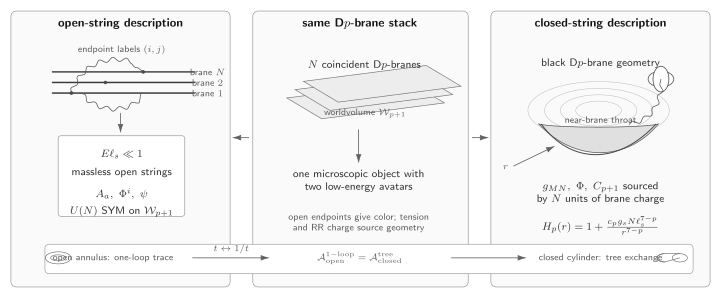
A stack of coincident D-branes is simultaneously an open-string boundary condition and a closed-string source. At low energy, massless open strings give super-Yang—Mills on the worldvolume , while the same branes source the metric, dilaton, and Ramond-Ramond potential . Open/closed duality is already visible in the equality between the one-loop open-string annulus and tree-level closed-string exchange.
D-branes as boundary conditions
Section titled “D-branes as boundary conditions”Let be the string length. An open string has worldsheet coordinates with . Varying the Polyakov action gives a boundary term of the schematic form
There are two simple ways to make this vanish at an endpoint:
or
A D-brane is an object with Neumann boundary conditions along spatial directions and time, and Dirichlet boundary conditions in the remaining transverse directions. Splitting spacetime coordinates as
the endpoint boundary conditions are
The constants specify the transverse position of the brane. The open string endpoint is free to move along the brane but is fixed in the transverse directions. The brane worldvolume is therefore a -dimensional spacetime,
A small but important point: the brane is not merely a rigid wall. The transverse position becomes a dynamical field on the brane. For one brane, slow transverse fluctuations are described by scalar fields on . The brane can bend, move, and carry gauge flux.
In type IIA string theory, stable BPS D-branes have even . In type IIB string theory, stable BPS D-branes have odd . The D3-brane, central to AdS/CFT, is therefore a type IIB object.
The massless open-string spectrum
Section titled “The massless open-string spectrum”Quantizing an open superstring ending on a D-brane gives massless excitations localized on the brane. Their bosonic fields are
Here is a gauge field along the brane, and the scalars describe transverse motion. It is useful to distinguish the physical transverse coordinate from the canonically normalized adjoint scalar . They are related schematically by
This relation is one of the earliest appearances of the energy/radial intuition that later becomes important in AdS/CFT: a scalar vev in the gauge theory measures a transverse separation in string units.
For a single D-brane, the low-energy theory is abelian. For coincident D-branes, the story changes dramatically.
Open strings can begin on brane and end on brane . The labels are Chan—Paton labels. A massless field therefore carries two brane labels,
and becomes an matrix. The massless open strings on coincident branes form the adjoint representation of . At energies small compared with the string scale, their leading interactions are described by maximally supersymmetric Yang—Mills theory in dimensions:
The exact numerical normalization of depends on the trace convention. The robust scaling is
or, keeping one common convention,
For D3-branes, the gauge coupling is dimensionless. In the convention commonly used for the canonical AdS/CFT dictionary, one instead writes
The factor of two relative to some DBI normalizations is not physics; it is a trace-normalization convention. What matters physically is the relation between the string coupling , the rank , and the ‘t Hooft coupling .
Brane separation and the Coulomb branch
Section titled “Brane separation and the Coulomb branch”Suppose the branes are separated in a transverse direction. An open string stretching from brane to brane has minimum length
The energy of a stretched fundamental string is its tension times its length,
In the worldvolume gauge theory, this same excitation is an off-diagonal -boson made massive by a scalar expectation value. The dictionary is
For separated branes, the gauge group is broken as
for generic positions. For coincident branes, the off-diagonal strings become massless and the full nonabelian symmetry is restored. This is a beautiful string-theoretic origin of gauge symmetry enhancement: nonabelian gauge symmetry appears when extended objects coincide.
The center-of-mass describes the collective motion of the whole brane stack. In the canonical AdS/CFT limit, this abelian sector decouples, and the interacting theory is usually stated as super-Yang—Mills. This is why both and appear in discussions of D3-branes. The brane construction naturally gives ; the interacting holographic CFT is the nonabelian part.
The Dirac—Born—Infeld action
Section titled “The Dirac—Born—Infeld action”The low-energy dynamics of a single D-brane is governed by the Dirac—Born—Infeld plus Wess—Zumino action. In string frame,
with
Here:
- is the pullback of the spacetime metric and NS—NS two-form to the brane.
- is the worldvolume gauge-field strength.
- is the spacetime dilaton.
- is the brane charge/tension unit before substituting a constant dilaton.
A common convention is
For constant dilaton , the physical energy per unit -volume is
The factor is crucial. At weak string coupling, D-branes are heavy nonperturbative objects. Yet open strings ending on them have perturbative interactions controlled by . This is one reason D-branes are so powerful: they let us study nonperturbative stringy objects using perturbative open strings.
Expanding the DBI action in flat space gives
After writing and promoting the fields to matrices for coincident branes, this expansion becomes the Yang—Mills action plus higher-derivative corrections. The expansion parameter is roughly
Thus ordinary Yang—Mills theory is the leading low-energy approximation to open-string dynamics on the branes.
Ramond—Ramond charge and the Wess—Zumino coupling
Section titled “Ramond—Ramond charge and the Wess—Zumino coupling”D-branes do not only have tension. They also carry Ramond—Ramond charge. The Wess—Zumino part of the brane action is schematically
The most direct term is
so a D-brane is electrically charged under a Ramond—Ramond -form potential . In the convention above,
The equality between tension and charge, after the appropriate powers of are accounted for, is the hallmark of a BPS object. A stack of parallel identical D-branes preserves half of the supersymmetry of the ambient type II theory. Forces from NS—NS exchange and RR exchange cancel for static parallel branes. This cancellation is what allows an arbitrary number of coincident branes to form a stable supersymmetric configuration.
The exponential in the Wess—Zumino term is also important. It says that worldvolume gauge flux can induce lower-dimensional D-brane charge. For example, gauge flux on a D-brane can source , , and so on. This idea underlies many later constructions: baryon vertices, brane polarization, anomaly inflow, topological charges on flavor branes, and K-theoretic classifications of D-brane charge.
For the core AdS/CFT story, the key point is simpler:
In the D3-brane example, this flux becomes the self-dual five-form flux through the in .
D-branes as gravitational sources
Section titled “D-branes as gravitational sources”Closed strings contain the graviton , the dilaton , the NS—NS two-form , and Ramond—Ramond gauge potentials. Since D-branes have tension and RR charge, they source these fields. At distances large compared with , a stack of D-branes is described by a classical supergravity solution when the curvature is small in string units and string loops are suppressed.
The extremal D-brane solution in string frame has the schematic form
with RR flux determined by . The harmonic function is
where is a numerical constant depending on conventions. The important quantity is the combination
For a single brane at weak coupling, the gravitational field is weak. For branes, the source is amplified by . Thus a stack can have a reliable gravitational description even when is small, provided is large enough.
The D3-brane is special. For , the dilaton is constant:
and
The near-horizon limit replaces by and produces
This one formula already contains the central parameter relation of the canonical correspondence:
Large curvature radius in string units means
while weak string loops require
Thus the classical supergravity regime corresponds to
Different authors phrase the last condition slightly differently because the strict planar expansion is organized in powers of at fixed , while the ten-dimensional string loop coupling is . The practical message is robust: large suppresses quantum gravity loops, and large suppresses string-scale curvature corrections.
Open/closed string duality before AdS/CFT
Section titled “Open/closed string duality before AdS/CFT”The equality between open-string and closed-string descriptions appears even before taking a near-horizon limit. Consider the annulus amplitude for open strings ending on D-branes. In the open-string channel, it is a one-loop vacuum diagram:
The same worldsheet can be reinterpreted by exchanging the roles of worldsheet space and time. With a modular transformation , the annulus becomes a closed string propagating between two boundary states:
This is not merely an analogy. It is the same string path integral. The two interpretations are:
At low energy, the left side becomes a loop effect in the worldvolume gauge theory. The right side becomes exchange of closed-string supergravity fields sourced by the branes. This is the prototype of the gauge/gravity idea: diagrams in a gauge theory can be reorganized as processes in a closed-string theory.
There is an important difference between this statement and full AdS/CFT. Open/closed duality of worldsheet diagrams is a perturbative string identity in a background containing branes. AdS/CFT is a nonperturbative equivalence between a quantum field theory and string theory in a spacetime where the branes have been replaced by flux and geometry after a decoupling limit. The former suggests the latter; it is not yet the latter.
The decoupling logic
Section titled “The decoupling logic”At energies
massive string modes are not excited. For a stack of D-branes in asymptotically flat spacetime, the low-energy spectrum contains two sectors:
At weak coupling, these sectors interact weakly. The open strings give a gauge theory on the brane worldvolume; the closed strings give ten-dimensional supergravity in the ambient spacetime.
For D3-branes, the same physical system also has a black-brane description. The low-energy modes in this description separate into:
The decoupled asymptotically flat closed strings appear on both sides and can be discarded. What remains is the famous identification:
The near-horizon geometry is , and the open-string gauge theory is four-dimensional super-Yang—Mills.
This decoupling argument explains why the duality is not just “branes make a curved metric.” The asymptotically flat region is removed. The brane degrees of freedom are not additional matter inserted into AdS; they are the boundary CFT itself. The branes have disappeared as localized sources and reappeared as flux, geometry, and boundary degrees of freedom.
The dictionary produced by D-branes
Section titled “The dictionary produced by D-branes”D-branes provide the first concrete entries of the AdS/CFT dictionary.
| D-brane statement | Gauge-theory interpretation | Gravity/string interpretation |
|---|---|---|
| coincident D-branes | rank gauge theory with adjoint matrices | RR flux number |
| open string endpoint | color index | boundary of an open-string worldsheet |
| string from brane to brane | matrix element | stretched string excitation |
| brane separation | scalar eigenvalue or Coulomb-branch vev | transverse position in spacetime |
| massless open strings | gauge fields, scalars, fermions | worldvolume degrees of freedom |
| brane tension | vacuum energy before supersymmetric cancellations | gravitational source |
| RR charge | conserved brane charge | flux through surrounding sphere |
| open-string annulus | gauge-theory loop | closed-string exchange |
| large stack | many color degrees of freedom | classical geometry possible |
The table also clarifies why AdS/CFT is not a mysterious coincidence between unrelated theories. It is built from a single string-theoretic object viewed in two different low-energy ways.
Regimes of validity
Section titled “Regimes of validity”The D-brane picture contains several expansions. Mixing them up is one of the easiest ways to misunderstand holography.
Open-string low-energy limit
Section titled “Open-string low-energy limit”To obtain worldvolume Yang—Mills theory, one takes
Massive open strings have masses of order , so they decouple. The DBI action reduces to SYM plus higher-dimension corrections suppressed by powers of .
Open-string perturbation theory
Section titled “Open-string perturbation theory”Open-string interactions are controlled by . On branes, the effective planar expansion is controlled by the ‘t Hooft combination
For D3-branes, up to convention-dependent factors,
Small means perturbative gauge theory is useful. Large means the gauge theory is strongly coupled, but the dual string background may become weakly curved.
Classical supergravity
Section titled “Classical supergravity”The closed-string gravitational description is classical when both string loops and stringy curvature corrections are small. In the D3 case:
and
Thus weakly curved classical gravity corresponds to strongly coupled large- gauge theory. This is why AdS/CFT is useful: it maps hard gauge-theory problems to easier gravity problems, and also maps hard quantum-gravity problems to well-defined gauge-theory questions.
What to remember
Section titled “What to remember”D-branes are the first place where the phrase “gauge/gravity duality” becomes literal rather than poetic.
- Open strings ending on coincident D-branes produce a gauge theory.
- The same D-branes are massive RR-charged objects that source closed-string fields.
- Large makes the gravitational field strong even when is small.
- The open-string annulus equals closed-string exchange, giving a perturbative precursor of gauge/gravity duality.
- A decoupling limit removes the ambient bulk and identifies the brane gauge theory with strings in the near-horizon geometry.
The next page turns this logic into the canonical derivation using D3-branes.
Common mistakes
Section titled “Common mistakes”Mistake 1: “D-branes are just boundary conditions.”
Section titled “Mistake 1: “D-branes are just boundary conditions.””They are boundary conditions for open strings, but also dynamical objects with tension, charge, collective coordinates, and worldvolume fields. Treating them only as fixed walls misses the gravitational side of the story.
Mistake 2: “The gauge boson is a closed-string graviton.”
Section titled “Mistake 2: “The gauge boson is a closed-string graviton.””The worldvolume gauge boson comes from a massless open string. The graviton comes from a massless closed string. Gauge/gravity duality relates complete theories, not individual perturbative particles in the naive weak-coupling description.
Mistake 3: “The center is the interacting holographic theory.”
Section titled “Mistake 3: “The U(1)U(1)U(1) center is the interacting holographic theory.””The brane stack naturally gives , but the center-of-mass decouples in the D3-brane limit. The interacting CFT is usually the part.
Mistake 4: “Large automatically means classical gravity.”
Section titled “Mistake 4: “Large NNN automatically means classical gravity.””Large suppresses closed-string loops, but it does not by itself suppress corrections. For the D3-brane duality, one also needs large to make the AdS curvature radius large in string units.
Mistake 5: “The branes sit inside AdS as extra matter.”
Section titled “Mistake 5: “The branes sit inside AdS as extra matter.””In the near-horizon AdS description, the original D3-branes are replaced by five-form flux and geometry. Probe branes can later be added to introduce defects or flavors, but the original color branes are not extra localized matter in the AdS bulk.
Exercises
Section titled “Exercises”Exercise 1: Boundary conditions and worldvolume fields
Section titled “Exercise 1: Boundary conditions and worldvolume fields”An open string ends on a D-brane. Write the boundary conditions for coordinates parallel and transverse to the brane. Explain why the massless bosonic open-string modes are a worldvolume gauge field and transverse scalars .
Solution
Split the ten-dimensional coordinates as
At an open-string endpoint on a D-brane,
The Neumann condition says the endpoint can move along the brane. The corresponding massless vector polarizations become a gauge field on the -dimensional worldvolume. The Dirichlet condition fixes the transverse position, but the position can fluctuate from point to point along the brane. These fluctuations become scalar fields , usually written in gauge-theory variables as .
Exercise 2: Chan—Paton factors and the origin of
Section titled “Exercise 2: Chan—Paton factors and the origin of U(N)U(N)U(N)”Consider coincident D-branes. An open string can begin on brane and end on brane . Show why the massless open-string fields are naturally matrices and explain why the gauge group is rather than when the branes coincide.
Solution
The open string carries endpoint labels . Therefore each massless excitation has components
These are matrices. When the branes are separated, strings with have nonzero length and are massive, so only the diagonal fields remain light. This gives at generic separation. When the branes coincide, the stretched-string length goes to zero, the off-diagonal strings become massless, and the full matrix-valued set of fields becomes dynamical. The resulting nonabelian gauge symmetry is .
Exercise 3: Stretched strings and -boson masses
Section titled “Exercise 3: Stretched strings and WWW-boson masses”Two D-branes are separated by a transverse distance . Estimate the mass of the lightest open string stretching between them. Explain the gauge-theory interpretation.
Solution
The fundamental string tension is
A string stretched a distance has classical energy
In the worldvolume gauge theory, separating branes corresponds to giving an adjoint scalar a diagonal expectation value. The off-diagonal gauge bosons become massive by the Higgs mechanism. Their mass is the same stretched-string energy after using
Thus the geometry of separated branes is the Coulomb branch of the gauge theory.
Exercise 4: Gauge coupling from the DBI action
Section titled “Exercise 4: Gauge coupling from the DBI action”Starting from the DBI action for a single D-brane in flat space and constant dilaton,
show that the Yang—Mills coupling scales as
Solution
Use
For an antisymmetric , the linear trace vanishes, and the first nontrivial term is proportional to . The coefficient of the gauge kinetic term is
Since the Yang—Mills action has coefficient , one obtains
Numerical powers of and factors of depend on trace conventions.
Exercise 5: When is the D3-brane geometry classical?
Section titled “Exercise 5: When is the D3-brane geometry classical?”For D3-branes,
State the conditions for the type IIB description on to be well approximated by classical supergravity.
Solution
There are two independent requirements.
First, the curvature radius must be large compared with the string length:
This suppresses higher-derivative corrections, so the low-energy supergravity action is reliable.
Second, string loops must be suppressed:
Equivalently, at fixed large , one needs parametrically large. In the CFT, the first condition means strong ‘t Hooft coupling, while the second is the large- expansion.
Exercise 6: Open loop versus closed exchange
Section titled “Exercise 6: Open loop versus closed exchange”Explain in words why the one-loop annulus diagram of open strings ending on D-branes can also be interpreted as a tree-level closed-string exchange diagram.
Solution
The annulus is a two-dimensional worldsheet with two boundaries. If one chooses worldsheet time to run around the annulus, the diagram is a one-loop trace over open-string states. If one instead chooses worldsheet time to run from one boundary to the other, the same surface describes a closed string emitted by one boundary state and absorbed by the other. The two descriptions are related by a modular transformation of the annulus parameter. Therefore
At low energy, this becomes the statement that gauge-theory loop effects know about exchange of gravitational closed-string modes.
Further reading
Section titled “Further reading”- Joseph Polchinski, “Dirichlet-Branes and Ramond-Ramond Charges”. The foundational paper identifying D-branes as RR-charged dynamical objects.
- Juan Maldacena, “The Large Limit of Superconformal Field Theories and Supergravity”. The original AdS/CFT proposal using brane decoupling limits.
- Ofer Aharony, Steven Gubser, Juan Maldacena, Hirosi Ooguri, and Yaron Oz, “Large Field Theories, String Theory and Gravity”. The classic review, especially useful for the D-brane construction and parameter regimes.
- Clifford V. Johnson, D-Branes. A detailed pedagogical textbook on D-brane technology.
- Joseph Polchinski, String Theory, Vol. 2. The standard reference for D-branes, RR charge, and the DBI/WZ actions.