
First Tests of the Correspondence
The main idea
Section titled “The main idea”The canonical duality is not supported by one miraculous calculation. It is supported by a web of mutually consistent checks:
Some checks are kinematical: they compare symmetries, charges, and parameter spaces. Some are protected: supersymmetry and conformal symmetry allow comparison between weakly coupled field theory and strongly curved or weakly curved bulk descriptions. Some are genuinely dynamical strong-coupling predictions: classical gravity computes quantities in a regime where ordinary perturbation theory in the gauge theory is not reliable.
That distinction is essential. A protected equality can be checked directly against weak-coupling field theory. A nonprotected classical-supergravity result is usually not supposed to equal the free-field answer. It is the answer at large and large .
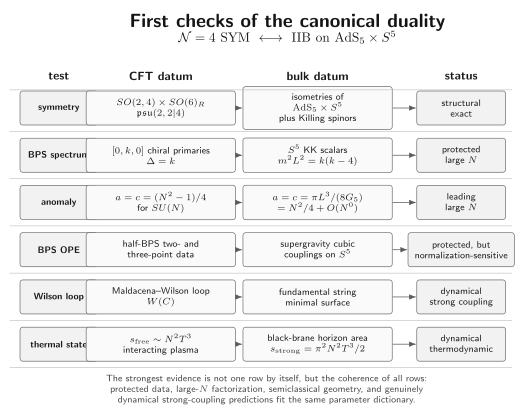
A compact evidence matrix for the canonical correspondence. Symmetries and protected data can be matched sharply; nonprotected observables such as Wilson loops and thermal entropy are strong-coupling predictions in the large- regime.
The goal of this page is not to prove the duality. A duality between complete quantum theories is not proved by checking a finite list of observables. The goal is to understand why the canonical example became compelling: many independent pieces of physics, each with different assumptions, fit the same dictionary.
What counts as a test?
Section titled “What counts as a test?”A useful test must compare the same observable on the two sides. In practice, this usually means one of the following.
| Type of check | CFT side | Bulk side | Strength |
|---|---|---|---|
| Symmetry | global and superconformal symmetries | spacetime isometries and Killing spinors | exact structural test |
| Parameter dictionary | , , | flux, radius, axio-dilaton, | exact up to conventions |
| Protected spectrum | short multiplets, chiral primaries | Kaluza-Klein supergravity modes | robust BPS test |
| Anomalies | , , R-symmetry anomalies | holographic renormalization | sharp large- test |
| Protected correlators | constrained two- and three-point functions | supergravity couplings | normalization-sensitive test |
| Nonlocal probes | Wilson and ‘t Hooft loops | strings and D-branes | strong-coupling prediction |
| Thermal physics | strongly coupled plasma | black branes | strong-coupling prediction |
The most common beginner mistake is to put all rows in the same box. They are not the same kind of evidence. The equality
is a protected large- comparison. The strong-coupling Wilson-loop potential
is not a weak-coupling equality. It is a prediction for the planar, large- gauge theory.
Symmetry matching
Section titled “Symmetry matching”The bosonic conformal group of a four-dimensional CFT in Lorentzian signature is
The isometry group of is also . This is not a loose analogy: the conformal transformations of the boundary are induced by bulk isometries acting on the conformal boundary of AdS.
The six real scalars of SYM transform under the R-symmetry group
The isometry group of the round is precisely
Thus the bosonic symmetry match is
The full match is stronger. The superconformal algebra of SYM is
with Poincaré supercharges and conformal supercharges. Type IIB string theory on with self-dual five-form flux preserves the same supersymmetries. In this sense the near-horizon D3-brane geometry has exactly the right enhanced symmetry to be dual to the superconformal theory on the branes.
This is a structural test, not a dynamical one. Many theories can share a symmetry group. The striking point is that the same symmetry group also organizes the spectrum, correlation functions, protected multiplets, and brane probes.
Parameter matching
Section titled “Parameter matching”The parameter dictionary derived earlier is itself a first test:
Each entry has a physical interpretation.
| CFT quantity | Bulk quantity | Meaning |
|---|---|---|
| flux through | rank equals D3-brane charge | |
| ’t Hooft coupling controls string-scale curvature | ||
| large- expansion controls bulk loops | ||
| complex gauge coupling equals IIB axio-dilaton | ||
| IIB S-duality | electric-magnetic duality maps to string duality |
The last row is conceptually important. The conjectured duality of SYM is naturally identified with type IIB S-duality. In particular, electric Wilson lines and magnetic ‘t Hooft lines are exchanged in the same way that fundamental strings and D1-strings are exchanged.
A useful way to remember the evidence is this:
The dictionary is overconstrained. The same that counts gauge degrees of freedom also fixes flux quantization, the five-dimensional Newton constant, the black-brane entropy, and the leading central charge.
Protected local operators and Kaluza-Klein modes
Section titled “Protected local operators and Kaluza-Klein modes”The simplest protected single-trace operators are chiral primaries built from the six adjoint scalars:
They transform in the symmetric traceless representation of , equivalently the representation
and their scaling dimensions are protected:
On the bulk side, the fields dual to these operators arise from Kaluza-Klein reduction of type IIB supergravity on . The relevant scalar modes have masses
Using the scalar mass-dimension relation in ,
one obtains
The physical branch for these chiral primaries gives
This is a much sharper check than merely matching dimensions. The same modes also carry the same quantum numbers, sit in the same short supermultiplets, and interact through couplings constrained by the same superconformal representation theory.
There is a small but important subtlety. Not every scalar harmonic on directly has mass . The chiral-primary supergravity modes are particular gauge-invariant mixtures of metric and five-form fluctuations. The mass formula above is the result after diagonalizing the Kaluza-Klein spectrum.
The stress-tensor multiplet
Section titled “The stress-tensor multiplet”The case is especially important. The operator
sits in the same short multiplet as the stress tensor, the currents, and the supersymmetry currents. On the bulk side, this corresponds to the massless five-dimensional gauged supergravity multiplet obtained from compactifying type IIB supergravity on .
For ,
which saturates the Breitenlohner-Freedman bound in :
The apparent negative mass is not an instability. It is exactly the value required for a dimension-two protected scalar in a four-dimensional CFT.
The stress tensor itself is dual to the bulk graviton:
and the currents are dual to the gauge fields descending from the isometries of :
This organizes a large fraction of the dictionary into one protected supermultiplet.
Central charges and Weyl anomalies
Section titled “Central charges and Weyl anomalies”Four-dimensional CFTs have Weyl-anomaly coefficients and . For SYM with gauge algebra ,
The equality follows from extended supersymmetry. The precise value can be computed from the free field content because these anomaly coefficients are protected.
On the gravity side, the same coefficients are extracted from the logarithmic divergence of the renormalized on-shell action in asymptotically gravity. For two-derivative Einstein gravity,
Using the canonical dictionary
we get
This matches the leading large- field-theory answer:
The missing is not mysterious. Classical supergravity computes the leading term. The correction comes from quantum effects in the bulk, including the difference between and the interacting sector.
This is one of the cleanest early tests because it connects three ideas at once:
Protected correlators
Section titled “Protected correlators”Conformal symmetry fixes the position dependence of two- and three-point functions of scalar primaries:
when , and
The nontrivial data are the normalization constants and OPE coefficients. For half-BPS operators, many of these coefficients are protected or strongly constrained. On the bulk side, they are computed from quadratic and cubic terms in the Kaluza-Klein reduced supergravity action.
Schematically, a cubic interaction
produces a Witten diagram whose coefficient is identified with the CFT OPE coefficient after choosing consistent normalizations.
This check is more delicate than the symmetry match. The operator normalization, spherical-harmonic normalization on , holographic counterterms, and multi-particle mixing all matter. Still, the agreement of protected two- and three-point data was one of the early signs that the dictionary was not just matching spectra but matching interactions.
Wilson loops and fundamental strings
Section titled “Wilson loops and fundamental strings”A Wilson loop is a nonlocal operator. In SYM the natural half-BPS Maldacena-Wilson loop couples both to the gauge field and to the scalars:
where is a unit vector in the scalar space. The bulk dual is a fundamental string worldsheet ending on the contour at the AdS boundary:
with
Since
the classical string action scales as . For a rectangular loop of temporal extent and spatial separation , one extracts the heavy-quark potential from
Classical string theory in gives
at leading order in large and large .
This result has the correct conformal scaling , but a strongly coupled coefficient proportional to . It is not an area law and therefore not confinement. The theory is conformal, so the potential must be Coulombic. The nontrivial prediction is the strong-coupling coefficient and its geometric origin as a minimal string worldsheet.
This is a good example of how AdS/CFT tests become predictions. The weak-coupling potential begins as a perturbative series in . The gravity result lives in the opposite regime, .
Thermal entropy and black branes
Section titled “Thermal entropy and black branes”Thermal SYM on is dual, at large and large , to the planar AdS black brane. The entropy density is computed from the horizon area:
The free-field entropy density of SYM is
At large the ratio is therefore
This was historically striking. The strong-coupling entropy is close to the free answer, but not equal to it. That is exactly what one should expect for a nonprotected thermodynamic quantity. The entropy changes with the ‘t Hooft coupling. The gravity calculation gives its limiting value at and .
The same black-brane geometry also predicts transport coefficients, quasinormal-mode spectra, screening lengths, and real-time response. Those are not protected checks; they are predictions for strongly coupled plasma physics. We will return to them in the finite-temperature and transport modules.
Absorption and greybody factors
Section titled “Absorption and greybody factors”Another early class of tests came from comparing absorption of bulk fields by D3-branes with correlation functions of worldvolume operators. For example, a dilaton fluctuation couples to a gauge-theory operator schematically of the form
The absorption cross section computed in supergravity is related to the imaginary part of a retarded two-point function in the brane theory. These calculations were important because they compared dynamical quantities, not just symmetry representations.
Conceptually, this is a precursor to modern real-time holography:
At finite temperature the same logic becomes the statement that infalling boundary conditions at a black-hole horizon compute retarded correlators in the thermal state.
Why protected tests are powerful
Section titled “Why protected tests are powerful”A protected quantity is not merely a quantity that happens to be simple. It is a quantity whose value is constrained by symmetry or topology strongly enough that it can be transported across coupling space.
For example, the dimension of a chiral primary is fixed by its R-charge. It cannot continuously drift with without violating shortening conditions. Thus the same number appears at weak coupling and in the supergravity Kaluza-Klein spectrum.
By contrast, the Konishi operator
is not protected. Its dimension is small at weak coupling but grows at strong coupling. In the bulk it is not a light supergravity mode; it belongs to the stringy spectrum. This is exactly what the parameter dictionary predicts: when
string excitations have masses of order
in AdS units, while protected supergravity modes remain light.
This gives a modern refinement of the original tests. The classical supergravity limit is not supposed to reproduce the entire finite-coupling CFT spectrum. It reproduces the low-dimension protected sector and the large- limit of unprotected observables whose bulk description stays within low-energy gravity.
What these tests do not prove
Section titled “What these tests do not prove”The first tests are impressive, but they have limitations.
First, symmetry matching alone is never enough. Many distinct theories can share the same symmetry algebra.
Second, protected data are special. They are excellent consistency checks, but they do not by themselves establish the full non-BPS spectrum or arbitrary finite- observables.
Third, classical supergravity probes only a corner of the full duality:
for low-energy bulk observables. Finite- physics requires stringy corrections. Finite- physics requires bulk loops and genuinely quantum gravity effects.
Fourth, the boundary gauge group and global form matter in refined questions. The interacting brane theory is usually taken to be , while the decoupled center-of-mass is not part of the interacting AdS throat. Line operators can also depend on the global form of the gauge group and on choices of boundary conditions for bulk gauge fields.
The right conclusion is therefore measured but strong:
The early tests show that the canonical dictionary is deeply overconstrained and internally coherent. They do not reduce the duality to a theorem, but they explain why it became a central nonperturbative definition of quantum gravity in AdS.
A useful hierarchy of evidence
Section titled “A useful hierarchy of evidence”When reading the literature, classify each claimed check by the regime in which it lives.
Level 1: exact structural matching
Section titled “Level 1: exact structural matching”Examples:
These are part of the architecture of the duality.
Level 2: protected quantitative matching
Section titled “Level 2: protected quantitative matching”Examples:
These can often be compared between weak field theory and strong-coupling gravity.
Level 3: semiclassical strong-coupling predictions
Section titled “Level 3: semiclassical strong-coupling predictions”Examples:
These are predictions in a controlled but nonperturbative CFT regime.
Level 4: full quantum-duality statements
Section titled “Level 4: full quantum-duality statements”Examples:
at finite and finite , including all stringy and quantum-gravity corrections. These are the deepest statements and usually cannot be checked by elementary supergravity calculations.
Common mistakes
Section titled “Common mistakes”Mistake 1: Comparing classical gravity to free field theory for nonprotected observables
Section titled “Mistake 1: Comparing classical gravity to free field theory for nonprotected observables”The entropy example teaches the rule. The free answer and strong-coupling answer need not agree:
at leading large . This is not a discrepancy. It is a strong-coupling prediction.
Mistake 2: Treating all supergravity matches as exact finite- matches
Section titled “Mistake 2: Treating all supergravity matches as exact finite-NNN matches”Classical supergravity gives the leading large- answer. For central charges,
is the leading part of
The difference is subleading in the bulk loop expansion.
Mistake 3: Forgetting that SYM is conformal
Section titled “Mistake 3: Forgetting that N=4\mathcal N=4N=4 SYM is conformal”The Wilson-loop potential behaves like , not like . The string worldsheet in AdS computes a strongly coupled Coulombic potential, not confinement.
Mistake 4: Confusing Kaluza-Klein modes with arbitrary string states
Section titled “Mistake 4: Confusing Kaluza-Klein modes with arbitrary string states”Protected KK modes are light at strong coupling. Generic string states are heavy in AdS units when . The supergravity spectrum is not the whole CFT spectrum.
Mistake 5: Ignoring normalization
Section titled “Mistake 5: Ignoring normalization”Agreement of correlators requires consistent normalizations of operators, spherical harmonics, kinetic terms, and Newton constants. Many apparent mismatches are convention mismatches.
Exercises
Section titled “Exercises”Exercise 1: The bosonic symmetry match
Section titled “Exercise 1: The bosonic symmetry match”Show that the bosonic symmetry group of the canonical duality is
Identify which factor comes from which side of the correspondence.
Solution
The conformal group of four-dimensional Minkowski space is , which is also the isometry group of . The R-symmetry of SYM rotates the six real scalars and is , which is also the isometry group of the round .
Thus
The full supersymmetric statement enhances this to the supergroup .
Exercise 2: Central charge from the Newton constant
Section titled “Exercise 2: Central charge from the Newton constant”Use
and
to compute the leading large- central charges. Compare with the exact field-theory result.
Solution
Substitution gives
The exact result is
The gravity result matches the leading term. The difference is an correction, so it is invisible in classical supergravity.
Exercise 3: Chiral primaries and the mass-dimension relation
Section titled “Exercise 3: Chiral primaries and the mass-dimension relation”A tower of scalar supergravity modes dual to chiral primaries has
Use the scalar relation
to show that the protected branch gives .
Solution
The mass-dimension equation becomes
This can be rewritten as
or
Thus
For the standard chiral-primary tower with , the physical protected branch is
For , the mass is , saturating the Breitenlohner-Freedman bound.
Exercise 4: The factor of
Section titled “Exercise 4: The factor of 3/43/43/4”The free-field entropy density of SYM at large is
The strong-coupling black-brane result is
Compute the ratio and explain why it is not a contradiction.
Solution
The ratio is
There is no contradiction because entropy is not protected. The free-field result is valid at , while the black-brane result is valid at and . The entropy can and does vary with the coupling.
Exercise 5: Protected versus unprotected operators
Section titled “Exercise 5: Protected versus unprotected operators”Explain why the chiral primary
is visible in classical supergravity, while the Konishi operator
is not a light supergravity mode at large .
Solution
The first operator is a half-BPS chiral primary. Its dimension is protected by the shortening condition of the superconformal algebra, so at all values of the coupling. It belongs to the protected Kaluza-Klein supergravity spectrum.
The Konishi operator is not protected. Its dimension receives anomalous corrections. At strong coupling it corresponds to a stringy excitation whose dimension grows parametrically like a positive power of , schematically at leading string scale. Since classical supergravity keeps only modes with masses of order , the Konishi operator is not part of the light supergravity spectrum.
Further reading
Section titled “Further reading”- Juan Maldacena, The Large Limit of Superconformal Field Theories and Supergravity.
- Ofer Aharony, Steven Gubser, Juan Maldacena, Hirosi Ooguri, and Yaron Oz, Large Field Theories, String Theory and Gravity.
- Marc Henningson and Kostas Skenderis, The Holographic Weyl Anomaly.
- Daniel Freedman, Samir Mathur, Alec Matusis, and Leonardo Rastelli, Correlation Functions in the CFT/AdS Correspondence.
- Juan Maldacena, Wilson Loops in Large Field Theories.
- Soo-Jong Rey and Jung-Tay Yee, Macroscopic Strings as Heavy Quarks.
- Steven Gubser, Igor Klebanov, and Amanda Peet, Entropy and Temperature of Black 3-Branes.