
18. Experimental Connections and Epistemic Limits
This final page has a different character from the previous ones. Earlier pages developed holographic mechanisms: quantum critical transport, charged black branes, EMD scaling geometries, incoherent metals, momentum relaxation, fermionic response, probe flavor, superconductivity, stripes, Hall response, anomalies, chaos, and nonequilibrium dynamics. This page asks the uncomfortable question that every serious application must eventually face:
What, exactly, can holography teach us about real quantum matter?
The answer is neither cynical nor naive. Holography is not a microscopic derivation of the cuprate phase diagram, graphene hydrodynamics, heavy-fermion criticality, or any other laboratory system. It is also not just a pretty analogy. It is a controlled framework for strongly coupled many-body dynamics in certain large- quantum systems, plus a disciplined model-building language for regimes where conventional quasiparticle methods are not obviously appropriate.
The goal of this page is to make that distinction precise. A trustworthy use of holography must say which part of a calculation is exact, which part is top-down but truncated, which part is bottom-up, which part is phenomenological, and which part is merely suggestive. The best holographic comparison to experiment is not a slogan such as “black holes describe strange metals.” It is a chain of reasoning:
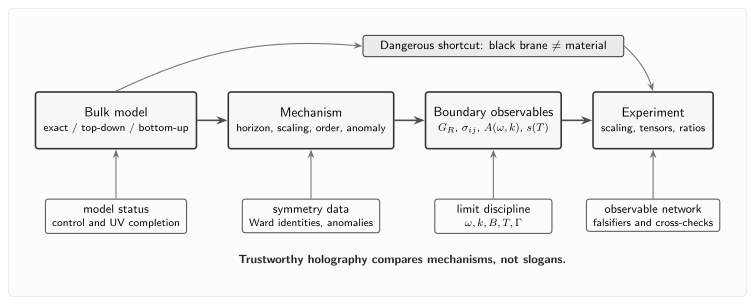
A responsible comparison begins with experimental observables, strips them down to low-energy data such as symmetries, conservation laws, dimensionality, density, temperature, and disorder, then chooses a holographic model with an explicit epistemic status. The model should return not only fits, but correlated predictions and failure modes.
Prerequisites and role of this page
Section titled “Prerequisites and role of this page”This page assumes the standard AdS/CFT dictionary and the previous pages. In particular, it uses the language of retarded Green’s functions, hydrodynamics, finite density, charged black branes, momentum relaxation, EMD scaling, fermionic spectral functions, superconducting instabilities, spatially modulated order, Hall response, anomaly-induced transport, chaos, and nonequilibrium dynamics.
The page does not assume detailed knowledge of any particular material. The point is structural: how should one connect holographic calculations to empirical systems without losing either mathematical control or physical honesty?
The central principle is:
Holography is most reliable when it identifies mechanisms, scaling structures, and constrained relations among observables, not when it is used as a one-parameter curve-fitting machine.
Four epistemic levels
Section titled “Four epistemic levels”When reading or writing holographic quantum matter papers, separate four levels of claim.
| Level | Meaning | Typical example | What can be claimed |
|---|---|---|---|
| Exact duality | A specific quantum theory is dual to a specific string/M-theory background | canonical supersymmetric AdS/CFT examples | Exact equality in principle; difficult observables may still be hard |
| Top-down model | A controlled truncation or brane construction inside string/M theory | probe flavor branes, consistent supergravity truncations | Strong internal consistency; field theory may still be unlike a material |
| Bottom-up model | A gravitational effective theory engineered to capture selected IR physics | Einstein—Maxwell—dilaton, axions, Q-lattices | Mechanism and scaling insight; UV completion may be unknown |
| Phenomenological analogy | A holographic result is compared to a material trend | linear- resistivity, Hall-angle scaling, Planckian rates | Suggestive comparison only; microscopic identification is not established |
The epistemic level is not a measure of usefulness. Bottom-up models can be extremely useful. Phenomenological analogies can inspire real progress. But the level controls what kind of conclusion is justified.
For example, if an EMD model produces
that is not by itself evidence that a given material is “described by EMD gravity.” It is evidence that a particular class of strongly coupled, momentum-relaxing, scale-covariant systems can realize linear resistivity. To connect this to experiment, one must ask which assumptions generated the scaling: charge density, entropy density, momentum relaxation, incoherent conductivity, hyperscaling violation, dangerously irrelevant couplings, disorder, lattice effects, or some combination.
What data can holography reasonably address?
Section titled “What data can holography reasonably address?”Holography is best suited to observables controlled by strongly coupled collective dynamics. It is not equally useful for all experimental quantities.
Thermodynamics
Section titled “Thermodynamics”Thermodynamic quantities are often the cleanest starting point:
and susceptibilities such as
A holographic geometry gives these quantities from horizon data and renormalized boundary data. Scaling geometries are especially useful because they relate multiple thermodynamic exponents. For example, in a spatially -dimensional hyperscaling-violating regime,
A comparison to experiment should not fit only this single exponent. It should ask whether the same and also organize charge response, heat capacity, optical conductivity, entanglement-like diagnostics, and the temperature dependence of other observables.
Transport
Section titled “Transport”Transport is where holography has had the most influence. The central observables are the electric, thermoelectric, and thermal conductivities:
A holographic model can compute these from retarded correlators or, in special DC limits, from horizon formulae. The key is to distinguish three mechanisms:
- momentum drag, where finite density and slow momentum relaxation produce a Drude-like contribution;
- incoherent transport, where a current orthogonal to momentum relaxes without waiting for momentum decay;
- pair creation or quantum critical transport, where charge response is intrinsic to the strongly coupled bath.
The common low-frequency structure is
but this formula is not a universal explanation of every metal. It assumes a hydrodynamic regime with one slow momentum mode and a well-defined relaxation rate . In strongly disordered or strongly incoherent regimes, the decomposition may cease to be the right language.
Spectral functions
Section titled “Spectral functions”Holography gives direct access to spectral functions:
This is especially useful when quasiparticles are absent. Instead of sharp poles near the real axis, the response is often organized by quasinormal modes. A holographic “non-Fermi liquid” is therefore primarily a statement about spectral response, not automatically about DC transport.
For fermions, the important diagnostic is whether the Green’s function near behaves like
If dominates over the analytic term, the excitation is not a Landau quasiparticle. But this does not by itself determine the resistivity. Transport requires current relaxation, vertex structure, momentum conservation, and the coupling of charge carriers to the rest of the system.
Ordered phases
Section titled “Ordered phases”Holography can describe order parameters by source-free vevs. The diagnostic is simple but crucial:
This applies to superconducting/superfluid order, charge density waves, helical phases, pair density waves, and other spontaneous phases. The most useful experimental comparisons are not only transition temperatures, but also collective modes, conductivities, pinning frequencies, optical weights, susceptibility, and competition or coexistence among orders.
Nonequilibrium dynamics
Section titled “Nonequilibrium dynamics”Holography is unusually powerful for nonequilibrium questions because classical gravity provides a nonlinear initial-boundary value problem. It can address thermalization, hydrodynamization, quench response, entropy production, horizon growth, and entanglement growth.
However, nonequilibrium comparison is delicate. A holographic quench usually describes a homogeneous, large-, strongly coupled system with specific sources. A laser-driven material has lattice effects, phonons, disorder, finite carrier density, long-range Coulomb forces, and microscopic bands. The comparison should focus on robust structures: scaling collapse, relaxation hierarchies, causality, conservation laws, and the separation between thermalization and hydrodynamization.
The danger of one-observable fitting
Section titled “The danger of one-observable fitting”A single power law is rarely enough.
Suppose an experiment observes
A holographic model may reproduce this through many different mechanisms:
| Mechanism | Schematic origin of | What else should be checked? |
|---|---|---|
| momentum relaxation | optical Drude width, thermopower, Hall response | |
| incoherent conductivity | small Drude weight, diffusivity, compressibility | |
| EMD scaling | horizon scaling laws | entropy, susceptibility, optical exponents |
| probe brane DBI | nonlinear flavor-sector dynamics | scaling, density dependence, nonlinear response |
| quantum criticality | no quasiparticles and | universality, scaling collapse, absence of long-lived modes |
The same observed exponent can come from different physics. Therefore the relevant question is not “Can holography fit the exponent?” but “Which correlated pattern of observables follows from the same mechanism?”
A good holographic comparison should predict at least one of the following beyond the fitted quantity:
- a relation between electric and thermal transport;
- a Hall-angle or magnetoresistance pattern;
- an optical conductivity crossover;
- a diffusion constant or susceptibility scaling;
- a collective mode dispersion;
- a spectral-function scaling form;
- an entropy or heat-capacity exponent;
- a relation between chaos diagnostics and transport;
- a phase-boundary or instability criterion.
Large : feature, limitation, and diagnostic
Section titled “Large NNN: feature, limitation, and diagnostic”The classical gravity limit corresponds to a large number of degrees of freedom. This has consequences.
Large suppresses quantum fluctuations of many single-trace operators. It also makes saddle-point geometry meaningful. This is why black branes can provide controlled thermodynamics and response functions. But ordinary materials do not have literal color degrees of freedom. They are finite-component systems with electrons, phonons, impurities, Coulomb interactions, and crystal structure.
This does not make holography useless. It means that holography is most compelling when it identifies IR structures insensitive to microscopic details. Examples include hydrodynamic constraints, Ward identities, horizon dissipation, quasinormal-mode relaxation, emergent scaling, and universal instability mechanisms.
Large becomes dangerous when one compares quantities that depend sensitively on fluctuations suppressed at large . Examples include:
- critical exponents near ordinary finite- thermal transitions;
- fluctuation-induced destruction of long-range order in low dimensions;
- disorder fluctuations beyond mean field;
- mesoscopic interference;
- true electron-counting constraints in finite-component systems;
- sharp quasiparticle features produced by small numbers of bands.
A useful rule is:
Use large- holography to understand strongly coupled collective dynamics. Be cautious when the phenomenon is controlled by finite- fluctuations, microscopic band structure, or weak disorder interference.
The role of hydrodynamics
Section titled “The role of hydrodynamics”Hydrodynamics is often the honest bridge between holography and experiments. It does not require a microscopic holographic dual. It requires only conservation laws, symmetries, thermodynamics, and a derivative expansion.
For example, at finite density with weak momentum relaxation,
This formula is not specifically holographic. Holography supplies examples where , , and can be computed in strongly coupled systems, and where their scaling can be nontrivial. But the formula itself is hydrodynamic. That is a virtue, not a weakness: hydrodynamic quantities are exactly the kind of quantities that can be compared across very different microscopic systems.
The best experimental uses of holography often look like this:
- identify the correct hydrodynamic variables;
- determine which quantities are conserved, weakly relaxed, or strongly relaxed;
- use holography to compute or motivate the strongly coupled coefficients;
- compare the full transport matrix, not only one element.
Case study I: graphene near charge neutrality
Section titled “Case study I: graphene near charge neutrality”Graphene near charge neutrality is a useful example because it has a relativistic-looking low-energy theory and can exhibit hydrodynamic electron flow. But it is not literally a large- holographic CFT with a classical Einstein gravity dual.
At charge neutrality, the current has reduced overlap with momentum. This allows an intrinsic conductivity analogous to quantum critical transport:
rather than being dominated entirely by momentum drag. The holographic lesson is not that graphene is a black brane. The lesson is that a strongly interacting relativistic fluid can have finite intrinsic conductivity, diffusion, viscosity, and collective response even without quasiparticles.
Responsible comparison asks:
- Is the system in a hydrodynamic regime?
- Are electron-electron scattering rates faster than impurity and phonon scattering rates?
- Are thermoelectric and viscosity signatures consistent with the same fluid picture?
- Do measured conductivities, diffusivities, and susceptibilities obey the expected hydrodynamic relations?
The holographic model provides a controlled extreme of strong coupling. Graphene provides a finite-component laboratory realization of related hydrodynamic principles.
Case study II: cuprate strange metals
Section titled “Case study II: cuprate strange metals”Cuprate strange metals are the most tempting and most dangerous target. They show striking phenomena: linear- resistivity, unconventional superconductivity, pseudogap physics, strong anisotropies, Hall-angle puzzles, optical anomalies, competing orders, and strong correlation effects.
Holography is relevant because it naturally produces compressible states without quasiparticles, short relaxation times, strong dissipation, superconducting instabilities, and scaling regimes. But no known simple holographic model is a microscopic dual of the cuprates.
A sober holographic question is not:
Is the cuprate strange metal a charged black brane?
The useful questions are:
- Can a strongly coupled finite-density bath produce linear- resistivity without quasiparticles?
- Can momentum relaxation and incoherent conductivity be separated experimentally?
- Can Hall angle, magnetoresistance, optical conductivity, and thermopower be organized by one scaling structure?
- Can superconducting order emerge as an instability of a non-Fermi-liquid metal?
- Can competing orders and spatial modulation appear naturally near the same regime?
- What data would rule out a proposed holographic mechanism?
This is the right level of claim: holography supplies mechanisms and consistency constraints, not a finished microscopic theory of the cuprates.
Case study III: heavy fermions and quantum critical metals
Section titled “Case study III: heavy fermions and quantum critical metals”Heavy-fermion compounds often exhibit quantum critical behavior, non-Fermi-liquid scaling, anomalous transport, and competition between magnetism and Kondo screening. They are not obviously large- holographic systems, but they raise questions that holography is built to address: what replaces quasiparticles at strong coupling, how local criticality appears, and how transport behaves when a Fermi surface interacts with a critical bath.
The throat of an extremal charged black brane is a useful warning and inspiration. It produces semi-local criticality: frequency scales but momentum may enter parametrically. This resembles some phenomenological ideas of local quantum criticality, but the analogy should not be overclaimed.
Good comparisons should ask whether the same scaling appears in:
and whether magnetic field, pressure, or doping tunes the system in a way compatible with the proposed critical structure.
Case study IV: Weyl semimetals and anomaly-induced transport
Section titled “Case study IV: Weyl semimetals and anomaly-induced transport”Weyl semimetals are a cleaner setting for some holographic ideas because anomalies impose robust constraints. The chiral anomaly gives an axial charge pumping equation of the schematic form
Together with constitutive relations, this can produce anomaly-induced longitudinal magnetoconductivity,
in an appropriate regime. Holography can model strongly coupled anomalous transport using bulk Chern—Simons terms and horizon dissipation.
Even here, comparison must be careful. Real Weyl semimetals have multiple nodes, lattice effects, disorder, current-jetting issues, orbital magnetoresistance, phonons, and finite intervalley relaxation. The anomaly is robust, but the measured conductivity is not only the anomaly.
The trustworthy claim is: holography gives controlled strongly coupled examples of anomaly-induced transport and topological phase transitions. It does not eliminate the need to separate anomaly physics from mundane transport channels.
What would count as real evidence?
Section titled “What would count as real evidence?”A holographic mechanism becomes compelling when it explains a structured set of observations with fewer assumptions than competing pictures.
Useful evidence includes:
1. Correlated scaling
Section titled “1. Correlated scaling”If a model predicts
then the exponents should not be fitted independently. They should be related by the same scaling structure.
2. Matrix consistency
Section titled “2. Matrix consistency”Transport should be compared as a matrix. A proposed mechanism for should also say something about , , , Hall response, and magnetoresistance when these are experimentally accessible.
3. Order-of-limits consistency
Section titled “3. Order-of-limits consistency”Holographic response functions often depend on limits such as
Experiments also have finite frequency, finite momentum, finite disorder, finite size, and finite field. A comparison that ignores order of limits may fit the wrong object.
4. Ward identities and conservation laws
Section titled “4. Ward identities and conservation laws”A model should satisfy the correct Ward identities. For example, in a finite-density system with exact translations, the DC electric conductivity is singular if and current overlaps with momentum. A finite measured conductivity then requires momentum relaxation, a probe-sector limit, charge neutrality, or another mechanism.
5. Failure modes
Section titled “5. Failure modes”A useful model says when it should fail. If a holographic mechanism predicts incoherent transport but the optical data show a narrow Drude peak with a long-lived quasiparticle-like relaxation time, then the model is not describing that regime.
What would count against a holographic interpretation?
Section titled “What would count against a holographic interpretation?”Several observations would not disprove holography in general, but would weaken a specific holographic mechanism.
- A sharp, long-lived quasiparticle peak controlling both spectral response and transport.
- Transport dominated by phonons or impurities in the relevant temperature window.
- A single fitted exponent with no correlated scaling among other observables.
- A proposed finite-density holographic metal with no account of momentum relaxation.
- A model requiring strong translation breaking when the sample is experimentally clean and hydrodynamic.
- A claimed topological response with no control of magnetization currents, contact terms, or current definitions.
- A superconducting comparison that ignores whether the boundary is global or gauged.
- An instability analysis that identifies a linear zero mode but never checks the nonlinear thermodynamic endpoint.
The point is not to police language. The point is to make the comparison scientific.
A practical comparison protocol
Section titled “A practical comparison protocol”When using holography to interpret a material or experiment, follow this protocol.
Step 1: Identify the regime
Section titled “Step 1: Identify the regime”Is the experiment probing equilibrium thermodynamics, DC transport, optical response, spectral functions, collective modes, magnetotransport, a phase transition, or nonequilibrium dynamics?
Step 2: List the slow variables
Section titled “Step 2: List the slow variables”Ask which quantities are conserved or slowly relaxed:
This determines whether hydrodynamics, memory matrix, incoherent transport, or a fully numerical holographic model is appropriate.
Step 3: Determine the symmetry data
Section titled “Step 3: Determine the symmetry data”Specify spatial dimension, rotational symmetry, translations, lattice symmetry, time reversal, parity, charge conjugation, magnetic field, anomalies, and whether symmetry breaking is explicit or spontaneous.
Step 4: Choose the minimal holographic model
Section titled “Step 4: Choose the minimal holographic model”Do not add fields just because they are available. Add fields because the boundary question requires them:
| Boundary ingredient | Bulk ingredient |
|---|---|
| stress tensor | metric |
| conserved charge | gauge field |
| relevant deformation | scalar source |
| running coupling / scaling | dilaton |
| momentum relaxation | axions, lattice, Q-lattice, disorder, massive gravity |
| charged order | charged scalar or vector |
| fermionic spectral probe | bulk spinor |
| anomaly | Chern—Simons term |
| flavor sector | probe brane / DBI action |
Step 5: Label the epistemic status
Section titled “Step 5: Label the epistemic status”State whether the model is exact, top-down, bottom-up, or phenomenological. If bottom-up, say which features are universal and which depend on the chosen action.
Step 6: Compare multiple observables
Section titled “Step 6: Compare multiple observables”Do not stop at . Compare the transport matrix, optical conductivity, susceptibilities, entropy, spectral response, collective modes, and field dependence if possible.
Step 7: State failure modes
Section titled “Step 7: State failure modes”A model that cannot fail is not a model. Say which observations would contradict the proposed mechanism.
Dimensionless ratios and cautious universality
Section titled “Dimensionless ratios and cautious universality”Holography is especially useful for dimensionless ratios. The famous example is
in a large class of two-derivative Einstein gravity duals. This result is powerful because it is not tied to a microscopic band structure. But even here, the correct statement includes caveats: higher-derivative corrections, anisotropy, broken translations, finite coupling corrections, and nonrelativistic settings can modify the relation.
Similarly, Planckian-looking timescales
are suggestive, but one must identify which relaxation time is being discussed: phase coherence, momentum relaxation, current relaxation, energy diffusion, chaos, or quasiparticle lifetime. These are not automatically the same quantity.
For chaos, holographic Einstein gravity often gives a Lyapunov exponent
but chaos diagnostics are not the same as transport coefficients. Relations such as
are useful organizing ideas only when their assumptions are specified.
The final epistemic rule
Section titled “The final epistemic rule”A good holographic paper or webpage should be able to finish the following sentences:
- The boundary phenomenon we want to understand is …
- The slow variables are …
- The symmetries are …
- The model’s epistemic status is …
- The universal part of the answer is …
- The model-dependent part is …
- The observables compared are …
- The prediction beyond the fit is …
- The result would fail if …
If those sentences cannot be completed, the comparison is probably not yet sharp enough.
Common pitfalls
Section titled “Common pitfalls”| Pitfall | Why it is wrong | Better statement |
|---|---|---|
| “Holography explains the cuprates.” | No accepted microscopic dual of the cuprates is known. | Holography provides mechanisms for non-quasiparticle transport and ordered instabilities. |
| “Linear- resistivity proves Planckian dissipation.” | One must identify the relaxation time and mechanism. | Linear resistivity is compatible with several mechanisms, including momentum relaxation and incoherent transport. |
| “A finite holographic DC conductivity means translations are broken.” | Probe sectors and charge-neutral systems can have finite intrinsic conductivity. | Check current-momentum overlap and the sector being measured. |
| “An throat means local quantum criticality in the material.” | is an IR feature of a model; real systems need additional evidence. | Compare spectral, thermodynamic, and transport scaling together. |
| “A holographic superconductor is automatically an electromagnetic superconductor.” | The boundary is usually global unless gauged. | The standard model is a superfluid unless boundary electromagnetism is added. |
| “Bottom-up means unreliable.” | Bottom-up models can isolate universal mechanisms. | Reliability depends on what is being claimed. |
| “Top-down means experimentally realistic.” | Top-down control does not imply material realism. | Top-down models are internally controlled but may describe exotic field theories. |
Exercises
Section titled “Exercises”Exercise 1: One exponent is not enough
Section titled “Exercise 1: One exponent is not enough”Suppose a material has over a decade in temperature. Give three distinct holographic or hydrodynamic mechanisms that could produce this behavior, and list one additional observable that would help distinguish each mechanism.
Solution
Three possible mechanisms are:
-
Momentum relaxation with . If
and the Drude term dominates, then . One should check the optical conductivity: a Drude-like peak should have width set by .
-
Incoherent conductivity with . If the Drude weight is small or momentum is strongly relaxed, the intrinsic conductivity can dominate. One should check whether thermoelectric response and diffusion are also governed by the same incoherent channel.
-
Scaling geometry with a temperature-dependent horizon formula. In an EMD or hyperscaling-violating regime, the horizon data may give under specific exponent choices. One should check entropy, susceptibility, and optical conductivity scaling to see whether the same and are consistent.
The lesson is that is a diagnostic, not a mechanism.
Exercise 2: Momentum conservation and infinite conductivity
Section titled “Exercise 2: Momentum conservation and infinite conductivity”Consider a finite-density translationally invariant system. Explain why exact momentum conservation generically produces a singular contribution to the electric conductivity. Then explain two ways to avoid this conclusion.
Solution
At finite density, the electric current usually overlaps with momentum. If momentum is conserved, an applied electric field accelerates the momentum density rather than producing a steady state. Hydrodynamically this gives
before including relaxation. The imaginary pole implies a delta function in the real part of the conductivity.
Two ways to avoid the singular DC conductivity are:
-
Break translations, explicitly or effectively, so that momentum relaxes at a rate . Then
-
Work at charge neutrality or in an incoherent sector, where the measured current has no overlap with momentum. Then the intrinsic conductivity can give a finite DC response even with exact translations.
A third possibility is a probe-sector limit, where the flavor current carries only a subleading fraction of the total momentum of the full system.
Exercise 3: Classifying claims
Section titled “Exercise 3: Classifying claims”Classify each claim as exact, top-down, bottom-up, or phenomenological.
- A D3/D7 probe-brane system at finite density has DBI dynamics for the flavor sector.
- An axion model with action gives finite DC conductivity.
- A cuprate strange metal is literally dual to a four-dimensional black brane.
- Type IIB string theory on is dual to super Yang—Mills theory.
Solution
-
Top-down model. The D3/D7 construction is embedded in string theory, though it is usually studied in a probe approximation and does not describe an ordinary material.
-
Bottom-up model. The axion model is an effective holographic model engineered to break translations and compute transport. It may have embeddings in special cases, but the generic use is bottom-up.
-
Phenomenological analogy, and too strong as stated. There is no accepted microscopic dual showing that a cuprate is literally a black brane. A better statement is that black-brane models can realize mechanisms relevant to strange-metal phenomenology.
-
Exact duality in principle. In practice, calculations are often performed in particular large- and large-coupling limits, but the statement is the canonical exact AdS/CFT proposal.
Exercise 4: Testing a hyperscaling-violating interpretation
Section titled “Exercise 4: Testing a hyperscaling-violating interpretation”A proposed IR regime in spatial dimensions has and . What entropy scaling does it predict? What additional measurement would you request before taking the interpretation seriously?
Solution
The entropy scaling is
Before taking the interpretation seriously, one should request additional observables governed by the same scaling regime. Examples include charge susceptibility, optical conductivity scaling, heat capacity, diffusion constants, or momentum-relaxation dependence. A single entropy exponent is not enough, because many mechanisms can produce the same power over a limited temperature window.
Exercise 5: Boundary gauging and superconductivity
Section titled “Exercise 5: Boundary gauging and superconductivity”Why is the standard bottom-up holographic superconductor more precisely a holographic superfluid? What extra ingredient is needed to describe an electromagnetic superconductor?
Solution
In the usual AdS/CFT dictionary, a bulk gauge field corresponds to a conserved global current in the boundary theory. Condensing a charged boundary operator spontaneously breaks a global symmetry, which is the definition of a superfluid. An electromagnetic superconductor requires the boundary to be dynamically gauged, so that the photon is a boundary dynamical field and the Meissner effect is meaningful. Without boundary gauging, the model can still have a delta function in conductivity and a Goldstone mode, but the strict electromagnetic interpretation is incomplete.
Summary
Section titled “Summary”Holographic quantum matter is powerful because it gives controlled examples of strongly coupled systems without quasiparticles, where transport, dissipation, order, entanglement, and nonequilibrium dynamics can be computed using classical gravity. It is most trustworthy when used to identify mechanisms and constrained relations among observables.
The main lesson of this page is epistemic discipline:
But the inequality is not a dismissal. It is precisely what makes holography useful. It provides a mathematically sharp extreme of strong coupling against which real quantum matter can be compared. The comparison becomes authoritative when it is explicit about symmetries, conservation laws, model status, observable predictions, and failure modes.
Further reading
Section titled “Further reading”For broader context on holographic quantum matter, consult Sean A. Hartnoll, Andrew Lucas, and Subir Sachdev, Holographic quantum matter. For a condensed-matter-oriented introduction, consult Jan Zaanen, Yan Liu, Ya-Wen Sun, and Koenraad Schalm, Holographic Duality in Condensed Matter Physics. For a textbook introduction to gauge/gravity duality and applications, consult Martin Ammon and Johanna Erdmenger, Gauge/Gravity Duality: Foundations and Applications.