Skip to content

Four-Point Functions and Cross-Ratios

Two- and three-point functions teach us the kinematics of conformal symmetry. Four-point functions are where conformal field theory becomes genuinely dynamical.

For scalar primaries, conformal symmetry fixes the two-point function up to normalizations and the three-point function up to OPE coefficients. But for four operators, conformal symmetry leaves a nontrivial function of two variables. That function is not a nuisance. It is the first place where the full interacting content of the CFT appears.

For AdS/CFT, this is a crucial transition:

two-point databulk spectrum and kinetic terms,three-point databulk cubic couplings,\boxed{ \text{two-point data} \leftrightarrow \text{bulk spectrum and kinetic terms}, \qquad \text{three-point data} \leftrightarrow \text{bulk cubic couplings}, }

while

four-point functionsbulk exchange diagrams, contact interactions, loops, and locality constraints.\boxed{ \text{four-point functions} \leftrightarrow \text{bulk exchange diagrams, contact interactions, loops, and locality constraints}. }

So this page is not merely about introducing uu and vv. It is about learning the language in which crossing symmetry, OPE associativity, conformal blocks, Witten diagrams, and eventually bulk locality all speak to each other.

Let Oi(xi)\mathcal O_i(x_i) be scalar primary operators in a Euclidean CFT on Rd\mathbb R^d. We write

xij2=(xixj)2.x_{ij}^2=(x_i-x_j)^2.

The two-point and three-point functions are highly constrained:

O1(x1)O2(x2)=C12δΔ1,Δ2(x122)Δ1,\langle \mathcal O_1(x_1)\mathcal O_2(x_2)\rangle = \frac{C_{12}\delta_{\Delta_1,\Delta_2}}{(x_{12}^2)^{\Delta_1}},

and

O1(x1)O2(x2)O3(x3)=C123(x122)Δ1+Δ2Δ32(x232)Δ2+Δ3Δ12(x312)Δ3+Δ1Δ22.\langle \mathcal O_1(x_1)\mathcal O_2(x_2)\mathcal O_3(x_3) \rangle = \frac{C_{123}} {(x_{12}^2)^{\frac{\Delta_1+\Delta_2-\Delta_3}{2}} (x_{23}^2)^{\frac{\Delta_2+\Delta_3-\Delta_1}{2}} (x_{31}^2)^{\frac{\Delta_3+\Delta_1-\Delta_2}{2}}}.

The constants C12C_{12} and C123C_{123} are CFT data after a choice of normalization. No arbitrary function appears.

For four points, the situation changes. There are conformally invariant combinations of the positions, so conformal symmetry cannot determine the full answer. Schematically,

O1(x1)O2(x2)O3(x3)O4(x4)=fixed powers of xij2×an arbitrary function of cross-ratios.\langle \mathcal O_1(x_1)\mathcal O_2(x_2)\mathcal O_3(x_3)\mathcal O_4(x_4) \rangle = \text{fixed powers of }x_{ij}^2 \times \text{an arbitrary function of cross-ratios}.

That arbitrary function contains infinitely many pieces of CFT data. Its singular limits encode OPEs. Its consistency under permutations gives crossing equations. Its large-NN structure tells us whether the theory can look like weakly coupled gravity in AdS.

A conformal transformation is a composition of translations, rotations, dilatations, and special conformal transformations. Translation invariance says a correlator can depend only on differences xixjx_i-x_j. Rotation invariance says scalar correlators can depend only on squared distances xij2x_{ij}^2. Scale invariance then says only dimensionless ratios of these distances may survive after extracting the required powers.

Special conformal transformations are the final constraint. Under

xμxμ=xμbμx212bx+b2x2,x^\mu \mapsto x^{\prime\mu} = \frac{x^\mu-b^\mu x^2}{1-2b\cdot x+b^2x^2},

one finds

xij2=xij2σiσj,σi=12bxi+b2xi2.\boxed{ {x_{ij}^{\prime}}^2 = \frac{x_{ij}^2}{\sigma_i\sigma_j}, \qquad \sigma_i=1-2b\cdot x_i+b^2x_i^2. }

Therefore the following two quantities are invariant:

u=x122x342x132x242,v=x142x232x132x242.\boxed{ u=\frac{x_{12}^2x_{34}^2}{x_{13}^2x_{24}^2}, \qquad v=\frac{x_{14}^2x_{23}^2}{x_{13}^2x_{24}^2}. }

The factors of σi\sigma_i cancel between numerator and denominator. These are the standard conformal cross-ratios.

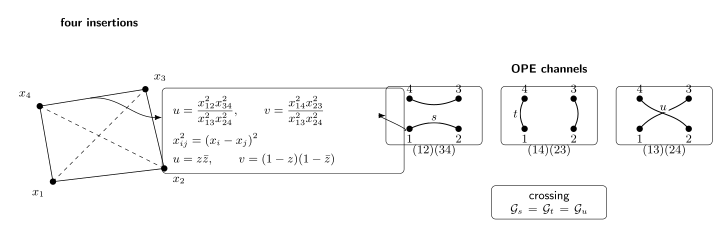
For four generic points in d2d\geq 2, there are two independent conformal invariants. In two dimensions, it is often more natural to use one complex cross-ratio zz and its antiholomorphic partner zˉ\bar z. In higher-dimensional Euclidean CFTs, one can also introduce z,zˉz,\bar z by

u=zzˉ,v=(1z)(1zˉ).\boxed{ u=z\bar z, \qquad v=(1-z)(1-\bar z). }

For Euclidean configurations, zz and zˉ\bar z are complex conjugates when the four points lie in a real two-plane. After Lorentzian continuation, they should be treated as independent variables living on different analytic sheets.

Four-point cross-ratios and OPE channels

Four scalar insertions have two independent conformal cross-ratios, uu and vv. Different OPE limits organize the same four-point function into different channels: (12)(34)(12)(34), (14)(23)(14)(23), and (13)(24)(13)(24). Crossing symmetry says that these decompositions describe the same correlator.

Let

Δij=ΔiΔj.\Delta_{ij}=\Delta_i-\Delta_j.

A convenient conformally covariant form for four scalar primaries is

O1(x1)O2(x2)O3(x3)O4(x4)=1(x122)Δ1+Δ22(x342)Δ3+Δ42(x242x142)Δ122(x142x132)Δ342G(u,v).\boxed{ \begin{aligned} &\left\langle \mathcal O_1(x_1)\mathcal O_2(x_2) \mathcal O_3(x_3)\mathcal O_4(x_4) \right\rangle \\[4pt] &\quad = \frac{1} {(x_{12}^2)^{\frac{\Delta_1+\Delta_2}{2}} (x_{34}^2)^{\frac{\Delta_3+\Delta_4}{2}}} \left(\frac{x_{24}^2}{x_{14}^2}\right)^{\frac{\Delta_{12}}{2}} \left(\frac{x_{14}^2}{x_{13}^2}\right)^{\frac{\Delta_{34}}{2}} \mathcal G(u,v). \end{aligned} }

The prefactor is conventional. It is chosen so that all nontrivial dependence is packaged into a dimensionless function G(u,v)\mathcal G(u,v). Other prefactors are equally valid, but they move simple powers of uu and vv between the prefactor and the reduced correlator.

For identical scalar primaries ϕ\phi of dimension Δ\Delta, the formula simplifies to

ϕ(x1)ϕ(x2)ϕ(x3)ϕ(x4)=G(u,v)(x122x342)Δ.\boxed{ \left\langle \phi(x_1)\phi(x_2)\phi(x_3)\phi(x_4) \right\rangle = \frac{\mathcal G(u,v)}{(x_{12}^2x_{34}^2)^\Delta}. }

This is the most important normalization for first contact with the conformal bootstrap.

The identity operator contribution in the 123412\to 34 channel is then simply

G(u,v)=1+,u0,v1.\mathcal G(u,v)=1+\cdots, \qquad u\to 0, \quad v\to 1.

Here the dots are contributions from nontrivial operators in the ϕ×ϕ\phi\times\phi OPE.

Cross-ratios become more transparent in a conformal frame. The conformal group can move four generic points into a two-dimensional plane and then fix three of them. A standard choice is

x10,x31,x4,x2z.x_1\to 0, \qquad x_3\to 1, \qquad x_4\to \infty, \qquad x_2\to z.

Then the two cross-ratios become

u=zzˉ,v=(1z)(1zˉ).\boxed{ u=z\bar z, \qquad v=(1-z)(1-\bar z). }

This frame is extremely useful, but it hides some symmetry. The four original points are all on equal footing. Choosing a conformal frame is like fixing a gauge: it is convenient, but the final answer must be expressible in terms of invariant data.

The main OPE limits are:

s channel: x1x2u0,v1,z,zˉ0,t channel: x2x3v0,u1,z,zˉ1,u channel: x1x3z,zˉafter a suitable frame choice.\begin{array}{ccl} \text{$s$ channel: } x_1\to x_2 &\Longleftrightarrow& u\to 0,\quad v\to 1,\quad z,\bar z\to 0,\\[4pt] \text{$t$ channel: } x_2\to x_3 &\Longleftrightarrow& v\to 0,\quad u\to 1,\quad z,\bar z\to 1,\\[4pt] \text{$u$ channel: } x_1\to x_3 &\Longleftrightarrow& z,\bar z\to \infty\quad \text{after a suitable frame choice.} \end{array}

The names s,t,us,t,u are borrowed from scattering theory. In a CFT, the channels are not scattering channels in flat spacetime, but the analogy is powerful: each channel corresponds to grouping the four operators into two OPE pairs.

For identical scalar operators, the four-point function must be invariant under permutations of the insertions. This gives functional equations for G(u,v)\mathcal G(u,v).

Using

ϕ1ϕ2ϕ3ϕ4=G(u,v)(x122x342)Δ,\left\langle \phi_1\phi_2\phi_3\phi_4 \right\rangle = \frac{\mathcal G(u,v)}{(x_{12}^2x_{34}^2)^\Delta},

exchange x1x3x_1\leftrightarrow x_3. The cross-ratios transform as

(u,v)(v,u).(u,v)\mapsto (v,u).

The prefactor changes, and equality of the correlator gives

G(u,v)=(uv)ΔG(v,u).\boxed{ \mathcal G(u,v) = \left(\frac{u}{v}\right)^\Delta \mathcal G(v,u). }

Another useful permutation is x1x2x_1\leftrightarrow x_2, under which

(u,v)(uv,1v),(u,v) \mapsto \left(\frac{u}{v},\frac1v\right),

and for a bosonic identical scalar one obtains

G(u,v)=G(uv,1v).\boxed{ \mathcal G(u,v)=\mathcal G\left(\frac{u}{v},\frac1v\right). }

These equations are simple to write and hard to solve. Their meaning is deep: the OPE must be associative.

In the ss channel one expands the product ϕ(x1)ϕ(x2)\phi(x_1)\phi(x_2) and separately ϕ(x3)ϕ(x4)\phi(x_3)\phi(x_4). In the tt channel one instead expands ϕ(x2)ϕ(x3)\phi(x_2)\phi(x_3) and ϕ(x1)ϕ(x4)\phi(x_1)\phi(x_4). Both procedures compute the same function. Crossing symmetry is the equality of these two expansions.

This is the conceptual heart of the conformal bootstrap.

The OPE of two identical scalars has the schematic form

ϕ(x1)ϕ(x2)OλϕϕOCO(x12,x2)O(x2),\phi(x_1)\phi(x_2) \sim \sum_{\mathcal O} \lambda_{\phi\phi\mathcal O} C_{\mathcal O}(x_{12},\partial_{x_2}) \mathcal O(x_2),

where the sum runs over primary operators and their descendants. Plugging this OPE into the four-point function gives an expansion of G(u,v)\mathcal G(u,v).

For identical scalars in a unitary CFT, the schematic conformal block expansion is

G(u,v)=Oϕ×ϕλϕϕO2GΔO,O(u,v).\boxed{ \mathcal G(u,v) = \sum_{\mathcal O\in \phi\times\phi} \lambda_{\phi\phi\mathcal O}^2 G_{\Delta_{\mathcal O},\ell_{\mathcal O}}(u,v). }

The functions GΔ,(u,v)G_{\Delta,\ell}(u,v) are conformal blocks. They are fixed by symmetry and encode the contribution of one primary operator together with all of its descendants. The coefficients λϕϕO2\lambda_{\phi\phi\mathcal O}^2 are nonnegative in a reflection-positive Euclidean CFT when ϕ\phi is real and the operators are normalized appropriately.

The identity operator contributes

G0,0(u,v)=1.G_{0,0}(u,v)=1.

A scalar primary of dimension ΔO\Delta_{\mathcal O} begins at small uu roughly as

GΔO,0(u,v)uΔO/2×a function of v,u0,G_{\Delta_{\mathcal O},0}(u,v) \sim u^{\Delta_{\mathcal O}/2} \times \text{a function of }v, \qquad u\to 0,

while a spin-\ell primary carries angular dependence controlled by SO(d)SO(d) representation theory.

We will study conformal blocks systematically later. For now, the point is this:

the four-point function is a generating function for the spectrum and OPE coefficients.\boxed{ \text{the four-point function is a generating function for the spectrum and OPE coefficients.} }

The crossing equation becomes a nontrivial constraint on those data:

Os-channelλϕϕO2GΔ,(u,v)=(uv)ΔOt-channelλϕϕO2GΔ,(v,u).\sum_{\mathcal O\in s\text{-channel}} \lambda_{\phi\phi\mathcal O}^2 G_{\Delta,\ell}(u,v) = \left(\frac{u}{v}\right)^\Delta \sum_{\mathcal O\in t\text{-channel}} \lambda_{\phi\phi\mathcal O}^2 G_{\Delta,\ell}(v,u).

For identical scalars, the set of exchanged operators is the same on both sides, but the functions are evaluated in different channels.

A very important benchmark is a generalized free field. Let ϕ\phi be a scalar operator with unit-normalized two-point function

ϕ(x)ϕ(0)=1(x2)Δ.\langle \phi(x)\phi(0)\rangle=\frac1{(x^2)^\Delta}.

A generalized free field has Wick-like factorization of higher-point functions, even though it need not come from a free local Lagrangian. Its four-point function is

ϕ1ϕ2ϕ3ϕ4GFF=1(x122x342)Δ+1(x132x242)Δ+1(x142x232)Δ.\langle \phi_1\phi_2\phi_3\phi_4 \rangle_{\mathrm{GFF}} = \frac1{(x_{12}^2x_{34}^2)^\Delta} + \frac1{(x_{13}^2x_{24}^2)^\Delta} + \frac1{(x_{14}^2x_{23}^2)^\Delta}.

Therefore, in our reduced normalization,

GGFF(u,v)=1+uΔ+(uv)Δ.\boxed{ \mathcal G_{\mathrm{GFF}}(u,v) = 1+u^\Delta+\left(\frac{u}{v}\right)^\Delta. }

This formula is one of the fastest ways to see why generalized free fields are central to holography. In a large-NN CFT, single-trace operators often behave at leading order like generalized free fields:

G(u,v)=GGFF(u,v)+1NpGconn(u,v)+.\mathcal G(u,v) = \mathcal G_{\mathrm{GFF}}(u,v) + \frac1{N^p}\mathcal G_{\mathrm{conn}}(u,v) + \cdots.

The disconnected terms describe free propagation of noninteracting bulk particles. The connected term is where bulk interactions begin. In a semiclassical AdS dual, Gconn\mathcal G_{\mathrm{conn}} is computed by tree-level Witten diagrams: exchange diagrams plus contact diagrams.

Suppose O\mathcal O is a single-trace scalar primary in a large-NN CFT, normalized so that

O(x)O(0)N0.\langle \mathcal O(x)\mathcal O(0)\rangle\sim N^0.

Large-NN factorization says

O1O2O3O4=O1O2O3O4+O1O3O2O4+O1O4O2O3+O1O2O3O4conn.\langle \mathcal O_1\mathcal O_2\mathcal O_3\mathcal O_4 \rangle = \langle\mathcal O_1\mathcal O_2\rangle \langle\mathcal O_3\mathcal O_4\rangle + \langle\mathcal O_1\mathcal O_3\rangle \langle\mathcal O_2\mathcal O_4\rangle + \langle\mathcal O_1\mathcal O_4\rangle \langle\mathcal O_2\mathcal O_3\rangle + \langle\mathcal O_1\mathcal O_2\mathcal O_3\mathcal O_4\rangle_{\mathrm{conn}}.

Usually

OOOOconnOOOO\langle\mathcal O\mathcal O\mathcal O\mathcal O\rangle_{\mathrm{conn}} \ll \langle\mathcal O\mathcal O\rangle\langle\mathcal O\mathcal O\rangle

at large NN. The leading disconnected answer is generalized free. The first correction encodes anomalous dimensions and OPE coefficients of double-trace operators

[OO]n,O2n{μ1μ}Otraces,[\mathcal O\mathcal O]_{n,\ell} \sim \mathcal O\,\partial^{2n}\partial_{\{\mu_1}\cdots\partial_{\mu_\ell\}}\mathcal O - \text{traces},

with approximate dimensions

Δn,(0)=2Δ+2n+.\Delta_{n,\ell}^{(0)}=2\Delta+2n+\ell.

Interactions shift these dimensions:

Δn,=2Δ+2n++1Npγn,+.\Delta_{n,\ell} = 2\Delta+2n+\ell+\frac1{N^p}\gamma_{n,\ell}+\cdots.

In AdS, these double-trace operators are two-particle states. Their anomalous dimensions are boundary measurements of bulk interactions.

The most important information in a four-point function often appears in its singular limits.

The ss-channel OPE limit is

x1x2,u0,v1.x_1\to x_2, \qquad u\to 0, \qquad v\to 1.

This limit reveals which operators appear in ϕ×ϕ\phi\times\phi. Operators of smaller dimension dominate. For example, the identity contribution gives 11, while a scalar primary O\mathcal O of dimension ΔO\Delta_{\mathcal O} contributes at order uΔO/2u^{\Delta_{\mathcal O}/2}.

In Lorentzian signature, one can take one cross-ratio small while keeping the other fixed or small in a different way. A basic lightcone limit is

u0,u1v1.u\to 0, \qquad u \ll 1-v \ll 1.

Such limits are the entry point to the lightcone bootstrap. They imply the existence of large-spin double-twist operators and are closely related to the emergence of locality in AdS.

After analytic continuation around branch points in z,zˉz,\bar z, one obtains Lorentzian Regge limits. These limits probe high-energy bulk scattering in AdS and are constrained by causality and chaos bounds. The same Euclidean function G(u,v)\mathcal G(u,v) therefore contains much more than Euclidean geometry: its analytic continuation knows about Lorentzian dynamics.

Four-point functions are the natural meeting point of CFT bootstrap and AdS dynamics.

A tree-level AdS four-point function has two broad types of contributions:

contact Witten diagramlocal bulk quartic interaction,\boxed{ \text{contact Witten diagram} \quad\Longleftrightarrow\quad \text{local bulk quartic interaction}, }

and

exchange Witten diagrambulk field exchanged between two pairs of boundary insertions.\boxed{ \text{exchange Witten diagram} \quad\Longleftrightarrow\quad \text{bulk field exchanged between two pairs of boundary insertions}. }

On the CFT side, the same answer must admit an OPE expansion in every channel. Thus a single AdS diagram is not merely a Feynman-like object; it must be compatible with conformal block decompositions and crossing symmetry.

The dictionary is:

single-trace exchangesingle-particle bulk field,double-trace towertwo-particle bulk states,anomalous dimensions γn,bulk interactions,crossing symmetryconsistent factorization of the same bulk process,large-spin behaviorbulk locality and long-distance propagation.\begin{array}{ccl} \text{single-trace exchange} &\leftrightarrow& \text{single-particle bulk field},\\[3pt] \text{double-trace tower} &\leftrightarrow& \text{two-particle bulk states},\\[3pt] \text{anomalous dimensions }\gamma_{n,\ell} &\leftrightarrow& \text{bulk interactions},\\[3pt] \text{crossing symmetry} &\leftrightarrow& \text{consistent factorization of the same bulk process},\\[3pt] \text{large-spin behavior} &\leftrightarrow& \text{bulk locality and long-distance propagation}. \end{array}

This is why four-point functions are a central object in modern holography. A CFT with a sparse large-NN spectrum and appropriately behaved four-point functions can look like a local gravitational theory in AdS. A CFT whose four-point functions violate the expected analyticity, positivity, or large-spin constraints cannot.

There are several common notational choices. They are all equivalent, but mixing them carelessly causes many wrong factors.

One convention uses xij=xixjx_{ij}=|x_i-x_j| and writes powers of xijx_{ij} directly. This page uses xij2x_{ij}^2 and therefore many exponents include factors of 1/21/2.

Another convention defines

ϕ1ϕ2ϕ3ϕ4=1(x122x342)ΔG(u,v),\langle\phi_1\phi_2\phi_3\phi_4\rangle = \frac{1}{(x_{12}^2x_{34}^2)^\Delta} \mathcal G(u,v),

while another defines a symmetrized object F(u,v)\mathcal F(u,v) by extracting additional powers of uu and vv. The crossing equation changes form under this redefinition, but the physical content is unchanged.

In two-dimensional CFT, one often writes

ϕ1(z1,zˉ1)ϕ4(z4,zˉ4)=fixed powers×F(z,zˉ),\langle \phi_1(z_1,\bar z_1)\cdots\phi_4(z_4,\bar z_4) \rangle = \text{fixed powers} \times \mathcal F(z,\bar z),

where

z=z12z34z13z24,zˉ=zˉ12zˉ34zˉ13zˉ24.z=\frac{z_{12}z_{34}}{z_{13}z_{24}}, \qquad \bar z=\frac{\bar z_{12}\bar z_{34}}{\bar z_{13}\bar z_{24}}.

For a 2D CFT, zz and zˉ\bar z are especially powerful because the global conformal group factorizes into holomorphic and antiholomorphic pieces, and the local conformal symmetry enhances this further to Virasoro symmetry.

The four-point function is the first CFT correlator with an undetermined function:

O1O2O3O4=kinematic prefactor×G(u,v).\boxed{ \langle \mathcal O_1\mathcal O_2\mathcal O_3\mathcal O_4\rangle = \text{kinematic prefactor}\times \mathcal G(u,v). }

The two cross-ratios are

u=x122x342x132x242,v=x142x232x132x242.\boxed{ u=\frac{x_{12}^2x_{34}^2}{x_{13}^2x_{24}^2}, \qquad v=\frac{x_{14}^2x_{23}^2}{x_{13}^2x_{24}^2}. }

The OPE decomposes G(u,v)\mathcal G(u,v) into conformal blocks. Crossing symmetry equates different decompositions. In large-NN holographic CFTs, the disconnected part is generalized free, while the connected part encodes bulk interactions.

So the real lesson is:

Four-point functions are where CFT data becomes dynamical geometry.\boxed{ \text{Four-point functions are where CFT data becomes dynamical geometry.} }

Use

xij2=xij2σiσj{x_{ij}^{\prime}}^2 = \frac{x_{ij}^2}{\sigma_i\sigma_j}

under a special conformal transformation to show that

u=x122x342x132x242,v=x142x232x132x242 u=\frac{x_{12}^2x_{34}^2}{x_{13}^2x_{24}^2}, \qquad v=\frac{x_{14}^2x_{23}^2}{x_{13}^2x_{24}^2}

are invariant.

Solution

Under the transformation,

x122x342=x122x342σ1σ2σ3σ4,{x_{12}^{\prime}}^2{x_{34}^{\prime}}^2 = \frac{x_{12}^2x_{34}^2}{\sigma_1\sigma_2\sigma_3\sigma_4},

and

x132x242=x132x242σ1σ3σ2σ4.{x_{13}^{\prime}}^2{x_{24}^{\prime}}^2 = \frac{x_{13}^2x_{24}^2}{\sigma_1\sigma_3\sigma_2\sigma_4}.

The same product σ1σ2σ3σ4\sigma_1\sigma_2\sigma_3\sigma_4 appears in numerator and denominator, so it cancels:

u=x122x342x132x242=x122x342x132x242=u.u' = \frac{{x_{12}^{\prime}}^2{x_{34}^{\prime}}^2}{{x_{13}^{\prime}}^2{x_{24}^{\prime}}^2} = \frac{x_{12}^2x_{34}^2}{x_{13}^2x_{24}^2} =u.

The same calculation gives

v=x142x232x132x242=x142x232x132x242=v.v' = \frac{{x_{14}^{\prime}}^2{x_{23}^{\prime}}^2}{{x_{13}^{\prime}}^2{x_{24}^{\prime}}^2} = \frac{x_{14}^2x_{23}^2}{x_{13}^2x_{24}^2} =v.

Thus uu and vv are conformal invariants.

Exercise 2. Crossing under x1x3x_1\leftrightarrow x_3

Section titled “Exercise 2. Crossing under x1↔x3x_1\leftrightarrow x_3x1​↔x3​”

For an identical scalar ϕ\phi of dimension Δ\Delta, define

ϕ1ϕ2ϕ3ϕ4=G(u,v)(x122x342)Δ.\langle\phi_1\phi_2\phi_3\phi_4\rangle = \frac{\mathcal G(u,v)}{(x_{12}^2x_{34}^2)^\Delta}.

Show that exchanging x1x_1 and x3x_3 gives

G(u,v)=(uv)ΔG(v,u).\mathcal G(u,v)=\left(\frac{u}{v}\right)^\Delta\mathcal G(v,u).
Solution

Under x1x3x_1\leftrightarrow x_3, the cross-ratios exchange:

(u,v)(v,u).(u,v)\mapsto (v,u).

The correlator can therefore also be written as

ϕ3ϕ2ϕ1ϕ4=G(v,u)(x322x142)Δ=G(v,u)(x232x142)Δ.\langle\phi_3\phi_2\phi_1\phi_4\rangle = \frac{\mathcal G(v,u)}{(x_{32}^2x_{14}^2)^\Delta} = \frac{\mathcal G(v,u)}{(x_{23}^2x_{14}^2)^\Delta}.

Since the fields are identical bosonic scalars, the correlator is unchanged by the permutation. Therefore

G(u,v)(x122x342)Δ=G(v,u)(x232x142)Δ.\frac{\mathcal G(u,v)}{(x_{12}^2x_{34}^2)^\Delta} = \frac{\mathcal G(v,u)}{(x_{23}^2x_{14}^2)^\Delta}.

Multiplying by (x122x342)Δ(x_{12}^2x_{34}^2)^\Delta gives

G(u,v)=(x122x342x232x142)ΔG(v,u).\mathcal G(u,v) = \left( \frac{x_{12}^2x_{34}^2}{x_{23}^2x_{14}^2} \right)^\Delta \mathcal G(v,u).

But

x122x342x232x142=uv.\frac{x_{12}^2x_{34}^2}{x_{23}^2x_{14}^2} = \frac{u}{v}.

Hence

G(u,v)=(uv)ΔG(v,u).\mathcal G(u,v)=\left(\frac{u}{v}\right)^\Delta\mathcal G(v,u).

Exercise 3. Generalized free four-point function

Section titled “Exercise 3. Generalized free four-point function”

Assume

ϕ(x)ϕ(0)=1(x2)Δ\langle\phi(x)\phi(0)\rangle=\frac1{(x^2)^\Delta}

and Wick-like factorization. Show that

GGFF(u,v)=1+uΔ+(uv)Δ.\mathcal G_{\mathrm{GFF}}(u,v) = 1+u^\Delta+\left(\frac{u}{v}\right)^\Delta.
Solution

Wick-like factorization gives three pairings:

ϕ1ϕ2ϕ3ϕ4=1(x122)Δ(x342)Δ+1(x132)Δ(x242)Δ+1(x142)Δ(x232)Δ.\langle\phi_1\phi_2\phi_3\phi_4\rangle = \frac1{(x_{12}^2)^\Delta(x_{34}^2)^\Delta} + \frac1{(x_{13}^2)^\Delta(x_{24}^2)^\Delta} + \frac1{(x_{14}^2)^\Delta(x_{23}^2)^\Delta}.

Factor out (x122x342)Δ(x_{12}^2x_{34}^2)^{-\Delta}:

ϕ1ϕ2ϕ3ϕ4=1(x122x342)Δ[1+(x122x342x132x242)Δ+(x122x342x142x232)Δ].\langle\phi_1\phi_2\phi_3\phi_4\rangle = \frac1{(x_{12}^2x_{34}^2)^\Delta} \left[ 1+ \left(\frac{x_{12}^2x_{34}^2}{x_{13}^2x_{24}^2}\right)^\Delta + \left(\frac{x_{12}^2x_{34}^2}{x_{14}^2x_{23}^2}\right)^\Delta \right].

The second term is uΔu^\Delta. For the third term,

x122x342x142x232=uv.\frac{x_{12}^2x_{34}^2}{x_{14}^2x_{23}^2} = \frac{u}{v}.

Thus

GGFF(u,v)=1+uΔ+(uv)Δ.\mathcal G_{\mathrm{GFF}}(u,v) = 1+u^\Delta+\left(\frac{u}{v}\right)^\Delta.

Exercise 4. Cross-ratios in the conformal frame

Section titled “Exercise 4. Cross-ratios in the conformal frame”

In the conformal frame

x1=0,x2=z,x3=1,x4=,x_1=0, \qquad x_2=z, \qquad x_3=1, \qquad x_4=\infty,

show that

u=zzˉ,v=(1z)(1zˉ).u=z\bar z, \qquad v=(1-z)(1-\bar z).
Solution

Treat the point at infinity by taking x4=Rx_4=R and sending RR\to\infty. In complex notation,

x122=z2=zzˉ,x132=1,x_{12}^2=|z|^2=z\bar z, \qquad x_{13}^2=1,

and for large RR,

x342R2,x242R2.x_{34}^2\sim R^2, \qquad x_{24}^2\sim R^2.

Therefore

u=x122x342x132x242zzˉ.u = \frac{x_{12}^2x_{34}^2}{x_{13}^2x_{24}^2} \to z\bar z.

Similarly,

x232=z12=(1z)(1zˉ),x142R2,x_{23}^2=|z-1|^2=(1-z)(1-\bar z), \qquad x_{14}^2\sim R^2,

while

x132=1,x242R2.x_{13}^2=1, \qquad x_{24}^2\sim R^2.

Thus

v=x142x232x132x242(1z)(1zˉ).v = \frac{x_{14}^2x_{23}^2}{x_{13}^2x_{24}^2} \to (1-z)(1-\bar z).