
The DBI Action and D-Brane Worldvolume Fields
A D-brane is a dynamical object, not a rigid boundary condition. Its low-energy fields are precisely the massless open-string modes living on it: a gauge field tangent to the brane and scalar fields describing transverse motion. The nonlinear action that organizes these fields is the Dirac—Born—Infeld action, usually abbreviated DBI.
The main result is that a single D-brane moving in a background is described, to lowest order in derivatives but to all orders in a slowly varying field strength, by
Here , , are worldvolume coordinates, is the embedding of the brane into spacetime, denotes pullback to the brane, and is the field strength of the open-string gauge field. The constant
is the RR charge normalization in common string-frame conventions. In a flat background with constant dilaton , the physical D-brane tension is
This scaling is one of the first signs that D-branes are nonperturbative from the viewpoint of closed-string perturbation theory, even though their excitations are ordinary perturbative open strings.
Embedding fields and pullbacks
Section titled “Embedding fields and pullbacks”A D-brane sweeps out a -dimensional worldvolume. Choose local coordinates
and describe the embedding by spacetime functions
The pullback metric is
Similarly,
The DBI action is invariant under reparametrizations of the brane worldvolume. A convenient gauge for a nearly flat brane is static gauge:
The fields are the transverse displacement fields. In flat spacetime,
It is often useful to define canonically normalized scalar fields up to the gauge-coupling normalization by
The reason for the factor is T-duality: a gauge component along a compact direction becomes a transverse scalar after duality, and in the abelian case.
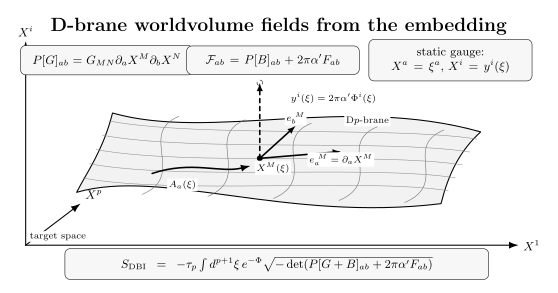
The worldvolume fields of a D-brane have a geometric interpretation. The gauge field lives tangentially on the brane, while scalar fields describe transverse fluctuations of the embedding.
The analogy with the Nambu—Goto action is immediate. If and , the DBI action becomes
This is exactly the Nambu—Goto action, but with the D-string tension
Thus a D1-brane is a stringlike object, but it is heavier than a fundamental string at weak coupling.
Why the combination appears
Section titled “Why the combination B+2πα′FB+2\pi\alpha' FB+2πα′F appears”The appearance of
is not an arbitrary aesthetic choice. It is forced by gauge invariance of the open-string worldsheet.
An open string ending on a D-brane couples to the NS—NS two-form through the bulk term
and to the brane gauge field through the boundary term
Under the -field gauge transformation
the bulk term shifts by a boundary contribution. The boundary term cancels it if
Therefore
is gauge invariant. The DBI determinant must be built from this combination.
This is also visible directly in the open-string boundary condition. In a flat background with constant and , the variation of the worldsheet action gives, along Neumann directions,
The endpoint does not see and separately; it sees .
The flat-space DBI action
Section titled “The flat-space DBI action”In flat spacetime with and constant dilaton, static gauge gives
Equivalently, using ,
This expression contains several important physical effects at once.
First, the constant term is the brane tension:
Second, the determinant resums all powers of the field strength for slowly varying fields. It is not merely Maxwell theory; it is a nonlinear theory with a maximum electric field.
Third, the scalar fields are on the same footing as the gauge field. This is a consequence of T-duality. Gauge components in directions that become transverse turn into brane-position fields.
Expansion and the Yang—Mills limit
Section titled “Expansion and the Yang—Mills limit”At energies much smaller than the string scale, the fields are weak and slowly varying. Expanding the determinant gives the familiar kinetic terms.
For a small matrix ,
Since is antisymmetric, it has no linear trace. To quadratic order in flat space,
In terms of this becomes
Thus the abelian gauge coupling on a single D-brane is determined by
Using the physical tension , one obtains
For , this coupling is dimensionless. Depending on the normalization of nonabelian generators, this formula is often written with an additional factor of ; the invariant statement is that the D3-brane gauge coupling is proportional to .
The low-energy approximation has two separate restrictions:
for the Yang—Mills truncation. The full DBI action relaxes the second condition for abelian constant fields, but not the first: derivative corrections still appear at higher orders in .
Coincident branes and matrix-valued scalars
Section titled “Coincident branes and matrix-valued scalars”For coincident D-branes, the massless open strings carry Chan—Paton labels . The worldvolume fields become matrices:
At low energy the theory is the dimensional reduction of ten-dimensional super-Yang—Mills to dimensions. Its bosonic terms are
Here
and
The scalar potential is nonnegative when written as
For Hermitian matrices, the commutator is anti-Hermitian, so the minus sign makes the energy positive. The classical moduli space satisfies
The matrices can then be simultaneously diagonalized:
The eigenvalues are brane positions,
Off-diagonal fields are open strings stretched between different branes. When the branes separate, these fields become massive, just as in the stretched-string formula.
The fully nonabelian DBI action is more subtle than simply replacing ordinary products by matrix products. The symmetrized-trace prescription captures part of the answer for slowly varying fields, but commutator and derivative corrections are important in general. The low-energy Yang—Mills action above is the reliable universal limit.
D-branes as objects with tension proportional to
Section titled “D-branes as objects with tension proportional to 1/gs1/g_s1/gs”The tension formula
is worth comparing with other objects:
The fundamental string has tension independent of . D-branes are heavier by one power of . Classical solitons of closed-string effective field theory, such as some NS—NS objects, are heavier by .
This intermediate scaling is exactly what makes D-branes special. They are nonperturbative from the closed-string viewpoint, but their internal dynamics is captured by weakly coupled open strings when is small.
T-duality is consistent with the tension formula. Compactify a D-brane along a circle of radius and T-dualize along that circle. The wrapped brane mass contains a factor . The dual brane has dimension and the dual coupling is
Then
as required.
Electric flux and fundamental strings bound to a D-string
Section titled “Electric flux and fundamental strings bound to a D-string”The DBI square root has a particularly clear interpretation for a D1-brane with electric field. Let
For a straight D-string in flat space,
The canonical electric displacement is
The Hamiltonian density is
Because the worldvolume gauge field is compact, the integrated electric displacement is quantized. A uniform electric flux carrying units of fundamental-string charge has
Therefore the tension is
This is the tension of a bound state of one D-string and fundamental strings at vanishing RR axion. In the weak-coupling limit, the D-string is heavy, but the electric flux records the dissolved F-string charge.
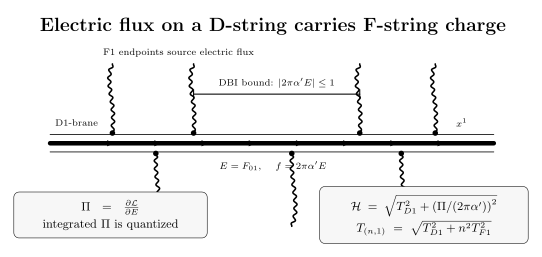
Electric flux on a D-string is not just an electromagnetic decoration. Its canonical displacement is quantized and measures fundamental-string charge dissolved in the D-string worldvolume.
The upper bound is the DBI version of a critical electric field. As , the electric displacement diverges, meaning that the D-string carries an increasingly large number of F-strings.
Couplings to closed-string fields
Section titled “Couplings to closed-string fields”The DBI action also tells us how a D-brane sources closed-string fields. Expand the background fields around flat space:
At linear order, the D-brane couples to the graviton, dilaton, and two-form through the expansion of
For example, a static flat brane has a coupling to the graviton proportional to its stress tensor:
The coupling to the antisymmetric field appears through . These linear couplings are the field-theory limit of disk amplitudes with one closed-string vertex operator and any number of open-string insertions.
The Ramond—Ramond couplings are not contained in the DBI action. They are described by a separate Wess—Zumino term, which will become essential for understanding D-brane charge:
For now, the important point is that the DBI action encodes the NS—NS couplings and the nonlinear dynamics of the brane’s open-string fields.
Open-string tachyon condensation
Section titled “Open-string tachyon condensation”The bosonic open string has a tachyon, and non-BPS D-branes or brane—antibrane systems in superstring theory also contain tachyonic open strings. The DBI action above describes stable BPS branes; unstable branes require an additional tachyon field .
A useful schematic form is
The qualitative physics is the crucial part. At the unstable D-brane exists and its energy density is the brane tension. As the tachyon condenses, the system rolls toward a vacuum in which the brane has disappeared:
Equivalently, if the tachyon potential is measured relative to the original closed-string vacuum, the negative tachyon vacuum energy cancels the positive D-brane tension.
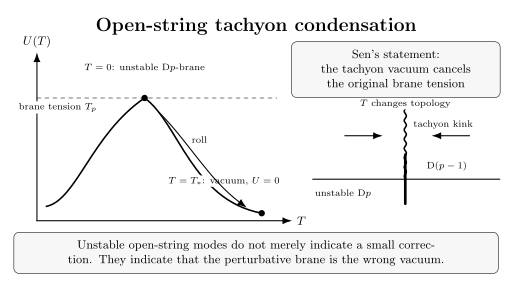
Open-string tachyon condensation removes an unstable D-brane. Lower-dimensional D-branes can appear as topological defects of the tachyon field.
There is a beautiful brane-descent picture behind this statement. A kink of the tachyon field on an unstable D-brane behaves as a stable D-brane. Vortices in brane—antibrane systems similarly produce lower-dimensional branes. Later, in open string field theory, this qualitative picture becomes a quantitative calculation: the energy difference between the perturbative maximum and the tachyon vacuum precisely equals the original brane tension.
What DBI does and does not claim
Section titled “What DBI does and does not claim”The DBI action is powerful, but it has a domain of validity.
It is reliable for a single brane when the fields vary slowly compared with the string length,
For constant abelian field strengths, it resums all powers of . For rapidly varying fields, massive open strings cannot be ignored, and higher-derivative corrections appear.
For many coincident branes, the leading low-energy action is nonabelian super-Yang—Mills. The exact nonabelian DBI action is not simply obtained by putting a trace around the abelian square root. Matrix ordering, commutators, and couplings to background fields carry real physical information.
Even with these qualifications, DBI captures the essential lessons:
The next step is to use open-string one-loop amplitudes and closed-string exchange to measure D-brane tensions and forces directly. That will make the relation between D-branes and closed-string supergravity completely explicit.
Exercises
Section titled “Exercises”Exercise 1: D1 DBI as the Nambu—Goto action
Section titled “Exercise 1: D1 DBI as the Nambu—Goto action”Set , , , and take constant dilaton. Show that the DBI action reduces to the Nambu—Goto action for the embedding .
Solution
For , the worldvolume is two-dimensional. With , the DBI action is
In flat spacetime,
Therefore
This is precisely the Nambu—Goto action, with tension rather than .
Exercise 2: Expanding the DBI determinant
Section titled “Exercise 2: Expanding the DBI determinant”Starting from
derive the quadratic action for and .
Solution
Write
The scalar term is already quadratic in , while is linear in the fields. Using
and , the scalar contribution is
The quadratic gauge-field contribution comes from . Because , it gives
Thus
Exercise 3: The gauge-invariant two-form
Section titled “Exercise 3: The gauge-invariant two-form”Show that is invariant under
Solution
Since pullback commutes with exterior differentiation,
The field strength transforms as
Therefore
Exercise 4: The Yang—Mills coupling on a D-brane
Section titled “Exercise 4: The Yang—Mills coupling on a Dppp-brane”Use the DBI expansion to show that
for the abelian normalization used in this page.
Solution
The Maxwell term from DBI is
Comparing with
gives
Substituting
yields
so
Exercise 5: Electric flux on a D-string
Section titled “Exercise 5: Electric flux on a D-string”For
compute the Hamiltonian density and show that it can be written as
Solution
Let
Then
The Hamiltonian density is
Since ,
Therefore
Also,
Thus
which gives
Exercise 6: T-duality and D-brane tensions
Section titled “Exercise 6: T-duality and D-brane tensions”Show that the D-brane tension formula is consistent with T-duality along a circle wrapped by the brane:
Solution
The wrapped D-brane has mass density, measured per unit unwrapped volume,
The T-dual object is a D-brane with coupling
Its tension is
Since
we find