
Generalized Free Fields
The previous modules developed CFT as an operator algebra: local operators, Ward identities, correlation functions, radial quantization, conformal blocks, crossing, and the special machinery of two-dimensional CFT. We now turn to the extra structure that makes a CFT holographic.
The first large- idea is factorization. In a large- CFT, properly normalized single-particle operators have two-point functions of order one, while connected higher-point functions are suppressed. In the strict limit, such operators behave like generalized free fields.
This page explains what that means, why it is not the same thing as an ordinary free scalar field, and why it is the correct boundary language for a free quantum field in AdS.
The central picture is:
More concretely, a scalar single-trace operator behaves at leading order as if all its correlation functions were generated by Wick contractions of its two-point function:
But do not let the word “free” fool you. A generalized free field is generally not a fundamental Lagrangian field satisfying a local equation of motion. It is a universal large- limit of an operator sector.
Large- normalization and factorization
Section titled “Large-NNN normalization and factorization”Let denote the normalization of the stress-tensor two-point function. In a matrix large- gauge theory, . In a vector model, often . For holography, is the natural measure of the number of CFT degrees of freedom and is proportional to an inverse bulk Newton constant:
Consider a scalar primary normalized by
Here means in Euclidean signature. For a normalized single-particle operator in a large- CFT, connected correlators scale schematically as
Thus
In the strict limit, connected correlators with three or more single-particle insertions vanish. Correlators then factorize into sums of products of two-point functions. This is the CFT version of the statement that the leading bulk theory is free.
For matrix theories, the same counting is often written as
for single-trace operators normalized to have order-one two-point functions. Since , this is the same scaling.
Definition of a generalized free field
Section titled “Definition of a generalized free field”A scalar primary of scaling dimension is called a generalized free field if its correlation functions are completely determined by the two-point function and Wick-like factorization:
and
Here
The adjective “generalized” is doing important work. For an ordinary free scalar field in dimensions, the scaling dimension is fixed to
and the field satisfies a local equation of motion
A generalized free scalar can instead have essentially any scalar-primary dimension consistent with unitarity,
but for generic it does not obey a local equation of motion. There is no null descendant unless and the theory is truly free in the ordinary sense.
So the right mental model is:
A generalized free field is free as an operator probability distribution, not necessarily as a local Lagrangian field.
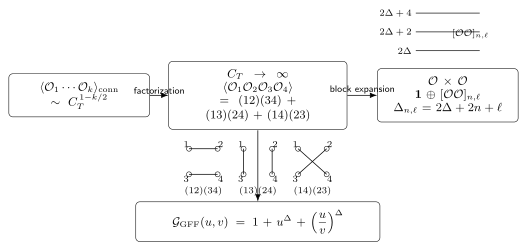
At leading large , normalized single-particle operators behave as generalized free fields. Correlators factorize, but the OPE still contains an infinite tower of double-trace primaries , which become two-particle states in global AdS. Interactions appear as corrections to OPE data.
The mean-field four-point function
Section titled “The mean-field four-point function”The simplest nontrivial example is the four-point function of identical scalar generalized free fields. Wick factorization gives
As usual for identical scalar four-point functions, define
where
Then the generalized-free or mean-field four-point function is
This is often called mean field theory, abbreviated MFT, in the conformal-bootstrap literature. The name is slightly misleading but useful. It means the universal crossing-symmetric solution produced by generalized-free Wick contractions.
The identical-scalar crossing equation is
The MFT answer obeys it immediately:
This small equation contains a surprisingly deep point. The disconnected-looking four-point function is not empty. When expanded in a chosen OPE channel, it contains infinitely many conformal families.
The OPE is not trivial
Section titled “The OPE is not trivial”The generalized-free four-point function has vanishing connected part, but its OPE is highly nontrivial. In the channel, the product contains the identity and an infinite tower of composite primaries:
For identical bosonic scalars, only even spins appear. The schematic form of these operators is
The subtractions are essential: the operator must be a conformal primary, so traces and descendants must be removed. At leading generalized-free order, the dimensions are
Their twists are
Thus the MFT four-point function admits a conformal-block expansion
with positive squared OPE coefficients
The precise closed-form expression for depends on the normalization convention for conformal blocks. The invariant statement is that crossing fixes all of them once the two-point normalization and dimension are chosen.
This is one of the first lessons of large- CFT:
Factorization says connected correlators vanish. It does not say the OPE contains only the identity.
Why double-trace dimensions are additive
Section titled “Why double-trace dimensions are additive”The dimensions
have a simple explanation from radial quantization.
A scalar primary creates a state on with cylinder energy
Descendants have energies , where is a nonnegative integer. In a generalized-free theory, two-particle energies add. The two-particle primary with spin and radial excitation number therefore has energy
By the state-operator map, cylinder energy is scaling dimension, so
The units correspond to angular momentum on the sphere. The units correspond to radial excitation. This interpretation is exactly what one expects for two free particles in global AdS.
AdS interpretation
Section titled “AdS interpretation”For a scalar primary of dimension , the dual bulk scalar field in has mass
At leading order in large , the bulk action is quadratic:
A Gaussian bulk path integral produces a Gaussian boundary generating functional:
where is the boundary two-point kernel. Functional derivatives with respect to produce Wick factorization. Hence the CFT statement
is the boundary version of the bulk statement
The double-trace operators are then interpreted as two-particle states:
This is why generalized free fields are unavoidable in AdS/CFT. They are not a toy model. They are the zeroth-order approximation to any weakly coupled bulk theory.
Turning on interactions
Section titled “Turning on interactions”A finite but large introduces connected correlators. In the four-point function this means
Correspondingly, double-trace dimensions and OPE coefficients receive corrections:
The anomalous dimensions are especially important. In global AdS, they are binding energies of two-particle states. For example:
| CFT effect | Bulk interpretation |
|---|---|
| nonzero connected four-point function | tree-level Witten diagram |
| two-particle binding energy or phase shift | |
| stress-tensor exchange | graviton exchange |
| conserved-current exchange | gauge-boson exchange |
| scalar single-trace exchange | exchange of another bulk scalar |
| corrections | loops and multi-particle effects |
This is one of the cleanest bridges between the conformal bootstrap and AdS perturbation theory.
Generalized free fields versus ordinary free fields
Section titled “Generalized free fields versus ordinary free fields”It is worth being very explicit about the difference.
An ordinary free scalar in dimensions has
and satisfies the equation of motion
The equation of motion says that the descendant is null. This shortening is visible in the conformal multiplet.
A generalized free scalar of dimension has no such equation for generic :
It is a long scalar conformal multiplet, not a shortened free-field multiplet.
There is also a stress-tensor issue. A complete local CFT in flat space has a stress tensor . The Ward identity fixes the existence of a nonzero three-point function
With the standard normalization , the OPE coefficient scales as
Thus decouples from the OPE at strict , but it returns at finite . This is exactly what should happen holographically: gravitons decouple when and reappear when gravitational interactions are restored.
A standalone exact generalized free field is therefore usually not a complete local CFT with a finite stress tensor. It is best understood as either the leading sector of a large- CFT or a formal mean-field solution of crossing for a chosen operator. For AdS/CFT, the first interpretation is the important one.
Multiple generalized free fields
Section titled “Multiple generalized free fields”A large- CFT usually has many single-particle primaries . At leading order, one may choose a basis in which their two-point functions are diagonal:
At , the multi-operator correlators factorize into pairings:
assuming the basis has no two-point mixing. If operators have different quantum numbers, the corresponding pairings vanish.
Their OPEs contain mixed double-trace operators
with leading dimensions
If , Bose symmetry restricts the allowed spins. If , both even and odd spins can appear, depending on the operator quantum numbers.
In AdS language, this is simply the spectrum of two-particle states made from different bulk fields.
Generalized free fields and the bootstrap
Section titled “Generalized free fields and the bootstrap”The mean-field four-point function is the universal starting point for large- bootstrap. One writes
where
Crossing then constrains . Its conformal block expansion determines the first anomalous dimensions and OPE-coefficient corrections of double-trace operators.
This perturbation theory is not a perturbation around a finite-dimensional spectrum. It is a perturbation around an infinite tower:
That infinite tower is not optional. It is the CFT signature of locality in the emergent bulk. Local bulk interactions produce highly constrained patterns of and .
A useful diagnostic is the large-spin behavior. For a holographic CFT, double-trace anomalous dimensions at large are controlled by low-twist single-trace exchanges:
where is the twist of the exchanged operator. This is the CFT version of long-distance forces in AdS.
What generalized free fields do and do not capture
Section titled “What generalized free fields do and do not capture”Generalized free fields capture:
| Captured by GFF | Meaning |
|---|---|
| two-point function of a single-particle operator | free bulk propagator |
| Wick factorization | no interactions at leading large |
| double-trace tower | two-particle Fock states |
| additive dimensions | additive energies on the cylinder/global AdS |
| positive MFT OPE coefficients | unitary multi-particle Hilbert space |
They do not capture:
| Not captured at strict GFF level | Appears as |
|---|---|
| stress-tensor exchange | OPE coefficient, effect in four-point data |
| binding energies | anomalous dimensions |
| bulk interactions | connected Witten diagrams |
| bulk loops | higher powers of |
| finite- operator mixing | mixing of double- and multi-trace operators |
So GFF is the correct zeroth order, but a holographic theory is not just a GFF. It is a controlled deformation of generalized free behavior, with special constraints from crossing, unitarity, sparse single-particle spectrum, and bulk locality.
AdS/CFT checkpoint
Section titled “AdS/CFT checkpoint”The core dictionary of this page is
and
The large- limit makes the CFT Hilbert space approximately a Fock space. Generalized free fields are the boundary operators that create the one-particle building blocks of this Fock space.
This is why a student of AdS/CFT must be comfortable with generalized free fields before learning Witten diagrams. The disconnected CFT correlator is the boundary imprint of the free bulk theory. The first connected correction is the boundary imprint of bulk interaction.
Summary
Section titled “Summary”A generalized free field is a primary operator whose correlators are Wick-factorized but whose dimension need not be that of an ordinary free field. In a large- CFT, normalized single-particle operators become generalized free fields at leading order:
The generalized-free four-point function is
Its OPE contains the double-trace tower
In AdS, this is the free two-particle spectrum. Finite- corrections turn this into interacting bulk physics:
The anomalous dimensions are where forces, binding energies, and Witten diagrams enter the CFT.
Exercises
Section titled “Exercises”Exercise 1. Derive the mean-field four-point function
Section titled “Exercise 1. Derive the mean-field four-point function”Let be a scalar generalized free field with
Show that
Solution
Wick factorization gives three pairings:
Factor out
The first term gives . The second gives
The third gives
Therefore
Exercise 2. Check crossing symmetry
Section titled “Exercise 2. Check crossing symmetry”For identical scalars, crossing requires
Verify this for .
Solution
Start from
Then
Reordering the terms gives
So the generalized-free four-point function is crossing-symmetric.
Exercise 3. Connected four-point function
Section titled “Exercise 3. Connected four-point function”Show that the connected four-point function of an exact generalized free field vanishes.
Solution
For any operator distribution, the connected four-point function is
where denotes . For a generalized free field,
Substitution gives
At finite large , this equality is corrected by terms of order for normalized single-particle operators.
Exercise 4. Double-trace dimensions from radial quantization
Section titled “Exercise 4. Double-trace dimensions from radial quantization”Use radial quantization to explain why the leading dimensions of double-trace operators are
Solution
A scalar primary creates a one-particle state on with energy
In the generalized-free limit, two-particle energies add. A two-particle state with orbital angular momentum and radial excitation number has energy
The state-operator map identifies cylinder energy with scaling dimension. Therefore
The same statement is the global-AdS energy spectrum of two noninteracting particles.
Exercise 5. Why exact GFF is not usually a complete finite- CFT
Section titled “Exercise 5. Why exact GFF is not usually a complete finite-CTC_TCT CFT”Explain why a scalar generalized free field with generic is not the same as an ordinary free scalar field, and why a complete finite- CFT cannot make vanish for a nontrivial scalar primary .
Solution
An ordinary free scalar has
and satisfies the equation of motion
In representation-theory language, the descendant is null. A generalized free field with generic has no such null descendant, so it is not an ordinary free scalar.
For the stress tensor, the Ward identity fixes how couples to any primary with nonzero scaling dimension. With the standard normalization , the OPE coefficient behaves schematically as
Thus this coupling vanishes only in the strict limit. At finite , the stress tensor cannot be removed from a complete local CFT. This is why exact generalized-free behavior should be understood as a leading large- limit or as a formal mean-field sector, not usually as a full finite- CFT.