
4. Finite Density and Charged Black Branes
The first three pages developed the neutral, quantum-critical side of holographic quantum matter. We saw how conformal fixed points are represented by asymptotically AdS geometries, how finite temperature produces horizons, and why horizons encode dissipative real-time response. This page adds the next essential ingredient: finite density.
Finite density is not a small decoration of a thermal state. A many-body system with a conserved charge can be placed at nonzero chemical potential, and the ground state can become compressible. In a Fermi liquid, compressibility is organized around a Fermi surface and long-lived quasiparticles. In holographic quantum matter, the simplest compressible state is instead organized around a charged black brane. The charge density is carried by radial electric flux, and at low temperature the near-horizon region may become , a geometry that captures a peculiar kind of low-energy criticality.
The goal of this page is to make the finite-density dictionary precise enough that later pages can build on it without re-explaining the basics. We will separate four ideas that are often blurred:
- the boundary chemical potential is a source;
- the boundary charge density is the response conjugate to that source;
- the bulk Maxwell field is dual to a global current, not automatically to the laboratory photon;
- a charged horizon is a controlled large- compressible state, not automatically a realistic metal.
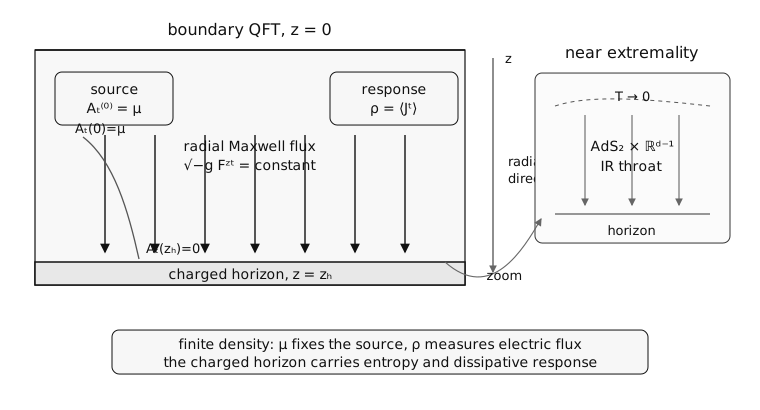
Finite density in holography is encoded by a boundary source , a bulk electric field, and a charged horizon. The radial electric flux measures the charge density . If the flux enters the horizon, the charge is fractionalized; if it is carried by explicit charged bulk matter outside the horizon, the charge is more cohesive.
Conventions for this page
Section titled “Conventions for this page”This sequence uses the common holographic quantum matter convention:
- the boundary theory has spatial dimensions and spacetime dimension ;
- the bulk geometry is asymptotically ;
- the radial coordinate is , with the boundary at and the horizon at ;
- Greek boundary indices run over ;
- the AdS radius is .
Thus a -dimensional boundary system corresponds to and a four-dimensional bulk.
This page assumes familiarity with the basic source/operator dictionary, finite-temperature black branes, and the first three pages of the sequence. In particular, we use without rederiving the source/operator rule
Boundary finite density
Section titled “Boundary finite density”Let the boundary theory have a conserved global current,
with charge
A finite-density state is most cleanly prepared in the grand-canonical ensemble,
The chemical potential is not the charge density. It is the source conjugate to the charge. The grand potential is
and for a homogeneous state with spatial volume ,
The pressure , entropy density , and charge density obey
Equivalently,
For a conformal theory in flat space, the equilibrium stress tensor is traceless,
Combining this with gives
Dimensional analysis then implies the scaling form
up to possible anomaly-related subtleties in special backgrounds.
A system is compressible if the charge density changes continuously with . A useful diagnostic is the susceptibility
In a conventional metal, is tied to the density of quasiparticle states near a Fermi surface. In the simplest charged black brane, is encoded instead in the response of radial electric flux to the boundary value of .
The bulk gauge field as a source
Section titled “The bulk gauge field as a source”In holography, a global symmetry of the boundary theory corresponds to a bulk gauge redundancy. The associated bulk gauge field has near-boundary expansion
for the generic case . Logarithms and special powers can appear in low dimensions or special normalizations, but the source/response logic is the same.
For a homogeneous finite-density state, only is nonzero. The leading coefficient is the chemical potential,
while the normalizable coefficient determines the charge density.
A minimal bulk action is
Here fixes the current normalization, and includes boundary terms and counterterms. The radial canonical momentum of the gauge field is
The boundary current is obtained from the renormalized limit of this canonical momentum:
For the homogeneous electric ansatz, the Maxwell equation gives
whenever there is no charged bulk matter outside the horizon. Thus the charge density is a conserved radial flux. This is the simplest form of Gauss’s law in the emergent dimension.
Chemical potential as a potential difference
Section titled “Chemical potential as a potential difference”There is an important gauge-invariance subtlety. A constant shift of can be a gauge transformation, so at a single radial point is not by itself physical. The physical chemical potential is the potential difference between the boundary and the horizon.
For a regular Euclidean black hole, the thermal time circle shrinks smoothly at the horizon. The one-form is regular at the tip only in a gauge where
Then
Equivalently,
This is the gauge-invariant statement. The common gauge choice is not merely cosmetic; it is the clean way to relate the Lorentzian gauge field to the smooth Euclidean saddle and the grand-canonical ensemble.
The minimal charged black brane
Section titled “The minimal charged black brane”The simplest bulk state at finite and is the planar Reissner—Nordstrom-AdS black brane. It is not the most general holographic finite-density phase, but it is the cleanest starting point.
A useful metric convention is
The boundary is at , and the horizon is at . A dimensionless parametrization of the charged solution is
and
The relation between and depends on the normalization of the Maxwell term. The qualitative physics is independent of that convention: measures the charge of the brane, sets the horizon scale, and is fixed by the regular potential difference between boundary and horizon.
The temperature follows from smoothness of the Euclidean horizon:
The entropy density is the horizon area density divided by :
The charge density is proportional to the radial electric displacement,
with the sign fixed by the convention that positive gives positive .
This is the first major lesson: in a large- holographic theory, finite-density thermal matter is described by a charged horizon, and the entropy density is geometrized as area density.
A concrete example: the charged black brane
Section titled “A concrete example: the AdS4AdS_4AdS4 charged black brane”Many holographic quantum matter applications use a -dimensional boundary theory. This corresponds to and a four-dimensional bulk. In a common normalization,
with
and
The temperature is
Extremality occurs at
The entropy density is
At fixed , this remains finite as . This finite zero-temperature entropy is one of the most important warnings in holographic finite-density physics. It is not the entropy of an ordinary clean Fermi liquid. It is a large- horizon entropy. It often signals that the minimal Reissner—Nordstrom-AdS solution is not the final ground state once additional bulk fields, charged matter, lattice effects, or corrections are included.
Nevertheless, the extremal solution is extremely useful because it supplies a solvable infrared region.
At extremality,
The blackening factor has a double zero at the horizon. Define
Near ,
Substituting into the metric gives
After a simple radial redefinition, the first and last terms form . The near-horizon geometry is
The factor means that time scales but space does not:
This is often called semi-local criticality or local quantum criticality. Correlators can have nontrivial frequency scaling while momentum behaves as a label of different infrared operators.
The correct attitude is:
Charged scalars can condense, fermion matter can backreact, a dilaton can run, and spatially modulated instabilities can appear. Later pages explain these possibilities.
Fractionalized charge and radial electric flux
Section titled “Fractionalized charge and radial electric flux”The conserved radial flux tells us where the charge lives in the bulk. In the minimal charged black brane, no charged matter field outside the horizon carries the charge. The electric flux enters the horizon. In boundary language, the charge is carried by deconfined large- degrees of freedom rather than by visible quasiparticles.
This motivates the terminology:
| Bulk charge support | Common name | Boundary interpretation |
|---|---|---|
| electric flux enters the horizon | fractionalized charge | charge hidden in the deconfined large- sector |
| charged matter outside the horizon | cohesive charge | charge carried by explicit matter-like degrees of freedom |
| both are present | partially fractionalized charge | mixed charge sector |
A charged scalar condensate, electron star, Dirac-hair solution, or probe-brane density can carry some or all of the electric flux outside the horizon. The minimal charged horizon is therefore the parent state from which more structured finite-density phases can branch.
Why finite-density transport is immediately subtle
Section titled “Why finite-density transport is immediately subtle”At zero density, current transport can be finite even with exact translation symmetry. At finite density, the electric current overlaps with momentum. If momentum is exactly conserved, a uniform electric field accelerates the state rather than producing a steady finite DC current.
Hydrodynamics makes this precise. In a relativistic charged fluid, the electric current contains a convective part,
The momentum density is
Therefore the current has a component proportional to momentum:
where is an incoherent current that does not drag momentum.
As a result, the optical conductivity contains a pole:
Using
we find
This delta function is not superconductivity. It is the consequence of exact momentum conservation at finite charge density. A true superfluid or superconductor has an additional stiffness associated with spontaneous breaking. Keeping these mechanisms separate is essential.
Finite DC conductivity requires one of the following mechanisms:
| Mechanism | What it does |
|---|---|
| explicit translation breaking | relaxes momentum |
| disorder or lattice | transfers momentum to the background |
| probe limit | neglects momentum carried by the large bath |
| particle-hole symmetry | removes the current-momentum overlap |
| incoherent current | transports charge without net momentum |
The charged black brane is therefore not, by itself, a finite-resistivity metal if translations are exact.
Linear response around the charged brane
Section titled “Linear response around the charged brane”At zero density, a transverse Maxwell fluctuation can often be studied without mixing with metric perturbations. At finite density this is no longer generally true. Because the background has , an electric perturbation sources momentum and energy flow.
A typical fluctuation problem contains coupled fields such as
This is the bulk reflection of the boundary fact that charge, energy, and momentum are coupled in finite-density hydrodynamics.
The retarded prescription is the same as before:
- impose the desired source at the boundary;
- impose infalling boundary conditions at the future horizon;
- solve the coupled linearized equations;
- evaluate the renormalized on-shell quadratic action;
- differentiate with respect to sources.
The new issue is not the prescription but the mixing. In finite-density problems, good variables are often gauge-invariant master fields, heat-current combinations, or incoherent-current combinations.
IR dimensions and instabilities
Section titled “IR dimensions and instabilities”The throat reorganizes low-energy physics. A fluctuation with spatial momentum behaves in the region like a field whose effective mass depends on . For a neutral scalar, schematically,
The corresponding infrared scaling dimension is
For charged fields, the near-horizon electric field reduces the effective mass. A schematic form is
where is the bulk charge and measures the dimensionless electric field in the throat. If becomes imaginary, the BF bound is violated and the charged black brane is unstable.
This is the seed of several later topics: holographic superconductors, fermionic response, spatially modulated phases, and more general infrared scaling geometries.
Ensembles: fixed and fixed
Section titled “Ensembles: fixed μ\muμ and fixed ρ\rhoρ”The standard charged-brane calculation fixes the boundary value of . This is the grand-canonical ensemble: and are fixed, while is determined dynamically.
To work at fixed charge density, one fixes the radial electric flux instead. In the gravitational action this requires a Legendre transform, schematically
The details depend on conventions and counterterms, but the conceptual point is simple: Dirichlet boundary conditions for fix , while Neumann-type boundary conditions fix .
Any trustworthy finite-density phase diagram should state the ensemble.
Dictionary at a glance
Section titled “Dictionary at a glance”The finite-density dictionary is compact, but each entry has a possible trap.
| Boundary object | Bulk object | Comment |
|---|---|---|
| global symmetry | bulk gauge redundancy | The boundary symmetry is global unless weakly gauged by hand. |
| conserved current | gauge field | Current correlators come from gauge-field fluctuations. |
| chemical potential | boundary-horizon potential difference | at one point is gauge-dependent. |
| charge density | radial electric flux | In pure Maxwell theory the flux is radially conserved. |
| grand-canonical ensemble | Dirichlet data for | Fix , let respond. |
| canonical ensemble | fixed radial electric flux | Fix , determine . |
| horizon electric flux | fractionalized charge | Charge is hidden in deconfined large- degrees of freedom. |
| charged bulk matter | cohesive charge | Charge is carried outside the horizon by explicit matter fields. |
This table is deliberately conservative. It avoids saying that a bulk electric field is literally the electromagnetic field in a metal. In most holographic quantum matter models, is dual to a conserved global current. To describe a material with a dynamical photon, one would still need to weakly gauge the boundary global symmetry.
Model control and epistemic status
Section titled “Model control and epistemic status”The same-looking Einstein—Maxwell equations can have different meanings. In a top-down construction, the gauge field may come from a precise Kaluza—Klein mode or brane sector of string theory. In a bottom-up model, the gauge field is introduced because the boundary theory is assumed to have a conserved current. In both cases the classical charged black brane is useful, but the level of microscopic control differs.
The safest language is:
| Statement | Status |
|---|---|
| A conserved boundary current is represented by a bulk gauge field. | Core holographic dictionary. |
| A charged AdS black brane describes a homogeneous large- finite-density state. | Standard semiclassical holography. |
| The minimal extremal RN-AdS throat has and finite entropy density. | True in the minimal two-derivative saddle. |
| This is the universal ground state of all strongly coupled metals. | False. |
| Holographic charged branes can model mechanisms relevant to strange metals. | Useful but model-dependent. |
This distinction is not philosophical decoration. It controls how one should read every formula in finite-density holography. A formula for , , or may be exact within a chosen bulk model while still being only a model-dependent statement about possible real materials.
What this solution teaches, and what it does not
Section titled “What this solution teaches, and what it does not”The charged black brane teaches several robust lessons:
- chemical potential is a boundary source;
- charge density is radial electric flux;
- compressible large- matter can be represented by a charged horizon;
- extremal charged horizons often generate infrared regions;
- finite density changes transport qualitatively because current overlaps with momentum;
- charge behind the horizon gives a clean gravitational meaning to fractionalized charge.
But the solution also has limitations:
- it is not an ordinary Landau Fermi liquid;
- it does not by itself produce finite DC resistivity in a translation-invariant system;
- it does not automatically describe a real metal;
- its finite extremal entropy is not necessarily stable;
- its infrared throat may be replaced by a scalar, fermionic, lattice, or dilatonic phase.
The minimal charged black brane is foundational because it gives a controlled large- parent state for compressible holographic matter.
Common pitfalls
Section titled “Common pitfalls”| Pitfall | Correction |
|---|---|
| Treating as the density | is the source; is the response. |
| Forgetting horizon regularity | In the regular gauge, , so is a potential difference. |
| Calling the clean DC conductivity finite | With exact translations and , is singular. |
| Interpreting the momentum delta function as superconductivity | Momentum conservation and superfluid stiffness are different mechanisms. |
| Treating as automatically stable | The throat is often unstable or modified by other fields. |
| Confusing bottom-up Einstein—Maxwell theory with a full string compactification | The same equations can have different levels of microscopic control. |
| Ignoring ensemble choice | Fixing and fixing require different boundary terms. |
Exercises
Section titled “Exercises”Exercise 1. Chemical potential as a potential difference
Section titled “Exercise 1. Chemical potential as a potential difference”Assume a static bulk gauge field with boundary at and horizon at . Explain why the chemical potential is
and why the regular Euclidean gauge usually sets .
Solution
The boundary chemical potential is the source for the conserved charge density, so it is the boundary value of the time component of the gauge field measured relative to the infrared end of the geometry. A constant shift of is a gauge transformation in Lorentzian signature, so only the potential difference is gauge-invariant.
At a nonextremal Euclidean horizon, the Euclidean time circle shrinks smoothly. The one-form is regular at the tip of this cigar only if its component along the shrinking circle vanishes there. Thus the regular gauge sets
In that gauge,
The physical statement is not that is gauge-invariant by itself. The physical statement is that the gauge-invariant source is the potential difference between boundary and horizon.
Exercise 2. Maxwell equation and radial electric flux
Section titled “Exercise 2. Maxwell equation and radial electric flux”For the metric
and gauge field , show that Maxwell’s equation implies
Then show that for .
Solution
The Maxwell equation is
For the electric ansatz, the only nontrivial component is :
Therefore
For the metric above,
Thus
Constancy implies
For ,
Exercise 3. Temperature of the charged black brane
Section titled “Exercise 3. Temperature of the charged black brane”For
show that
Solution
Near the horizon, the temperature is determined by
where the minus sign appears because for the outer horizon in this coordinate convention.
The derivative is
At ,
Therefore
Exercise 4. Extremal double zero and the throat
Section titled “Exercise 4. Extremal double zero and the AdS2AdS_2AdS2 throat”Show that at extremality,
the blackening function has a double zero at the horizon and
Solution
Let . Then
The horizon condition gives . A double zero requires :
Thus extremality occurs at
The second derivative is
At extremality and at ,
Therefore
This double zero is the metric origin of the near-horizon region.
Exercise 5. Why finite density gives a delta function in conductivity
Section titled “Exercise 5. Why finite density gives a delta function in conductivity”Use the hydrodynamic decomposition
to explain why exact momentum conservation implies a zero-frequency delta function in at .
Solution
If translations are exact, the total momentum is conserved. A uniform electric field couples to the electric current. At finite density, the current has a component proportional to momentum:
Since this component cannot decay when momentum is conserved, it produces a nondissipating contribution to the current. In frequency space, this appears as a pole in the imaginary conductivity:
The corresponding real part contains
This is the clean-limit momentum delta function. It should not be confused with a superfluid delta function, which is tied to spontaneous symmetry breaking.
Exercise 6. The BF-bound instability
Section titled “Exercise 6. The AdS2AdS_2AdS2 BF-bound instability”In the extremal throat, a fluctuation has infrared exponent
Explain why signals an instability of the charged black brane.
Solution
The stability bound for a scalar in is the Breitenlohner-Freedman bound
If the effective mass violates this bound in the near-horizon region, the scalar fluctuation grows in the infrared throat. In the full geometry this appears as an instability of the extremal or near-extremal charged black brane. If the scalar is charged under the bulk Maxwell field, the usual endpoint is a new branch with scalar hair, interpreted as a phase with spontaneous breaking of the boundary global symmetry.
References and further reading
Section titled “References and further reading”The page is designed as a graduate-level reference point after the standard AdS/CFT dictionary. For broader context, useful references include treatments of finite-temperature and finite-density holography, charged AdS black holes, quantum critical transport, and holographic quantum matter. Standard sources include lectures and reviews by Hartnoll, Lucas, Sachdev, Son, Starinets, Iqbal, Liu, and textbook discussions of finite temperature, density, and condensed-matter applications in gauge/gravity duality.
What comes next
Section titled “What comes next”This page introduced the minimal finite-density parent state. The next page studies what happens when the infrared geometry is allowed to run. Einstein—Maxwell—Dilaton models replace the fixed throat by Lifshitz, hyperscaling-violating, and more general scaling regimes.