
Heavy-Ion Lessons and Limitations
The main idea
Section titled “The main idea”Holography is not a derivation of real-world heavy-ion phenomenology from first principles. There is no known controlled string dual of physical QCD with , light quarks, confinement, chiral symmetry breaking, asymptotic freedom, and the experimentally relevant crossover region. The standard finite-temperature AdS/CFT plasma is instead the thermal state of a large-, strongly coupled CFT, most famously super-Yang—Mills theory.
That sounds like a devastating mismatch. It is not. It is a warning label.
Heavy-ion collisions create a short-lived deconfined state of QCD matter whose spacetime evolution is well described, after a very early stage, by relativistic viscous hydrodynamics. Holographic plasmas provide the best-controlled examples of quantum many-body systems that are hot, dense in degrees of freedom, strongly coupled, non-quasiparticle-like, and analytically or numerically tractable. They teach us what strongly coupled plasma dynamics can look like when no weakly coupled kinetic description is available.
The right slogan is therefore not
The right slogan is
Those lessons can be compared with QCD, used to build intuition, or embedded into phenomenological models, but every comparison must state the assumptions.
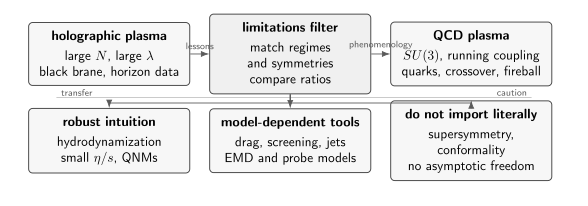
Holographic plasmas give controlled lessons about strongly coupled finite-temperature quantum field theories. Translating those lessons to QCD requires separating universal structures, model-dependent details, and phenomenological guesses. The caveats are not cosmetic: QCD has , running coupling, fundamental quarks, confinement physics, and hard UV processes absent from the simplest SYM plasma.
This page is about how to use holography responsibly in the heavy-ion context: what to learn, what not to claim, and how to recognize which statements are controlled.
The heavy-ion problem in one page
Section titled “The heavy-ion problem in one page”A relativistic heavy-ion collision is not simply a thermal field theory calculation. Very schematically, the physical story is:
- two Lorentz-contracted nuclei collide;
- an initially far-from-equilibrium state forms;
- the stress tensor becomes well described by viscous hydrodynamics;
- the plasma expands and cools;
- near the QCD crossover it converts into hadrons;
- the final particles encode information about the earlier fluid evolution.
The hydrodynamic stage is governed by conservation laws,
together with a constitutive relation. In four boundary spacetime dimensions, a neutral relativistic fluid has
where
and
The microscopic theory enters through the equation of state and the transport coefficients , , relaxation times, conductivities, and higher-order coefficients. Holography is useful because these quantities and the approach to hydrodynamics can be computed in controlled strongly coupled theories.
For the canonical AdS black brane dual to strongly coupled SYM,
because the theory is conformal. QCD near the crossover is not conformal, so these equations are not QCD predictions. They are a baseline: the simplest holographic plasma.
Why holography entered heavy-ion physics
Section titled “Why holography entered heavy-ion physics”The early surprise from RHIC, and later from LHC heavy-ion collisions, was not merely that a deconfined plasma was produced. It was that the plasma seemed to behave like a very good fluid. Hydrodynamic modeling required small dissipative corrections and early applicability of hydrodynamics. That is hard to reconcile with a gas of long-lived weakly interacting quasiparticles, where transport coefficients are naturally large because particles carry momentum over long mean free paths.
Holography gave a concrete counterexample to the quasiparticle intuition. In strongly coupled SYM at large and large , the shear viscosity and entropy density are
so
The number is famous, but the deeper point is structural: black brane horizons are dissipative objects, and the same horizon data determine hydrodynamic transport in the boundary theory. Holography made it impossible to maintain the old prejudice that quantum field theories at strong coupling must be too complicated to have quantitatively computable real-time transport.
There are three reasons this mattered for heavy-ion physics.
First, it showed that small is natural in a strongly coupled plasma. Second, it supplied calculable models of far-from-equilibrium relaxation without quasiparticles. Third, it gave a language in which entropy production, energy loss, screening, and hydrodynamization are geometrized.
The crucial word is models. Not QCD itself.
Similarities and differences with QCD
Section titled “Similarities and differences with QCD”The simplest holographic plasma shares some broad finite-temperature features with deconfined QCD: it is a non-Abelian plasma, it has many degrees of freedom, it supports hydrodynamic modes, it has screened interactions, and it has a dual description in which thermal equilibrium is a black brane.
But the differences are significant.
| Feature | Strongly coupled SYM plasma | QCD quark-gluon plasma |
|---|---|---|
| Gauge group | with | |
| Coupling | fixed exactly marginal | running coupling |
| Matter | adjoint gluons, fermions, scalars | gluons and fundamental quarks |
| Vacuum | conformal, no confinement | confining, chiral symmetry breaking |
| Finite-temperature transition | Hawking-Page on ; planar theory always deconfined | crossover at physical quark masses and |
| Equation of state | approximately conformal only at sufficiently high | |
| Bulk viscosity | nonzero, important near nonconformal regimes | |
| UV physics | strongly coupled at all scales in the gravity limit | asymptotically free |
A good heavy-ion use of holography begins by deciding which differences matter for the question being asked. For example, shear viscosity in a near-equilibrium plasma may be less sensitive to supersymmetry than a detailed statement about hadronization. A high-energy jet probes UV physics, where real QCD is closer to weak coupling than to the classical gravity limit. A heavy quark moving slowly through a strongly coupled medium may be a better candidate for qualitative holographic intuition than a very hard light parton.
Lesson 1: nearly perfect fluidity is natural at strong coupling
Section titled “Lesson 1: nearly perfect fluidity is natural at strong coupling”The shear viscosity is defined by the Kubo formula
In a two-derivative Einstein-gravity dual, the perturbation behaves like a minimally coupled scalar near the horizon. The membrane-paradigm calculation gives
and therefore
This result is universal within a class of theories: isotropic, translationally invariant black branes governed by two-derivative Einstein gravity, with no extra higher-derivative corrections affecting the transverse graviton coupling.
But it is not a theorem about all quantum fluids. Stringy corrections, finite-coupling corrections, higher-derivative terms, anisotropy, finite density, and other effects can change the ratio. In the canonical theory, the schematic structure is
with the leading type-IIB finite-coupling correction increasing the ratio. In more general holographic effective theories, the correction can have either sign unless consistency conditions such as causality, positivity, and ultraviolet completion restrict it.
The responsible heavy-ion lesson is therefore:
The irresponsible lesson would be:
The first statement is a robust conceptual achievement. The second is not correct.
Lesson 2: hydrodynamization is not isotropization
Section titled “Lesson 2: hydrodynamization is not isotropization”A common trap is to think hydrodynamics requires local equilibrium in the strong sense that all pressures are nearly equal. Holography helped sharpen the distinction between hydrodynamization and isotropization.
Hydrodynamization means that the stress tensor is accurately described by a hydrodynamic constitutive relation, perhaps including viscous corrections. Isotropization means that, in the local rest frame, spatial pressures are approximately equal:
These are not the same condition. In a rapidly expanding plasma, viscous gradients can be large enough that the hydrodynamic stress tensor is anisotropic even when hydrodynamics is already working.
For boost-invariant Bjorken flow, write the local-rest-frame stress tensor schematically as
For a conformal fluid at first viscous order,
where is proper time. Thus hydrodynamics itself predicts pressure anisotropy when is not negligible.
Holographic simulations of expanding strongly coupled plasma made this point concrete: the stress tensor can be well described by hydrodynamics before the pressure anisotropy has disappeared. In bulk language, the geometry has settled enough that the slow hydrodynamic sector controls the boundary stress tensor, while nonhydrodynamic quasinormal modes are already decaying but not necessarily invisible.
This lesson influenced heavy-ion thinking because hydrodynamic descriptions of collisions often begin very early. Holography does not prove that QCD hydrodynamizes by a particular time, but it demonstrates that early hydrodynamization is plausible in a strongly coupled plasma and that isotropy is not the right diagnostic.
Lesson 3: quasinormal modes are transient plasma modes
Section titled “Lesson 3: quasinormal modes are transient plasma modes”In weakly coupled kinetic theory, the approach to equilibrium is often described in terms of particle distributions relaxing through collisions. In holography, the analogous transient degrees of freedom are quasinormal modes of the black brane.
A retarded correlator has poles in the complex frequency plane,
and late-time perturbations decay as
Hydrodynamic poles approach the origin as . For example,
Nonhydrodynamic poles remain at frequencies of order and decay on timescales of order . This provides a precise way to talk about the transition from transient microscopic dynamics to hydrodynamics.
For heavy-ion physics, the lesson is not that QCD transient modes are literally the same as classical black-brane quasinormal modes. The lesson is that hydrodynamics can be understood as the dominance of a small set of slow modes over a tower of rapidly decaying modes. This perspective also underlies modern discussions of hydrodynamic attractors and the asymptotic character of the gradient expansion.
Lesson 4: heavy probes are strings, not quasiparticles
Section titled “Lesson 4: heavy probes are strings, not quasiparticles”Heavy quarks and quarkonia are important probes of the quark-gluon plasma. Holography provides a clean strong-coupling picture for external heavy probes: a heavy quark is the endpoint of a fundamental string, and the string extends into the black-brane geometry.
For a heavy quark moving with velocity through the strongly coupled plasma, the trailing-string calculation gives the drag force
The worldsheet of the trailing string has its own horizon. This is a beautiful result: dissipation experienced by the boundary heavy quark is encoded in horizon physics on the string worldsheet.
The formula is not a QCD formula. It depends on the normalization of , on the definition of the heavy quark as an external string endpoint, on the infinite-coupling limit, and on the theory being SYM. But the mechanism is useful: a strongly coupled plasma can drain energy and momentum from a heavy probe without invoking a dilute set of scatterers.
Similarly, Wilson-loop calculations at finite temperature show screening of the heavy-quark potential. At zero temperature, the strong-coupling potential in SYM behaves as
At finite temperature, connected string worldsheets cease to dominate beyond a screening length of order
up to dimensionless constants and velocity/orientation dependence. Again, the lesson is qualitative and structural: in a strongly coupled plasma, screening and dissociation can be geometrized by the competition between string worldsheets near a black-brane horizon.
Lesson 5: entropy production becomes horizon dynamics
Section titled “Lesson 5: entropy production becomes horizon dynamics”Far from equilibrium, entropy in quantum field theory is subtle. The fine-grained von Neumann entropy of an isolated system is conserved under unitary evolution, while coarse-grained entropy can grow as information becomes inaccessible to a chosen effective description.
Classical gravity gives a useful dual language. In holographic nonequilibrium processes, apparent horizons and event horizons evolve, and their areas define natural coarse-grained entropy candidates. In shock-wave collision models, energy injected into the boundary theory creates a dynamical asymptotically AdS geometry. The formation and growth of horizons encode entropy production in the strongly coupled plasma.
This is one of the most conceptually powerful aspects of holographic heavy-ion work. It gives a precise laboratory for studying strongly coupled, far-from-equilibrium, nonlinear dynamics using Einstein’s equations. It also connects heavy-ion-motivated questions to numerical relativity in AdS.
But the caveats remain. The simplest holographic shock waves are often planar, infinitely extended, conformal, and defined in a theory without confinement or running coupling. More realistic localized collisions and nonconformal models exist, but with more model dependence. The gravitational calculation is controlled within the chosen holographic theory; the translation to QCD is interpretive.
Universal, semi-universal, and model-dependent statements
Section titled “Universal, semi-universal, and model-dependent statements”Not all holographic claims have the same status. It is useful to separate them into four categories.
| Type of statement | Example | Status |
|---|---|---|
| Exact within a specified holographic theory | SYM at has | Controlled, but not QCD |
| Universal within two-derivative Einstein gravity | neutral isotropic black branes give | Conditional universality |
| Robust mechanism | horizons encode dissipation; QNMs encode transient relaxation | Broad conceptual lesson |
| Phenomenological translation | use a holographic drag estimate for charm in QGP | Model-dependent comparison |
| Bottom-up fit | choose a 5D potential to match the lattice QCD equation of state | Useful, but not derived from string theory unless embedded top-down |
A polished AdS/CFT resource should keep these categories visible. Many confusions in the literature come from sliding between them.
For example, the statement
is exact in the simplest large-, infinite-coupling, two-derivative holographic plasmas. The statement
is a phenomenological conclusion supported by hydrodynamic modeling and data. The statement
is neither a theorem nor a reliable inference.
Matching is not unique
Section titled “Matching is not unique”To compare SYM with QCD, one must choose a matching prescription. Different choices give different numerical translations.
Common choices include:
| Matching choice | What is equated | Why it is used | Caveat |
|---|---|---|---|
| fixed temperature | simple thermal comparison | degrees of freedom differ | |
| fixed entropy density | matches hydrodynamic density | changes effective temperature | |
| fixed energy density | useful for expansion dynamics | conformal equation of state differs | |
| fixed static force | heavy-quark potential matched at short distance | useful for heavy probes | short-distance QCD is not strongly coupled in the same way |
| bottom-up equation of state | choose a potential reproducing lattice thermodynamics | closer to QCD thermodynamics | model dependence enters the 5D action |
There is no canonical value of that makes SYM into QCD. Numerical comparisons should therefore be presented as sensitivity studies, not as predictions with a unique microscopic input.
What holography says about jets, and what it does not
Section titled “What holography says about jets, and what it does not”Jet physics is especially delicate. Very energetic partons probe short distances. In QCD, short-distance processes are governed by asymptotic freedom and are often well described by perturbation theory. The surrounding medium, however, can be strongly coupled, especially for soft momentum exchange and collective response.
Holography has contributed several ideas:
- a heavy quark can lose energy through a trailing string;
- stochastic forces on the quark are related to worldsheet horizon fluctuations;
- lightlike Wilson loops can define a jet-quenching parameter in a strongly coupled theory;
- falling strings can model energy deposition by energetic excitations;
- the medium response can be studied from metric and string perturbations.
The limitation is equally important: a high-energy QCD jet is not a classical string in AdS. Its production is perturbative, its shower has collinear structure, and the medium-induced radiation problem involves scales where weak-coupling methods may be essential. Holography is most defensible as a model of strongly coupled medium response or heavy-probe dynamics, not as a replacement for the full perturbative-QCD jet framework.
Bottom-up holographic QCD models
Section titled “Bottom-up holographic QCD models”So far this page has focused on the canonical conformal plasma. Heavy-ion motivated holography often goes further by modifying the bulk theory. Examples include Einstein-dilaton models, improved holographic QCD, V-QCD-like models with flavor sectors, anisotropic models, magnetic-field backgrounds, and finite-density constructions.
The general strategy is to write a five-dimensional effective action such as
then choose and additional couplings so that equilibrium thermodynamics resembles QCD data. This can produce nonconformal equations of state, nonzero bulk viscosity, crossover-like behavior, and more realistic transport trends.
These models are valuable, but their status is different from top-down AdS/CFT. Unless the model is derived from a controlled string compactification, the potential and couplings are phenomenological inputs. The output can still be useful, especially when one explores robust trends across families of models, but it should not be presented as a first-principles solution of QCD.
A good rule:
The most trustworthy applications are those that are transparent about which compromise is being made.
A practical checklist for claims
Section titled “A practical checklist for claims”When reading or writing a holographic heavy-ion statement, ask these questions.
Which field theory is being solved? Is it SYM, a top-down deformation, a probe-brane model, an Einstein-dilaton model, or a phenomenological 5D action?
What is the controlled limit? Are and infinite? Are or corrections known? Is the gravity action two-derivative?
What is the observable? Is it an equilibrium thermodynamic quantity, a near-equilibrium transport coefficient, a far-from-equilibrium stress tensor, a heavy-quark observable, or a jet-like quantity?
Is the statement universal? Does it follow from horizon regularity and two-derivative gravity, or from detailed model choices?
How is QCD matching done? Temperature, entropy density, energy density, static force, lattice equation of state, or something else?
Where does weak coupling matter? UV jets, early particle production, high-frequency response, and short-distance observables may require perturbative QCD or kinetic theory rather than a purely holographic description.
What is the uncertainty? If a number is quoted for QCD, what changes when the matching scheme, model potential, finite-coupling corrections, or finite- effects are varied?
This checklist prevents holography from becoming either oversold or undervalued.
The balanced conclusion
Section titled “The balanced conclusion”Holography changed the theoretical imagination of heavy-ion physics. It showed that black branes behave like strongly coupled fluids, that small is natural without quasiparticles, that hydrodynamics can become valid before isotropization, that real-time transport is computable from horizons, and that far-from-equilibrium plasma dynamics can be studied by solving classical gravitational initial-value problems.
At the same time, the simplest holographic plasma is not QCD. It is conformal, supersymmetric in its parent zero-temperature theory, large-, strongly coupled at all scales, and composed of adjoint degrees of freedom. The best use of holography is neither blind numerical identification nor excessive skepticism. It is controlled comparison.
The mature view is:
It is a microscope for strongly coupled quantum dynamics. Heavy-ion physics is one of the places where that microscope has been most illuminating.
Exercises
Section titled “Exercises”Exercise 1: Conformal hydrodynamics versus QCD
Section titled “Exercise 1: Conformal hydrodynamics versus QCD”In four spacetime dimensions, show that conformal invariance implies
for a homogeneous equilibrium plasma. Explain why this makes the simplest plasma a limited model of QCD near the crossover.
Solution
For a homogeneous equilibrium fluid in mostly-plus signature,
Conformal invariance implies that the stress tensor is traceless, up to possible anomalies on curved backgrounds. In flat space at finite temperature,
so
If the only scale is temperature, dimensional analysis gives
Therefore
QCD near the crossover has a running coupling and a dynamically generated scale. Its trace anomaly is not zero, so is not generally zero, and need not equal . This is one reason the conformal plasma is a useful baseline but not a complete model of the QCD plasma near the crossover.
Exercise 2: Hydrodynamization without isotropization
Section titled “Exercise 2: Hydrodynamization without isotropization”For Bjorken flow in a conformal fluid, first-order viscous hydrodynamics gives
Show that the pressure anisotropy is
Why does this demonstrate that hydrodynamics can be valid while the pressure is anisotropic?
Solution
Subtract the two hydrodynamic pressures:
Thus the hydrodynamic constitutive relation itself predicts anisotropy when the expansion rate is not negligible. Hydrodynamization means that the stress tensor is accurately described by hydrodynamics, not that . Isotropization is a stronger condition and can occur later.
Exercise 3: Dimensional analysis of the trailing-string drag force
Section titled “Exercise 3: Dimensional analysis of the trailing-string drag force”The holographic heavy-quark drag force in strongly coupled SYM is
Using natural units with , check the dimensions of this formula.
Solution
In natural units, momentum has dimension of energy, and time has dimension of inverse energy. Therefore
The ‘t Hooft coupling is dimensionless in four-dimensional SYM, and the velocity factor is dimensionless. Temperature has dimension of energy, so has dimension . Therefore the right-hand side has the correct dimension for a force.
This dimensional check does not prove the coefficient. The coefficient is a dynamical result of the trailing-string calculation in the black-brane background.
Exercise 4: Classify the claim
Section titled “Exercise 4: Classify the claim”Classify each statement as controlled, conditional universal, qualitative lesson, or model-dependent phenomenology.
- Strongly coupled SYM at has .
- Any QCD plasma must have .
- A strongly coupled plasma can hydrodynamize before its pressures become equal.
- A five-dimensional Einstein-dilaton model fitted to the lattice equation of state predicts the exact QCD bulk viscosity.
- Heavy-quark energy loss can be modeled by a trailing string in a strongly coupled plasma.
Solution
- Controlled. This is a statement about a precisely specified holographic theory in a specified limit.
- Not justified. The original viscosity-bound idea was historically important, but it is not a theorem about all QCD-like systems. Higher-derivative holographic theories and other systems can modify the ratio, subject to consistency constraints.
- Qualitative lesson. Holographic simulations and hydrodynamic constitutive relations show that this can happen. The statement is a robust lesson about hydrodynamics, not an exact QCD prediction.
- Model-dependent phenomenology. Fitting the equation of state improves realism, but the model is not a first-principles derivation of QCD unless it comes from a controlled top-down construction.
- Model-dependent phenomenology with a controlled core. The trailing-string result is controlled in the holographic model. Applying it to QCD heavy-quark energy loss requires matching assumptions and should be treated as a model.
Further reading
Section titled “Further reading”- J. Casalderrey-Solana, H. Liu, D. Mateos, K. Rajagopal, and U. A. Wiedemann, Gauge/String Duality, Hot QCD and Heavy Ion Collisions.
- D. Mateos, Gauge/string duality applied to heavy ion collisions: limitations, insights and prospects.
- W. Busza, K. Rajagopal, and W. van der Schee, Heavy Ion Collisions: The Big Picture, and the Big Questions.
- G. Policastro, D. T. Son, and A. O. Starinets, Shear viscosity of strongly coupled supersymmetric Yang-Mills plasma.
- P. Kovtun, D. T. Son, and A. O. Starinets, Viscosity in strongly interacting quantum field theories from black hole physics.
- P. M. Chesler and L. G. Yaffe, Holography and colliding gravitational shock waves in asymptotically AdS spacetime.
- M. P. Heller, Holography, Hydrodynamization and Heavy-Ion Collisions.
- C. P. Herzog, A. Karch, P. Kovtun, C. Kozcaz, and L. G. Yaffe, Energy loss of a heavy quark moving through supersymmetric Yang-Mills plasma.
- JETSCAPE Collaboration, Phenomenological constraints on the transport properties of QCD matter with data-driven model averaging.