Skip to content

Hagedorn Growth and String Thermodynamics

In light-cone gauge the physical Hilbert space of the critical bosonic string is completely transparent: the only creation operators are transverse oscillators. For the open string in D=26D=26,

αni,n=1,2,,i=1,,24.\alpha_{-n}^i, \qquad n=1,2,\ldots, \qquad i=1,\ldots,24.

The level operator is

N=n=1nNn,Nn=i=124Nn,i,N=\sum_{n=1}^\infty n\,N_n, \qquad N_n=\sum_{i=1}^{24}N_{n,i},

and the mass formula is

M2=N1α.M^2=\frac{N-1}{\alpha'}.

The first few levels looked innocent:

d0=1,d1=24,d2=324,d3=3200,d4=25650.d_0=1, \qquad d_1=24, \qquad d_2=324, \qquad d_3=3200, \qquad d_4=25650.

But the sequence grows much faster than any power of NN. This rapid growth is not a minor combinatorial curiosity. It is one of the first signs that string theory has a characteristic high-energy thermodynamics, controlled by a limiting scale called the Hagedorn temperature.

At level NN, a state is built by applying oscillators whose mode numbers add up to NN:

αn1i1αn2i2αnkik0;p,n1++nk=N.\alpha_{-n_1}^{i_1}\alpha_{-n_2}^{i_2}\cdots\alpha_{-n_k}^{i_k}|0;p\rangle, \qquad n_1+\cdots+n_k=N.

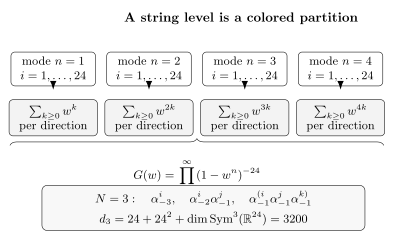
Because the oscillators are bosonic, repeated oscillators are symmetrized. Thus the problem is a partition problem, but with 24 colors, one for each transverse direction.

For example, at level N=2N=2 there are two possibilities:

α2i0;p,α1iα1j0;p.\alpha_{-2}^i|0;p\rangle, \qquad \alpha_{-1}^i\alpha_{-1}^j|0;p\rangle.

The first gives 2424 states. The second is symmetric in i,ji,j, so it gives

dimSym2(R24)=(24+212)=(252)=300.\dim \operatorname{Sym}^2(\mathbb R^{24}) = \binom{24+2-1}{2} = \binom{25}{2} = 300.

Therefore

d2=24+300=324.d_2=24+300=324.

Similarly, at level N=3N=3,

3,2+1,1+1+13, \qquad 2+1, \qquad 1+1+1

give

d3=24+242+(24+313)=24+576+2600=3200.d_3 = 24+24^2+\binom{24+3-1}{3} = 24+576+2600 = 3200.

This combinatorics is best packaged in a generating function.

String oscillator levels as colored partitions.

Each oscillator mode nn can be occupied any nonnegative number of times in each of the 2424 transverse directions. A state at level NN is therefore a 2424-colored partition of NN.

For each fixed pair (n,i)(n,i), the occupation number can be 0,1,2,0,1,2,\ldots, so its contribution to the generating function is

1+wn+w2n+=11wn.1+w^n+w^{2n}+\cdots = \frac{1}{1-w^n}.

Multiplying over all oscillator modes and transverse directions gives

G(w)=TrwN=N=0dNwN=n=11(1wn)24.G(w) = \operatorname{Tr} w^N = \sum_{N=0}^\infty d_N w^N = \prod_{n=1}^\infty \frac{1}{(1-w^n)^{24}}.

Equivalently,

dN=[wN]G(w).d_N=[w^N]\,G(w).

The notation [wN][w^N] means “coefficient of wNw^N.”

The coefficient dNd_N may be extracted by Cauchy’s theorem:

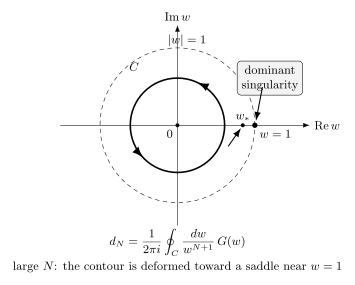
dN=12πiCdwwN+1G(w),d_N = \frac{1}{2\pi i} \oint_C \frac{dw}{w^{N+1}}G(w),

where CC is a small contour around the origin. For fixed, small NN, this is just a formal way of extracting a Taylor coefficient. For large NN, it becomes a saddle-point problem.

The dominant large-NN contribution comes from the singularity of G(w)G(w) closest to the origin. Since

G(w)=n=1(1wn)24,G(w)=\prod_{n=1}^\infty (1-w^n)^{-24},

the most important singularity is at

w=1.w=1.

Physically, w1w\to1 weights high oscillator levels less and less, so the trace over the infinitely many string states becomes singular.

Contour extraction of the coefficient d_N.

The degeneracy dNd_N is a contour integral in the complex ww-plane. For large NN, the contour can be analyzed by deforming it toward the dominant singularity near w=1w=1.

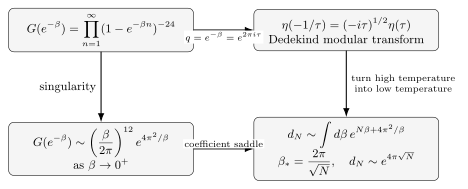
To analyze this singularity, set

w=eβ,β>0,w=e^{-\beta}, \qquad \beta>0,

and take β0+\beta\to0^+. Then

G(eβ)=n=1(1eβn)24.G(e^{-\beta}) = \prod_{n=1}^\infty (1-e^{-\beta n})^{-24}.

This product is closely related to the Dedekind eta function. With

q=e2πiτ,η(τ)=q1/24n=1(1qn),q=e^{2\pi i\tau}, \qquad \eta(\tau)=q^{1/24}\prod_{n=1}^\infty(1-q^n),

we use

q=eβ,τ=iβ2π.q=e^{-\beta}, \qquad \tau=\frac{i\beta}{2\pi}.

The modular transformation

η(1/τ)=(iτ)1/2η(τ)\eta(-1/\tau)=(-i\tau)^{1/2}\eta(\tau)

implies, for β0+\beta\to0^+,

n=1(1eβn)(2πβ)1/2exp(π26β).\prod_{n=1}^\infty(1-e^{-\beta n}) \sim \left(\frac{2\pi}{\beta}\right)^{1/2} \exp\left(-\frac{\pi^2}{6\beta}\right).

Therefore

G(eβ)(β2π)12exp(4π2β).G(e^{-\beta}) \sim \left(\frac{\beta}{2\pi}\right)^{12} \exp\left(\frac{4\pi^2}{\beta}\right).

The exponential factor is the key. The power β12\beta^{12} affects only the power-law prefactor in dNd_N, not the leading exponential growth.

Modular transformation and saddle-point estimate for the oscillator degeneracy.

The modular transformation of the eta function turns the w1w\to1 singularity into an explicit exponential. A saddle-point estimate then gives dNe4πNd_N\sim e^{4\pi\sqrt N}.

Using

wN1dweNβdβw^{-N-1}\,dw \simeq -e^{N\beta}\,d\beta

near w=eβw=e^{-\beta}, the exponential part of the coefficient integral is

dNdβexp(Nβ+4π2β).d_N \sim \int d\beta\, \exp\left( N\beta+\frac{4\pi^2}{\beta} \right).

The saddle point satisfies

0=ddβ(Nβ+4π2β)=N4π2β2,0 = \frac{d}{d\beta} \left( N\beta+\frac{4\pi^2}{\beta} \right) = N-\frac{4\pi^2}{\beta^2},

so

β=2πN.\beta_*=\frac{2\pi}{\sqrt N}.

At the saddle,

Nβ+4π2β=2πN+2πN=4πN.N\beta_*+\frac{4\pi^2}{\beta_*} = 2\pi\sqrt N+2\pi\sqrt N = 4\pi\sqrt N.

Thus the open-string level degeneracy has the leading asymptotic behavior

dNexp(4πN),N1.d_N \sim \exp(4\pi\sqrt N), \qquad N\gg1.

More precisely,

dN=const×N27/4exp(4πN)(1+O(N1/2)),d_N = \text{const}\times N^{-27/4}\exp(4\pi\sqrt N) \left(1+O(N^{-1/2})\right),

but the exponential is what controls the Hagedorn phenomenon.

From level degeneracy to density of massive string states

Section titled “From level degeneracy to density of massive string states”

The open-string mass formula is

M2=N1α.M^2=\frac{N-1}{\alpha'}.

At large level, the intercept is negligible:

NαM2.N\simeq \alpha' M^2.

Therefore

dNexp(4πN)exp(4παM).d_N \sim \exp(4\pi\sqrt N) \sim \exp(4\pi\sqrt{\alpha'}\,M).

This means that the density of string states grows exponentially with the mass:

ρ(M)exp(βHM),\rho(M) \sim \exp(\beta_H M),

with

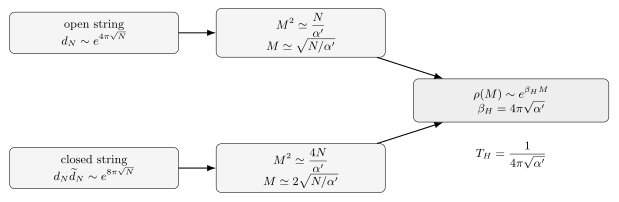
βH=4πα,TH=14πα.\boxed{ \beta_H=4\pi\sqrt{\alpha'}, \qquad T_H=\frac{1}{4\pi\sqrt{\alpha'}}. }

Here we use units kB==c=1k_B=\hbar=c=1.

For the closed string, the same Hagedorn temperature appears. The critical closed bosonic string has independent left- and right-moving transverse oscillators, with

N=N~N=\widetilde N

by level matching and

M2=4α(N1).M^2=\frac{4}{\alpha'}(N-1).

The degeneracy at fixed matched level is roughly

dNcloseddNd~Nexp(8πN).d_N^{\mathrm{closed}} \sim d_N\,\widetilde d_N \sim \exp(8\pi\sqrt N).

But

NαM24,N\simeq \frac{\alpha' M^2}{4},

so

exp(8πN)exp(8παM2)=exp(4παM).\exp(8\pi\sqrt N) \simeq \exp(8\pi\cdot \frac{\sqrt{\alpha'}M}{2}) = \exp(4\pi\sqrt{\alpha'}M).

Thus both open and closed critical bosonic strings have the same leading Hagedorn inverse temperature:

βH=4πα.\beta_H=4\pi\sqrt{\alpha'}.

Open and closed strings give the same Hagedorn temperature.

Open strings have one tower of oscillators, while closed strings have left- and right-moving towers. Level matching changes the mass-level relation in just the right way for the leading Hagedorn temperature to agree.

Why the canonical partition function diverges

Section titled “Why the canonical partition function diverges”

Consider the single-string canonical partition function, suppressing momentum-space powers:

Z1(β)dMρ(M)eβM.Z_1(\beta) \sim \int^\infty dM\,\rho(M)e^{-\beta M}.

Using

ρ(M)eβHM,\rho(M)\sim e^{\beta_H M},

we get

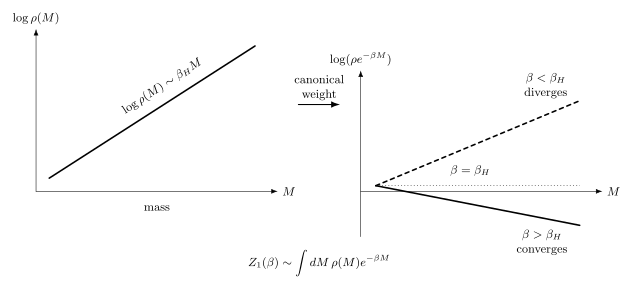
Z1(β)dMe(ββH)M.Z_1(\beta) \sim \int^\infty dM\, e^{-(\beta-\beta_H)M}.

This integral converges only when

β>βH,\beta>\beta_H,

or equivalently

T<TH.T<T_H.

For

ββH,\beta\leq \beta_H,

the exponential growth of the number of string states overwhelms the Boltzmann suppression.

Hagedorn growth and the convergence of the thermal partition function.

The density of states grows as ρ(M)eβHM\rho(M)\sim e^{\beta_H M}. The canonical Boltzmann factor eβMe^{-\beta M} suppresses high masses only when β>βH\beta>\beta_H.

This is the string-theoretic analog of the Hagedorn behavior originally discovered in hadronic physics: adding energy does not simply populate a fixed number of particle species with higher momenta. Instead, it opens up exponentially many internal string oscillator states.

The Hagedorn scale has several complementary meanings.

First, it is a statement about the spectrum. Strings have infinitely many oscillator modes, and the number of ways to distribute a large level NN among them grows exponentially in N\sqrt N. Since MNM\sim\sqrt N, this becomes exponential growth in MM.

Second, it is a statement about thermal equilibrium. In a canonical ensemble, high-mass string states are Boltzmann-suppressed by eβMe^{-\beta M}, but the number of such states is enhanced by eβHMe^{\beta_H M}. When β\beta approaches βH\beta_H from above, the competition becomes marginal.

Third, it is a statement about the extended nature of strings. A point particle with finitely many species has a density of internal states that is finite or polynomial. A string has an infinite tower of vibrational modes, and the high-energy thermodynamics remembers this tower.

At this stage in the course, the Hagedorn calculation also serves a structural purpose. We have seen that even the free string knows about modular functions, contour integrals, and asymptotic CFT state counting. These tools will reappear immediately when we study perturbative string interactions as sums over worldsheet geometries.

Compute d2d_2, d3d_3, and d4d_4 for the open critical bosonic string using only transverse oscillators.

Solution

At level N=2N=2, the partitions are 22 and 1+11+1:

d2=24+(252)=24+300=324.d_2 = 24+\binom{25}{2} = 24+300 = 324.

At level N=3N=3, the partitions are 33, 2+12+1, and 1+1+11+1+1:

d3=24+242+(263)=24+576+2600=3200.d_3 = 24+24^2+\binom{26}{3} = 24+576+2600 = 3200.

At level N=4N=4, the partitions are

4,3+1,2+2,2+1+1,1+1+1+1.4,\qquad 3+1,\qquad 2+2,\qquad 2+1+1,\qquad 1+1+1+1.

Thus

d4=24+242+(252)+24(252)+(274).d_4 = 24 + 24^2 + \binom{25}{2} + 24\binom{25}{2} + \binom{27}{4}.

Using

(252)=300,(274)=17550,\binom{25}{2}=300, \qquad \binom{27}{4}=17550,

we find

d4=24+576+300+7200+17550=25650.d_4 = 24+576+300+7200+17550 = 25650.

Exercise 2. Derive the generating function

Section titled “Exercise 2. Derive the generating function”

Show that

G(w)=TrwN=n=1(1wn)24.G(w)=\operatorname{Tr}w^N = \prod_{n=1}^{\infty}(1-w^n)^{-24}.
Solution

For each oscillator αni\alpha_{-n}^i, the occupation number Nn,iN_{n,i} can be any nonnegative integer. Its contribution to the trace is

k=0wnk=11wn.\sum_{k=0}^{\infty}w^{nk} = \frac{1}{1-w^n}.

There are 2424 transverse directions for each nn, so fixed nn contributes

i=12411wn=(1wn)24.\prod_{i=1}^{24}\frac{1}{1-w^n} = (1-w^n)^{-24}.

Multiplying over all positive modes gives

G(w)=n=1(1wn)24.G(w) = \prod_{n=1}^{\infty}(1-w^n)^{-24}.

Assume

G(eβ)(β2π)12e4π2/βG(e^{-\beta}) \sim \left(\frac{\beta}{2\pi}\right)^{12} e^{4\pi^2/\beta}

as β0+\beta\to0^+. Ignoring the power of β\beta, use a saddle-point approximation to show that

dNe4πN.d_N\sim e^{4\pi\sqrt N}.
Solution

Near w=eβw=e^{-\beta}, the coefficient integral has exponential part

dNdβexp(Nβ+4π2β).d_N \sim \int d\beta\, \exp\left( N\beta+\frac{4\pi^2}{\beta} \right).

Define

S(β)=Nβ+4π2β.S(\beta)=N\beta+\frac{4\pi^2}{\beta}.

The saddle satisfies

S(β)=N4π2β2=0,S'(\beta)=N-\frac{4\pi^2}{\beta^2}=0,

so

β=2πN.\beta_*=\frac{2\pi}{\sqrt N}.

Then

S(β)=N2πN+4π22π/N=2πN+2πN=4πN.S(\beta_*) = N\frac{2\pi}{\sqrt N} + \frac{4\pi^2}{2\pi/\sqrt N} = 2\pi\sqrt N+2\pi\sqrt N = 4\pi\sqrt N.

Therefore

dNe4πN,d_N\sim e^{4\pi\sqrt N},

up to a power-law prefactor.

Exercise 4. Same Hagedorn temperature for closed strings

Section titled “Exercise 4. Same Hagedorn temperature for closed strings”

Using

dNopene4πN,d_N^{\mathrm{open}}\sim e^{4\pi\sqrt N},

show that the closed bosonic string has the same leading βH\beta_H as the open bosonic string.

Solution

For a closed string, level matching gives

N=N~,N=\widetilde N,

and the large-level degeneracy is approximately

dNcloseddNd~Ne4πNe4πN=e8πN.d_N^{\mathrm{closed}} \sim d_N\widetilde d_N \sim e^{4\pi\sqrt N}e^{4\pi\sqrt N} = e^{8\pi\sqrt N}.

The closed-string mass formula is

M2=4α(N1).M^2=\frac{4}{\alpha'}(N-1).

At large NN,

NαM24,NαM2.N\simeq \frac{\alpha'M^2}{4}, \qquad \sqrt N\simeq \frac{\sqrt{\alpha'}M}{2}.

Therefore

dNclosedexp(8παM2)=exp(4παM).d_N^{\mathrm{closed}} \sim \exp\left(8\pi\cdot\frac{\sqrt{\alpha'}M}{2}\right) = \exp(4\pi\sqrt{\alpha'}M).

Thus

βH=4πα,TH=14πα.\beta_H=4\pi\sqrt{\alpha'}, \qquad T_H=\frac{1}{4\pi\sqrt{\alpha'}}.

Exercise 5. General number of transverse bosons

Section titled “Exercise 5. General number of transverse bosons”

Suppose a light-cone string had dd transverse bosonic oscillators, so that

Gd(w)=n=1(1wn)d.G_d(w)=\prod_{n=1}^\infty (1-w^n)^{-d}.

Show that the leading open-string growth is

dNexp(2πdN6),d_N\sim \exp\left(2\pi\sqrt{\frac{dN}{6}}\right),

and find the corresponding open-string Hagedorn inverse temperature.

Solution

For dd transverse bosons, the Cardy estimate gives

dNexp(2πdN6).d_N \sim \exp\left(2\pi\sqrt{\frac{dN}{6}}\right).

For an open string with

M2Nα,M^2\simeq \frac{N}{\alpha'},

we have

NαM2.N\simeq \alpha'M^2.

Therefore

dNexp(2πdα6M).d_N \sim \exp\left( 2\pi\sqrt{\frac{d\alpha'}{6}}\,M \right).

Thus the Hagedorn inverse temperature is

βH=2πdα6.\beta_H = 2\pi\sqrt{\frac{d\alpha'}{6}}.

For the critical bosonic string, d=24d=24, so

βH=2π4α=4πα.\beta_H = 2\pi\sqrt{4\alpha'} = 4\pi\sqrt{\alpha'}.