
Witten Diagrams and Large-N Perturbation Theory
The main idea
Section titled “The main idea”The previous pages computed scalar two-point and three-point functions. Those calculations were the first pieces of a larger machine. In AdS/CFT, the semiclassical expansion of the bulk path integral gives a diagrammatic expansion of CFT correlation functions. The diagrams are called Witten diagrams.
A Witten diagram is the AdS analogue of a Feynman diagram, but with an important twist: its external legs usually end on the conformal boundary. The external legs are bulk-to-boundary propagators, the internal lines are bulk-to-bulk propagators, and the vertices are integrated over AdS. Schematically,
This is not merely a convenient notation. It is the operational bridge between the bulk effective action and the CFT data. Masses determine operator dimensions, cubic couplings determine OPE coefficients, quartic and exchange diagrams determine four-point functions, and loops determine corrections.
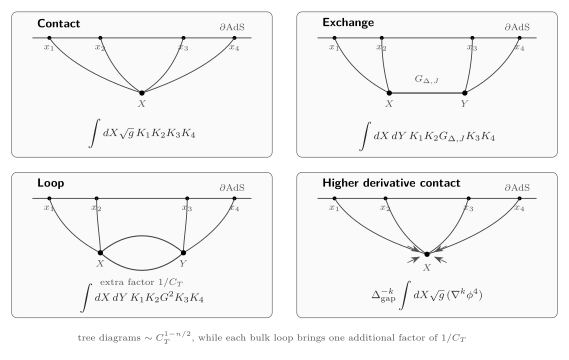
Witten diagrams are the perturbative Feynman rules of AdS/CFT. Contact diagrams come from local AdS vertices, exchange diagrams contain a bulk-to-bulk propagator , bulk loops are suppressed by additional powers of , and higher-derivative contact vertices encode finite-gap or finite-coupling corrections.
The most useful organizing parameter is not literally always . It is the effective number of degrees of freedom, which may be measured by the stress-tensor two-point coefficient . For the canonical matrix large- examples,
For unit-normalized single-trace operators, connected correlators have the characteristic scaling
Thus a tree-level three-point function scales as , a tree-level connected four-point function scales as , and each additional bulk loop brings one more power of .
For a matrix theory with , this becomes
This page explains where those powers come from, how to write the diagrams, what the diagrams mean in the CFT OPE, and where the common traps lie.
The bulk action as a generating machine
Section titled “The bulk action as a generating machine”Consider a collection of bulk fields dual to single-trace CFT operators . The precise field content may come from a top-down compactification, such as type IIB on , or from a bottom-up effective theory. At low energies relative to the string scale, a typical bulk effective action has the form
where multiplies the classical two-derivative action. In a theory with a large gap to stringy or higher-spin states, the leading local action also admits a derivative expansion,
The two expansions are logically distinct:
| Bulk effect | CFT interpretation | Typical size for unit-normalized operators |
|---|---|---|
| Tree-level two-derivative supergravity | Leading connected large- correlators at strong coupling | |
| Tree-level higher-derivative vertex | Finite-gap or finite-coupling correction | |
| One bulk loop | First quantum gravity correction | |
| bulk loops | Higher quantum gravity correction | |
| String genus in a closed-string theory | Nonplanar correction | usually in matrix large- |
In the canonical SYM example,
so the large-gap expansion is the large-‘t Hooft-coupling expansion. The first famous type-IIB correction to the two-derivative supergravity action is an -type term, suppressed by a positive power of . The precise power depends on the operator and interaction under consideration, but the conceptual point is universal: finite coupling is not the same expansion as finite .
Diagrammatic rules in Euclidean AdS
Section titled “Diagrammatic rules in Euclidean AdS”For clarity, take Euclidean AdS in Poincare coordinates,
A scalar field dual to a scalar primary of dimension has mass
The bulk-to-boundary propagator is
with a normalization convention such as
The bulk-to-bulk propagator solves
with the boundary condition appropriate to the chosen quantization. For spinning fields, one uses the corresponding tensor, spinor, gauge-field, or graviton propagator, together with gauge fixing and ghost contributions when loops are involved.
The basic scalar rules are then as follows.
Contact diagrams
Section titled “Contact diagrams”A quartic interaction
contributes to the four-point function through
For a general -point contact vertex,
This is the AdS version of a local interaction. It has one integration point because all external legs meet at one bulk point.
Derivative interactions insert derivatives acting on the propagators. For example,
gives
Different derivative bases can be related by integration by parts, equations of motion, and field redefinitions. The separated-point CFT correlator is invariant, but contact terms and intermediate-looking vertices can change.
Exchange diagrams
Section titled “Exchange diagrams”Suppose a field of dimension and spin couples through cubic vertices to pairs of fields. In scalar notation,
The corresponding -channel exchange diagram is
There are also - and -channel diagrams obtained by permuting the external operators.
For a spin- exchange, carries tensor indices and the cubic vertices contain derivatives and contractions. The symbolic structure is the same, but the numerator data are richer. A graviton exchange diagram, for instance, is controlled by the coupling of the matter stress tensor to the metric perturbation and is dual to stress-tensor exchange in the CFT.
Loop diagrams
Section titled “Loop diagrams”A one-loop bulk correction to a four-point function has the schematic form
possibly with sums over species and tensor structures. In an effective field theory, these integrals can have ultraviolet divergences when the bulk points collide. Those divergences are removed by local bulk counterterms, just as in ordinary QFT. The difference is that the resulting finite answer must also respect AdS boundary conditions and CFT crossing symmetry.
Bulk loops are conceptually important because they compute quantum gravity corrections. In practice they are technically much harder than tree-level Witten diagrams. They require gauge fixing, ghosts, counterterms, and sometimes the full tower of string modes to define the UV completion.
Large- counting from bulk topology
Section titled “Large-NNN counting from bulk topology”There is a clean way to derive the powers of . Work with canonically normalized bulk fields , so that the quadratic action is order one,
This normalization is obtained by rescaling the original classical field by . In this basis, an -point vertex carries the factor
Consider a connected diagram with external legs, vertices, internal lines, and loops. If vertex has valence , then
The product of vertex factors gives
The loop number satisfies
for a connected diagram. Therefore
This is one of the most useful formulas in large- holography.
For ,
For ,
For , tree-level normalization is order one for unit-normalized operators.
In matrix large- theories with , this same formula says
This is the same topology that appeared in the double-line genus expansion: every extra closed-string loop costs .
Connected versus disconnected four-point functions
Section titled “Connected versus disconnected four-point functions”Four-point functions are where Witten diagrams first become a genuinely new object. For an identical unit-normalized scalar single-trace operator with
conformal symmetry lets us write
where
At leading order in large , the operator behaves like a generalized free field. The four-point function is just the sum of Wick-like disconnected contractions,
Interactions in the bulk produce the connected part,
Here is computed by tree-level contact and exchange Witten diagrams. The term receives one-loop Witten diagrams, as well as corrections from lower-order data required by crossing and unitarity.
This is a good place to notice a common source of confusion. The leading four-point function is order one, but it is disconnected. The leading connected four-point function is order . In the bulk, the disconnected piece is not a connected Witten diagram; it comes from products of lower-point functions. The first connected bulk process is a tree diagram.
OPE interpretation: single-trace and double-trace data
Section titled “OPE interpretation: single-trace and double-trace data”A Witten diagram is also a statement about the CFT OPE.
At large , a product of two single-trace operators contains double-trace operators of the schematic form
with leading dimensions
Bulk interactions shift these dimensions,
Tree-level contact diagrams contribute to the anomalous dimensions and OPE coefficients of these double-trace operators. Exchange diagrams do that too, but they also contain the exchange of a single-trace operator dual to the intermediate bulk field. If the exchanged bulk field has dimension and spin , then the CFT four-point function knows about the single-trace primary appearing in the appropriate OPE channel.
The rough dictionary is:
| Witten diagram feature | CFT OPE feature |
|---|---|
| Contact vertex | Corrections to double-trace OPE data |
| Derivative contact vertex | More structured spin and twist dependence of double-trace data |
| Exchange of field | Single-trace operator plus induced double-trace corrections |
| Graviton exchange | Stress-tensor exchange and universal gravitational binding effects |
| Bulk loop | One-loop anomalous dimensions, multi-particle thresholds, bulk counterterms |
| Higher-derivative vertex | Finite-gap corrections; polynomial high-energy behavior in Mellin space |
This is why four-point functions are so central in modern holography. They are simultaneously scattering experiments in AdS, consistency conditions from the CFT bootstrap, and probes of bulk locality.
Mellin space: why Witten diagrams resemble scattering amplitudes
Section titled “Mellin space: why Witten diagrams resemble scattering amplitudes”Position-space Witten diagrams can be complicated. Mellin space often makes their structure look much closer to ordinary scattering amplitudes. One does not need Mellin technology to use this course, but the basic dictionary is too useful to ignore.
For scalar four-point functions, the Mellin representation writes the reduced correlator roughly as an inverse Mellin transform,
The exact Gamma factors are fixed by external dimensions and convention. The important object is the Mellin amplitude . In holographic CFTs,
| AdS process | Mellin-space behavior |
|---|---|
| Non-derivative contact vertex | Polynomial of low degree, often a constant |
| Higher-derivative contact vertex | Higher-degree polynomial in |
| Exchange diagram | Poles associated with the exchanged single-trace operator |
| Loop diagram | More complicated analytic structure, including sums and cuts in suitable limits |
This is the AdS analogue of the statement that local interactions give polynomial scattering amplitudes, while particle exchange gives poles. The analogy becomes literal in a flat-space limit where the AdS radius is taken large compared with local scattering scales.
Mellin space also clarifies the role of the gap. A large gap means that, below the gap, heavy stringy or higher-spin states can be integrated out. Their effects appear as local higher-derivative contact interactions, hence as polynomial Mellin amplitudes suppressed by powers of .
Locality, crossing, and the large-gap condition
Section titled “Locality, crossing, and the large-gap condition”A large- expansion alone does not guarantee an Einstein-like bulk dual. Vector models can have large , but their bulk duals, when they exist, are higher-spin theories rather than ordinary two-derivative gravity. A local Einstein-like bulk requires more structure.
The modern CFT-first criterion is roughly:
The gap is essential. If there is an infinite tower of light higher-spin single-trace operators, then low-energy bulk scattering is not described by a finite set of local fields with a small number of derivatives. Conversely, when the low-energy single-trace spectrum is sparse and the gap is large, four-point functions can often be organized as local AdS interactions plus exchange diagrams.
From the CFT side, crossing symmetry is the statement that different OPE decompositions of the same correlator agree. From the bulk side, crossing is the statement that the sum of contact and exchange diagrams gives a consistent AdS scattering process. A single exchange diagram in one channel is generally not by itself the full answer; consistency usually requires adding other channels and contact terms.
Boundary conditions and the type of correlator
Section titled “Boundary conditions and the type of correlator”The diagrammatic rules above were Euclidean and vacuum-like. In Euclidean AdS, one usually imposes regularity in the interior. This produces Euclidean CFT correlators.
Lorentzian AdS requires more care. A bulk-to-bulk propagator can be Feynman, retarded, advanced, Wightman, or something else. In a black-hole background, the correct prescription for retarded correlators involves infalling boundary conditions at the horizon. The same diagram topology can therefore compute different real-time observables depending on the contour and boundary conditions.
For this reason, it is better to say:
The next real-time page in this module will revisit this point for retarded Green functions. For now, the diagrams should be understood as Euclidean correlator diagrams unless stated otherwise.
What counts as a physical diagram?
Section titled “What counts as a physical diagram?”Not every individual diagram is an observable. Gauge choices, field redefinitions, integrations by parts, and counterterm schemes can change intermediate diagrams. The physical object is the full renormalized correlator at separated points, together with scheme-dependent contact terms when those are relevant.
For example, a field redefinition
can move strength between a cubic vertex and a quartic vertex. It can change how a calculation is represented diagrammatically, but it cannot change the full CFT correlator. Similarly, local counterterms on the AdS boundary change contact terms in CFT correlators, but not separated-point OPE data.
The safest attitude is:
Witten diagrams are a calculational language for the renormalized bulk path integral, not separately gauge-invariant particles of meaning.
The exception is when a particular analytic feature is invariant. For instance, the pole associated with a genuine single-trace exchange is physical. But the polynomial contact ambiguity around it is often scheme- or field-basis-dependent.
Worked example: the scaling of a four-point contact diagram
Section titled “Worked example: the scaling of a four-point contact diagram”Take a single scalar field with a canonically normalized bulk action
The connected four-point contact diagram is proportional to
Thus
For , this is . That is precisely the connected four-point scaling of unit-normalized single-trace operators in a matrix large- theory.
Now add a higher-derivative interaction,
Its four-point contribution is still tree-level, so it has the same large- scaling , but it is additionally suppressed by . This is why tree-level finite-coupling corrections and loop-level finite- corrections should not be conflated.
Common mistakes
Section titled “Common mistakes”Mistake 1: “A Witten diagram is just a Feynman diagram in one higher dimension.”
Only partly. The internal logic is Feynman-like, but the external legs usually end on the boundary, the vertices are integrated over curved AdS, and the result is constrained by conformal symmetry rather than by ordinary momentum conservation.
Mistake 2: “Tree level means leading order in all expansions.”
Tree level means leading order in the bulk loop expansion. A tree-level higher-derivative vertex can be subleading in or , while still being leading in .
Mistake 3: “Large automatically means Einstein gravity.”
No. Large gives factorization and a weakly coupled bulk expansion. A local Einstein-like bulk also requires a sparse low-dimension spectrum and a large gap to higher-spin/stringy states.
Mistake 4: “The exchange diagram only contains single-trace exchange.”
The exchanged bulk field corresponds to a single-trace primary, but the full CFT conformal-block decomposition also contains double-trace operators. The bulk diagram packages both kinds of information.
Mistake 5: “A contact term is always unphysical.”
Separated-point contact ambiguities often do not affect OPE data, but contact terms can matter for Ward identities, anomalies, response functions, and scheme-dependent local terms in generating functionals.
Mistake 6: “One can ignore disconnected pieces.”
For four-point functions, the leading large- answer is disconnected and order one. The connected Witten diagrams start at order . Mixing these two statements is a classic normalization error.
Exercises
Section titled “Exercises”Exercise 1: Topological counting
Section titled “Exercise 1: Topological counting”Consider a connected Witten diagram made from canonically normalized bulk fields. Suppose an -point vertex scales as . Let the diagram have external legs and bulk loops. Show that the diagram scales as
Solution
Let the diagram have vertices and internal lines. If vertex has valence , then the total number of half-edges attached to vertices is
because external legs contribute once and internal lines contribute twice. The product of vertex factors is
For a connected diagram,
so
Therefore the diagram scales as
Exercise 2: Four-point large- orders
Section titled “Exercise 2: Four-point large-NNN orders”For a unit-normalized single-trace scalar , determine the large- order of the following pieces of
- The disconnected generalized-free contribution.
- The tree-level connected contact contribution.
- The tree-level exchange contribution.
- A one-loop bulk bubble contribution.
Solution
The disconnected generalized-free contribution is order one, because it is a product of two unit-normalized two-point functions.
The tree-level connected contact and exchange diagrams are both connected four-point tree diagrams. Using
with and , both scale as
A one-loop bulk bubble has and , so it scales as
For matrix large , these are respectively , , , and .
Exercise 3: Write the exchange integral
Section titled “Exercise 3: Write the exchange integral”A scalar field of dimension couples to four scalar fields through
Write the -channel exchange contribution to the four-point function.
Solution
The external fields are represented by bulk-to-boundary propagators , and the exchanged field is represented by a bulk-to-bulk propagator . The -channel exchange diagram is
The - and -channel diagrams are obtained by permuting the external labels.
Exercise 4: Contact diagrams and double-trace data
Section titled “Exercise 4: Contact diagrams and double-trace data”Explain why a tree-level contact Witten diagram contributes to anomalous dimensions of double-trace operators , even though it does not exchange a new single-particle bulk field.
Solution
At leading large , the product contains generalized-free double-trace operators with dimensions
A connected four-point function at order changes the conformal-block decomposition. Those changes can appear as corrections to OPE coefficients and as anomalous dimensions,
A contact Witten diagram gives precisely such an order- connected four-point function. Since it has no internal bulk propagator, it does not introduce a new single-trace exchange pole. Its CFT content is therefore encoded in the corrected double-trace data required by the OPE and crossing symmetry.
Exercise 5: Finite-gap versus loop suppression
Section titled “Exercise 5: Finite-gap versus loop suppression”Suppose a four-point function receives two corrections:
Interpret these two terms in the bulk. Which one is tree-level? Which one is a quantum correction?
Solution
The term
has the same scaling as a tree-level connected four-point diagram, but it is suppressed by powers of the gap. It is naturally interpreted as a tree-level higher-derivative contact interaction obtained by integrating out heavy stringy or higher-spin states.
The term
has the scaling of a one-loop bulk correction to a four-point function. It is a quantum correction in the bulk semiclassical expansion.
Thus finite-gap corrections and bulk-loop corrections are different expansions, even though both are subleading relative to the leading tree-level supergravity answer.
Further reading
Section titled “Further reading”- Edward Witten, “Anti de Sitter Space and Holography”. The original boundary-value formulation that introduced the diagrammatic AdS calculation of CFT correlators.
- S. S. Gubser, I. R. Klebanov, and A. M. Polyakov, “Gauge Theory Correlators from Non-Critical String Theory”. The original GKPW generating-functional prescription.
- Daniel Z. Freedman, Samir D. Mathur, Alec Matusis, and Leonardo Rastelli, “Correlation Functions in the CFT/AdS Correspondence”. A classic explicit treatment of AdS correlator integrals.
- Eric D’Hoker and Daniel Z. Freedman, “Supersymmetric Gauge Theories and the AdS/CFT Correspondence”. Detailed lecture notes on correlators, Witten diagrams, and supergravity normalizations.
- Idse Heemskerk, Joao Penedones, Joseph Polchinski, and James Sully, “Holography from Conformal Field Theory”. A modern CFT-first analysis of large , crossing, gaps, and local bulk interactions.
- Joao Penedones, “Writing CFT Correlation Functions as AdS Scattering Amplitudes”. A foundational reference on Mellin amplitudes and the scattering-amplitude viewpoint.
- A. Liam Fitzpatrick, Jared Kaplan, Joao Penedones, Suvrat Raju, and Balt C. van Rees, “A Natural Language for AdS/CFT Correlators”. A useful guide to Mellin-space factorization and Witten-diagram intuition.