
Embedding-Space Formalism
The conformal group acts nonlinearly on ordinary coordinates . Translations and rotations are simple, but inversions and special conformal transformations are not. The embedding-space formalism removes this asymmetry by replacing physical points with null rays in two extra dimensions:
In embedding space, conformal transformations act linearly. The price is a projective redundancy. The reward is that conformal distances, cross-ratios, tensor structures, and AdS bulk-to-boundary propagators become simple ambient inner products.
This page uses Euclidean notation unless otherwise stated. For Lorentzian CFT, replace by ; the group changes from to , but the formulas have the same form.
The projective null cone
Section titled “The projective null cone”Introduce an ambient space with coordinates
and inner product
Thus
The physical space is the set of nonzero null vectors modulo positive rescaling:
The representative is not physical; the ray is physical. This distinction is the whole point of the formalism.
A convenient section of the cone is
Then every finite point is represented by
It is indeed null:
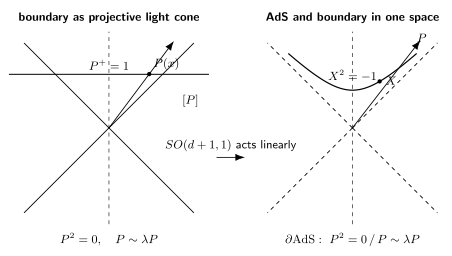
A schematic two-dimensional slice of the embedding construction. CFT boundary points are null rays modulo . The gauge chooses one representative of each finite boundary point. Euclidean AdS is the hyperboloid inside the same ambient space, and its boundary is approached by as .
The basic distance identity
Section titled “The basic distance identity”For two points , write and . Then
It is therefore natural to define
On the section ,
This formula is the first little miracle: the ordinary squared distance is an ambient inner product.
Infinity and the compactified space
Section titled “Infinity and the compactified space”The section does not cover the whole projective cone. Null rays with are points at conformal infinity. A useful representative of the point at infinity is
This clarifies inversion. The origin is
Inversion is simply the exchange
So the origin maps to . Nothing singular happens on the projective cone; singularities only appear after choosing the flat section.
Linear conformal transformations
Section titled “Linear conformal transformations”The group acts linearly on and preserves . Therefore it maps null rays to null rays. After acting on , we return to the flat section by a projective rescaling:
The new point is the conformally transformed point in ordinary coordinates. The factor is the compensating scale needed to restore the choice .
For example, inversion gives
so
Translations are also linear upstairs:
Applied to , this gives
A special conformal transformation is inversion, then translation, then inversion. In ordinary coordinates it becomes
but in embedding space it is just another linear transformation.
Sections are Weyl frames
Section titled “Sections are Weyl frames”The flat representative obeys
If we choose another section
then, using and ,
Thus changing the section of the projective cone is exactly a Weyl transformation of the physical metric:
This is the geometric reason the same cone describes flat space, the cylinder , and the sphere: they are different Weyl frames of the same conformal geometry.
Scalar primaries as homogeneous functions
Section titled “Scalar primaries as homogeneous functions”A scalar primary of dimension is lifted to a homogeneous function on the null cone:
The physical operator is obtained by pullback to the section:
The conformal dimension is now the homogeneity degree on the projective cone. A correlator must therefore have the correct weight under independent rescalings of each point:
This is often the fastest way to derive scalar correlators.
Two- and three-point functions
Section titled “Two- and three-point functions”For two scalar primaries, the only invariant is . Hence
Since , homogeneity requires
Thus, after diagonalizing operators with identical quantum numbers,
On the flat section,
For three scalar primaries, write
Homogeneity gives
Solving,
Therefore
The coefficient is dynamical data. The powers of are kinematics.
Four-point functions and cross-ratios
Section titled “Four-point functions and cross-ratios”At four points, two independent cross-ratios appear:
On the flat section,
For identical scalar primaries of dimension , a common convention is
The function is dynamical. The OPE and crossing symmetry will constrain it later.
Spinning operators
Section titled “Spinning operators”Embedding space becomes especially useful for spinning operators. A symmetric traceless spin- primary can be packaged using an auxiliary polarization vector:
The conditions are
There is also the gauge redundancy
The homogeneity is
A physical polarization is embedded by
Then
Thus implements tracelessness.
Two common gauge-invariant building blocks are
and
Different references normalize these objects differently. The invariant content is the same: spinning tensor structures are homogeneous, transverse, and invariant under .
The AdS hyperboloid
Section titled “The AdS hyperboloid”The same ambient space contains AdS. Set the AdS radius to . Euclidean is
A convenient Poincare-coordinate embedding is
It obeys . As ,
Thus the conformal boundary of AdS is the same projective null cone used to represent CFT points.
The basic bulk-boundary invariant is
Therefore the scalar bulk-to-boundary propagator can be written as
In Poincare coordinates,
This formula is the first concrete bridge from CFT embedding-space kinematics to AdS calculations.
AdS/CFT checkpoint
Section titled “AdS/CFT checkpoint”Embedding space makes three facts manifest:
The basic bulk-boundary invariant is . The basic boundary-boundary invariant is .
How to use the formalism in practice
Section titled “How to use the formalism in practice”For scalar correlators, the recipe is almost mechanical. First write all possible ambient inner products . Then impose the correct projective weight at each point. Finally choose a section, usually , to recover the ordinary coordinate-space expression.
For spinning correlators, the same logic applies with one extra rule: every expression must be invariant under
This gauge redundancy removes unphysical ambient components. It is the embedding-space version of the statement that a CFT tensor lives tangent to the physical spacetime, not in the extra radial direction of the cone.
A proposed expression should pass four checks:
- It is built from ambient contractions, so or covariance is manifest.
- It has the correct homogeneity in every .
- It is invariant under whenever polarizations are present.
- After setting and , it reduces to a sensible physical-space tensor structure.
This is why embedding space is so useful in the conformal bootstrap. Tensor structures that look painful in physical coordinates become polynomial algebra in and .
Generators in embedding space
Section titled “Generators in embedding space”The conformal algebra also becomes simple. On scalar ambient functions, the linear generators are
They obey the algebra in Euclidean signature, or in Lorentzian signature. The usual generators , , , and are linear combinations of these after choosing lightcone coordinates and . This is the algebraic reason conformal Casimir equations are cleaner in embedding notation.
One should remember, however, that the ambient function is defined only up to its values away from the cone. Physical statements must be independent of any arbitrary off-cone extension. Homogeneity and projective gauge invariance are what keep the calculation honest.
Lorentzian caution
Section titled “Lorentzian caution”The formulas above are algebraic. Lorentzian CFT also requires causal information: Wightman ordering, time ordering, retarded commutators, and prescriptions. Embedding space makes covariance manifest, but it does not by itself choose a Lorentzian correlator. The same algebraic expression can correspond to different real-time orderings depending on how the singularities are approached.
This distinction matters in holography. Euclidean bulk-to-boundary propagators are straightforward powers of . Lorentzian propagators require the correct contour or prescription, especially near light cones and horizons.
Exercises
Section titled “Exercises”Exercise 1: Null representative
Section titled “Exercise 1: Null representative”Show that is null and that .
Solution
Using
we get
For two points,
Therefore
Exercise 2: Inversion
Section titled “Exercise 2: Inversion”Show that swapping and gives physical inversion .
Solution
Start from
After swapping and ,
Using projectivity,
This is with .
Exercise 3: Three-point exponents
Section titled “Exercise 3: Three-point exponents”Derive the scalar three-point powers from homogeneity.
Solution
Write
Homogeneity at gives
Solving gives
Exercise 4: Polarization lift
Section titled “Exercise 4: Polarization lift”Verify that satisfies and .
Solution
Since ,
Also,
because .
Exercise 5: Bulk-to-boundary invariant
Section titled “Exercise 5: Bulk-to-boundary invariant”Show that
Solution
Using
we find
Thus
Multiplying by gives the result.
Summary
Section titled “Summary”The embedding-space dictionary is
The basic invariant is
A scalar primary is a homogeneous function on the cone:
AdS is the hyperboloid in the same ambient space, and its boundary is the same projective null cone. This is why embedding space is one of the cleanest bridges from CFT kinematics to the AdS/CFT dictionary.