
Entanglement and Modular Hamiltonian
Entanglement is where CFT starts to look like geometry.
A CFT is defined by local operator data, but a state of the CFT contains nonlocal information. Given a spatial region , the reduced density matrix knows how the degrees of freedom in are correlated with the degrees of freedom in the complement . The entropy of is not an ordinary thermodynamic entropy: even the vacuum has nonzero entanglement entropy. In holographic CFTs this entropy becomes an area in one higher-dimensional spacetime.
This page introduces the CFT side of that story. The essential chain of ideas is
The central point is that entanglement entropy is usually hard, but for special regions in the vacuum of a CFT, the modular Hamiltonian is known exactly. The most important example for AdS/CFT is a ball-shaped region.
Reduced density matrix
Section titled “Reduced density matrix”Let the CFT be quantized on a Cauchy slice . Suppose is a spatial subregion and is its complement. In a regulated theory, the Hilbert space is approximately factorized as
This factorization is morally correct for a scalar lattice theory. In continuum QFT it is more subtle because of UV modes near the entangling surface , and in gauge theory there are additional subtleties associated with constraints and edge modes. For this course, the regulated picture is the right starting point.
Given a global density matrix , the reduced density matrix on is
For a pure global state , the reduced density matrix is generally mixed. The entanglement entropy of is the von Neumann entropy
If the global state is pure and the Hilbert-space factorization is exact, then
This equality is a useful diagnostic. If the global state is thermal, mixed, or if the factorization has gauge-theory subtleties, this equality need not hold in the naive form.
The Rényi entropies are
The entanglement entropy is obtained by taking the limit
The Rényi entropies contain more information than . In principle, knowing all reconstructs the spectrum of .
UV structure of entanglement entropy
Section titled “UV structure of entanglement entropy”Entanglement entropy in continuum QFT is UV divergent. The reason is local: modes just inside and just outside are highly entangled at arbitrarily short distances.
For a smooth entangling surface in a -dimensional CFT, the leading divergence has the area-law form
where is a UV cutoff. The coefficient is regulator dependent. It is not a universal observable.
The universal part is the real prize. Its form depends on the spacetime dimension. In even , there is usually a universal logarithmic term. In odd , there is often a universal cutoff-independent constant term. In , the leading term itself is logarithmic and controlled by the central charge.
For example, in a parity-invariant two-dimensional CFT with , the entanglement entropy of a single interval of length in the vacuum on the plane is
where is nonuniversal. More generally, if , the coefficient becomes .
This formula is one of the cleanest places where the central charge becomes a measure of degrees of freedom.
Modular Hamiltonian
Section titled “Modular Hamiltonian”The modular Hamiltonian of region is defined by
with the normalization convention . Equivalently,
Some references instead write
Then
The two conventions differ by an additive constant. Additive constants do not affect modular flow or variations , but they do affect the literal equation . With the normalized convention above,
The modular Hamiltonian generates modular flow:
This looks like time evolution, but it is usually not generated by a local integral of the stress tensor. For a generic region and a generic state, is an extremely nonlocal operator.
That is why the few known local examples are so important.
Vacuum half-space: Rindler modular Hamiltonian
Section titled “Vacuum half-space: Rindler modular Hamiltonian”Consider the CFT vacuum in flat Lorentzian spacetime and the half-space region
The causal domain of is the right Rindler wedge. The modular Hamiltonian is local and equals the boost generator:
up to the normalization convention discussed above.
This result is the QFT version of the statement that the Minkowski vacuum restricted to a Rindler wedge is thermal with respect to boosts. In Euclidean signature, the argument is almost geometric: the plane near the entangling surface is described by polar coordinates, and regularity requires angular period .
The half-space formula is the prototype for black-hole thermality. Near a smooth horizon, the geometry locally looks Rindler. This is why modular Hamiltonians, Unruh physics, and black-hole entropy are not separate subjects.
Vacuum ball: the most important CFT example
Section titled “Vacuum ball: the most important CFT example”Now take the CFT vacuum and let be the ball of radius at :
The domain of dependence is a causal diamond. A conformal transformation maps this diamond to a hyperbolic cylinder,
Under this map, the vacuum reduced density matrix on the ball becomes a thermal density matrix on hyperbolic space. The modular flow is generated by the conformal Killing vector
At , this reduces to
Therefore the modular Hamiltonian is
again up to an additive constant if one uses the unnormalized convention.
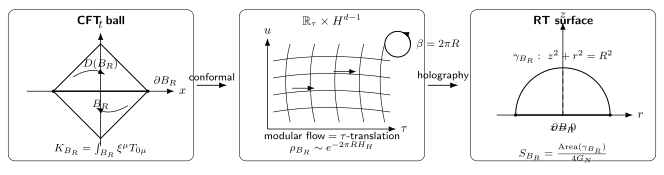
For the CFT vacuum, the reduced density matrix on a ball has a local modular Hamiltonian. The causal diamond is conformal to , where modular flow becomes time translation at inverse temperature . In holographic CFTs, is computed by the RT surface anchored on .
The factor
is worth remembering. It vanishes at the entangling surface , because the conformal Killing vector becomes null there. It is largest at the center of the ball. The modular Hamiltonian weights the energy density according to its position inside the causal diamond.
A useful explicit conformal map from the diamond to the hyperbolic cylinder is
The flat metric in the diamond becomes Weyl-equivalent to
Thus the reduced vacuum density matrix is equivalent, in the hyperbolic frame, to
where is the Hamiltonian generating translations in on . This is often the most efficient route to spherical entanglement entropy.
Entanglement first law
Section titled “Entanglement first law”Let be a reference reduced density matrix and let be a nearby state with
The first-order variation of entropy is
Thus
This is called the entanglement first law. It is not a thermodynamic assumption; it is a linear-algebra identity.
For a ball in the CFT vacuum, the first law gives the explicit formula
for any sufficiently small perturbation of the state.
This equation is much more powerful than it first appears. In holographic CFTs, the left-hand side is the first variation of an area, while the right-hand side is the boundary energy. Requiring this equality for all balls is closely related to the linearized Einstein equation in the bulk.
Relative entropy
Section titled “Relative entropy”The nonlinear version of the entanglement first law is relative entropy. Given two density matrices and , define
Let
Then relative entropy can be written as
where
and
The inequality says
In words: entropy gain cannot exceed modular-energy gain. In holography, relative entropy becomes a positive bulk energy quantity. This is one of the cleanest ways in which unitarity and causality of the CFT constrain the bulk geometry.
The first law follows by expanding relative entropy around . Since relative entropy has a minimum at equality, its first variation vanishes:
Mutual information
Section titled “Mutual information”A useful finite quantity is the mutual information between two disjoint regions and :
For separated regions, the short-distance divergences near and cancel, so is cutoff independent. It is also nonnegative, because it can be written as a relative entropy:
Mutual information is therefore a clean diagnostic of correlations between regions. In holographic large- CFTs, the leading RT answer for can undergo a sharp transition when the minimal surface for changes topology. This transition is a geometric version of the statement that correlations between distant regions can become parametrically small at large .
Replica trick
Section titled “Replica trick”The replica trick computes through the Rényi entropies. In Euclidean path-integral language,
where is the partition function on an -sheeted geometry branched over the entangling surface .
Then
In two-dimensional CFT, the branch points can be represented by twist operators. For a single interval in the vacuum on the plane,
For a parity-invariant CFT with , the twist operator has dimensions
Therefore
and the Rényi entropy is
Taking gives
This derivation is a perfect example of the CFT philosophy: a seemingly nonlocal quantity, the entropy of a region, is computed by local operator data in a replicated theory.
Holographic checkpoint: RT, HRT, and entanglement wedge
Section titled “Holographic checkpoint: RT, HRT, and entanglement wedge”For a holographic CFT in a state with a classical static bulk dual, the Ryu-Takayanagi formula says
where is the bulk minimal surface satisfying
and homologous to .
In time-dependent states, the Hubeny-Rangamani-Takayanagi prescription replaces by an extremal surface. At the next order in the bulk semiclassical expansion, the entropy includes a bulk entanglement term:
For the vacuum of a holographic CFT on flat space and a ball , the RT surface in Poincaré AdS is a hemisphere,
The region between and is the entanglement wedge. Roughly, it is the bulk region encoded by the boundary density matrix . This idea becomes precise in quantum error-correction formulations of AdS/CFT.
The ball modular Hamiltonian is special because both sides are tractable:
while
Equating their first variations is the entanglement first law. In holography, this becomes a gravitational first law for the corresponding Rindler wedge in AdS.
Common pitfalls
Section titled “Common pitfalls”The phrase “entanglement entropy of a CFT” always requires a region and a regulator. Only universal pieces are regulator independent.
The modular Hamiltonian is not usually the physical Hamiltonian. It becomes a familiar geometric generator only for special regions and special states, such as a half-space or a ball in the vacuum.
The equation depends on the convention . If one writes , then .
The RT formula is not a definition of CFT entanglement entropy. It is a dynamical statement about holographic CFTs with a semiclassical gravity dual.
What to remember
Section titled “What to remember”The reduced density matrix is the complete CFT object associated with a spatial region . Its entropy is UV divergent, but its universal terms carry physical data. The modular Hamiltonian is usually nonlocal, but for the vacuum half-space and vacuum ball it is a local stress-tensor integral. The entanglement first law
is the linearized bridge between entropy and energy. In holographic CFTs, it becomes the bridge between boundary entanglement and bulk gravitational dynamics.
For AdS/CFT preparation, the most important formula on this page is
The second most important formula is
The first is pure CFT. The second is holography. Their compatibility is one of the deepest checks of AdS/CFT.
Exercises
Section titled “Exercises”Exercise 1: Entanglement first law from linear algebra
Section titled “Exercise 1: Entanglement first law from linear algebra”Let , with . Define . Show that
Solution
The entropy is
For a small variation, the first variation is
The second term is
which vanishes because . Therefore
Exercise 2: Ball first law for constant energy density
Section titled “Exercise 2: Ball first law for constant energy density”Suppose a small perturbation of the vacuum has approximately constant energy density inside a ball:
Using the ball modular Hamiltonian, show that
where is the area of the unit -sphere.
Solution
The first law gives
Let be the number of spatial dimensions. Then
Thus
The radial integral is
Therefore
Exercise 3: Interval entropy from twist operators
Section titled “Exercise 3: Interval entropy from twist operators”In a two-dimensional CFT with , the twist operator for the -replica theory has
Use the two-point function of twist operators to derive
Solution
The replica partition function for one interval is proportional to the twist two-point function:
A primary with dimensions has two-point function
Restoring the cutoff gives
Then
The limit gives .
Exercise 4: Positivity of relative entropy and the first law
Section titled “Exercise 4: Positivity of relative entropy and the first law”Let be a reference state and . Show that
Then explain why the first-order variation around implies the entanglement first law.
Solution
By definition,
Using
we get
Subtract the same expression at . Since , this gives
Relative entropy is nonnegative and has a minimum at . Therefore its first variation vanishes around the reference state:
Thus
or
Exercise 5: Why the ball modular Hamiltonian is local
Section titled “Exercise 5: Why the ball modular Hamiltonian is local”Explain why the modular Hamiltonian of a ball in the CFT vacuum is local, while the modular Hamiltonian of a generic shaped region is not expected to be local.
Solution
The half-space modular Hamiltonian is local because the vacuum restricted to a Rindler wedge is thermal with respect to the boost generator. A boost is generated by a local integral of .
A ball-shaped domain of dependence is conformally equivalent to a Rindler wedge, or equivalently to . Since a CFT maps local stress-tensor generators to local stress-tensor generators under conformal transformations, the ball modular Hamiltonian is also local:
For a generic region, there is no conformal transformation mapping its causal domain to a geometric wedge with a simple Killing flow. The modular flow is then not generated by an ordinary spacetime symmetry. Consequently, is generally a complicated nonlocal operator.
Further reading
Section titled “Further reading”For the two-dimensional CFT side, read the DMS discussion of finite-size scaling, boundaries, modular methods, and the operator formalism. For modern AdS/CFT applications, the essential next readings are Ryu-Takayanagi, Hubeny-Rangamani-Takayanagi, Lewkowycz-Maldacena, Faulkner-Lewkowycz-Maldacena, and the JLMS relation between boundary and bulk modular Hamiltonians.