
Single-Trace and Multi-Trace Operators
The previous page introduced generalized free fields: the universal leading behavior of normalized single-particle operators in a large- CFT. This page explains where those operators come from in matrix large- theories and how their products become the multi-particle Hilbert space of AdS.
The slogan is
This slogan is powerful, but it must be handled carefully. “Single trace” is a microscopic label in gauge theories. “Single particle” is the more invariant holographic idea. At large , the two notions usually coincide in familiar matrix theories such as super-Yang-Mills, but the exact statement is about the organization of the CFT Hilbert space and OPE data.
By the end of this page, the following dictionary should feel natural:
Finite- corrections are equally important. They make particles interact, generate anomalous dimensions, and mix operators with the same quantum numbers.
The basic matrix-theory picture
Section titled “The basic matrix-theory picture”In a large- gauge theory, the elementary fields are matrices in color space. For example, an adjoint scalar of an gauge theory can be written as
or, in explicit color indices, as
Gauge-invariant local operators are built by contracting color indices. The simplest contractions are traces:
A single-trace operator has one color trace. A double-trace operator is a product of two traces at the same spacetime point, after renormalization and projection onto a conformal primary. A multi-trace operator is a product of several traces.
Schematic examples are
and
The word “schematic” matters. Operators with derivatives, spin, flavor indices, -symmetry indices, and fermions require projections onto irreducible Lorentz and internal-symmetry representations. In a CFT, one ultimately wants conformal primaries, not merely arbitrary products of fields.
Normalization convention
Section titled “Normalization convention”There are several conventions in the literature. In this course, unless stated otherwise, a single-trace primary is normalized so that
With this normalization, connected correlators of single-trace primaries scale as
Equivalently, since holographic matrix theories have ,
Thus
and
This is the normalization in which single-trace operators behave as generalized free fields at .
If one uses unnormalized traces, powers of move into the definition of the operator. That is harmless, but it often obscures the holographic dictionary. The invariant statement is the scaling of normalized correlators.
Where the counting comes from
Section titled “Where the counting comes from”The origin of the scaling is the double-line expansion. In a matrix theory, propagators carry two color lines. A Feynman graph can be drawn as a two-dimensional surface. The power of is determined by the topology of that surface.
A connected genus- contribution with normalized single-trace insertions scales as
The leading contribution is planar, , so
This is the CFT side of the string perturbation expansion:
and, in a theory with a classical gravity limit,
More precisely, in AdS units,
So the same parameter that suppresses connected correlators suppresses bulk quantum gravity effects.
Single trace means one-particle, not necessarily supergravity
Section titled “Single trace means one-particle, not necessarily supergravity”A single-trace operator creates one object in the bulk. That object may be a light supergravity particle, a Kaluza-Klein mode, a massive string excitation, or something heavier. The word “particle” here means one bulk quantum, not necessarily a low-energy graviton-like excitation.
For example, in SYM, half-BPS single traces have the schematic form
where projects onto a symmetric traceless representation of . These operators are dual to Kaluza-Klein modes on .
Other single traces, such as operators with many derivatives or large spin-chain excitation number, can be dual to stringy states rather than supergravity fields. At strong ‘t Hooft coupling, many such stringy single-trace operators become heavy. A sparse low-dimension single-trace spectrum is one of the signals that the bulk effective theory is local and gravitational at low energies.
Thus the refined dictionary is:
| CFT object | Bulk object |
|---|---|
| light single-trace primary | light one-particle field in AdS |
| heavy single-trace primary | massive stringy one-particle state |
| stress tensor | graviton |
| conserved current | gauge field |
| double-trace primary | two-particle state |
| -trace primary | -particle state |
The stress tensor is special because of Ward identities, but holographically it is still a single-particle operator: it creates the graviton.
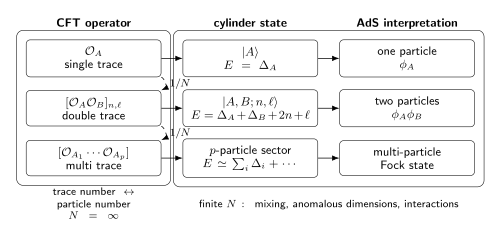
At , normalized single-trace primaries behave as one-particle creators, while multi-trace primaries behave as multi-particle states. Finite- effects weakly mix sectors with the same global quantum numbers and generate anomalous dimensions.
Multi-trace operators are not naive products
Section titled “Multi-trace operators are not naive products”A product such as is singular. To define a local operator, one must renormalize the coincident-point product. In a CFT, one also wants a conformal primary. The resulting double-trace primary is denoted
For scalar single-trace primaries, its schematic form is
The braces denote symmetric traceless projection on the spin- indices. The ellipsis contains terms with derivatives distributed differently between the two operators, plus trace subtractions and descendant subtractions. These terms are fixed by the requirement that the result be a primary:
At leading large , the dimension is additive:
For identical bosonic scalars, Bose symmetry allows only even in the OPE . If the two operators are distinct, both even and odd spins can appear, subject to the full set of global-symmetry selection rules.
Higher multi-trace primaries are built similarly:
At , their leading dimensions are sums of one-particle dimensions plus nonnegative integer excitation energies. In radial quantization, this is just the statement that a free Fock space has additive energies.
Normal ordering and orthogonality
Section titled “Normal ordering and orthogonality”It is useful to think of multi-trace operators as normal-ordered products. For two distinct normalized scalar primaries, write schematically
The subtractions remove identity pieces, lower-trace pieces, and descendant contamination. In an exact generalized-free sector, this is directly analogous to normal ordering in an ordinary free theory.
For example, suppose and are distinct generalized free scalar primaries with diagonal two-point functions. Then the leading two-point function of the simple scalar double trace is
If , the Wick contraction gives an extra factor of , so the unit-normalized scalar double trace is
This is exactly the same combinatorics as the normalization of identical two-particle states.
At strict , operators with different particle number are orthogonal after proper normal ordering:
At finite , this orthogonality is corrected by powers of .
The OPE knows about both single and multi-trace sectors
Section titled “The OPE knows about both single and multi-trace sectors”Consider the OPE of two normalized single-trace scalar primaries. Schematically,
The important point is the different -scaling:
| OPE contribution | Scaling in | Bulk meaning |
|---|---|---|
| identity | disconnected propagation | |
| double-trace tower | two-particle states | |
| single-trace exchange | cubic bulk coupling | |
| anomalous double-trace data in four-point functions | tree-level interaction |
This is why the generalized-free four-point function has a nontrivial conformal-block expansion even though its connected part vanishes. The leading OPE data in the channel are mostly multi-trace data. The genuinely interacting single-particle exchange data enter one order later.
For identical scalar , the leading large- OPE takes the form
At finite ,
in matrix theories where connected four-point functions scale as . The anomalous dimensions are the CFT imprint of bulk interactions.
Operator mixing
Section titled “Operator mixing”At , trace number is a good organizing principle. At finite , it is not an exact quantum number. Operators with the same Lorentz spin, scaling dimension range, and global-symmetry quantum numbers can mix.
Suppose there is a single-trace primary and a double-trace primary with the same quantum numbers. Their dilatation operator may take the schematic form
where and contain diagonal anomalous-dimension corrections. If the two leading dimensions are separated by an order-one gap,
then the mixing angle is small:
If the two levels are nearly degenerate, however, the mixing can be order one even though the off-diagonal matrix element is -suppressed. This is ordinary degenerate perturbation theory, but in AdS/CFT it has a clear physical meaning: a one-particle state can mix strongly with a two-particle state when their energies are close.
This is how resonances and multi-particle thresholds appear in CFT language.
Single-particle versus single-trace in an abstract CFT
Section titled “Single-particle versus single-trace in an abstract CFT”In a general CFT, one may not have a Lagrangian or color traces. For holography, the more invariant concept is a single-particle primary.
A practical large- definition is this: a primary is single-particle if it belongs to a chosen basis of normalized primaries whose connected correlators obey
and if it cannot be written, at leading order, as a normal-ordered product of lower-particle primaries.
This definition is recursive. Once the single-particle primaries are identified, multi-particle primaries are built from their products and primary projections.
For matrix gauge theories, this abstract definition agrees with the usual single-trace/multi-trace language for low-dimension operators at large . For vector models, the terminology changes: the natural single-particle operators are often bilinears rather than traces, and the bulk dual, when it exists, is usually a higher-spin theory rather than ordinary Einstein gravity. The large- logic of factorization and multi-particle composites is still present.
Finite- trace relations
Section titled “Finite-NNN trace relations”At finite , traces are not all independent. This is a basic algebraic fact: finite-size matrices obey polynomial identities. For one matrix, the Cayley-Hamilton theorem implies that sufficiently long traces can be expressed in terms of lower traces. For several noncommuting matrices, the relations are more complicated, but finite- constraints still exist.
In the large- limit, these relations disappear for operators of fixed dimension. That is why it is consistent to discuss an infinite tower of multi-trace states at .
But if the operator dimension grows with , finite- constraints become physically important. In AdS/CFT, this is related to stringy exclusion effects, giant gravitons, and the fact that a finite- CFT has fewer independent states than the naive infinite- Fock space.
The safe rule for this course is
In that regime, single-trace and multi-trace language is reliable.
Multi-trace deformations versus multi-trace operators
Section titled “Multi-trace deformations versus multi-trace operators”A multi-trace operator is a local operator in the CFT spectrum. A multi-trace deformation is a change of the action by such an operator. For example,
These are related but not identical concepts. The operator belongs to the spectrum whether or not we deform by it. Adding it to the action changes the theory.
In AdS/CFT, double-trace deformations are especially important because they modify boundary conditions for the dual bulk field. We will return to this idea later. On this page, the main point is spectral: multi-trace operators are the CFT names of multi-particle states.
The large- Hilbert space as a Fock space
Section titled “The large-NNN Hilbert space as a Fock space”Radial quantization gives the cleanest picture. A primary creates a state
with cylinder energy
A double-trace primary creates a two-particle state:
At ,
At finite ,
This is precisely the structure of perturbation theory for weakly interacting particles in global AdS. The CFT dilatation operator is the global-AdS Hamiltonian.
Thus the large- Hilbert space is approximately
where denotes a Fock-space construction. The approximation breaks down when finite- constraints, strong mixing, black-hole states, or very high energies become important.
The OPE as a particle-number expansion
Section titled “The OPE as a particle-number expansion”The operator product expansion can be reorganized by particle number. For two single-particle operators,
This ordering may look surprising: why do two-particle operators appear at order one, while single-particle exchange is suppressed? The answer is that two generalized-free particles are already present in the disconnected theory. A single-particle exchange between two external particles requires an interaction vertex, and interaction vertices are -suppressed.
For a four-point function of single-trace scalars, the expansion is
The leading term contains the identity and double-trace blocks. The correction contains single-trace exchange and corrections to double-trace data.
This is the conceptual bridge to Witten diagrams:
| CFT expansion | AdS perturbation theory |
|---|---|
| identity block | disconnected propagation |
| leading double-trace blocks | free two-particle states |
| single-trace exchange at in four-point functions | tree-level exchange Witten diagram |
| anomalous dimensions of double traces | binding energies and phase shifts |
| corrections | loop Witten diagrams |
The precise power of depends on whether one discusses OPE coefficients or full connected correlators. For normalized single traces, cubic OPE coefficients scale as , while their contribution to a four-point function scales as .
AdS/CFT checkpoint
Section titled “AdS/CFT checkpoint”The core holographic dictionary is
for a single-particle bulk field or string state, and
The large- expansion controls how sharply this particle-number interpretation holds. At , trace number is conserved and the Hilbert space is Fock-like. At finite , trace number can change, reflecting bulk interactions:
through processes whose amplitudes are suppressed by powers of .
This is why large- CFT is the right language for quantum gravity in AdS. It gives a nonperturbative operator algebra, but at large that algebra reorganizes itself into the perturbative Hilbert space of particles, strings, and interactions.
Summary
Section titled “Summary”Single-trace operators are the basic gauge-invariant operators of matrix large- theories. With order-one two-point normalization, their connected correlators scale as
At , they create one-particle states. Multi-trace primaries create multi-particle states. For scalar double traces,
Finite- effects mix operators with the same quantum numbers and shift multi-trace dimensions:
These anomalous dimensions are the CFT form of bulk binding energies and scattering data. The whole point of large- holography is that a complicated CFT operator algebra becomes, to leading order, a Fock-space problem in AdS.
Exercises
Section titled “Exercises”Exercise 1. Connected scaling and factorization
Section titled “Exercise 1. Connected scaling and factorization”Assume normalized single-trace operators obey
Show that the four-point function factorizes at leading order, while its connected part is suppressed by .
Solution
For ,
For ,
The full four-point function decomposes into connected and disconnected pieces:
The disconnected products are order , while the connected term is order . Thus
This is large- factorization.
Exercise 2. Unit normalization of an identical double trace
Section titled “Exercise 2. Unit normalization of an identical double trace”Let be a generalized free scalar with
Show that the scalar double-trace operator
has unit-normalized two-point function at leading order:
Solution
Using Wick factorization and normal ordering, contractions inside the same normal-ordered product are removed. The only leading contractions pair the two fields at with the two fields at :
Therefore
The factor is the same Bose-symmetry normalization as for two identical particles.
Exercise 3. Additive dimensions from the cylinder
Section titled “Exercise 3. Additive dimensions from the cylinder”Let and be scalar primaries of dimensions and . Use radial quantization to explain why
Solution
Radial quantization maps a primary operator to a state on :
At , two-particle energies add. A two-particle state built from and has base energy
Orbital angular momentum adds units of energy, and the radial excitation number adds units. Therefore
By the state-operator correspondence, cylinder energy equals scaling dimension, so
Exercise 4. Small mixing angle
Section titled “Exercise 4. Small mixing angle”Consider two operators with the same quantum numbers and dilatation matrix
where . Compute the leading mixing angle.
Solution
For a real symmetric matrix, the mixing angle satisfies
If the off-diagonal term is small compared to the level splitting, then
Thus the mixing is suppressed by when the two levels are not nearly degenerate. If becomes of order , this perturbative estimate fails and the mixing can become order one.
Exercise 5. Single-trace exchange in a four-point function
Section titled “Exercise 5. Single-trace exchange in a four-point function”Suppose the OPE coefficient of three normalized single-trace operators scales as
Explain why exchange of a single-trace primary in a four-point function of normalized single traces contributes at order .
Solution
A conformal-block contribution from exchanging in the and channels is proportional to a product of two OPE coefficients:
Each cubic single-trace OPE coefficient scales as , so
Thus single-trace exchange appears at order in the connected four-point function. This matches the bulk statement that a tree-level exchange Witten diagram is suppressed by one power of the gravitational coupling .