
Holographic Renormalization
The main idea
Section titled “The main idea”The previous page computed a scalar two-point function and quietly used a phrase that deserves its own lecture: the renormalized on-shell action. This phrase is not cosmetic. The classical action of an asymptotically AdS solution is usually divergent, and the canonical momenta that would naïvely define one-point functions are usually divergent as well.
The reason is geometric. In Poincaré coordinates,
the conformal boundary sits at infinite proper distance. A bulk integral near contains powers of
so evaluating the action on a solution typically produces terms that diverge as . In the CFT, the same divergences are the usual ultraviolet divergences of a quantum field theory in the presence of sources. The AdS radial direction converts CFT UV divergences into near-boundary bulk divergences.
Holographic renormalization is the systematic cure:
Here is the on-shell bulk action evaluated in the regulated region , and is a sum of local covariant functionals of the fields induced on the cutoff surface . After the limit is taken, functional derivatives of define finite CFT one-point functions.
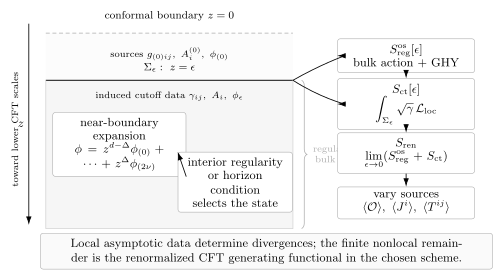
Holographic renormalization regulates the asymptotic AdS region at , evaluates the bulk action on shell, adds local counterterms built from cutoff data and , and then removes the cutoff. The result is the finite generating functional whose functional derivatives give and .
There is an excellent way to remember the whole subject:
Holographic renormalization is ordinary QFT renormalization written in radial Hamiltonian language.
The divergent terms are local because UV divergences in a local QFT are local in the sources. The finite nonlocal part is the physics: it knows about the state, the interior boundary condition, and correlation functions at separated points.
The cutoff prescription
Section titled “The cutoff prescription”Work in an asymptotically locally AdS spacetime. Near the conformal boundary, use Fefferman-Graham coordinates,
The regulated manifold is
The induced metric on is
The CFT source for the stress tensor is not itself. It is the finite metric appearing in the near-boundary expansion
Equivalently, is a cutoff-dependent representative of the same conformal class:
For a scalar field dual to an operator of dimension in standard quantization,
so the cutoff field
is not itself the source. The source is the finite coefficient
up to the usual logarithmic refinements when anomalies are present.
The central object is then
for gravity, with the Gibbons-Hawking term included when the metric is dynamical. The counterterms are local functionals on :
The counterterm density is organized as a derivative expansion. It contains terms such as
The logarithmic terms are special: they encode conformal anomalies and introduce a renormalization scale.
A scalar example: where the divergences come from
Section titled “A scalar example: where the divergences come from”Take a scalar in Euclidean AdS with action
The mass-dimension relation is
For now assume is not at one of the special values where the two radial series degenerate and logarithmic terms appear. The near-boundary expansion has the form
The coefficients below order are local functions of the source . For example, using
one finds
when . By contrast, is not determined by the near-boundary analysis alone. It is the response coefficient, fixed by regularity in the interior or by a Lorentzian horizon prescription.
On shell, the scalar action reduces to a boundary term. With and outward normal pointing toward decreasing ,
so
Insert the leading asymptotic behavior . Since
the leading term behaves as
This diverges for . The divergence is local in the source. That is the first and most important lesson.
A counterterm cancels it:
At the next order one needs a two-derivative counterterm. With the same sign convention,
Equivalently, after integrating by parts on the cutoff surface,
The denominator warns us about a logarithmic case. When it vanishes, the power-law counterterm is replaced by a logarithmic counterterm, and the dual CFT has a conformal anomaly in the presence of the scalar source.
The renormalized scalar action is
The one-point function is then defined by varying the renormalized action with respect to the finite source:
For a single scalar in standard quantization and for non-logarithmic cases,
The local term is scheme-dependent. It comes from finite local counterterms and from contact terms. The nonlocal part, encoded by how depends on , is the physical response.
What is fixed locally, and what is not
Section titled “What is fixed locally, and what is not”The near-boundary expansion separates two kinds of data.
| Data | Determined by near-boundary equations? | CFT meaning |
|---|---|---|
| chosen freely | source for | |
| chosen freely | source for | |
| chosen freely up to gauge transformations | source for | |
| below normalizable order | yes, locally | contact terms and divergences |
| below normalizable order | yes, locally | contact terms and divergences |
| not fully | stress-tensor expectation value | |
| no | scalar one-point function | |
| normalizable modes | no | state or response data |
This distinction is worth burning into memory. Holographic renormalization does not solve the bulk problem. It determines the universal local terms near the boundary. To compute the actual one-point function in a chosen state, one still needs the full bulk solution or the appropriate linearized bulk-to-boundary propagator.
That is why the two-point function on the previous page required regularity in the interior. Near-boundary analysis told us which terms diverged and how to subtract them; regularity determined the nonlocal kernel .
Gravity: counterterms and the stress tensor
Section titled “Gravity: counterterms and the stress tensor”When the metric is dynamical, the bulk action must include the Gibbons-Hawking term so that Dirichlet boundary conditions for the induced metric are well posed. In Lorentzian signature, one commonly writes
Here
For this Lorentzian convention, the first purely gravitational counterterms are
for . The next curvature-squared term, needed for , has the form
The pole at again signals a logarithmic counterterm and a Weyl anomaly.
The renormalized stress tensor is defined by varying the renormalized action with respect to the finite boundary metric:
Equivalently, one can compute the Brown-York tensor on the cutoff surface, add counterterm contributions, and then rescale to the finite boundary metric:
In Fefferman-Graham gauge,
For odd there is no local conformal anomaly and no term for pure gravity. For even , is local in the boundary metric and encodes the anomaly.
For pure Einstein gravity with a flat boundary metric, the stress tensor often reduces to the simple expression
provided the Fefferman-Graham expansion is written with flat and no additional matter sources. In curved backgrounds or in even boundary dimensions, local curvature terms must be added.
The first Fefferman-Graham coefficients
Section titled “The first Fefferman-Graham coefficients”The near-boundary Einstein equations determine the early coefficients locally. For pure gravity with boundary dimension ,
This formula already shows why the counterterm is needed. Curvature of the boundary source metric feeds into the near-boundary expansion and produces divergences in the on-shell action.
The coefficient is different. Einstein’s equations constrain its trace and divergence, but not its transverse traceless part. That remaining data is the expectation value of the CFT stress tensor. In this sense, the stress tensor is the normalizable gravitational mode.
For example, in a thermal state on flat space, is proportional to the energy density and pressure. In a state dual to pure AdS with the standard vacuum subtraction on flat , , and the renormalized stress tensor vanishes.
Ward identities from radial constraints
Section titled “Ward identities from radial constraints”One of the cleanest features of holographic renormalization is that CFT Ward identities arise from the bulk constraint equations.
Suppose the CFT is deformed by scalar sources and background gauge fields :
Boundary diffeomorphism invariance of gives
with covariant derivatives built from . If the background gauge field is nondynamical and the current is conserved without an anomaly, the last term vanishes.
Boundary Weyl transformations give the trace identity
The first term is the explicit breaking of conformal invariance by relevant or irrelevant sources. The second term is the conformal anomaly. It is present only in special dimensions and source backgrounds. For a CFT on flat space with all sources off, , and the stress tensor is traceless.
These identities are not optional consistency checks. If a holographic computation gives a one-point function that violates them, then the counterterms, signs, normalizations, or boundary conditions are wrong.
Logarithmic divergences and conformal anomalies
Section titled “Logarithmic divergences and conformal anomalies”Power divergences are removed by power counterterms. Logarithmic divergences are more interesting.
A typical logarithmic contribution has the form
To subtract it, introduce a renormalization scale and add
where is the cutoff-surface version of the local anomaly density. The renormalized action now depends on :
This is the holographic version of the Callan-Symanzik equation. The trace anomaly follows because a Weyl rescaling of can be compensated by changing the cutoff scale.
In a four-dimensional CFT, the purely gravitational anomaly has the schematic form
For classical two-derivative Einstein gravity duals, one often finds at leading order in large . Higher-derivative bulk terms can change this relation.
Finite counterterms and scheme dependence
Section titled “Finite counterterms and scheme dependence”Counterterms are not unique. Once all divergences are canceled, one may add finite local terms:
These terms define a renormalization scheme. They modify one-point functions by local functions of the sources and modify correlators by contact terms. They do not change separated-point correlators such as
nor do they change universal anomaly coefficients.
This is exactly like ordinary QFT. The coefficient of a separated power law in a two-point function is physical once the operator normalization is fixed. A contact term proportional to is scheme-dependent.
A common mistake is to ask whether a one-point function is “the” answer without specifying the scheme. For many observables, especially stress tensors on curved backgrounds, only scheme-invariant combinations are physically meaningful.
Radial Hamiltonian viewpoint
Section titled “Radial Hamiltonian viewpoint”The cutoff surface may be treated as a constant-time slice, with the radial coordinate playing the role of time. The induced fields are generalized coordinates, and their radial canonical momenta are holographic one-point functions before renormalization.
For a scalar,
This momentum diverges as . Since
the finite source-normalized momentum is schematically
with logarithmic and local refinements in anomalous cases. This is the same object obtained by varying with respect to .
For the metric, the canonical momentum is essentially the extrinsic curvature:
Adding metric counterterms gives the finite Brown-York stress tensor. The radial Hamiltonian constraint becomes the trace Ward identity; the radial momentum constraint becomes the diffeomorphism Ward identity.
This viewpoint is powerful because it explains why counterterms can be found recursively. One solves the Hamilton-Jacobi equation for the local divergent part of Hamilton’s principal function. The nonlocal finite part remains undetermined by the asymptotic analysis, and that nonlocal part is precisely the generating functional of the dual QFT.
A practical recipe
Section titled “A practical recipe”For most holographic calculations, the following recipe is the safest.
Step 1: Put the solution in Fefferman-Graham form near the boundary
Section titled “Step 1: Put the solution in Fefferman-Graham form near the boundary”Write
and expand every field. Identify the finite sources , , , and so on.
Step 2: Introduce a cutoff surface
Section titled “Step 2: Introduce a cutoff surface”Evaluate the action on and keep the cutoff dependence. Do not drop boundary terms. For gravity, include the Gibbons-Hawking term. For gauge fields and scalars, make sure the variational principle matches the desired ensemble or quantization.
Step 3: Add local counterterms
Section titled “Step 3: Add local counterterms”Construct from the induced fields on . The counterterms must be local and covariant with respect to the cutoff metric . Use the near-boundary equations to determine all divergent terms.
Step 4: Define the renormalized action
Section titled “Step 4: Define the renormalized action”Take
Add finite local counterterms only when a clear scheme choice is needed.
Step 5: Vary finite sources
Section titled “Step 5: Vary finite sources”Compute
and
Check the Ward identities. This is the best quick test that the calculation is sane.
Contact terms versus separated-point correlators
Section titled “Contact terms versus separated-point correlators”The two-point function obtained from the renormalized action has the schematic structure
The contact terms are distributions supported at :
They are important in Ward identities and anomalies. They are also scheme-dependent. So there are two bad habits to avoid:
- Throwing away all contact terms before checking Ward identities.
- Treating scheme-dependent contact terms as universal observables.
The right rule is sharper: contact terms are local data of the renormalization scheme, while separated-point nonlocal correlators are fixed by the bulk dynamics and boundary conditions.
Common mistakes
Section titled “Common mistakes”Mistake 1: Confusing the cutoff field with the source
Section titled “Mistake 1: Confusing the cutoff field with the source”The source for a scalar is not . It is the coefficient in
Likewise, the source for the stress tensor is , not the divergent induced metric .
Mistake 2: Omitting the Gibbons-Hawking term
Section titled “Mistake 2: Omitting the Gibbons-Hawking term”For gravity, the on-shell Einstein-Hilbert action alone does not have the correct Dirichlet variational principle. The Gibbons-Hawking term is not an optional boundary decoration; it is part of the definition of the problem.
Mistake 3: Using flat-space counterterms in a curved-source problem
Section titled “Mistake 3: Using flat-space counterterms in a curved-source problem”Counterterms must be covariant in the cutoff metric. Even if the final calculation is specialized to flat space, curved counterterms are often needed to derive the correct stress tensor and Ward identities.
Mistake 4: Calling every finite term physical
Section titled “Mistake 4: Calling every finite term physical”Finite local terms are scheme choices. Before assigning physical meaning to a finite one-point function, ask whether a finite local counterterm could shift it.
Mistake 5: Solving only near the boundary and expecting the full answer
Section titled “Mistake 5: Solving only near the boundary and expecting the full answer”Near-boundary analysis determines divergences and local terms. It does not determine the nonlocal response. For that, one needs regularity, infalling horizon conditions, normalizability, or another interior condition appropriate to the state.
Exercises
Section titled “Exercises”Exercise 1: Leading scalar counterterm
Section titled “Exercise 1: Leading scalar counterterm”Consider a scalar in Euclidean AdS with
Using
show that the leading divergence is canceled by
Solution
Near ,
and
Therefore
The counterterm gives
which cancels the divergence.
Exercise 2: The first local coefficient
Section titled “Exercise 2: The first local coefficient”For the scalar equation
insert
and show that
Solution
Let . Since , the coefficient of the term vanishes automatically. The term gives
The bracket is
Thus
so
Exercise 3: The trace Ward identity from Weyl invariance
Section titled “Exercise 3: The trace Ward identity from Weyl invariance”Assume the renormalized generating functional depends on a metric source and a scalar source for an operator of dimension . Under an infinitesimal Weyl transformation,
Ignoring anomalies, show that Weyl invariance of implies
Solution
The variation of the renormalized action is
Substituting the Weyl variations gives
If there is no anomaly and is Weyl invariant, this must vanish for arbitrary , hence
Exercise 4: Pure AdS and vacuum stress tensor
Section titled “Exercise 4: Pure AdS and vacuum stress tensor”For pure AdS with flat boundary metric, the Fefferman-Graham expansion is
Using the flat-boundary formula
show that the renormalized stress tensor vanishes on . Why does this conclusion require a statement about the scheme or background?
Solution
For pure AdS in the Poincaré patch,
so all subleading coefficients vanish, including
The flat-boundary formula therefore gives
The qualification matters because stress tensors can be shifted by finite local curvature counterterms on curved backgrounds. On flat those curvature terms vanish, so the standard vacuum subtraction gives zero. On a curved boundary such as , the vacuum stress tensor may include Casimir-energy and anomaly contributions.
Exercise 5: Why the logarithmic counterterm has physical content
Section titled “Exercise 5: Why the logarithmic counterterm has physical content”Suppose the regulated action contains
One subtracts it using
Show that the renormalized action depends on , and interpret this dependence.
Solution
Adding the regulated and counterterm pieces leaves a finite contribution
up to convention-dependent signs and finite local choices. Therefore
This is the holographic Callan-Symanzik equation. The logarithmic divergence cannot be removed without introducing a scale , so scale invariance is anomalous. Equivalently, appears in the trace Ward identity.
Further reading
Section titled “Further reading”- Sebastian de Haro, Kostas Skenderis, and Sergey N. Solodukhin, “Holographic Reconstruction of Spacetime and Renormalization in the AdS/CFT Correspondence”. The systematic Fefferman-Graham and counterterm treatment for gravity and matter.
- Massimo Bianchi, Daniel Z. Freedman, and Kostas Skenderis, “Holographic Renormalization”. A detailed treatment of holographic renormalization for RG flows and correlation functions.
- Kostas Skenderis, “Lecture Notes on Holographic Renormalization”. The standard pedagogical reference for the formalism, Ward identities, anomalies, and examples.
- Vijay Balasubramanian and Per Kraus, “A Stress Tensor for Anti-de Sitter Gravity”. The classic Brown-York-plus-counterterms construction of the holographic stress tensor.
- M. Henningson and K. Skenderis, “The Holographic Weyl Anomaly”. The early derivation of boundary Weyl anomalies from the AdS gravitational action.