
Real-Time Correlators and Infalling Boundary Conditions
The problem with “just Wick rotate”
Section titled “The problem with “just Wick rotate””The Euclidean GKPW prescription computes Euclidean correlation functions by solving a regular elliptic boundary-value problem in Euclidean AdS. That is already a powerful statement, but real-time physics asks sharper questions. A plasma does not merely have Euclidean correlators; it has response functions, spectral densities, relaxation rates, conductivities, viscosities, and quasinormal modes. These objects know about causality and dissipation.
The central real-time object is the retarded Green function. For a bosonic operator in a translation-invariant state,
It vanishes for . That single fact is not a small detail: it fixes the analytic structure of and distinguishes retarded response from time-ordered, advanced, Wightman, and Euclidean correlators.
At zero temperature and in simple vacuum problems, one can often compute a Euclidean correlator and analytically continue momenta. At finite temperature, with horizons, branch cuts, hydrodynamic poles, and dissipative absorption, the correct continuation is most cleanly implemented by a Lorentzian bulk rule:
To compute an equilibrium retarded two-point function, solve the Lorentzian bulk wave equation with the prescribed boundary source and impose infalling boundary conditions at the future horizon.
The phrase “infalling at the horizon” is the bulk version of causality. It says that the disturbance created by the boundary source may fall into the black hole, but no independent classical signal is allowed to emerge from the future horizon.
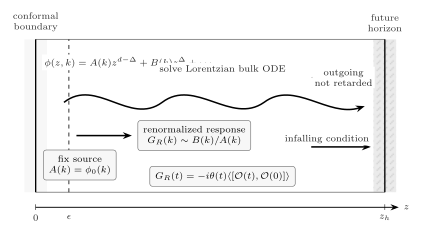
The retarded two-point function is obtained by fixing the boundary source , imposing the future-horizon infalling condition, solving the Lorentzian bulk equation, and reading off the renormalized response . Outgoing data would correspond to a different real-time prescription.
This page is the bridge between Euclidean Witten diagrams and the transport calculations that appear later in the course.
Real-time Green functions in QFT
Section titled “Real-time Green functions in QFT”Suppose the CFT action is deformed by a source,
In linear response, the induced one-point function is
up to the sign convention chosen for the source term. In momentum space,
The retarded correlator is analytic in the upper half of the complex -plane. Its poles in the lower half-plane control relaxation. Its imaginary part gives the spectral response. A common convention is
where is often called the spectral density or spectral function. Some communities define instead. The physics is not in the sign convention; it is in the analytic structure, pole locations, residues, and positivity properties.
At finite temperature, Euclidean correlators are evaluated at discrete Matsubara frequencies. For bosonic operators,
and the Euclidean correlator is related to by analytic continuation only after one identifies the correct analytic function:
with possible convention-dependent signs. In holography, the infalling condition implements the same choice directly in the bulk.
The Lorentzian bulk problem
Section titled “The Lorentzian bulk problem”Consider a scalar field in an asymptotically AdS geometry,
where is a normalization proportional to the appropriate power of or . In a translation-invariant background, write
Near the conformal boundary ,
where
For standard quantization, is the source for , while determines the response. The renormalized one-point function has the schematic form
The retarded two-point function is the linear response coefficient,
Equivalently, if one solves the bulk equation with source normalized to , then
where is a polynomial or logarithmic contact-term contribution fixed by counterterms and scheme choices.
A very useful version of the same statement uses the radial canonical momentum. With the above action and the usual outward-normal convention at ,
Then the retarded correlator can be extracted as
again up to the overall sign implied by the source convention. The subscript is the important part: the solution must be the one that is infalling at the future horizon.
Black branes and the infalling condition
Section titled “Black branes and the infalling condition”For many applications the bulk background is the planar AdS black brane,
The conformal boundary is at , the horizon is at , and the Hawking temperature is
The scalar wave equation becomes
The near-horizon behavior follows from the singular terms. Let
Since , a Frobenius ansatz gives
so
Which sign is infalling? Define the tortoise coordinate
For the radial coordinate increasing toward the horizon, an ingoing Eddington-Finkelstein coordinate is
A wave that is smooth in near the future horizon behaves as
Thus the retarded prescription chooses
The opposite sign is outgoing from the future horizon. It is not the correct boundary condition for the causal response of a thermal state.
A particularly clean numerical implementation is to switch to ingoing Eddington-Finkelstein coordinates from the beginning. Then the infalling solution is simply the solution that is regular at the future horizon. This is often more stable than factoring out a complex power in Schwarzschild-like coordinates.
Why a horizon produces dissipation
Section titled “Why a horizon produces dissipation”In Euclidean signature, regularity at the Euclidean cigar fixes the thermal correlator. In Lorentzian signature, the future horizon is a one-way membrane for classical waves. A boundary perturbation can fall through the horizon, carrying energy into the black hole. From the CFT perspective, the perturbation has been absorbed by the thermal medium.
For a scalar with real , the radial flux
is radially conserved when the bulk equation is real. Evaluated at the boundary, it is related to the imaginary part of the retarded correlator. Evaluated at the horizon, it is the flux crossing the horizon. The equality between the two is the holographic origin of absorption and spectral weight.
This gives a useful slogan:
The imaginary part of is the boundary shadow of flux lost through the future horizon.
The statement is especially transparent for transport. Conductivity comes from Maxwell waves absorbed by the horizon; shear viscosity comes from metric perturbations absorbed by the horizon; diffusion poles arise because conserved densities relax through long-wavelength horizon dynamics.
Extracting in practice
Section titled “Extracting GRG_RGR in practice”For a scalar two-point function in a black-brane background, the practical algorithm is:
- Fourier decompose the field with .
- Solve the radial ODE with the infalling condition at .
- Normalize the solution so that the leading boundary coefficient is the desired source, often .
- Expand near and read off the response coefficient.
- Add counterterms and contact terms required by holographic renormalization.
- Interpret the result as with the chosen normalization of .
In formula form, write the infalling solution near the boundary as
If , the source-normalized solution is , and
This is the Lorentzian analog of the Euclidean result, but with a crucial difference: the ratio is computed from the infalling solution.
For gauge fields and gravitons the same logic applies, but the fields are constrained by gauge invariance and diffeomorphism invariance. One usually works with gauge-invariant master fields or fixes a convenient radial gauge. The response is then extracted from the renormalized canonical momentum conjugate to the source. For example,
Later transport calculations will use precisely this recipe.
Poles, quasinormal modes, and relaxation
Section titled “Poles, quasinormal modes, and relaxation”The poles of occur when the infalling solution has no source term at the boundary:
The same solution is then infalling at the horizon and normalizable at the boundary. These are the quasinormal modes of the asymptotically AdS black brane.
The logic is simple but profound:
A mode with frequency
contributes a late-time factor
Stability of the thermal state requires , so poles of a stable retarded correlator lie in the lower half-plane. Hydrodynamic poles are special quasinormal modes whose frequencies vanish as . For example, a diffusive mode has
This is why quasinormal-mode calculations are not merely gravitational spectroscopy. They compute relaxation rates of the dual quantum system.
What changes without a horizon?
Section titled “What changes without a horizon?”In pure Lorentzian AdS there is no black-brane horizon. The interior condition is then not “infalling at the horizon.” Instead one chooses the condition appropriate to the state and correlator.
For the vacuum in Poincaré AdS, the retarded prescription is implemented by the usual choice and regularity in the interior. For global AdS, regularity at the origin and boundary conditions at conformal infinity lead to a discrete normal-mode spectrum. The resulting retarded correlator has poles on the real axis before interactions or finite- effects are included. At finite temperature, the horizon moves those poles into the lower half-plane and turns normal modes into quasinormal modes.
So the real rule is not “always impose infalling.” The real rule is:
Specify the Lorentzian state and contour. For an equilibrium thermal state with a future horizon, the retarded two-point function is computed by the infalling future-horizon solution.
That more careful version prevents many misconceptions.
Beyond retarded two-point functions
Section titled “Beyond retarded two-point functions”The infalling prescription is the workhorse for equilibrium retarded two-point functions. It is not, by itself, the full Lorentzian AdS/CFT dictionary.
A complete real-time QFT calculation uses a time contour. For thermal systems, the Schwinger-Keldysh contour doubles fields and naturally organizes retarded, advanced, time-ordered, anti-time-ordered, and Wightman correlators. In holography this contour structure is mirrored by more elaborate Lorentzian bulk constructions, often involving multiple boundary segments glued through complex time evolution.
For many transport applications, we only need the retarded two-point function. Then the simple rule is enough. But for noise, fluctuation-dissipation relations, out-of-time-order correlators, real-time higher-point functions, and nonequilibrium states, one must keep the contour structure. The bulk problem is then not merely a single classical ODE with an infalling condition.
The hierarchy is useful:
| Boundary observable | Bulk prescription |
|---|---|
| Euclidean correlator | Euclidean regular solution |
| Equilibrium retarded two-point function | Lorentzian solution infalling at the future horizon |
| Quasinormal spectrum | Infalling at the horizon and normalizable at the boundary |
| Time-ordered or Wightman correlator | Schwinger-Keldysh contour and associated bulk gluing |
| Nonequilibrium real-time response | Lorentzian initial-value or mixed initial-boundary-value problem |
Contact terms and scheme dependence
Section titled “Contact terms and scheme dependence”The nonanalytic part of contains physical spectral information: poles, branch cuts, thresholds, and dissipative imaginary parts. Local counterterms add terms polynomial in and , and logarithmic counterterms appear when conformal anomalies are present.
For example, changing the finite counterterm can shift
Such shifts affect contact terms in position space but do not move quasinormal poles or change dissipative spectral weight at separated points. This is why pole locations, residues after fixed normalization, and Kubo limits are often more robust than the full polynomial part of a correlator.
When computing transport coefficients, however, contact terms and source conventions still matter. A Kubo formula is a precise statement about a precise operator normalization. Sloppy normalization can change a numerical answer by factors of , , , or the AdS radius .
The membrane viewpoint
Section titled “The membrane viewpoint”There is a powerful near-horizon intuition behind the infalling prescription. For sufficiently low frequency and momentum, many radial evolution equations become flow equations for response functions. The boundary Green function can sometimes be related to horizon data because the relevant radial canonical momentum is conserved or nearly conserved.
For a Maxwell field, the radial electric flux is dual to the boundary current. In simple two-derivative theories at zero spatial momentum, the DC conductivity can be read directly from horizon data. For metric perturbations, a similar universality underlies the famous two-derivative result
These universal results are not magic. They come from three ingredients:
- a conserved radial flux or canonical momentum in the hydrodynamic limit,
- the infalling regularity condition at the future horizon,
- the holographic identification of boundary response with renormalized canonical momentum.
Later chapters will make this concrete for conductivity and viscosity.
Common mistakes
Section titled “Common mistakes”Mistake 1: confusing Euclidean regularity with Lorentzian infalling behavior. Euclidean regularity gives thermal Euclidean correlators. Lorentzian infalling behavior gives retarded response. They are related, but not identical operations.
Mistake 2: imposing both infalling and outgoing conditions. A second-order radial ODE needs one condition at the horizon and one source normalization at the boundary. Imposing both infalling and outgoing behavior overconstrains the problem except at special frequencies.
Mistake 3: calling every bulk normal mode a quasinormal mode. Normal modes are regular and normalizable in horizonless geometries. Quasinormal modes are infalling at a horizon and normalizable at the boundary. Their frequencies are usually complex.
Mistake 4: forgetting counterterms. The infalling condition fixes the nonlocal physics, but the on-shell action is still divergent near the boundary. Holographic renormalization is not optional.
Mistake 5: treating as meaningful before fixing operator normalization. The ratio gives the functional form of the Green function, but the overall coefficient depends on the bulk action normalization and the CFT operator normalization.
Mistake 6: using the retarded prescription for all real-time correlators. Time-ordered and Wightman correlators require additional contour information. Retarded two-point functions are the simplest and most frequently used case, not the whole story.
Exercises
Section titled “Exercises”Exercise 1: Near-horizon exponents
Section titled “Exercise 1: Near-horizon exponents”Consider the planar black-brane metric
For a scalar mode , show that near the two independent behaviors are
Solution
Let
Near the horizon,
The singular part of the scalar equation is
Use . Since , the derivative terms give
The frequency term gives
Therefore
so
Exercise 2: Which sign is infalling?
Section titled “Exercise 2: Which sign is infalling?”Using
show that a mode regular in the ingoing coordinate has the behavior
Solution
A wave regular in the ingoing coordinate has phase
Near the horizon,
Thus
Therefore the negative exponent is the infalling one with the coordinate convention used here.
Exercise 3: Poles from the source coefficient
Section titled “Exercise 3: Poles from the source coefficient”Let the infalling solution near the boundary be
Assume standard quantization and ignore contact terms. Explain why poles of occur when .
Solution
For nonzero , the source-normalized solution is
The response is proportional to , so
If while the infalling solution is nontrivial, then the solution is normalizable at the boundary and infalling at the horizon. This is precisely a quasinormal mode. The ratio diverges, so the retarded Green function has a pole.
Exercise 4: A diffusive pole
Section titled “Exercise 4: A diffusive pole”A conserved density often has a retarded correlator of the schematic form
where is a susceptibility and is a diffusion constant. Find the pole and interpret it in time.
Solution
The pole occurs when the denominator vanishes:
Therefore
The corresponding time dependence is
This is the Fourier-space form of diffusion. Long-wavelength perturbations with small decay slowly, while short-wavelength perturbations decay faster.
Exercise 5: Contact terms and spectral functions
Section titled “Exercise 5: Contact terms and spectral functions”Suppose a finite local counterterm shifts a retarded correlator by
where are real constants. Does this shift move the quasinormal-mode poles? Does it change for real ?
Solution
The added term is a polynomial in frequency and momentum, so it has no poles. Therefore it does not move the quasinormal-mode poles of the original correlator.
For real and real , the added polynomial is real if are real. It therefore does not change on the real frequency axis. In position space it changes contact terms supported at coincident points. The nonlocal dissipative spectral weight is unchanged.
Further reading
Section titled “Further reading”- D. T. Son and A. O. Starinets, “Minkowski-space correlators in AdS/CFT correspondence: recipe and applications”. The classic practical prescription for retarded Green functions and infalling boundary conditions.
- C. P. Herzog and D. T. Son, “Schwinger-Keldysh propagators from AdS/CFT correspondence”. A clear treatment of the finite-temperature real-time contour and the relation to the retarded prescription.
- K. Skenderis and B. C. van Rees, “Real-time gauge/gravity duality: Prescription, Renormalization and Examples”. A systematic account of Lorentzian holographic renormalization and real-time correlators.
- G. Policastro, D. T. Son, and A. O. Starinets, “From black holes to hydrodynamics: the shear viscosity of strongly coupled supersymmetric Yang-Mills plasma”. A landmark application of retarded correlators to transport.
- N. Iqbal and H. Liu, “Universality of the hydrodynamic limit in AdS/CFT and the membrane paradigm”. A modern membrane-paradigm perspective on horizon data and response functions.