
Map of the Course
Why the course needs a map
Section titled “Why the course needs a map”AdS/CFT is not a single technique. It is a framework in which several technical subjects become different faces of the same quantum system: large- field theory, string theory, anti-de Sitter geometry, black-hole thermodynamics, conformal field theory, hydrodynamics, entanglement, and quantum gravity.
That richness is exactly why beginners often get lost. One paper computes a two-point function from an on-shell action. Another paper talks about D3-branes and decoupling limits. Another derives a black-brane viscosity. Another computes an extremal surface. Another discusses islands, replica wormholes, and quantum error correction. All of these are AdS/CFT, but they do not all use the same starting point.
This page is the road map. It explains what each module is for, which modules depend on which earlier ideas, and how to choose a reading path suited to a research goal. The point is not to force a single linear route. The point is to keep the logical dependencies visible.
The central spine of the course is
In terms of modules, this is
This is the fastest route from basic orientation to a working modern dictionary. The remaining modules are not optional in the sense of being unimportant; they are specialized tracks that become more useful once the core dictionary is in place.
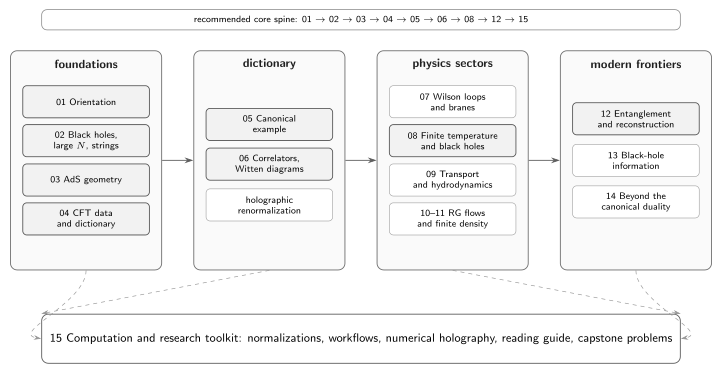
A coarse dependency graph for the course. Gray modules form the recommended core spine . White modules are specialized tracks. The arrows are not prerequisites in a strict mathematical sense; they indicate the order in which the concepts become easiest to understand.
The three kinds of dependence
Section titled “The three kinds of dependence”There are three different meanings of “depends on” in this course.
First, there is conceptual dependence. One should understand why black-hole entropy suggests holography before trying to interpret the Ryu-Takayanagi formula as a microscopic statement about quantum gravity. One should understand why the AdS boundary is timelike before discussing real-time boundary conditions. This kind of dependence is about meaning.
Second, there is technical dependence. To compute a scalar two-point function, one needs the scalar wave equation in AdS, the near-boundary expansion, the mass-dimension relation, the regulated on-shell action, and functional differentiation with respect to sources. This kind of dependence is about calculation.
Third, there is regime-of-validity dependence. To use a two-derivative Einstein action, one needs a CFT regime in which both stringy and quantum-gravity corrections are suppressed. To use a probe brane, one needs the flavor sector not to backreact strongly on the geometry. To use hydrodynamics, one needs long wavelengths compared with the local thermal scale. This kind of dependence is about control.
A mature AdS/CFT calculation keeps all three visible:
Whenever a result seems too elegant, ask which of these four pieces has been hidden.
The course in four layers
Section titled “The course in four layers”The course is organized into four layers. The layers are not chronological history. They are levels of precision.
Layer 1: why holography is plausible
Section titled “Layer 1: why holography is plausible”The first layer explains why one should expect a connection between gravity and lower-dimensional quantum systems at all.
Modules 01 and 02 introduce the conceptual pressure that leads to holography. Black-hole entropy scales like area, large- gauge theories have string-like expansions, and D-branes give a concrete system with both gauge-theory and gravitational descriptions.
The key lesson is:
This layer prevents a common misunderstanding. AdS/CFT is not merely a clever computational trick for strongly coupled field theory. It is a precise realization of the idea that quantum gravity may be encoded in non-gravitational variables living at the boundary.
Layer 2: the working dictionary
Section titled “Layer 2: the working dictionary”The second layer turns the slogan into equations. This is the heart of modules 03 through 06.
AdS geometry tells us what “the boundary” means, how the radial coordinate behaves, why the conformal group appears as an isometry group, and why different coordinate systems represent different field-theory states or patches. The CFT dictionary then identifies sources, operators, states, and bulk fields.
The central relation is the generating-functional dictionary
In the classical gravity limit this becomes
in Euclidean signature. Differentiating with respect to gives CFT correlators. The word is not decoration: holographic renormalization is what makes the variational problem finite and physically meaningful.
The key lesson is:
Layer 3: physical sectors
Section titled “Layer 3: physical sectors”The third layer applies the dictionary to important observables and states.
Wilson loops become string worldsheets. Thermal states become Euclidean saddles or Lorentzian black holes. Transport coefficients become low-frequency limits of retarded correlators. RG flows become domain-wall geometries. Finite-density states become charged black holes or more elaborate charged geometries.
The same computational grammar appears again and again:
The key lesson is:
A local one-point function probes asymptotic coefficients. A two-point function probes wave propagation through the bulk. A Wilson loop probes an extremal worldsheet. Entanglement entropy probes an extremal codimension-two surface. A retarded correlator at finite temperature probes both the boundary and the horizon.
Layer 4: emergence, information, and research practice
Section titled “Layer 4: emergence, information, and research practice”The fourth layer is where the course becomes modern.
Entanglement is not merely another observable. In holography it is one of the organizing principles of bulk emergence. The Ryu-Takayanagi and Hubeny-Rangamani-Takayanagi prescriptions connect boundary entanglement to bulk extremal surfaces. Quantum corrections replace area alone by generalized entropy,
Entanglement wedges, modular flow, and quantum error correction then sharpen what it means for bulk locality to be encoded redundantly in boundary degrees of freedom.
The black-hole information module uses these ideas to revisit unitarity, chaos, Page curves, islands, and the limits of semiclassical reasoning. The final toolkit module collects the practical techniques needed to compute, compare conventions, read papers, and formulate research-level problems.
The key lesson is:
Module-by-module guide
Section titled “Module-by-module guide”The following guide says what each module is for and what the reader should be able to do after finishing it.
| Module | Role in the course | After finishing it, you should be able to… |
|---|---|---|
| 01 Orientation | Establishes the meaning of the duality and the four languages. | Distinguish exact duality statements from semiclassical approximations. |
| 02 Black holes, large , and strings | Explains the preconditions for holography: area entropy, large- expansion, D-branes. | Explain why large- gauge theories can have string-like descriptions and why branes produce gauge/gravity pairs. |
| 03 Anti-de Sitter geometry | Makes AdS a working spacetime. | Use global, Poincare, and Fefferman-Graham coordinates and interpret the conformal boundary. |
| 04 CFT data and the dictionary | Turns the correspondence into an operator map. | Translate between CFT sources/operators and bulk fields/boundary data. |
| 05 The canonical example | Builds the D3-brane duality. | Explain the parameter map of SYM and type IIB string theory on AdS. |
| 06 Correlators, Witten diagrams, and renormalization | Teaches the first complete calculations. | Compute simple correlators and understand counterterms, contact terms, and real-time prescriptions. |
| 07 Wilson loops, branes, and nonlocal observables | Adds strings and branes as probes of extended observables. | Compute the leading strong-coupling behavior of Wilson loops and identify brane defects. |
| 08 Finite temperature and black holes | Relates thermal CFT states to gravitational saddles. | Compute black-brane temperature, entropy, free energy, and interpret horizons. |
| 09 Transport, hydrodynamics, and plasma physics | Turns real-time correlators into response coefficients. | Use Kubo formulas, infalling boundary conditions, and hydrodynamic limits. |
| 10 RG flows, confinement, and QCD-like duals | Explores nonconformal dynamics. | Analyze domain walls, holographic -functions, mass gaps, and confinement diagnostics. |
| 11 Finite density and holographic quantum matter | Adds charge density and finite-density phases. | Work with charged black holes, AdS throats, holographic fermions, superconductors, and momentum relaxation. |
| 12 Entanglement, geometry, and bulk reconstruction | Introduces the modern information-theoretic dictionary. | Use RT/HRT, quantum corrections, entanglement wedges, and quantum-error-correction language. |
| 13 Black-hole information and quantum gravity | Uses AdS/CFT to sharpen unitarity puzzles. | Explain TFD states, chaos, Page curves, islands, and the distinction between coarse- and fine-grained entropy. |
| 14 Beyond the canonical duality | Places AdS/CFT in a broader landscape. | Compare AdS/CFT, ABJM, M5-brane, higher-spin, nonconformal, flat-space, and de Sitter directions. |
| 15 Computation and research toolkit | Converts the course into research practice. | Design calculations, check conventions, use dictionary tables, and formulate capstone-level problems. |
This table is intentionally practical. It is not asking, “What topics are fashionable?” It is asking, “What calculation or judgment does this chapter enable?”
First-pass route
Section titled “First-pass route”A first pass should be broad but not passive. The reader should not try to master every branch, but should understand the central spine well enough to recognize where each branch attaches.
A strong first pass is:
01 Orientation02 Black holes, large N, and strings03 Anti-de Sitter geometry04 CFT data and the dictionary05 The canonical example06 Correlators, Witten diagrams, and renormalization08 Finite temperature and black holes12 Entanglement, geometry, and bulk reconstruction15 Computation and research toolkitThis route gives the reader the origin, geometry, dictionary, canonical example, local observables, thermal states, entanglement, and practical conventions. Chapters 07, 09, 10, 11, 13, and 14 can then be entered according to research interest.
A useful slogan is:
The first pass should include exercises. Even in the orientation module, solving small problems prevents the subject from becoming a collection of metaphors.
Reading paths by research goal
Section titled “Reading paths by research goal”Different research goals require different routes. The following paths are efficient entry points rather than strict requirements.
Local correlators and Witten diagrams
Section titled “Local correlators and Witten diagrams”Read:
01 -> 03 -> 04 -> 05 -> 06 -> 15This path is for readers who want to compute CFT correlation functions, OPE data, spectral functions, or Witten diagrams. The essential technical step is understanding how the near-boundary behavior of a bulk field encodes both a source and a response:
Here is the source for , while is related to after holographic renormalization and convention choices. The same logic generalizes to gauge fields, gravitons, and higher-spin fields, with additional constraints from gauge symmetry and Ward identities.
Black holes and thermal field theory
Section titled “Black holes and thermal field theory”Read:
01 -> 02 -> 03 -> 04 -> 06 -> 08 -> 13This path is for Hawking-Page transitions, black branes, quasinormal modes, entropy, chaos, and the information problem. The essential bridge is the thermal partition function:
The most important distinction is between thermodynamic entropy, coarse-grained geometric entropy, and fine-grained entropy. The formula is not automatically the answer to every entropy question.
Holographic transport and plasma physics
Section titled “Holographic transport and plasma physics”Read:
01 -> 03 -> 04 -> 06 -> 08 -> 09 -> 15This path is for shear viscosity, conductivities, diffusion, heavy-ion-inspired lessons, and hydrodynamic effective theory. The key object is the retarded Green function
In the bulk, retarded correlators in black-hole backgrounds are selected by infalling boundary conditions at the future horizon. This is not a minor technicality; it is the causal prescription.
RG flows, confinement, and QCD-like models
Section titled “RG flows, confinement, and QCD-like models”Read:
01 -> 02 -> 03 -> 04 -> 05 -> 06 -> 07 -> 10 -> 15This path is for relevant deformations, domain walls, hard-wall and soft-wall models, mass gaps, Wilson-loop confinement criteria, flavor branes, and meson spectra.
The central geometric idea is that an RG flow is represented by radial evolution of the bulk solution. In simple domain-wall coordinates,
and monotonicity properties of encode versions of holographic -theorems under suitable energy conditions.
The main caution is that bottom-up models are useful controlled laboratories, not automatic derivations of real-world QCD.
Finite density and holographic quantum matter
Section titled “Finite density and holographic quantum matter”Read:
01 -> 03 -> 04 -> 06 -> 08 -> 09 -> 11 -> 15This path is for chemical potential, charged black holes, strange-metal transport, holographic superconductors, and fermionic spectral functions.
The key dictionary is
up to conventions and coordinate choices. The leading boundary value is the chemical potential , while the subleading coefficient is related to the charge density .
The most common trap is forgetting momentum conservation. In a translationally invariant charged system, the electric current overlaps with momentum, so the DC conductivity usually contains a delta function or an infinite contribution. Momentum relaxation is not optional if one wants finite DC transport in such models.
Entanglement, reconstruction, and quantum information
Section titled “Entanglement, reconstruction, and quantum information”Read:
01 -> 03 -> 04 -> 08 -> 12 -> 13 -> 15This path is for RT/HRT surfaces, entanglement wedges, modular Hamiltonians, quantum extremal surfaces, islands, and quantum error correction.
The conceptual bridge is the reduced density matrix
At leading large , entanglement entropy is geometrized. Beyond leading order, the relevant object is the generalized entropy,
extremized over candidate quantum extremal surfaces. This is where the course becomes directly connected to modern black-hole information physics.
Top-down string theory and noncanonical dualities
Section titled “Top-down string theory and noncanonical dualities”Read:
01 -> 02 -> 03 -> 05 -> 07 -> 14 -> 15This path is for brane constructions, AdS/CFT, ABJM, M5-branes, higher-spin/vector-model duality, nonconformal branes, and holography beyond AdS.
The important lesson is that AdS/CFT is the canonical example, not the definition of holography. Other dualities have different numbers of supersymmetries, different dimensions, different compact spaces, and different scaling of degrees of freedom:
The comparison of these examples teaches which features are universal and which are artifacts of the canonical duality.
Numerical holography and gravitational construction
Section titled “Numerical holography and gravitational construction”Read:
01 -> 03 -> 04 -> 06 -> 08 -> 10 -> 11 -> 15This path is for solving bulk equations beyond homogeneous ansatzes: holographic lattices, localized black holes, inhomogeneous horizons, time-independent boundary value problems, or Einstein-DeTurck methods.
The central warning is that in gravity the equations are constrained by diffeomorphism invariance. A numerical solution is not trustworthy merely because the residual of some discretized equations is small. One must specify gauge conditions, boundary conditions, asymptotics, regularity, and convergence diagnostics. In the Einstein-DeTurck method, for example, one introduces
and must check that the solution has rather than merely solving a Ricci-soliton-like modified problem.
A map by observable
Section titled “A map by observable”Sometimes the fastest route is not by chapter but by observable. Start from the boundary quantity and ask which bulk object computes it.
| Boundary quantity | Bulk object | Where to learn it | Main subtlety |
|---|---|---|---|
| scalar wave equation and on-shell action | 04, 06 | source/vev split and counterterms | |
| asymptotic metric coefficients | 04, 06, 08, 15 | Brown-York tensor and finite counterterms | |
| gauge-field fluctuation | 04, 06, 09, 11 | gauge invariance and infalling horizon data | |
| string worldsheet ending on | 05, 07 | regularization of the string area | |
| thermal entropy | black-hole horizon | 08 | ensemble and competing saddles |
| shear viscosity | metric perturbation | 06, 08, 09 | Kubo formula and two-derivative assumption |
| RG flow | domain-wall geometry | 04, 10 | source-driven versus vev-driven flows |
| confinement diagnostic | Wilson loop or IR geometry | 07, 10 | model dependence in QCD-like constructions |
| finite-density spectral function | charged black-hole perturbation | 06, 08, 11 | near-horizon AdS and boundary conditions |
| entanglement entropy | RT/HRT/QES surface | 12 | homology, time dependence, quantum corrections |
| Page curve | quantum extremal surfaces and islands | 12, 13 | fine-grained versus coarse-grained entropy |
| static inhomogeneous solution | elliptic gravity boundary-value problem | 15 | gauge fixing and DeTurck residual |
This table is a good diagnostic for whether one is thinking holographically. If the first entry in a project notebook is a bulk ansatz rather than a boundary observable, something may already be missing.
How to know whether you are ready for a chapter
Section titled “How to know whether you are ready for a chapter”Before reading a technical chapter, try to answer four questions.
First, what is the boundary observable? Is it a Euclidean correlator, a retarded correlator, a Wilson loop, an entropy, a charge density, a free energy, or an OPE coefficient?
Second, what is the bulk object? Is it a scalar field, metric perturbation, classical geometry, string worldsheet, brane embedding, extremal surface, or quantum extremal surface?
Third, what is fixed and what is varied? For a generating functional, the source is fixed and the expectation value is obtained by variation. For a thermodynamic ensemble, temperature or chemical potential may be fixed. For an entanglement calculation, the boundary region is fixed and the surface is varied.
Fourth, what approximation is being used? Is the computation exact in the CFT, leading in , leading at large , probe-level in , hydrodynamic in and , or semiclassical in ?
When these questions are unclear, the most useful move is often to write a small dictionary table:
AdS/CFT becomes much less mysterious when every calculation is reduced to such entries.
Common mistakes the course is designed to prevent
Section titled “Common mistakes the course is designed to prevent”Mistake 1: learning formulas without regimes
Section titled “Mistake 1: learning formulas without regimes”A formula such as
is universal for a broad class of two-derivative Einstein-gravity duals, but it is not an exact theorem of all quantum field theories. Higher-derivative terms, finite-coupling corrections, anisotropy, broken translations, and other effects can change transport results.
A formula becomes knowledge only when its assumptions are visible.
Mistake 2: saying “large means classical gravity”
Section titled “Mistake 2: saying “large NNN means classical gravity””Large gives factorization and suppresses bulk loops. It does not automatically remove stringy or higher-spin modes. A vector model can have a large- expansion but a higher-spin-like bulk dual, not an ordinary Einstein dual.
For an Einstein-like bulk description one typically needs both large and a sparse low-dimension single-trace spectrum with a large gap to higher-spin or stringy operators. In the canonical example, this gap is controlled by large ‘t Hooft coupling.
Mistake 3: forgetting that the boundary problem is variational
Section titled “Mistake 3: forgetting that the boundary problem is variational”The dictionary is not just
A calculation becomes an AdS/CFT calculation only after the source, boundary condition, allowed variations, boundary terms, and renormalized one-point function have been specified. A bulk field without a variational principle is not yet a CFT observable.
Mistake 4: treating radial position as literally energy
Section titled “Mistake 4: treating radial position as literally energy”The UV/IR relation is profound, but the radial coordinate is not itself a gauge-invariant field-theory energy. In Poincaré AdS, the transformation
is an isometry, so moving radially is tied to scale transformations. In general geometries, the precise version of this idea is encoded in cutoff surfaces, holographic renormalization, and radial Hamilton-Jacobi evolution.
Mistake 5: taking bottom-up models too literally
Section titled “Mistake 5: taking bottom-up models too literally”Bottom-up holography is valuable. It isolates mechanisms and universality classes. But a bottom-up model is not automatically a complete quantum gravity theory. Whenever a model is not embedded in a controlled top-down construction, one should distinguish
from
This distinction is especially important in QCD-like and condensed-matter applications.
Milestones for self-assessment
Section titled “Milestones for self-assessment”After the orientation unit, you should be able to answer these questions without looking them up.
- What is the difference between and its classical approximation?
- Why does black-hole entropy motivate holography but not by itself define a duality?
- Why do large- gauge theories suggest string perturbation theory?
- What are the four languages of AdS/CFT, and when is each most useful?
- Which modules are necessary for computing a two-point function, a Wilson loop, a black-brane entropy, a conductivity, or an entanglement entropy?
After the core spine, you should be able to perform these tasks.
- Derive the scalar mass-dimension relation .
- Explain why and in the canonical example.
- Compute the structure of a scalar two-point function from a bulk action.
- Explain the role of counterterms in holographic renormalization.
- Compute the temperature and entropy density of a planar AdS black brane.
- State the RT/HRT prescription and describe when quantum corrections must be included.
These are not final achievements. They are the minimum fluency required to read research papers without the notation doing all the driving.
Exercises
Section titled “Exercises”Exercise 1: Find the shortest responsible path
Section titled “Exercise 1: Find the shortest responsible path”For each goal, choose a reading path through the modules. Keep the path as short as possible, but include every module whose ideas are genuinely needed.
- Compute a scalar Euclidean two-point function at zero temperature.
- Understand why appears in simple holographic plasmas.
- Study holographic superconductors.
- Understand the Page curve and islands at a conceptual level.
- Analyze a Wilson loop at strong coupling in the canonical duality.
Solution
There is more than one reasonable answer, but a good minimal set is:
- . Orientation, AdS geometry, the source/operator dictionary, and correlator technology are essential. Module 05 is useful for the canonical normalization context, but not strictly necessary for the abstract scalar calculation.
- . One needs the dictionary, real-time correlators, black-brane geometry, and Kubo formulas. Module 05 helps if the goal is specifically SYM.
- . A holographic superconductor uses a charged black-hole background, charged matter fields, linear response, and finite-density thermodynamics.
- . Black-hole entropy gives the starting puzzle, black holes supply the thermal/horizon setting, entanglement gives quantum extremal surfaces, and module 13 discusses Page curves and islands directly.
- . The string/D-brane origin and canonical example matter because the Wilson loop is computed by a fundamental string worldsheet with tension set by .
Exercise 2: Identify the hidden approximation
Section titled “Exercise 2: Identify the hidden approximation”For each statement, identify the approximation or condition under which it is true.
- A CFT two-point function can be computed by evaluating a classical bulk action on a solution.
- A Wilson loop is dominated by a classical string worldsheet.
- A thermal state is described by a classical black brane.
- Entanglement entropy is exactly area divided by .
- A bottom-up Einstein-Maxwell-scalar model defines a complete quantum gravity theory.
Solution
- This uses the semiclassical bulk limit. In a large- holographic CFT with a weakly curved bulk dual, the string/gravity path integral is approximated by .
- This uses the large- limit in which the string length is small compared with the AdS radius, so the string path integral is dominated by a classical Nambu-Goto or Polyakov saddle. Quantum fluctuations give corrections.
- This uses large to suppress quantum gravity loops and sufficiently strong coupling to suppress stringy corrections. It also assumes the relevant saddle is a black brane rather than another phase.
- The area formula is the leading semiclassical result. Quantum corrections add bulk entanglement and require the generalized entropy. In time-dependent cases one uses HRT, and beyond leading order one uses quantum extremal surfaces.
- This is generally false. A bottom-up model can be a useful effective description or phenomenological model, but it is not automatically a UV-complete quantum gravity theory.
Exercise 3: Reconstruct a computation from the map
Section titled “Exercise 3: Reconstruct a computation from the map”Suppose you want the retarded Green function of a conserved current at nonzero temperature and charge density. Write the schematic holographic workflow and identify the modules that teach each step.
Solution
The observable is
The current maps to a bulk gauge field:
At nonzero temperature and density one usually studies fluctuations of around a charged black-hole background. The near-boundary value of is the source. The subleading coefficient gives the current expectation value. At the horizon one imposes infalling boundary conditions to obtain a retarded correlator.
The workflow is:
The relevant modules are for the geometry, for the current/gauge-field dictionary, for correlators and renormalization, for black branes, for retarded functions and Kubo formulas, and for finite density.
Exercise 4: Translate a research question into modules
Section titled “Exercise 4: Translate a research question into modules”Consider the question: “How does momentum relaxation change the low-frequency optical conductivity of a finite-density holographic metal?” Identify the minimum modules needed and explain what each contributes.
Solution
A reasonable minimum path is
Module clarifies the distinction between exact duality and model-dependent phenomenology. Module supplies the black-brane geometry and radial interpretation. Module gives the gauge-field/current dictionary. Module teaches how to extract correlators from the on-shell action. Module introduces finite-temperature black branes. Module gives linear response, optical conductivity, and Kubo formulas. Module introduces finite density and momentum relaxation models. Module is needed for conventions, normalizations, and research workflow.
One might also use module if the model includes an RG flow or an IR geometry designed to mimic confinement or scaling violation.
Further reading
Section titled “Further reading”The original proposal and the first precise correlator prescriptions remain essential landmarks:
- Maldacena, “The Large Limit of Superconformal Field Theories and Supergravity”.
- Gubser, Klebanov, and Polyakov, “Gauge Theory Correlators from Non-Critical String Theory”.
- Witten, “Anti de Sitter Space and Holography”.
- Aharony, Gubser, Maldacena, Ooguri, and Oz, “Large Field Theories, String Theory and Gravity”.
Use these references as landmarks, not as replacements for the course structure. The goal of this course is to make the logic between those landmarks transparent enough that later research papers become navigable rather than encyclopedic.