
Ryu-Takayanagi and HRT
The main idea
Section titled “The main idea”The Ryu-Takayanagi formula is one of the sharpest forms of the slogan that spacetime geometry is made from quantum degrees of freedom. Given a spatial region in a boundary CFT, its entanglement entropy is computed, at leading order in the classical bulk limit, by the area of a codimension-two surface in the bulk:
This looks almost too simple. It is not. Each symbol hides a condition.
The boundary of the bulk surface must end on the entangling surface,
and the surface must be homologous to . In a static state, is the minimal-area surface on a suitable bulk time-reflection slice. In a time-dependent state, the correct surface is the Hubeny-Rangamani-Takayanagi surface : a codimension-two extremal surface in Lorentzian spacetime,
The superscript is important. This is the leading, classical, order- contribution in an Einstein-like holographic CFT. The next page adds quantum corrections, where the area term is supplemented by bulk entanglement across the surface.
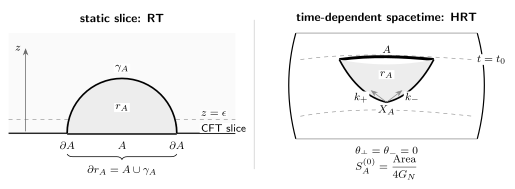
The RT prescription computes from a minimal surface on a static bulk slice. The covariant HRT prescription replaces by a spacelike extremal surface with vanishing null expansions . In both cases the surface is anchored on and satisfies the homology condition with a bulk region .
The formula resembles the Bekenstein-Hawking entropy law, but it is not merely a black-hole formula. For a generic boundary subregion , the surface is usually not a horizon. It is a new geometric object: a surface selected by the quantum entanglement pattern of the boundary state.
A good way to remember the hierarchy is:
| Boundary object | Bulk object | Leading holographic formula |
|---|---|---|
| Entangling surface | Surface anchor | |
| Reduced density matrix | Entanglement wedge data | bounded by and |
| Entanglement entropy | Area of or | |
| Entropy inequalities | Geometric inequalities | minimal or extremal surfaces obey constraints |
| Thermal entropy | Horizon area in special cases |
The RT/HRT formula is a computational tool, a conceptual bridge, and a consistency condition on any proposed bulk dual. It is also the doorway to entanglement wedges, bulk reconstruction, quantum error correction, and modern black-hole information physics.
Setup and notation
Section titled “Setup and notation”We use the course convention that the boundary theory is a CFT and the bulk is asymptotically AdS. On a boundary Cauchy slice , choose a spatial region
The entangling surface is
which has dimension . The RT/HRT surface has dimension in the bulk. Equivalently, it is codimension two in the -dimensional bulk spacetime.
For a bulk theory that comes from a compactification, such as type IIB string theory on , one may either compute the area in the full ten-dimensional Einstein-frame geometry or in the consistent lower-dimensional Einstein-frame metric after integrating over the compact space. One should not use the string-frame area unless the prescription has been modified appropriately. Entropy is gravitational, and the classical Bekenstein-Hawking area law uses Einstein frame.
The Newton constant in this page means the Newton constant of the bulk theory in which the area is being computed. For example, for the canonical AdS/CFT duality, the five-dimensional Newton constant satisfies
so RT areas scale like . This is why classical holographic entanglement captures the leading large- part of the CFT entropy.
The static RT prescription
Section titled “The static RT prescription”Suppose the boundary state is represented by a static, time-reflection-symmetric bulk geometry. Let be the corresponding Riemannian bulk spatial slice. The RT surface is the surface that solves
and minimizes the area functional among admissible surfaces satisfying the homology condition. The leading entropy is
Here is shorthand for the homology condition: there exists a bulk spatial region such that
up to orientations and possible components on horizons or end-of-the-world branes when those are part of the setup.
The three essential conditions are therefore:
| Condition | Meaning | Why it matters |
|---|---|---|
| Anchoring | The bulk surface computes the entropy of that boundary region, not another one. | |
| Minimality | has smallest area among allowed surfaces | Entropy is selected by the dominant saddle. |
| Homology | bounds a bulk region | Ensures the correct complement property and excludes pathological surfaces. |
The word “minimal” means global minimality, not merely a local solution of the Euler-Lagrange equation. In practice one often solves the extremal-surface equation and then compares the areas of all candidate surfaces. This comparison is responsible for many entanglement phase transitions.
The homology condition
Section titled “The homology condition”The homology condition is not cosmetic. Without it, the formula would fail in simple situations.
Consider a thermal state of a holographic CFT dual to a one-sided AdS black hole. If is the entire boundary spatial slice, then is empty. A surface with no boundary could be the empty surface, giving zero entropy. But the thermal density matrix has nonzero entropy. The homology condition forces the relevant surface to include the horizon, giving
This is exactly the Bekenstein-Hawking entropy of the bulk black hole.
For a pure state on a single connected boundary, the homology condition also helps guarantee
The same surface can be viewed as homologous to or to , with complementary homology regions. This is the geometric version of the equality of entanglement entropy for complementary regions in a pure state.
There is a useful slogan:
Later, will become the spatial part of the entanglement wedge. The entanglement wedge is not just an auxiliary region for drawing RT pictures; it is the bulk region encoded in the boundary density matrix .
Example: one interval in AdS/CFT
Section titled “Example: one interval in AdS3_33/CFT2_22”The cleanest RT calculation is the vacuum entropy of an interval in a two-dimensional CFT. Work on a constant-time slice of Poincaré AdS:
Let the boundary interval be
The RT surface is a bulk geodesic connecting the two endpoints. By symmetry, it is the semicircle
Introduce the cutoff . Parametrize the geodesic by
The induced line element is
The cutoff restricts the endpoints to
Therefore the regulated geodesic length is
The RT formula gives
Using the Brown-Henneaux central charge
we obtain
which is precisely the universal CFT vacuum result for a single interval.
This computation is worth digesting. The UV divergence of the CFT entropy comes from the infinite length of the bulk geodesic near the asymptotic boundary. The radial cutoff is the bulk avatar of the boundary UV cutoff. A long-distance boundary entanglement calculation has been replaced by a short geometric minimization problem.
Example: a strip in AdS
Section titled “Example: a strip in AdSd+1_{d+1}d+1”For higher-dimensional CFTs, exact answers are rarer, but the area-law structure is transparent. Consider a strip region in the vacuum CFT:
Regulate the transverse volume by
On a constant-time slice of Poincaré AdS,
parametrize the surface by . The area functional is
Because the Lagrangian does not depend explicitly on , there is a conserved quantity:
where is the deepest point of the surface. This gives
The regulated area has the form
where is a dimension-dependent numerical constant. The first term is the expected area-law divergence of a -dimensional QFT:
The finite term is fixed by conformal invariance and scales like . This is the higher-dimensional analog of the logarithm in CFT.
Spheres and hyperbolic black holes
Section titled “Spheres and hyperbolic black holes”For a ball-shaped region in the vacuum of a CFT,
the RT surface in Poincaré AdS is the hemisphere
This looks like the interval calculation, but it has a deeper meaning. The reduced density matrix of a CFT vacuum on a ball is conformally related to a thermal density matrix on hyperbolic space. In the bulk, the corresponding coordinate transformation maps the RT surface to the horizon of a hyperbolic AdS black hole. Thus the RT formula for a ball can be viewed as an ordinary horizon entropy calculation in disguise.
This observation is central in later arguments relating the entanglement first law to the linearized Einstein equations. For a ball in the CFT vacuum, the modular Hamiltonian is local:
The entanglement first law,
then becomes a direct bridge between variations of area in the bulk and variations of the CFT stress tensor.
Minimal, extremal, and why HRT is needed
Section titled “Minimal, extremal, and why HRT is needed”The RT formula assumes a static geometry with a preferred Riemannian spatial slice. Many interesting states are not static: quenches, collapsing shells, shockwaves, evaporating effective geometries, and time-dependent black holes. In a Lorentzian spacetime, “minimal area on a time slice” is not a covariant statement. Different slicings of the same spacetime could give different answers.
The HRT prescription fixes this. For a boundary region lying on a boundary Cauchy slice, the HRT surface is a codimension-two spacelike surface satisfying:
with the same homology condition as RT, and with vanishing first variation of area under all local deformations. Equivalently, the two null expansions vanish:
This is the natural generalization of a stationary surface to Lorentzian geometry. If there are several extremal candidates, the prescription chooses the one with least area among the admissible extremal surfaces.
In a static spacetime with a time-reflection symmetry, HRT reduces to RT. The extremal surface lies on the symmetric time slice, and extremality in spacetime becomes minimality on that slice.
A useful distinction:
| Surface type | Where it lives | Variational condition | Used for |
|---|---|---|---|
| Minimal surface | Riemannian spatial slice | smallest area among candidates | RT in static states |
| Extremal surface | Lorentzian spacetime | first variation of area vanishes | HRT in time-dependent states |
| Horizon cross-section | Event/apparent/Killing horizon | causal or trapping condition | black-hole entropy, not generic |
The HRT surface is generally not a horizon. It is selected by boundary entanglement, not by causal trapping.
The area term as a large- saddle
Section titled “The area term as a large-NNN saddle”The RT/HRT formula is not a statement about an arbitrary CFT. It is a statement about CFTs with a semiclassical gravitational dual. In such theories, one has a large parameter, often denoted , such that
for matrix-like large- theories. Consequently,
The classical area computes the contribution. The term comes from quantum bulk fields entangled across the RT/HRT surface, and from shifts in the surface location. Those corrections are not optional if one asks a fine-grained quantum-gravity question. They are the subject of the next page.
For many classical holographic applications, however, the area term is the leading answer and already contains highly nontrivial physics: entropy inequalities, thermal entropy, confinement/deconfinement transitions, mutual information transitions, and geometric reconstruction regions.
Entanglement phase transitions
Section titled “Entanglement phase transitions”The RT prescription involves a minimization. Whenever two candidate surfaces exchange dominance, the leading large- entropy is continuous but not analytic. These are entanglement phase transitions.
A simple example is the union of two separated intervals in the vacuum of a holographic CFT:
There are two natural geodesic pairings for :
and
where at leading order. The RT answer is
The connected surface dominates when
In that phase, the leading mutual information is
In the disconnected phase, . This does not mean the exact mutual information vanishes. It means that it is subleading in . Classical geometry sees only the order- part.
This example is a warning against overinterpreting sharp classical transitions. The exact CFT entropy is smooth at finite . The sharp transition appears because the bulk saddle approximation replaces a sum over contributions by the dominant one.
Entropy inequalities from geometry
Section titled “Entropy inequalities from geometry”Entanglement entropy obeys powerful inequalities in quantum theory. The RT formula geometrizes many of them.
The most important is strong subadditivity:
For static RT surfaces, this inequality has a beautiful geometric proof. One draws the minimal surfaces for and , cuts and reglues them into candidate surfaces for and , and uses minimality. Since the RT surfaces for and have area no larger than the candidate reglue surfaces, the inequality follows.
Classical holographic entropies obey additional inequalities that are not true for arbitrary quantum states. A famous example is monogamy of mutual information:
or equivalently
This extra inequality is a signature of the special large- geometric entropy cone. It should not be imposed on generic quantum states, and it can receive corrections beyond the classical area approximation.
Thermal states and horizon contributions
Section titled “Thermal states and horizon contributions”RT surfaces in black-hole geometries encode both entanglement entropy and ordinary thermal entropy. The distinction depends on the region and the state.
For a finite region in a thermal CFT state dual to an AdS black brane, the RT surface usually dips toward the horizon. For small regions, it stays mostly near the boundary and the entropy is close to the vacuum result. For large regions, the surface develops a segment that runs near the horizon. The entropy then contains a volume-law piece proportional to the thermal entropy density:
where
For the entire boundary spatial slice in a one-sided thermal state, the entropy is the thermal entropy itself, and the relevant surface is the horizon. For the eternal two-sided black hole dual to the thermofield double state, the entropy of one entire boundary CFT is again the horizon area. The full two-sided state is pure, but either side alone is mixed.
This is the cleanest way to see how RT unifies black-hole entropy and ordinary subregion entanglement entropy.
RT surfaces and the entanglement wedge
Section titled “RT surfaces and the entanglement wedge”Given an RT surface , the homology region is the bulk spatial region whose boundary is . The entanglement wedge is the domain of dependence of :
For HRT, the analogous construction uses a bulk achronal region bounded by .
The next pages will explain the entanglement wedge in detail. For now, the key point is this:
This statement is much stronger than the area formula alone. It says that the reduced density matrix of a boundary subregion knows a particular bulk region. The RT/HRT surface is the boundary of that reconstructable region.
This is also why phase transitions are physically meaningful. When the dominant RT surface changes, the entanglement wedge can jump discontinuously at leading order in . In the exact finite- theory the transition is smoothed, but in the classical geometry it is a sharp change in the reconstructable bulk region.
The replica idea behind RT
Section titled “The replica idea behind RT”The RT formula was originally proposed as a holographic analog of the Bekenstein-Hawking area law. A later derivation uses the replica trick in the bulk.
In the boundary QFT, Rényi entropies are computed from
The entanglement entropy is obtained by analytic continuation:
Holographically, is computed by a bulk saddle whose boundary is the -fold replicated boundary geometry. In the classical bulk limit, differentiating with respect to creates a codimension-two conical defect. The regularity condition for this defect selects an extremal surface, and the derivative of the action gives its area divided by .
This is the same mechanism that produces black-hole entropy from a Euclidean conical defect. RT is therefore not a random geometric guess: it is a generalized gravitational entropy formula applied to replicated boundary regions.
For this page, the replica derivation is a consistency check and conceptual anchor. The full quantum-corrected story, including bulk entanglement and quantum extremal surfaces, comes next.
What RT/HRT does not say by itself
Section titled “What RT/HRT does not say by itself”RT/HRT is powerful, but one must keep its assumptions visible.
First, the classical formula computes only the leading area term. It does not include bulk-field entanglement across the surface:
as an exact finite- statement.
Second, the area functional assumes two-derivative Einstein gravity. Higher-derivative bulk theories require a generalized entropy functional. For example, curvature-squared terms do not simply use the area in Planck units.
Third, the surface must be computed in the appropriate Einstein-frame geometry. Using the wrong frame or forgetting internal compact directions can change the answer.
Fourth, minimal and extremal are not interchangeable words. In Lorentzian signature, one extremizes; in a static Riemannian slice, one minimizes.
Fifth, the RT surface is not generally the same as a causal horizon. Causal wedges and entanglement wedges are related but distinct. In many important examples, the entanglement wedge extends deeper than the causal wedge.
Common mistakes
Section titled “Common mistakes”| Mistake | Correction |
|---|---|
| “The RT surface is always a horizon.” | Only in special cases, such as the entropy of an entire thermal boundary or a ball after a conformal map. |
| “Any extremal surface is the answer.” | One must impose anchoring, homology, and choose the least-area admissible extremal surface. |
| “The disconnected mutual information phase means no correlations.” | It means no order- mutual information. Subleading correlations can remain. |
| “The area law divergence is mysterious in the bulk.” | It comes from the infinite area near the asymptotic boundary, regulated by . |
| “RT is exact.” | Classical RT is the leading term. Quantum corrections produce generalized entropy and quantum extremal surfaces. |
| “HRT is minimal on some chosen time slice.” | HRT is covariantly extremal in Lorentzian spacetime; the maximin construction is a theorem, not the definition used in calculations. |
Exercises
Section titled “Exercises”Exercise 1: The interval entropy in AdS
Section titled “Exercise 1: The interval entropy in AdS3_33”Consider the constant-time slice of Poincaré AdS,
and the interval . Show that the geodesic has regulated length
and hence
Solution
Parametrize the geodesic by
Then
so
The cutoff gives
The full geodesic has two equal halves, so
Using RT,
The Brown-Henneaux relation is
hence
Exercise 2: The strip first integral
Section titled “Exercise 2: The strip first integral”For the strip in AdS, derive the conserved quantity
Solution
The area density is
Since has no explicit dependence, the Hamiltonian-like quantity
is conserved. We compute
and therefore
At the turning point , the profile has . Thus
which gives
Exercise 3: Homology and the thermal entropy
Section titled “Exercise 3: Homology and the thermal entropy”In a one-sided thermal state dual to an AdS black hole, take to be the entire boundary spatial slice. Explain why the homology condition selects the horizon and gives the thermal entropy.
Solution
For the entire boundary spatial slice, . Without homology, the empty surface would be an allowed surface with zero area. That would incorrectly give for a thermal density matrix.
The homology condition requires a bulk region whose boundary is . In the exterior region of a black-hole geometry, the boundary slice by itself is not the full boundary of a compact bulk region; the horizon cross-section must be included. Thus the admissible surface is the horizon cross-section:
The RT formula gives
which is the Bekenstein-Hawking entropy of the black hole and the thermal entropy of the boundary state.
Exercise 4: A mutual-information phase transition
Section titled “Exercise 4: A mutual-information phase transition”For two equal intervals in a holographic CFT vacuum,
use to show that the connected RT pairing dominates when
Find the critical value of .
Solution
The disconnected candidate is
The connected candidate is
The connected candidate dominates when
This is equivalent to
so
Let . Then
or
The positive root is
Thus the connected phase dominates for
Exercise 5: Why HRT is not “minimal on a time slice”
Section titled “Exercise 5: Why HRT is not “minimal on a time slice””Explain why the phrase “choose the minimal surface on the boundary time slice” is not a covariant prescription in a time-dependent Lorentzian geometry.
Solution
A time-dependent Lorentzian spacetime does not come with a unique preferred bulk time slice anchored to a given boundary time. Different bulk foliations can agree at the boundary but differ in the interior. A prescription that minimizes area on a chosen slice would therefore depend on a gauge-like choice of slicing rather than on the spacetime geometry itself.
The HRT prescription avoids this by selecting a spacelike codimension-two surface that is extremal in the full Lorentzian spacetime. Its first variation of area vanishes under local deformations in both independent normal directions. Equivalently, its two null expansions vanish:
This condition is covariant. In static geometries with time-reflection symmetry, the HRT surface lies on the symmetric slice and reduces to the RT minimal surface.
Further reading
Section titled “Further reading”The original proposal is Ryu and Takayanagi, “Holographic Derivation of Entanglement Entropy from AdS/CFT”. The covariant extension is Hubeny, Rangamani, and Takayanagi, “A Covariant Holographic Entanglement Entropy Proposal”. The replica derivation is Lewkowycz and Maldacena, “Generalized Gravitational Entropy”. For geometric entropy inequalities, see Headrick and Takayanagi, “A Holographic Proof of the Strong Subadditivity of Entanglement Entropy”. A broad review is Nishioka, Ryu, and Takayanagi, “Holographic Entanglement Entropy: An Overview”.