
Strings from Flux Tubes
The organizing idea
Section titled “The organizing idea”The previous page explained why the large- expansion of a matrix gauge theory is topological. Ribbon graphs are naturally classified by two-dimensional surfaces, and each handle costs a factor of . That is a kinematical hint of strings.
This page adds the dynamical hint. In a confining gauge theory, the color-electric field between a heavy quark and antiquark does not spread out like the electric field in Maxwell theory. Instead it is squeezed into a narrow tube. If the tube has a roughly constant energy per unit length, then the energy of a widely separated pair grows linearly:
Here is the string tension and is the strong-coupling scale. As the quarks move through spacetime, the flux tube sweeps out a two-dimensional surface. At distances large compared with the flux-tube thickness, the leading effective action is proportional to the area of that surface. This is the second major reason that gauge theory wants to become string theory:
This statement is older and less precise than AdS/CFT. It is a powerful physical picture of confinement, not a complete solution of four-dimensional Yang-Mills theory. AdS/CFT changes the status of the story: in holographic theories, Wilson loops are computed by actual fundamental strings whose worldsheets end on the boundary contour. But one should keep two ideas distinct:
They are related, but not identical. The QCD string is an effective long-distance object in four-dimensional spacetime. The AdS/CFT string moves in a higher-dimensional curved target space, and the radial direction carries information about energy scale.
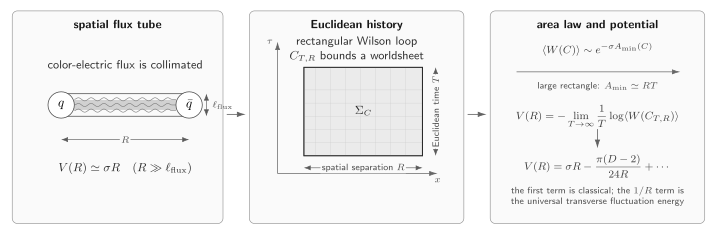
A confining flux tube has tension , so the Euclidean history of a heavy pair is approximated by a worldsheet action . A rectangular Wilson loop then gives and . Quantum fluctuations of the long string add the universal Lüscher correction for an open string in spacetime dimensions.
Wilson loops and heavy external sources
Section titled “Wilson loops and heavy external sources”The basic observable for a gauge-theory flux tube is the Wilson loop. For a closed contour and representation of the gauge group,
The symbol means path ordering. It is essential because non-Abelian gauge fields at different points of the loop do not commute. The trace makes the object gauge invariant.
The physical interpretation is clearest for a large rectangular loop. Take the rectangle to have spatial width and Euclidean time extent . Two long vertical sides represent a heavy quark and antiquark held fixed for Euclidean time ; the short horizontal sides create and annihilate the pair. The expectation value behaves at large as
so the static potential is extracted by
This formula is the bridge from an abstract gauge-invariant loop operator to the energy of a physical flux tube.
If the theory confines external fundamental charges, the large-loop behavior is an area law:
where is the minimal area bounded by , is the perimeter, and the ellipsis includes shape-dependent and quantum fluctuation terms. For the rectangle,
and therefore
The same logic also explains what confinement is not. In a Coulomb phase, one expects a potential such as
in four dimensions. Then is not proportional to at large . In a Higgs or screening phase, a large Wilson loop may instead obey a perimeter law,
which says that the dominant cost is local along the contour rather than extensive in the enclosed area.
There is a subtle but important caveat. Wilson loops are ultraviolet-singular composite operators. They have perimeter divergences and, when the contour has corners, cusp divergences. The confinement criterion concerns the infrared behavior after local UV divergences have been renormalized. The slogan “area law equals confinement” is meaningful only after separating these short-distance local terms from the large-distance scaling.
The flux-tube picture of confinement
Section titled “The flux-tube picture of confinement”Why should the energy grow linearly? A useful cartoon is the following. In Maxwell theory in dimensions, electric field lines spread over a sphere, so the energy density dilutes with distance. In a confining non-Abelian gauge theory, the vacuum behaves more like a medium that expels color-electric flux from most of space. The flux between fundamental charges is squeezed into a tube of transverse size
If the tube has tension , then a long tube has energy
The precise mechanism is theory-dependent. In compact Abelian gauge theory in three dimensions, monopole instantons give a controlled analytic mechanism. In four-dimensional Yang-Mills theory, confinement is strongly supported by lattice calculations and by many analytic arguments, but there is no closed-form solution of the full continuum theory. For this course, the important point is not a particular microscopic mechanism. The important point is the existence of a long object with a tension.
A long object with tension is naturally described by an effective string theory. Its worldsheet coordinates are , , and its embedding into spacetime is . The leading reparametrization-invariant action is the Nambu-Goto area action
where
in Euclidean flat spacetime. The coefficient is the physical string tension. In string-theory language one often writes
The subscript “eff” is important. The confining flux tube is not automatically a critical fundamental string. It is an infrared effective string whose parameters are determined by the gauge theory.
Effective string theory of a long flux tube
Section titled “Effective string theory of a long flux tube”The Nambu-Goto action is a good first approximation when the flux tube is much longer than its width. Choose static gauge for an almost straight open string stretched along the direction:
Here is the number of spacetime dimensions in which the flux tube lives. The transverse fields are the Goldstone modes associated with broken transverse translations. The induced metric is
and the Nambu-Goto action expands as
The first term is the classical area. The second term describes approximately massless transverse fluctuations on the worldsheet. The derivative expansion is controlled by the long length scale of the string, not by weak gauge coupling.
Quantizing these transverse modes gives a universal correction to the static potential. For an open string of length with Dirichlet endpoints, the zero-point energy of the transverse fields is
Therefore the long-distance potential has the form
or, in many parity-symmetric effective string setups, the next bulk correction begins at after boundary terms are treated appropriately. The constant is non-universal; it depends on the self-energy of the heavy sources and on the renormalization scheme. The term is the Lüscher term, universal because it is fixed by the number of transverse massless modes.
For a confining gauge theory in dimensions, , so
This formula is a beautiful example of how a gauge theory can exhibit stringy physics without yet invoking quantum gravity. The flux tube has vibrations. Its long-distance spectrum is organized like the spectrum of a string. But the effective string description is not valid at distances comparable to the tube thickness, and it does not by itself tell us the full microscopic gauge theory.
Large makes the string sharper
Section titled “Large NNN makes the string sharper”The flux-tube string is most useful in a large- gauge theory. The reason is the same topological counting discussed in the previous page.
In a pure Yang-Mills theory, a fundamental external quark cannot be screened by gluons, because gluons are adjoint and carry zero center charge. The flux tube between external fundamental sources cannot simply disappear. If the theory contains dynamical fundamental quarks, however, the tube can break by pair production:
At large with fixed , quark loops are suppressed. A diagram with fundamental boundaries behaves schematically as
Thus string breaking by dynamical fundamental matter is suppressed by . In the strict large- limit with fixed , open flux tubes are stable. This is one reason the large- limit is cleaner than real QCD with .
Similarly, closed flux tubes behave like closed strings. A closed loop of color flux can be interpreted as a glueball-like excitation. Its splitting and joining interactions are suppressed by powers of . Schematically,
The large- theory is therefore not merely stringy because its Feynman diagrams are ribbon graphs. It is stringy because its long-distance confining excitations are extended one-dimensional objects whose interactions become weak at large .
This is the intuitive large- picture of confining Yang-Mills:
| Gauge-theory object | String interpretation |
|---|---|
| Rectangular Wilson loop | Worldsheet with boundary |
| Area law | Classical string saddle |
| String tension | |
| Transverse flux-tube fluctuations | Massless worldsheet fields |
| Glueballs | Closed flux-tube states, approximately closed strings |
| Mesons at large | Open strings with quark endpoints |
| Quark loops at fixed | Boundaries suppressed by |
| Handles of the worldsheet | Closed-string loops suppressed by |
The table is schematic, but it captures a robust lesson: large and confinement together produce a controlled string expansion.
Wilson loops as sums over surfaces
Section titled “Wilson loops as sums over surfaces”The flux-tube picture suggests a formal rewriting of Wilson-loop expectation values as a sum over surfaces:
At leading order for a long smooth loop,
This formula should be read carefully. In ordinary four-dimensional Yang-Mills theory, it is not an exact microscopic definition of the theory. It is an infrared effective representation. It knows about the long flux tube but not necessarily about short-distance asymptotic freedom, small instantons, operator mixing, or the full spectrum of glueball states.
Nevertheless, the idea is profound. Gauge theory has a natural set of gauge-invariant variables: Wilson loops. If one could write exact equations for all Wilson loops, one would have a loop-space formulation of gauge theory. In the large- limit, factorization helps these loop equations close on expectation values of single loops. The Makeenko-Migdal equations are a famous expression of this idea. They are powerful, but solving them in four dimensions is extremely hard. This is one of the places where the phrase “QCD is a string theory” is both tantalizing and dangerous: the right string is not known in closed form.
AdS/CFT gives a different route. Rather than deriving the exact QCD string directly from Wilson-loop equations, it constructs explicit gauge theories whose string duals are known from D-branes and decoupling limits. Then Wilson-loop surfaces become actual string worldsheets in a higher-dimensional geometry.
What changes in AdS/CFT?
Section titled “What changes in AdS/CFT?”In holographic duality, the Wilson-loop idea becomes a boundary condition for a bulk string. The schematic prescription is
where is a fundamental-string worldsheet ending on the boundary contour , and
The ellipsis includes possible coupling to the NS-NS two-form and fermionic terms in the superstring action. At large and large ‘t Hooft coupling, the leading answer comes from the classical minimal area of the worldsheet.
For super-Yang-Mills, the supersymmetric Wilson loop is not just the ordinary gauge Wilson loop. It also couples to the six adjoint scalars:
where is a unit vector on . The scalar coupling encodes where the string endpoint sits on the internal . This is a useful reminder that the holographic Wilson loop is a precise operator in a particular gauge theory, not simply a borrowed QCD observable.
The bulk radial direction also changes the meaning of “string tension.” In flat-space effective string theory, the tension is a constant coefficient in the long-distance action. In a holographic background, the fundamental string tension is fixed by , but the effective tension measured along boundary spatial directions depends on the string-frame metric. Suppose the string-frame metric contains
A long horizontal segment sitting at radial position has effective boundary tension
with understood as its absolute value in Lorentzian signature. In confining holographic geometries, the spacetime often caps off smoothly or has an infrared wall. A long string drops to the radial position where is minimized and then stretches horizontally. The result is a linear potential,
In conformal AdS, by contrast, there is no confinement scale and no linear potential. The strong-coupling result for a heavy external quark-antiquark pair has the conformal form
not . The bulk string is fundamental, but the boundary theory is not confining. That is a vital distinction.
Why the QCD string is not automatically the fundamental string
Section titled “Why the QCD string is not automatically the fundamental string”It is tempting to say: “flux tubes are strings, so Yang-Mills must be ordinary string theory.” The truth is subtler.
A long confining flux tube in spacetime dimensions has universal transverse Goldstone modes. A critical superstring in flat ten-dimensional spacetime has many more worldsheet degrees of freedom, including fermions and internal coordinates. A holographic string in AdS moves in ten dimensions; the radial AdS coordinate and the coordinates are not visible in a naive four-dimensional flux-tube cartoon.
So the relation between gauge theory and string theory has layers:
AdS/CFT unifies the second and third layers in examples derived from D-branes. In confining holographic models, the first layer emerges from the third: the QCD-like flux tube is a fundamental string that falls to the infrared region of the bulk and then behaves like an effective long string in the boundary directions.
A worked example: area law to static potential
Section titled “A worked example: area law to static potential”Assume that a renormalized rectangular Wilson loop behaves for large as
The static potential is
Substituting gives
The term is a source self-energy contribution from the two long vertical sides of the rectangle. The term proportional to vanishes as . The coefficient of is the physical string tension.
Now include the leading transverse fluctuation correction:
Then
This derivation is simple, but it is the conceptual seed of much of holographic Wilson-loop physics. In Chapter 07, the same extraction of will be performed using a string worldsheet in AdS.
Common mistakes
Section titled “Common mistakes”Mistake 1: Every Wilson-loop area law is the same thing as AdS/CFT.
No. Wilson loops and area laws existed long before AdS/CFT. They diagnose confinement and motivate string descriptions of gauge theory. AdS/CFT gives a specific realization in which certain Wilson loops are computed by fundamental strings in a controlled bulk background.
Mistake 2: A flux tube is literally a zero-width string.
A gauge-theory flux tube has a finite thickness of order the inverse mass gap. The string description is an effective long-distance expansion valid when all lengths are much larger than that thickness.
Mistake 3: The Nambu-Goto action is the whole QCD string.
Nambu-Goto is the leading universal term. The effective action also contains boundary terms, higher-derivative corrections, possible massive worldsheet modes, and theory-dependent short-distance physics.
Mistake 4: Large alone implies confinement.
Large organizes diagrams and suppresses interactions, but it does not prove that a theory confines. For example, SYM at large is conformal, not confining.
Mistake 5: The holographic Wilson loop always gives .
Only confining holographic geometries produce a linear potential at large . In conformal AdS backgrounds, scale invariance forces to be proportional to up to a coupling-dependent coefficient.
Mistake 6: The perimeter term is irrelevant.
The perimeter term is not the confinement signal, but it is important for renormalization. Wilson loops have UV divergences localized on the contour, and cusped loops have additional cusp divergences.
Exercises
Section titled “Exercises”Exercise 1: From an area law to a linear potential
Section titled “Exercise 1: From an area law to a linear potential”Assume a rectangular Wilson loop obeys
for . Use
to derive the static potential.
Solution
Taking the logarithm gives
Therefore
Thus an area law for large rectangular Wilson loops implies a linearly rising potential with string tension .
Exercise 2: Perimeter law and screening
Section titled “Exercise 2: Perimeter law and screening”Suppose instead that a large rectangular Wilson loop behaves as
What potential follows from the rectangular-loop formula? Why does this not signal confinement?
Solution
The logarithm is
Then
The potential approaches a constant at large separation. This indicates screening rather than confinement. A confining potential grows linearly with ; a perimeter law gives a cost localized near the worldlines of the heavy sources.
Exercise 3: Expanding the Nambu-Goto action
Section titled “Exercise 3: Expanding the Nambu-Goto action”In static gauge, take
for . Show that the Nambu-Goto action begins as
Solution
The induced metric is
Let
For small fluctuations,
Since
we obtain
For a rectangular worldsheet of size , the first term is . This gives the desired expansion.
Exercise 4: The Lüscher coefficient in four dimensions
Section titled “Exercise 4: The Lüscher coefficient in four dimensions”For an open confining string in spacetime dimensions, the universal fluctuation correction is
What is this correction for a four-dimensional gauge theory?
Solution
For a flux tube in four-dimensional spacetime, . Therefore there are
transverse massless modes. Substituting gives
Thus the long-distance potential has the universal form
Exercise 5: Large- suppression of string breaking
Section titled “Exercise 5: Large-NNN suppression of string breaking”A large- diagram with genus and fundamental matter boundaries scales as
Compare a planar diagram with no fundamental loop to a planar diagram with one fundamental loop. What is the suppression factor when is fixed?
Solution
For and , the diagram scales as
For and , it scales as
The ratio is
Thus a single fundamental loop is suppressed by when is fixed as . This is the large- reason why string breaking by dynamical fundamental quarks is suppressed in the quenched limit.
Exercise 6: Effective string tension in a warped holographic metric
Section titled “Exercise 6: Effective string tension in a warped holographic metric”Consider a string-frame metric of the form
A long string segment sits at constant and stretches along for length during time . Use the Nambu-Goto action to show that its contribution to the potential is
with understood as its absolute value.
Solution
Choose worldsheet coordinates
The induced metric is diagonal:
where is taken as positive after Wick rotation or as an absolute value in Lorentzian signature. Thus
The Nambu-Goto action is
Therefore
Since for a static configuration, the potential is
with
Further reading
Section titled “Further reading”- Kenneth G. Wilson, “Confinement of Quarks”, Physical Review D 10, 2445 (1974). The foundational Wilson-loop formulation of confinement.
- Gerard ‘t Hooft, “A Planar Diagram Theory for Strong Interactions”, Nuclear Physics B 72, 461 (1974). The large- topological expansion that makes gauge theory string-like.
- Yu. Makeenko and Alexander A. Migdal, “Exact Equation for the Loop Average in Multicolor QCD”, Physics Letters B 88, 135 (1979). The classic large- loop equation.
- A. M. Polyakov, Gauge Fields and Strings. A classic source for the gauge-theory/string-theory viewpoint.
- Juan Maldacena, “Wilson Loops in Large N Field Theories”, arXiv:hep-th/9803002. The original holographic Wilson-loop prescription.
- Soo-Jong Rey and Jung-Tay Yee, “Macroscopic Strings as Heavy Quarks: Large-N Gauge Theory and Anti-de Sitter Supergravity”, arXiv:hep-th/9803001. A parallel early derivation of the Wilson-loop/string-worldsheet relation.
- Nadav Drukker, David J. Gross, and Hirosi Ooguri, “Wilson Loops and Minimal Surfaces”, arXiv:hep-th/9904191. A deeper analysis of minimal surfaces and loop properties in AdS/CFT.
- Michele Caselle, “Effective String Description of the Confining Flux Tube at Finite Temperature”, Universe 7, 170 (2021). A modern review of effective string theory for confining flux tubes.
The next page explains why D-branes provide a sharper mechanism than the flux-tube analogy: open strings on branes give gauge theories, while closed strings sourced by the same branes give gravitational geometries.