
DBI Action, Tachyon Condensation, and R--R Charges
Open-string T-duality turned D-branes into geometric hypersurfaces: open strings end on them, and separated branes make stretched strings massive. The final step is to understand D-branes as dynamical objects.
At low energies a single D-brane is governed by two complementary terms,
The Dirac—Born—Infeld action describes the brane tension, its motion in spacetime, and the gauge field living on its worldvolume. The Wess—Zumino action describes its Ramond—Ramond charge. The slogan is:
This is the natural endpoint of a first course in perturbative string theory: strings are still fundamental probes, but the theory has forced us to include extended charged objects in its spectrum.
Worldvolume fields of a D-brane
Section titled “Worldvolume fields of a Dppp-brane”Let the D-brane worldvolume be denoted by , with local coordinates
The brane is embedded in ten-dimensional spacetime by functions
In static gauge we identify the longitudinal spacetime coordinates with the worldvolume coordinates,
and the remaining transverse coordinates become scalar fields on the brane,
For a single brane, literally describes the transverse position of the brane. It is often useful to write
so that has the same engineering dimension as a gauge field obtained by dimensional reduction.
The massless open-string field that looked like a spacetime vector before imposing Dirichlet boundary conditions splits as
The components are a gauge field tangent to the brane. The components in the transverse directions are reinterpreted as scalar fields measuring brane motion.
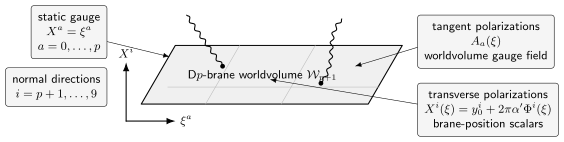
The massless open-string fields on a D-brane consist of a worldvolume gauge field and transverse scalars describing brane fluctuations.
For a stack of coincident D-branes, open strings carry Chan—Paton labels at their endpoints. The fields become matrices, and the low-energy gauge group is enhanced to for oriented open strings. This page mostly discusses the Abelian single-brane action, but the dimensional-reduction intuition survives: the leading non-Abelian theory on coincident D-branes is dimensionally reduced ten-dimensional super Yang—Mills.
The Dirac—Born—Infeld action
Section titled “The Dirac—Born—Infeld action”The gauge-invariant low-energy action for a single D-brane in a general NS—NS background is
Here
is the worldvolume field strength, and denotes pullback to the brane. For example,
and
The combination
is fixed by gauge invariance. Under
the brane gauge field shifts as
so that is invariant.
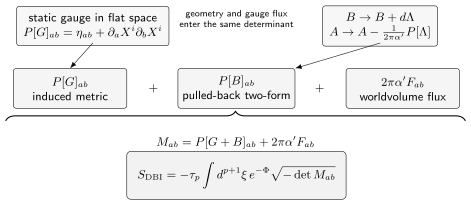
The DBI determinant combines induced geometry, the pulled-back -field, and the worldvolume flux . In static gauge, transverse brane motion enters through in flat space.
The coefficient convention used here separates the constant string coupling from the dilaton. If , then for a BPS Type II D-brane,
so the physical tension in a constant background is
The factor is physically important. A D-brane is visible already at disk level in open-string perturbation theory, so its tension scales as . It is therefore nonperturbative from the viewpoint of closed-string loops.
The small-field expansion
Section titled “The small-field expansion”The DBI action is a nonlinear completion of Maxwell theory. To see this, first set and take a space-filling brane in flat spacetime. Then
For an antisymmetric matrix , the determinant begins as
There is no term linear in , because is antisymmetric. In flat space with transverse scalars and small fields,
and the DBI action expands to
In terms of ,
The coefficient of the gauge kinetic term gives the Yang—Mills coupling on a single brane,
or equivalently
For coincident D-branes, this becomes the leading coefficient of the gauge theory. The scalars become matrices, and the potential includes commutator terms schematically of the form
Separated branes correspond to diagonal scalar expectation values; coincident branes restore the full non-Abelian gauge symmetry.
Geometric checks: D0 and D1 limits
Section titled “Geometric checks: D0 and D1 limits”A useful check is obtained by setting and . The DBI action reduces to a Nambu—Goto type volume action for the embedded brane.
For a D0-brane in flat spacetime, choose . The induced metric on the worldline is
so
Thus a D0-brane is a relativistic particle.
For a D1-brane with one transverse fluctuation and static gauge , , the induced metric components are
Therefore
and the D1-brane action becomes
This is the relativistic area action for a fluctuating stringlike brane.
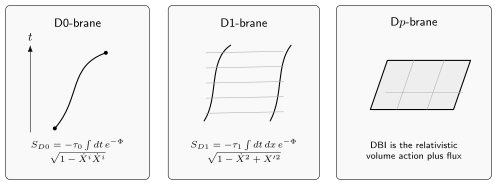
With , DBI reduces to the relativistic volume action for the embedded brane. A D0-brane is particle-like; a D1-brane is string-like; a D-brane is the higher-dimensional analogue.
Wess—Zumino coupling and R—R charge
Section titled “Wess—Zumino coupling and R—R charge”The DBI action describes tension and NS—NS couplings. D-branes also carry Ramond—Ramond charge. This is encoded by the Wess—Zumino coupling
The exponential is a formal sum of differential forms,
When integrating over , one keeps only the total -form part. The leading term is
which says that a D-brane is electrically charged under the R—R potential .
For BPS Type II D-branes, supersymmetry relates charge and tension. With the convention above,
More precisely, the equality is a statement about the normalized BPS charge and tension after placing the bulk fields in a common normalization.
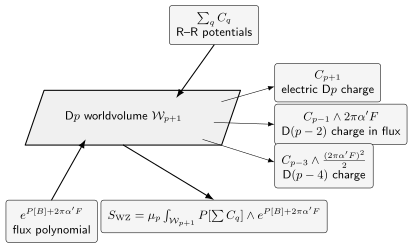
The Wess—Zumino term couples a D-brane to R—R potentials. The factor also shows that worldvolume flux carries lower-dimensional D-brane charge.
A key consequence is that flux on a brane represents dissolved lower-dimensional branes. For instance,
has the form of a D-brane charge distributed through the D-brane worldvolume. Similarly, a term involving represents D-brane charge. This is the elementary form of a deeper statement: in the full theory, D-brane charge is naturally organized by K-theory rather than only by ordinary homology.
Tachyon condensation on unstable branes
Section titled “Tachyon condensation on unstable branes”Not every D-brane is stable. Bosonic D-branes have open-string tachyons. Type II non-BPS branes and brane—antibrane pairs also contain tachyons in their open-string spectrum. A tachyon means that the perturbative configuration is not the true vacuum.
The qualitative potential has the form
where is the unstable open-string vacuum and is the closed-string vacuum after the brane has disappeared. In this picture, the negative contribution from the tachyon potential cancels the brane tension.
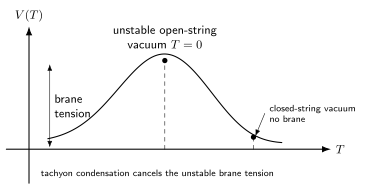
The unstable open-string vacuum at sits at the top of the tachyon potential. The endpoint of condensation is the closed-string vacuum with no unstable brane left behind.
BPS Type II D-branes are different. The GSO projection removes the open-string tachyon, and the brane is stabilized by its R—R charge. A charged brane cannot simply disappear unless its charge is carried away by another object or annihilated against an oppositely charged antibrane.
This distinction is one of the first places where the physical meaning of the GSO projection becomes vivid: it is not merely a rule for removing tachyons from a spectrum, but part of the structure that permits stable charged branes.
Type II brane spectra and T-duality
Section titled “Type II brane spectra and T-duality”Type II T-duality exchanges Type IIA and Type IIB. Along a compact direction , it acts locally as
and worldsheet supersymmetry gives the corresponding right-moving fermion sign flip,
In the Ramond sector, fermion zero modes act as spacetime gamma matrices. Flipping one right-moving fermion flips one right-moving spacetime chirality. Hence
The same T-duality changes D-brane dimension. If the dualized direction lies along the brane worldvolume, a Neumann direction becomes Dirichlet and
If the dualized direction is transverse to the brane, a Dirichlet direction becomes Neumann and
This explains the basic pattern of stable BPS D-branes:
Here one includes the D-instanton in Type IIB and the D8-brane in massive Type IIA.
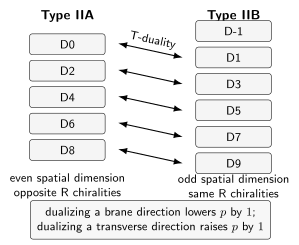
T-duality flips one Ramond chirality and exchanges Type IIA with Type IIB. It also changes a D-brane dimension by one, depending on whether the dualized circle is tangent or transverse to the brane.
R—R potentials and electric/magnetic duality
Section titled “R—R potentials and electric/magnetic duality”A D-brane couples electrically to . In Type IIA the BPS D-branes have even , so the corresponding R—R potentials have odd degree:
in a democratic description. In Type IIB the BPS D-branes have odd , so the potentials have even degree:
The Type IIB five-form field strength is self-dual, making the D3-brane a self-dual object.
Let
be the R—R field strength sourced electrically by a D-brane. In ten dimensions, its Hodge dual has degree
Locally one writes
An object electrically charged under is a D-brane. Therefore
Examples include
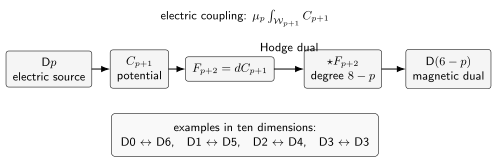
A D-brane is electrically charged under . The magnetic dual field strength corresponds to a D-brane in ten spacetime dimensions.
T-duality acts on R—R potentials in precisely the way required by the brane ladder. A component with one leg along the dualized circle loses that leg, while a component without such a leg gains one:
and
up to sign conventions and -field refinements. This is exactly what the WZ coupling needs in order to remain compatible with T-duality.
What has been achieved
Section titled “What has been achieved”The course began by replacing a point-particle worldline with a string worldsheet. Quantizing that worldsheet produced gravitons, gauge fields, CFT, ghosts, amplitudes, effective actions, spacetime supersymmetry, and dualities. The final lesson is that perturbative string theory is not only a theory of strings. It also contains D-branes: hypersurfaces on which open strings end, carrying gauge theories and R—R charges.
The three central formulas to retain are
and
These formulas are the gateway to many later developments: black branes, gauge/gravity duality, brane engineering of gauge theories, matrix models, and nonperturbative string/M-theory.
Exercises
Section titled “Exercises”Exercise 1. Maxwell theory from DBI
Section titled “Exercise 1. Maxwell theory from DBI”Show that, for an antisymmetric matrix ,
Solution
Let
Then
Since is antisymmetric, . Hence
Therefore
But
Thus
with the overall Minkowski sign included in the standard DBI square root.
Exercise 2. The D1-brane as a Nambu—Goto object
Section titled “Exercise 2. The D1-brane as a Nambu—Goto object”For a D1-brane in flat spacetime with one transverse scalar , use static gauge , to prove
Solution
The embedding is
The induced metric is
Therefore
The determinant is
Thus
Exercise 3. Gauge invariance of
Section titled “Exercise 3. Gauge invariance of P[B]+2πα′FP[B]+2\pi\alpha'FP[B]+2πα′F”Verify that is invariant under
Solution
The worldvolume field strength transforms as
Pullback commutes with exterior differentiation, so
Therefore
Exercise 4. Lower-dimensional charge from flux
Section titled “Exercise 4. Lower-dimensional charge from flux”Which term in the Wess—Zumino action represents D-brane charge dissolved in a D-brane?
Solution
Set for simplicity and expand
The term
has total form degree , so it can be integrated over the D-brane worldvolume. Since a D-brane couples electrically to , this term represents D-brane charge carried by magnetic flux on the D-brane.
Exercise 5. T-duality and brane dimension
Section titled “Exercise 5. T-duality and brane dimension”A Type IIB D3-brane wraps a circle direction . What brane is obtained after T-duality along ? What if the D3-brane is transverse to instead?
Solution
If the D3-brane wraps , then is a Neumann direction. T-duality turns it into a Dirichlet direction, so the brane loses one spatial dimension:
If the D3-brane is transverse to , then is a Dirichlet direction. T-duality turns it into a Neumann direction, so the brane gains one spatial dimension:
The theory changes from IIB to IIA because T-duality flips one right-moving Ramond chirality.
Exercise 6. Magnetic dual branes
Section titled “Exercise 6. Magnetic dual branes”Use ten-dimensional Hodge duality to find the magnetic duals of D0-, D1-, D2-, and D3-branes.
Solution
A D-brane couples electrically to , whose field strength is
In ten dimensions the Hodge dual has degree
Locally,
A brane electrically charged under has worldvolume dimension , hence spatial dimension . Therefore
In particular,
The D3-brane is self-dual in Type IIB.