
Parameters and Regimes of Validity
The main idea
Section titled “The main idea”The canonical duality has a deceptively small parameter dictionary. On the CFT side, the two parameters that matter most are
plus the theta angle. On the bulk side, the corresponding quantities are the string coupling , the string length , the AdS radius , and the five-dimensional Newton constant . In the convention used in this course,
so that
These three boxes are the practical beginning of the AdS/CFT approximation scheme.
The exact duality is not the statement that classical gravity equals strongly coupled gauge theory. The exact statement is closer to
Classical gravity appears only after further limits. The useful hierarchy is
A particularly clean weakly coupled type IIB supergravity regime is
The first inequality suppresses stringy curvature corrections; the second keeps . Many large- gravitational statements only require the slightly looser conditions and , but whenever one talks about ordinary perturbative type IIB strings, should not be forgotten.
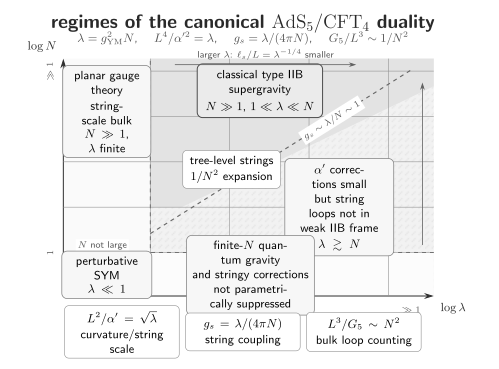
The two-dimensional parameter plane of the canonical duality. Increasing suppresses bulk loops because . Increasing suppresses string-scale curvature effects because . The upper-right region is the classical supergravity corner; the exact correspondence is the whole plane, not just that corner.
The important slogan is:
The rest of this page makes that slogan precise.
Conventions and the unavoidable factor of
Section titled “Conventions and the unavoidable factor of 2π2\pi2π”Before deriving the dictionary, it is worth saying something unglamorous but essential: the relation between and depends on how one normalizes gauge generators and the Yang-Mills action.
In this course, the nonabelian generators obey
and the Yang-Mills kinetic term is written schematically as
With this convention, the D3-brane worldvolume action gives
Some papers use a trace convention in which the same physics is written as
Nothing physical changes. What matters is the invariant relation
and the fact that the curvature radius in string units is controlled by the ‘t Hooft coupling. In formulas below, all numerical factors are in the convention unless explicitly stated otherwise.
The theta angle is packaged with the gauge coupling into
On the type IIB side, the corresponding modulus is the axio-dilaton
The canonical identification is
so that
This is also the cleanest way to remember the self-duality of the canonical example: type IIB S-duality acts on , while Montonen-Olive duality acts on .
Step 1: the D3-brane gauge coupling
Section titled “Step 1: the D3-brane gauge coupling”The worldvolume theory on coincident D3-branes contains a gauge field, six adjoint scalars, and their fermionic superpartners. At low energy, after decoupling the center-of-mass if desired, this is SYM.
The gauge kinetic term comes from expanding the Dirac-Born-Infeld action. For a single D3-brane, the relevant structure is
Expanding the square root gives a term proportional to
After translating to the nonabelian normalization above, one obtains
This is the first strong/weak clue. Weak open-string coupling means weak Yang-Mills coupling , but not necessarily weak ‘t Hooft coupling. At large , the combination that controls planar gauge dynamics is
Thus one can have
provided
That is exactly the regime in which classical type IIB supergravity is most comfortably interpreted as weakly coupled string theory in a weakly curved background.
Step 2: the AdS radius from the D3-brane geometry
Section titled “Step 2: the AdS radius from the D3-brane geometry”The extremal black D3-brane solution has metric
with
The radius is fixed by the D3-brane charge. In the standard normalization,
Near the branes, , the harmonic function becomes
and the metric reduces to with common radius .
Combining the charge-radius relation with the gauge-coupling relation gives
Therefore
This is the central reason why the duality is useful. The CFT coupling becomes the ratio between the curvature radius and the string length.
If , the gauge theory may be perturbative, but the bulk is highly stringy:
If , the gauge theory is strongly coupled in the planar sense, but the bulk curvature is small in string units:
This is the famous strong/weak inversion, but with a crucial qualifier: strong coupling alone is not enough. One also needs large to suppress quantum gravity loops.
Step 3: the string coupling
Section titled “Step 3: the string coupling”The string coupling is not controlled by alone. From
we get
This formula prevents a very common mistake. Large does not automatically mean large . In the ‘t Hooft limit,
one has
So the planar gauge theory corresponds to a tree-level string theory, even if the worldsheet sigma model is strongly curved when is not large.
The genus expansion of closed strings is organized as
After expressing everything in CFT variables, the genus expansion matches the large- expansion. At fixed ,
Tree-level closed string theory corresponds to the planar CFT. One-loop closed string theory corresponds to order corrections to the CFT free energy, or order corrections to normalized connected correlators.
For weakly coupled type IIB perturbation theory, it is natural to demand
Parametrically, this is usually written as
Together with , this gives the clean window
Because SYM has S-duality, the region with is not necessarily outside all control; one may choose a different duality frame for suitable questions. But the simple type IIB perturbative string expansion in the original frame is no longer weakly coupled there.
Step 4: Newton’s constant and the degrees of freedom
Section titled “Step 4: Newton’s constant and the N2N^2N2 degrees of freedom”The ten-dimensional Newton constant is related to and by
Compactifying on the round of radius gives
since
Now use
Squaring it,
Then
Thus
This is the five-dimensional gravitational loop-counting parameter. In bulk dimensions, the dimensionless strength of gravity at the AdS scale is roughly
For the canonical duality,
This matches the number of gluonic degrees of freedom in the adjoint gauge theory.
A sharp check is the central charge. For classical Einstein gravity in ,
Using , one finds
at leading large . The exact result is
so the classical supergravity answer captures the leading part. The missing is a finite- effect.
What large really suppresses
Section titled “What large λ\lambdaλ really suppresses”The bulk curvature scale is set by . Schematically,
Stringy higher-derivative corrections are organized in powers of times curvature. The basic dimensionless quantity is
So the naive expectation is
That expectation is correct as a measure of the worldsheet sigma-model curvature. It is also why massive string states have masses
Thus the dimensions of genuinely stringy single-particle operators grow like
at strong coupling.
However, one should not conclude that every protected-sector observable has its first correction at order . In type IIB on , supersymmetry forbids some lower higher-derivative terms, and the famous leading correction to many two-derivative supergravity observables comes from the schematic ten-dimensional interaction
For such observables, the correction scales as
This distinction matters. The string length is controlled by , worldsheet curvature by , and many leading supergravity-sector finite-coupling corrections by . These are related but not interchangeable.
What large really suppresses
Section titled “What large NNN really suppresses”Large suppresses bulk quantum loops. In a classical gravity calculation, the action scales as
A saddle-point approximation to the bulk path integral is therefore controlled by
This is the bulk version of large- factorization. For normalized single-trace operators,
while higher connected correlators scale schematically as
for a common normalization. Equivalently, after choosing operators with unit-normalized two-point functions, cubic bulk couplings are suppressed by , quartic couplings by , and loops by further powers of .
The CFT interpretation is simple: at , single-trace operators behave like generalized free fields at leading order. The bulk interpretation is equally simple: at , single-particle fields propagate and interact only classically at tree level.
Finite effects include:
| CFT statement | Bulk statement |
|---|---|
| corrections to connected correlators | closed-string loops / quantum gravity loops |
| finite- corrections to central charges | loop and measure corrections to the bulk effective action |
| trace identities at finite | stringy exclusion principle, finite-dimensional Hilbert-space constraints in protected sectors |
| operators with dimensions or charges | D-branes, giant gravitons, baryon-like objects |
| effects scaling like | nonperturbative brane effects rather than ordinary perturbation theory |
A good rule is this:
but they do not know the full finite- theory.
The main regimes
Section titled “The main regimes”The parameter map should be read as a map of calculational control, not as a thermodynamic phase diagram. There is no phase transition at or . The boundaries are parametric.
Weakly coupled gauge theory:
Section titled “Weakly coupled gauge theory: λ≪1\lambda\ll1λ≪1”When
the CFT is accessible by perturbation theory. If is also large, planar perturbation theory organizes diagrams efficiently. The bulk dual still exists, but it is not a low-curvature geometry. Since
the string length is larger than the AdS radius. In this regime, a geometric supergravity description is the wrong language.
This is not a contradiction. The duality says that there is a type IIB string theory description; it does not say that the string theory is always well approximated by Einstein gravity.
Planar string theory: at fixed
Section titled “Planar string theory: N≫1N\gg1N≫1 at fixed λ\lambdaλ”The ‘t Hooft limit is
Then
Bulk string loops are suppressed, so the dual is a tree-level string theory. But unless , the worldsheet sigma model on is not weakly curved.
This regime is central in integrability. The planar theory can sometimes be solved far beyond perturbative gauge theory or classical supergravity, but it is still not generic two-derivative gravity unless is also large.
Classical string theory: , arbitrary or large
Section titled “Classical string theory: N≫1N\gg1N≫1, λ\lambdaλ arbitrary or large”When , string loops are suppressed. If is not large, the bulk is a classical string theory in a highly curved background. If , semiclassical strings in a weakly curved geometry become useful.
Large charges can also create semiclassical string regimes even when the relevant expansion parameter is not simply . For example, spinning strings and BMN-type limits organize expansions in ratios such as
for large R-charge . These are refinements of the basic parameter map, not replacements for it.
Classical supergravity: ,
Section titled “Classical supergravity: N≫1N\gg1N≫1, λ≫1\lambda\gg1λ≫1”The simplest classical supergravity regime is
If one also wants weakly coupled type IIB strings in the original frame, use
In this region,
so both string-scale curvature corrections and quantum gravity loops are suppressed.
This is the regime used for the standard computations of:
| Observable | Leading bulk method | Parametric accuracy |
|---|---|---|
| stress-tensor two-point function | classical metric perturbation | leading |
| protected chiral-primary correlators | supergravity fields on | leading large , often protected in |
| thermal entropy of plasma | AdS black brane area | leading , strong |
| Wilson loops at strong coupling | classical fundamental string worldsheet | leading and leading large |
| transport coefficients such as | classical black-brane perturbations | two-derivative, large , large |
Five-dimensional Einstein gravity: an extra truncation
Section titled “Five-dimensional Einstein gravity: an extra truncation”Many holographic calculations use a five-dimensional action such as
This is not the full type IIB theory. It is a consistent low-energy subsector for certain observables, often involving the metric and a small number of supergravity fields.
There is a subtle but important point: does not have a parametric separation between the AdS scale and the Kaluza-Klein scale. Since the sphere radius is also ,
Therefore five-dimensional Einstein gravity is not obtained because all Kaluza-Klein modes are much heavier than AdS physics. It is obtained because certain truncations are consistent or because one restricts attention to universal sectors. Dropping the is a choice of sector, not a consequence of a large mass gap.
A compact dictionary of approximations
Section titled “A compact dictionary of approximations”Here is the practical dictionary students should keep nearby.
| CFT parameter or limit | Bulk meaning | What is suppressed? |
|---|---|---|
| quantum gravity loops | ||
| at fixed | closed-string loops; planar limit | |
| string-scale curvature effects | ||
| weakly coupled, weakly curved type IIB frame | both corrections and string loops | |
| finite | finite string length | higher-derivative and massive-string effects |
| finite | finite bulk Planck length | loop and nonperturbative quantum-gravity effects |
| highly curved string background | supergravity invalid, gauge perturbation useful | |
| nonzero RR axion | changes complex coupling | |
| S-duality | on | exchanges electric/magnetic descriptions |
One can also express the important length ratios as
and, in ten dimensions,
up to numerical factors and mild dependence on how one defines the ten-dimensional Planck length. The five-dimensional Planck scale is more directly tied to CFT counting:
How to read a holographic answer
Section titled “How to read a holographic answer”Suppose a classical gravity calculation gives a CFT observable as
A careful interpretation is not
The careful interpretation is
for many two-derivative supergravity-sector observables in the canonical example. For other observables, the first finite- correction may scale differently, so the schematic expression should be read as an example rather than a theorem.
For instance, the entropy density of strongly coupled plasma at leading supergravity order is
The free-field result at is larger by a factor of , so the celebrated comparison gives
at leading large . The number is not an exact function of ; it is a comparison between two endpoints of a coupling-dependent observable.
Similarly, the strong-coupling heavy-quark potential computed from a classical string worldsheet behaves as
The factor is not a small parameter. It is the classical string tension in AdS units:
So Wilson-loop calculations often use a different saddle-point expansion from supergravity field calculations: the string worldsheet action is large when .
Protected quantities versus generic quantities
Section titled “Protected quantities versus generic quantities”A common source of confusion is that some quantities can be matched at weak and strong coupling even though AdS/CFT is usually strong/weak. The reason is protection.
Examples include:
| Quantity | Why it can be robust |
|---|---|
| global symmetries | exact symmetry matching |
| central charges | protected by supersymmetry in SYM |
| dimensions of half-BPS chiral primaries | protected short multiplets |
| certain anomaly coefficients | determined by symmetry and topology |
| some extremal or near-extremal correlators | constrained by nonrenormalization theorems |
Generic unprotected operator dimensions do depend on . At weak coupling, they are perturbative anomalous dimensions. At strong coupling, many single-trace operators become heavy string states with
This is precisely what makes the strong-coupling CFT look like local Einstein gravity: the spectrum develops a large gap between low-spin supergravity operators and genuinely stringy higher-spin states.
Thus, large by itself is not enough for an Einstein-like bulk. One also needs a sparse light spectrum, or equivalently a large gap to higher-spin/stringy single-trace operators. In the canonical example, that gap is produced by large .
What changes outside the canonical example?
Section titled “What changes outside the canonical example?”The logic generalizes, but the exact powers do not always stay the same.
For a general large- holographic CFT,
where is the stress-tensor two-point coefficient. The analog of is less universal. In SYM, directly controls . In another CFT, the string gap may be controlled by a different parameter or may not be tunably large at all.
This is why the canonical example is special. It has:
- an exactly marginal coupling,
- a known top-down string construction,
- maximal supersymmetry,
- a tunable large- limit,
- a tunable large- gap,
- a concrete weakly curved geometry.
Bottom-up Einstein gravity models often assume the last two properties without deriving them from a complete CFT. That can be useful, but one should keep track of what is being assumed.
Common mistakes
Section titled “Common mistakes”Mistake 1: “Strong coupling means classical gravity.”
Strong ‘t Hooft coupling suppresses stringy curvature corrections, but classical gravity also requires large . A strongly coupled small- CFT is not described by classical Einstein gravity.
Mistake 2: “Large means large string coupling.”
The string coupling is
At large , one can have and simultaneously.
Mistake 3: “The can be ignored because it is small.”
The radius equals the AdS radius:
The Kaluza-Klein scale is therefore , not parametrically high. Five-dimensional Einstein gravity is a sector/truncation, not a naive low-energy compactification with a large KK gap.
Mistake 4: “Every finite-coupling correction is .”
The curvature expansion parameter is , but supersymmetry can remove lower corrections for certain observables. Many familiar type IIB supergravity-sector corrections begin at .
Mistake 5: “The parameter map is a phase diagram.”
The lines , , and are not phase-transition lines. They mark changes in calculational control.
Mistake 6: “Classical gravity computes the full CFT answer.”
Classical gravity computes the leading large-, large-, low-energy answer in a specified sector. The exact CFT contains the finite- spectrum, finite-coupling corrections, instantons, D-branes, string states, and nonperturbative effects.
Exercises
Section titled “Exercises”Exercise 1: From D3-branes to
Section titled “Exercise 1: From D3-branes to L4/α′2=λL^4/\alpha'^2=\lambdaL4/α′2=λ”Assume the D3-brane charge-radius relation
and the convention
Show that
Then find in terms of .
Solution
By definition,
Using gives
Substitute this into the D3-brane radius formula:
Therefore
Since ,
so
Exercise 2: Derive
Section titled “Exercise 2: Derive L3/G5=2N2/πL^3/G_5=2N^2/\piL3/G5=2N2/π”Use
and
Show that
Solution
First,
Thus
Now square the radius relation:
Therefore
This is the precise large- coefficient in the convention used here.
Exercise 3: Classify the regime
Section titled “Exercise 3: Classify the regime”For each pair , classify the most appropriate leading description among: perturbative gauge theory, planar but stringy bulk, weakly curved classical supergravity, or finite- quantum string/gravity.
- , .
- , .
- , .
- , .
- , .
Solution
-
is large but . This is planar perturbative gauge theory. The bulk is tree-level but highly stringy.
-
is large and , but is only moderately large. This is planar string theory with some curvature control, but not a clean two-derivative supergravity limit.
-
is large and is large. Also , so . This is a clean weakly coupled, weakly curved type IIB supergravity regime for low-energy observables.
-
is large, so the string length would be small compared with , but is not large. Bulk quantum gravity loops are not suppressed. This is not classical gravity.
-
is large and is large, so curvature is small and five-dimensional loops are suppressed. But in the original type IIB frame. The naive weakly coupled string expansion is not valid; one may need a duality frame or a genuinely nonperturbative description.
Exercise 4: Which correction dominates?
Section titled “Exercise 4: Which correction dominates?”Suppose a supergravity-sector observable has the schematic expansion
where and are order-one constants. Estimate which correction is parametrically larger when:
- , .
- , .
- , .
Solution
The finite-coupling correction is and the loop correction is .
- For and ,
The finite-coupling correction is much larger.
- For and ,
They are parametrically comparable.
- For and ,
The finite-coupling correction is larger by one order of magnitude, though neither is astronomically small.
Exercise 5: Why five-dimensional Einstein gravity is not just a KK low-energy limit
Section titled “Exercise 5: Why five-dimensional Einstein gravity is not just a KK low-energy limit”In , the sphere radius equals the AdS radius:
Estimate the Kaluza-Klein mass scale and compare it with the AdS curvature scale. Explain why this means that five-dimensional Einstein gravity should be viewed as a sector or consistent truncation, not as a generic low-energy limit with all KK modes decoupled.
Solution
Kaluza-Klein masses on a compact space of radius scale as
The AdS curvature scale is also
Therefore
There is no parametric hierarchy of the form . Thus, generic AdS-scale physics can couple to KK modes. Five-dimensional Einstein gravity is useful because certain subsectors are consistent truncations or because one studies universal observables involving only selected fields. It is not obtained by simply taking energies much lower than a parametrically heavy KK scale.
Further reading
Section titled “Further reading”- J. Maldacena, The Large N Limit of Superconformal Field Theories and Supergravity. The original D3-brane decoupling argument and the canonical parameter relations.
- O. Aharony, S. Gubser, J. Maldacena, H. Ooguri, and Y. Oz, Large N Field Theories, String Theory and Gravity. The standard review, especially useful for the large-, large-, and supergravity limits.
- E. D’Hoker and D. Freedman, Supersymmetric Gauge Theories and the AdS/CFT Correspondence. Detailed lecture notes on the canonical example, supergravity fields, and correlator normalization.
- I. Klebanov, TASI Lectures: Introduction to the AdS/CFT Correspondence. A compact pedagogical guide to the original dictionary and its uses.