
The Open Superstring Spectrum
We now build the open-string Hilbert space of the NSR theory. The two sectors have a wonderfully different character:
Before the GSO projection, the NS sector contains a tachyon. After the projection, the tachyon is removed and the massless NS vector combines with a massless R spinor into the ten-dimensional open-superstring vector multiplet. This page explains the spectrum before making the projection precise.
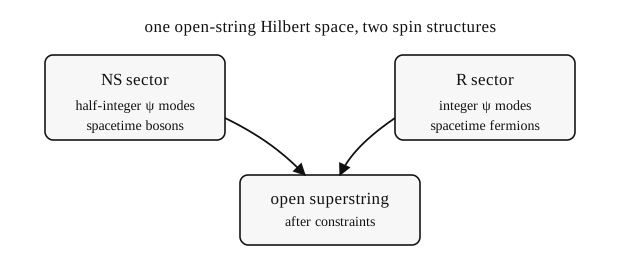
The open NSR string has two sectors. The NS sector has half-integer fermion modes and gives spacetime bosons; the R sector has integer fermion modes and gives spacetime fermions.
Open-string modes and mass formulas
Section titled “Open-string modes and mass formulas”For the open string, after doubling to a single holomorphic field, the standard mode expansions are
and
The oscillators obey
Creation operators have negative mode number. The matter number operator is
In the critical open superstring,
The physical-state constraints are the quantum versions of and :
and
with the additional R-sector zero-mode condition
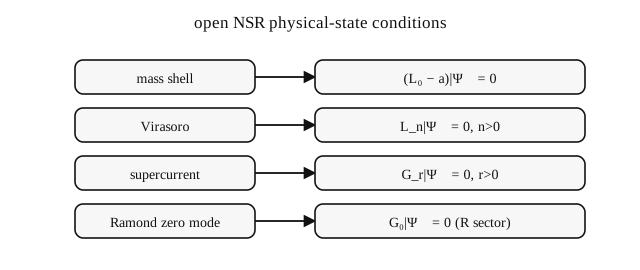
The supercurrent constraints are as important as the Virasoro constraints. In the R sector, becomes the spacetime Dirac operator on the massless ground state.
The NS sector: tachyon and massless vector
Section titled “The NS sector: tachyon and massless vector”The NS vacuum satisfies
It has , so
This is the open-string NS tachyon of the unprojected theory.
The first excited NS state is
It has , hence
The state is therefore a candidate massless vector.
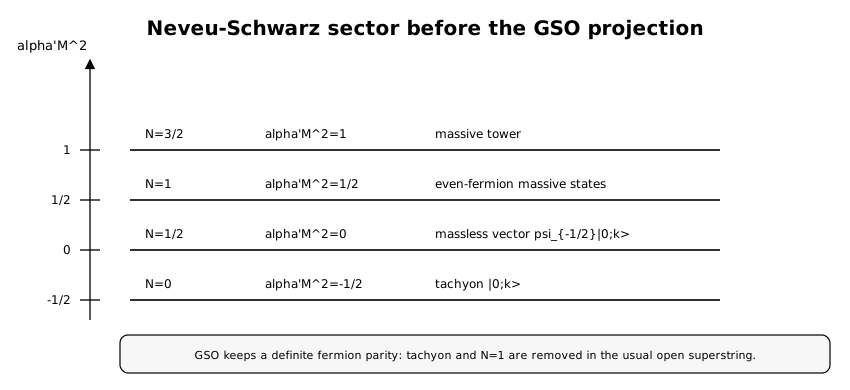
The unprojected NS sector contains a tachyonic ground state. The first fermionic excitation is a massless vector; this is the state that survives in the supersymmetric open string.
The physical-state condition gives transversality. To see it, use the leading term
Only the zero-mode piece acts nontrivially on the one-fermion state, so
Thus
There is also a null state generated by , giving the equivalence
This is exactly the linearized gauge redundancy of a massless vector.
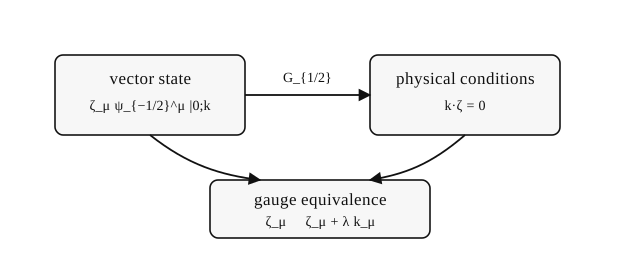
The NS massless state is transverse, and longitudinal polarizations are null. In it has physical polarizations.
So the first non-tachyonic NS state is a spacetime gauge boson with transverse polarizations, transforming as the of the massless little group .
Higher NS levels
Section titled “Higher NS levels”Before the GSO projection, both even and odd worldsheet-fermion number states occur. The level immediately above the massless vector is , with
A simple representative is
where the two fermion oscillators make the polarization antisymmetric before constraints are imposed. The next odd-fermion level is , with
At this level one encounters states of the schematic form
The constraints remove time-like and longitudinal components, leaving massive representations of the little group in ten dimensions. The detailed decomposition is less important here than the pattern: the string has infinitely many massive higher-spin states, now arranged into NSR superconformal multiplets. In the conventional GSO projection, one keeps a definite fermion parity; this removes the NS tachyon and the even-fermion level while keeping the massless vector and the massive level.
The R sector: spacetime spinors
Section titled “The R sector: spacetime spinors”The Ramond vacuum is degenerate because the fermion zero modes satisfy
Equivalently, after defining ,
So the ground state must carry a spinor index:
The R ground state has , and since ,
The R-sector zero-mode constraint becomes
On the ground state,
so the physical-state condition is the massless Dirac equation
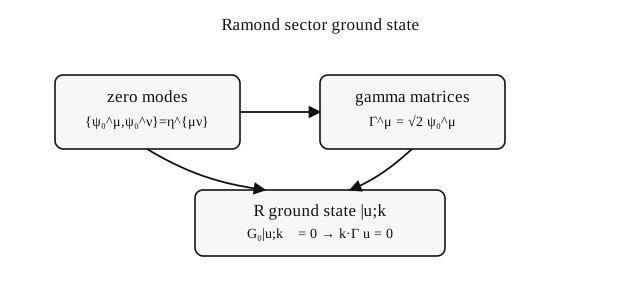
The Ramond ground state is massless and spinorial. The constraint becomes the spacetime Dirac equation.
This is one of the most beautiful facts about the NSR formalism: spacetime fermions emerge from worldsheet fields that are spacetime vectors.
Preview: matching bosons and fermions
Section titled “Preview: matching bosons and fermions”The physical massless NS vector has
polarizations in . The R ground state, after the appropriate chirality projection, also has physical degrees of freedom. The GSO projection will remove the NS tachyon and choose one Ramond chirality, producing the open-superstring massless multiplet.
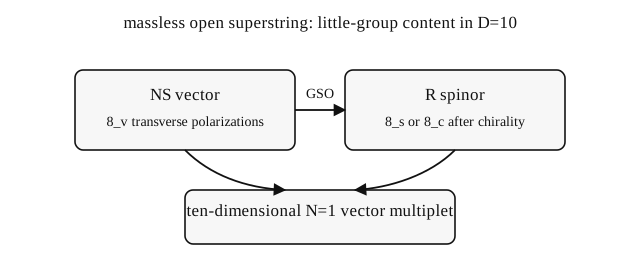
After the GSO projection, the massless open superstring contains an vector from the NS sector and one chiral spinor from the R sector. This is the ten-dimensional vector multiplet.
The next two pages supply the missing ingredients: ten-dimensional spinors and the GSO projection.
Exercises
Section titled “Exercises”Exercise 1. The mass of the first NS excitation
Section titled “Exercise 1. The mass of the first NS excitation”Show that is massless.
Solution
The oscillator raises the level by , so
Using the NS mass formula
we find
Thus the state is massless.
Exercise 2. Transversality from
Section titled “Exercise 2. Transversality from G1/2G_{1/2}G1/2”Derive for the NS massless vector.
Solution
At this level,
where the omitted terms annihilate the state. Since
for the open string, we get
The physical-state condition sets this to zero, hence
Exercise 3. Gauge equivalence from a null state
Section titled “Exercise 3. Gauge equivalence from a null state”Show that has the same form as a vector state with polarization proportional to .
Solution
The relevant term in is
Acting on the NS vacuum gives
This is a vector state with polarization
It is null and is quotiented out of the physical Hilbert space. Therefore
Exercise 4. The Ramond ground state is massless
Section titled “Exercise 4. The Ramond ground state is massless”Use the R-sector mass formula to show that the R ground state is massless.
Solution
The R ground state has no positive oscillator excitations, so
The R-sector mass formula is
Therefore
Exercise 5. The Dirac equation from
Section titled “Exercise 5. The Dirac equation from G0G_0G0”Show that the R-sector condition gives .
Solution
On the R ground state, oscillator terms with nonzero modes annihilate the state, so the relevant piece of is
The condition becomes
Using , this is equivalent to
This is the massless Dirac equation in momentum space.