
The Pre-AdS/CFT Dictionary
This page closes the CFT preparation course by assembling the pre-AdS/CFT dictionary. The word “pre” is important. We are not yet deriving holographic renormalization, computing Witten diagrams, or proving a duality. Instead, we are identifying the CFT structures that are about to become bulk structures.
The basic claim of AdS/CFT is not merely that two theories have the same symmetry group. It is that the complete quantum theory of gravity on an asymptotically AdS spacetime is encoded in the CFT generating functional. In its most compressed form, the dictionary says
The left-hand side is the generating functional of CFT correlators in the presence of sources for local operators . The right-hand side is the bulk string/gravity path integral with boundary conditions fixed by those same functions . In the semiclassical limit,
so CFT correlators are obtained by differentiating the renormalized on-shell bulk action with respect to boundary data.
The most important moral is this:
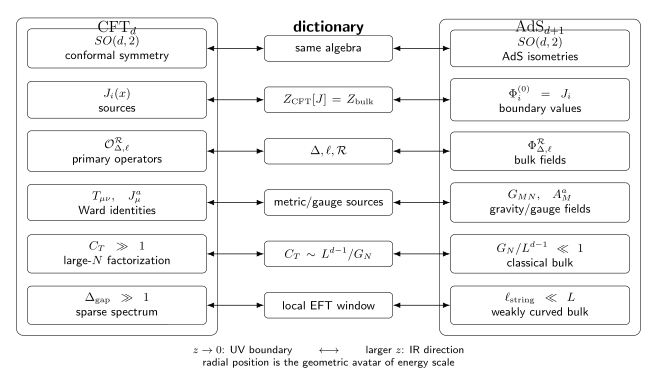
The pre-AdS/CFT dictionary identifies CFT sources, operators, symmetries, and large- structures with bulk fields, boundary conditions, gauge redundancies, and particle states. The central relation is the equality of generating functionals .
The generating-functional statement
Section titled “The generating-functional statement”Start with a CFT deformed by sources:
The Euclidean generating functional is
up to the sign convention chosen for source couplings. Functional derivatives generate correlation functions:
AdS/CFT interprets as the boundary value of a bulk field . Schematically,
Thus the CFT operation “turn on a source for ” becomes the bulk operation “solve the bulk equations with a prescribed boundary condition for .” This is the cleanest way to remember the dictionary: sources are boundary conditions, operators are responses.
More precisely, for Euclidean in Poincare coordinates,
the boundary is at . A scalar field of mass behaves near the boundary as
The coefficient is the source for the dual CFT operator . The coefficient is related, after holographic renormalization, to the one-point function in the presence of the source.
The scaling dimension is fixed by the bulk mass:
Equivalently,
The standard quantization usually takes . In the Breitenlohner—Freedman window
there is also an alternate quantization in which the roles of the two asymptotic modes are exchanged. At the exact BF bound the two roots coincide and logarithmic boundary behavior requires separate treatment. For a first reading of AdS/CFT, one should master standard quantization first and treat alternate quantization as a controlled refinement.
Operator versus source
Section titled “Operator versus source”A CFT operator and its source have complementary scaling dimensions. If
then the source term
is scale invariant when
So the source has engineering dimension
This explains the boundary behavior
The leading mode has precisely the scaling needed to represent a source. The subleading mode has precisely the scaling expected of a response controlled by an operator of dimension .
A useful slogan is
while
This distinction is everywhere in holography: scalar condensates, stress tensors, currents, black holes, entanglement, and double-trace deformations all depend on keeping source and response conceptually separate.
Symmetry dictionary
Section titled “Symmetry dictionary”The simplest entry is the symmetry match:
This is why conformal symmetry was unavoidable in the first place. The CFT conformal group is the bulk AdS isometry group. In global AdS, radial quantization becomes especially transparent: the CFT cylinder Hamiltonian is the bulk global time generator, and a CFT primary of dimension creates a bulk state of energy
The descendants created by correspond to excitations carrying angular momentum and radial structure in global AdS. This is the same representation theory viewed from two sides.
The stress tensor and conserved currents are the next universal entries:
| CFT structure | Bulk structure | Reason |
|---|---|---|
| metric | couples to the boundary metric and generates spacetime symmetries | |
| flavor current | gauge field | global CFT symmetry becomes bulk gauge redundancy |
| scalar primary | scalar field | source is boundary value of |
| exactly marginal operator | massless scalar modulus | changing the coupling moves along a conformal manifold |
| Wilson loop | string worldsheet or brane object | loop expectation values are computed by extended bulk saddles |
The stress tensor entry is especially important. The CFT source for is the background metric :
Therefore the bulk field whose boundary value is must be the bulk metric. The graviton is not optional in an AdS dual of a local CFT with a stress tensor.
Similarly, if a CFT has a conserved current , then the source is a background gauge field :
The dual bulk field is a gauge field . The global symmetry is global on the boundary because the gauge parameter is fixed at the boundary; in the interior it is a gauge redundancy.
Central charges and bulk couplings
Section titled “Central charges and bulk couplings”The normalization of stress-tensor correlators measures the number of CFT degrees of freedom. In a holographic CFT this number is proportional to the inverse bulk Newton constant:
The exact numerical coefficient depends on conventions for and the gravitational action, but the scaling is the invariant statement. Large means weak bulk quantum gravity:
For adjoint large- gauge theories,
so the genus expansion of the bulk string theory is the expansion of the CFT. Connected correlators of canonically normalized single-trace operators obey
This is the CFT origin of weak bulk interactions. A three-point coefficient of order is a cubic coupling suppressed by the bulk Planck scale. A connected four-point function of order is a tree-level exchange or contact process in the bulk.
Spectrum dictionary: single-trace and multi-trace
Section titled “Spectrum dictionary: single-trace and multi-trace”In a large- CFT, the most important structural distinction is
For a matrix gauge theory, single-trace operators have the schematic form
with normalization chosen so that their two-point functions are order one. These map to single-particle bulk states:
Multi-trace operators, after subtracting descendants and lower-trace mixing, map to multi-particle states:
At leading order in large , their dimensions are additive:
At subleading order,
where is the anomalous dimension. In the bulk, this is an interaction energy or binding energy. Thus large- CFT perturbation theory literally becomes perturbation theory for particles interacting in AdS.
The OPE coefficient dictionary is equally direct:
More generally, CFT four-point data encode exchange diagrams, contact interactions, loop corrections, and locality constraints.
Local bulk physics is an extra condition
Section titled “Local bulk physics is an extra condition”A large- CFT does not automatically have a weakly curved Einstein-gravity dual. Large gives a weakly coupled bulk in the sense of factorization, but the bulk may still be stringy or nonlocal at the AdS scale.
For an ordinary local effective field theory in AdS, one wants a large gap to higher-spin single-trace operators:
Here is the dimension of the lightest single-trace operator with spin greater than two, or more broadly the gap to genuinely stringy single-particle states. A sparse low-lying spectrum allows the low-energy bulk theory to be described by a small number of light fields.
The hierarchy is therefore:
For SYM, the role of this gap is controlled by the ‘t Hooft coupling
In the standard normalization of the dual,
so strong coupling makes the AdS radius large compared with the string length:
This is why classical supergravity requires both
Finite gives quantum gravity corrections. Finite gives stringy corrections.
The canonical SYM parameter map
Section titled “The canonical N=4\mathcal N=4N=4 SYM parameter map”For the standard example,
the main parameter relations are
Conventions for factors of vary, but the physical meanings are stable:
The protected half-BPS chiral primaries discussed earlier map to Kaluza—Klein modes on . Long unprotected single-trace operators map to massive string states. Wilson loops map to string worldsheets ending on boundary curves. The stress tensor maps to the graviton. The currents map to gauge fields arising from the isometries of .
Thermal and Lorentzian entries
Section titled “Thermal and Lorentzian entries”The Euclidean dictionary is often the first one learned, but real-time physics is equally central. Thermal CFT states correspond to asymptotically AdS black holes or black branes. For a planar thermal state,
Entropy density scales as
which matches the area density of the black-brane horizon in Planck units. Retarded correlators are computed by imposing infalling boundary conditions at the horizon. The simple mnemonic is
Entanglement has its own geometric entry. For holographic CFT states with a classical bulk dual, the leading large- entanglement entropy of a spatial region is computed by an extremal surface :
The dots denote quantum bulk corrections and higher-derivative corrections. From the CFT side, this is a statement about the reduced density matrix and the modular structure of the state. From the bulk side, it is a statement about geometry emerging from entanglement data.
What is and is not being claimed
Section titled “What is and is not being claimed”The dictionary is powerful, but it is easy to overstate it. The safe statements are:
- every bulk field corresponds to a CFT operator,
- every boundary condition for that field corresponds to a CFT source,
- bulk symmetries act as CFT global or spacetime symmetries,
- bulk interactions are encoded in OPE coefficients and higher-point functions,
- weakly coupled bulk physics requires large- factorization,
- local Einstein gravity requires more than large : it also requires a sparse spectrum and a large gap.
The unsafe statement is: “every CFT has a simple geometric bulk.” That is not true. A generic CFT may have a valid AdS representation only as a highly stringy, strongly quantum, non-geometric theory. Geometry is an emergent special regime, not an automatic consequence of conformal symmetry.
It is also misleading to imagine the dictionary as a one-to-one map between elementary CFT fields and elementary bulk fields. The CFT elementary variables may not be gauge invariant, may depend on a Lagrangian description, and may not exist in a non-Lagrangian CFT. The dictionary is formulated in terms of gauge-invariant local operators and their correlation functions.
Minimal checklist before starting AdS/CFT
Section titled “Minimal checklist before starting AdS/CFT”At this point, the essential CFT concepts are in place. Before reading a serious AdS/CFT paper, one should be comfortable with the following translations:
| CFT question | Bulk translation |
|---|---|
| What is the scaling dimension ? | What is the bulk mass ? |
| What is the source ? | What is the boundary value of ? |
| What is ? | What is the normalizable response mode? |
| What is ? | What is ? |
| Is there a conserved current? | Is there a bulk gauge field? |
| Is the operator single-trace? | Is the state single-particle? |
| Are correlators factorized? | Is the bulk weakly coupled? |
| Is there a large higher-spin gap? | Is the bulk local and weakly curved? |
| What is the thermal state? | What is the black hole or black brane? |
| What is the Wilson loop? | What string worldsheet ends on it? |
This is the conceptual bridge from modern CFT to AdS/CFT. The next step is to choose a bulk coordinate system, solve bulk equations near the boundary, renormalize the on-shell action, and compute correlators directly.
Exercises
Section titled “Exercises”Exercise 1: derive the scalar mass-dimension relation
Section titled “Exercise 1: derive the scalar mass-dimension relation”Consider a scalar field in Euclidean with metric
Near the boundary, ignore derivatives along and solve the massive wave equation
with the ansatz . Show that
and hence that .
Solution
For the metric above,
Ignoring boundary derivatives, the Laplacian gives
For ,
The wave equation therefore requires
or
The two roots are and , with
Exercise 2: source dimension and boundary falloff
Section titled “Exercise 2: source dimension and boundary falloff”Suppose a scalar primary has scaling dimension . Show that its source has dimension . Explain why this is consistent with the leading near-boundary falloff of the dual bulk field.
Solution
The source term is
Under , the measure scales as , while
For the deformation to be dimensionless, the source must scale as
so its engineering dimension is .
In AdS, the radial coordinate scales like a boundary length. The near-boundary field
is invariant under the combined scaling , if has dimension . Thus the source falloff is exactly what conformal covariance demands.
Exercise 3: large- factorization and bulk interactions
Section titled “Exercise 3: large-NNN factorization and bulk interactions”Assume canonically normalized single-trace operators obey
What does this imply for the scaling of bulk cubic and quartic interactions?
Solution
A CFT three-point coefficient of single-trace operators scales as
In the bulk, a three-point function is computed at tree level by a cubic interaction, so the cubic coupling scales as
Similarly, connected four-point functions scale as
They can arise from two cubic vertices joined by an exchange propagator, giving , or from a quartic contact coupling with
This is the CFT origin of weakly coupled bulk perturbation theory. In gravitational language,
Exercise 4: why the stress tensor maps to the metric
Section titled “Exercise 4: why the stress tensor maps to the metric”Use source coupling to explain why the CFT stress tensor must be dual to the bulk metric rather than to an ordinary scalar or vector field.
Solution
The stress tensor is defined as the response of the CFT generating functional to a variation of the background metric:
Thus the source for is the boundary metric . In the bulk dictionary, sources are boundary values of bulk fields. Therefore the bulk field whose boundary value is must be the bulk metric .
This also matches symmetry. The stress tensor generates spacetime transformations in the CFT. In the bulk, spacetime transformations are encoded by diffeomorphism invariance, whose gauge field is the metric. Hence
Exercise 5: when does a large- CFT have an Einstein-like dual?
Section titled “Exercise 5: when does a large-NNN CFT have an Einstein-like dual?”Explain why large is not enough to guarantee a weakly curved Einstein gravity dual. What extra spectral condition is needed?
Solution
Large gives factorization:
This implies weak bulk interactions and a small bulk Newton constant. But weak coupling does not imply that the bulk is described by a local two-derivative gravity theory. The bulk may still contain stringy states with masses of order the AdS scale.
To obtain a local Einstein-like effective theory, the CFT should have a sparse low-lying single-trace spectrum and a large gap to higher-spin/stringy single-trace operators:
Then the low-energy bulk dynamics can be organized as an effective field theory with finitely many light fields. Without such a gap, the bulk description, if it exists, is stringy or nonlocal at the AdS scale.
Takeaway
Section titled “Takeaway”The whole course can be summarized as a single chain:
The first AdS/CFT computations will now look much less mysterious. A bulk scalar is not introduced out of nowhere: it is the representation-theoretic avatar of a scalar primary. A graviton is not optional: it is the source-response partner of . A Witten diagram is not a new kind of observable: it is a reorganization of CFT conformal blocks and OPE data. A black brane is not merely a geometry: it is a thermal large- CFT state.
This is the point at which modern CFT becomes holography.