
Worldsheet Supersymmetry and the RNS Action
The bosonic string already contains the two signatures of string theory: an infinite tower of higher-spin states and, in the closed-string sector, a massless spin-two excitation. It also contains two serious defects. First, the ground state is tachyonic. Second, the spectrum has no spacetime fermions. A theory meant to include gravity and quantum matter cannot stop there.
The cure is supersymmetry, but there are two rather different things one might mean by that phrase:
- Spacetime supersymmetry acts on the target-space coordinates and turns spacetime bosons into spacetime fermions.
- Worldsheet supersymmetry acts on the two-dimensional fields living on the string worldsheet.
The Ramond—Neveu—Schwarz, or RNS, formulation begins with the second idea. It pairs each embedding coordinate with a two-dimensional Majorana fermion . The index is still a target-space vector index; the spinor index is a worldsheet spinor index. This distinction is essential. RNS fermions are not yet spacetime spinors. Spacetime fermions arise after quantizing the Ramond sector, and spacetime supersymmetry appears only after the GSO projection.
This page builds the classical and conformal-field-theory foundation for that story. The next pages will quantize the RNS system, introduce NS/R boundary conditions, and extract the superstring spectrum.
From the bosonic string to a supersymmetric string
Section titled “From the bosonic string to a supersymmetric string”The bosonic open string has mass formula
while the closed bosonic string has
Thus both theories contain tachyons. The closed string also contains a massless scalar, antisymmetric two-form, and graviton at level . In a hadronic interpretation, open strings would model mesons and closed strings would model glueballs; in a gravitational interpretation, the closed-string spin-two state is the great prize. The tachyon and the absence of fermions tell us that the bosonic string is not the final theory.
A tempting direct route is the Green—Schwarz idea: enlarge spacetime itself to superspace by adding target-space spinor coordinates to . The natural supersymmetric one-form is schematically
because under a rigid spacetime supersymmetry transformation
one has . This makes spacetime supersymmetry manifest. The price is that the action has a local fermionic gauge symmetry, kappa symmetry, and covariant quantization becomes subtle.
The RNS route takes the opposite bargain. It makes the two-dimensional theory almost free and therefore easy to quantize, but spacetime supersymmetry is hidden at first. Instead of a target-space spinor , introduce a worldsheet spinor field for each coordinate .
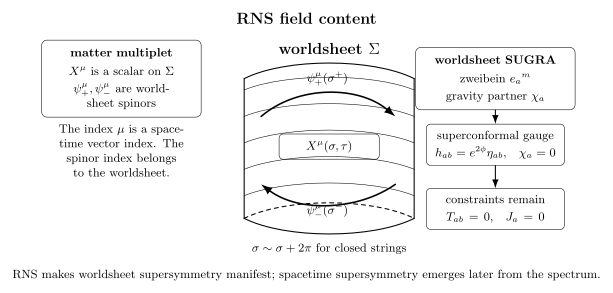
The RNS formulation places matter supermultiplets on the worldsheet. The fermions are spinors on the worldsheet but vectors in spacetime.
The basic RNS matter multiplet is therefore
Here and are the two chiral components of a two-dimensional Majorana spinor. They will become the left-moving and right-moving worldsheet fermions after Wick rotation.
Worldsheet spinors and gamma matrices
Section titled “Worldsheet spinors and gamma matrices”Let the Lorentzian worldsheet coordinates be
with metric
A convenient real representation of the two-dimensional gamma matrices is
so that
The chirality matrix is
A Majorana spinor may be written as
The notation is deliberately suggestive: in light-cone coordinates
the two chiral components obey first-order equations. One chirality depends only on and the other only on . Different books attach the words “left-moving” and “right-moving” to these components in slightly different ways, but the equations themselves are unambiguous.
The free RNS matter action
Section titled “The free RNS matter action”In conformal gauge the flat-worldsheet RNS action is
The bosonic term is the Polyakov action in conformal gauge. The new term is first order in derivatives, as appropriate for fermions. With the spinor decomposition above, the action can be written equivalently as
up to the harmless overall sign convention associated with Lorentzian continuation. The equations of motion are
Thus
while
The fermions are as free as the bosons, but their first-order nature is the key novelty. In quantization, their modes obey anticommutation relations rather than commutation relations. This one change is responsible for the Ramond-sector spacetime spinors and for the eventual cancellation of the bosonic tachyon.
Global worldsheet supersymmetry
Section titled “Global worldsheet supersymmetry”The flat action is invariant under the rigid worldsheet supersymmetry transformations
where and are constant anticommuting parameters. In spinor notation this is often written compactly as
The physical meaning is simple: and are superpartners on the worldsheet. Acting once with supersymmetry turns a bosonic embedding fluctuation into a worldsheet fermion. Acting again gives a worldsheet translation. Schematically,
So the RNS action is a two-dimensional supersymmetric field theory with free scalar multiplets.
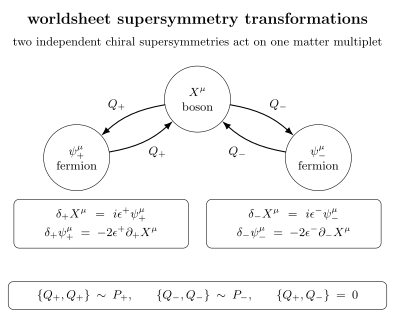
Worldsheet supersymmetry pairs the scalar with the two chiral worldsheet fermions and . Two transformations close onto translations along or .
Notice what this does not yet say. The field carries a vector index , not a spacetime spinor index. The RNS action has worldsheet supersymmetry manifestly, but spacetime supersymmetry remains hidden until the spectrum is projected appropriately.
Coupling to worldsheet supergravity
Section titled “Coupling to worldsheet supergravity”For the bosonic string, we first wrote a generally covariant worldsheet theory and then fixed conformal gauge. The analogous supersymmetric procedure is to couple the matter multiplet to two-dimensional supergravity.
The worldsheet gravity multiplet contains
where is the zweibein and is the worldsheet gravitino. The locally supersymmetric action has the schematic form
Here
and the ellipsis denotes terms quadratic in the gravitino that are required by local supersymmetry. We will rarely need the full expression. What matters conceptually is the role of the gauge fields:
and
The first equation is the Virasoro constraint. The second is its fermionic partner: the vanishing of the supercurrent. These are the classical seeds of the super-Virasoro constraints.
The locally supersymmetric theory has worldsheet diffeomorphisms, Weyl symmetry, local Lorentz symmetry, local supersymmetry, and super-Weyl symmetry. Using these, one can impose superconformal gauge,
After this gauge choice, the matter theory again looks free, but the constraints survive:
This is exactly parallel to the bosonic string. Conformal gauge made the bosonic action free but did not remove the Virasoro constraints. Superconformal gauge makes the RNS action free but does not remove the superconformal constraints.
Stress tensor and supercurrent in Lorentzian signature
Section titled “Stress tensor and supercurrent in Lorentzian signature”The holomorphic and antiholomorphic stress-tensor components are, in light-cone coordinates,
The fermionic currents are
On shell,
and
Thus the left-moving and right-moving sectors decouple classically. The stress tensor generates conformal transformations, while the supercurrent generates the local fermionic transformations that mix and . At the quantum level their Laurent modes become the generators and of the superconformal algebra.
Wick rotation and Euclidean worldsheet notation
Section titled “Wick rotation and Euclidean worldsheet notation”For operator methods it is best to Wick rotate the worldsheet and use complex coordinates. Let
and set
The Euclidean cylinder coordinate is
Locally we may map the cylinder to the complex plane by
In the common CFT normalization , the Euclidean RNS matter action in superconformal gauge is
The equations of motion are
Therefore
and
The basic short-distance singularities are
The holomorphic stress tensor and supercurrent are
Similarly,
The weights are
The antiholomorphic fields have the analogous barred weights.
Currents as contour generators
Section titled “Currents as contour generators”A holomorphic stress tensor acts on local operators by contour integration. If is a primary field of holomorphic weight , then
Equivalently,
where is the infinitesimal conformal vector field. The supercurrent generates the fermionic transformation,
where has conformal weight , so that has weight one and may be integrated around a contour.
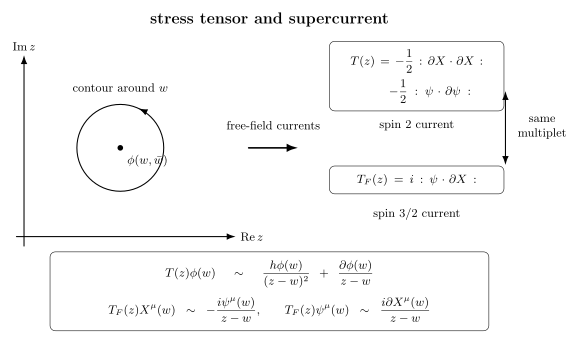
The stress tensor generates conformal transformations. Its fermionic partner generates worldsheet supersymmetry transformations. Their modes form the super-Virasoro algebra.
For example, using
one obtains
Likewise, using ,
These two OPEs are the Euclidean CFT version of
This is the compact reason the RNS theory is solvable: the matter fields are free, and all the symmetry generators are explicit bilinears in free fields.
Cylinder-to-plane map and the origin of spin structures
Section titled “Cylinder-to-plane map and the origin of spin structures”On the Euclidean cylinder the spatial coordinate is periodic:
With , radial quantization on the plane is cylinder time evolution in disguise. A primary field of weight transforms as
For a fermion, , hence
That square root is the first hint of a new ingredient. Fermions can be periodic or antiperiodic around the spatial circle:
These two choices are the Ramond and Neveu—Schwarz sectors. Their mode expansions, zero modes, and ground-state energies are the next step.
Exercises
Section titled “Exercises”Exercise 1: derive the RNS equations of motion
Section titled “Exercise 1: derive the RNS equations of motion”Starting from
derive the equations of motion for , , and .
Solution
Varying gives
Integrating by parts and dropping boundary terms,
Since the derivatives commute,
For the fermion , remember that the variation is Grassmann odd. The first-order kinetic term gives
After integrating by parts, the second term equals the first term rather than canceling it, because both and are anticommuting. Hence
so
Similarly,
Exercise 2: show that the supercurrent is conserved
Section titled “Exercise 2: show that the supercurrent is conserved”Use the equations of motion to show that
obey
Solution
For ,
The first term vanishes because . The second vanishes because . Hence
The calculation for is identical:
Exercise 3: compute the conformal weight of
Section titled “Exercise 3: compute the conformal weight of ψμ\psi^\muψμ”Using
and
show that has holomorphic conformal weight .
Solution
We compute the singular terms in the OPE . There are two possible contractions. The contraction of with gives
The contraction of with gives
Carefully keeping the fermion signs in the normal-ordered product, the result is
Comparing with the primary-field OPE
we read off
Exercise 4: recover supersymmetry from the supercurrent OPE
Section titled “Exercise 4: recover supersymmetry from the supercurrent OPE”Use
and the free-field OPEs to show that
and
Solution
The only singular contraction in is between and . Since
we have
Therefore
For , the singular contraction is between and :
Thus
These are precisely the infinitesimal transformations that exchange and .
Exercise 5: map a fermion from the cylinder to the plane
Section titled “Exercise 5: map a fermion from the cylinder to the plane”Let and let be a primary field of weight . Show that
Then explain why the cylinder mode expansion is naturally
with for periodic fermions and for antiperiodic fermions.
Solution
A primary field of holomorphic weight transforms under a coordinate change as
For ,
With ,
Expanding on the cylinder gives
Under ,
If the fermion is periodic, we need , so
If the fermion is antiperiodic, we need , so
These are the Ramond and Neveu—Schwarz modings, respectively.