
D-Brane Charges, BPS Bounds, and Dirac Quantization
D-branes entered the story as hyperplanes on which open strings can end. T-duality made them look geometrically inevitable. The next step is sharper and more physical: D-branes are charged, dynamical, BPS objects. They carry Ramond—Ramond charge, have a tension fixed exactly by supersymmetry, and obey a generalized Dirac quantization condition.
The core facts are these:
- A D-brane couples electrically to a Ramond—Ramond -form potential .
- It is a half-BPS object: it preserves of the type II supercharges.
- Two identical parallel BPS D-branes exert no static force on each other.
- A D-brane and a D-brane are electric/magnetic duals in ten dimensions, and their charges obey Dirac quantization.
This page explains how these statements fit together. The punchline is the exact normalization
for the Ramond—Ramond charge and the string-frame DBI tension parameter of a single elementary D-brane. In a constant dilaton background , the physical string-frame tension is
Many references denote the first quantity by rather than . Here is used for the -independent normalization appearing in the DBI/Wess—Zumino action, while is the actual energy per unit -volume measured at infinity in string frame.
D-branes as sources for Ramond—Ramond fields
Section titled “D-branes as sources for Ramond—Ramond fields”The low-energy action of a single abelian D-brane has two universal pieces. The Dirac—Born—Infeld term gives the tension and coupling to NS—NS fields:
The Wess—Zumino term gives the Ramond—Ramond couplings:
For the simplest flat brane with no worldvolume flux and no background -field, this reduces to
Thus a D-brane is an electric source for , just as a charged particle is an electric source for a one-form gauge potential .
The corresponding field strength is
up to the standard refinements involving -fields and Chern—Simons terms. Ignoring those refinements for the moment, the electric equation of motion has the schematic form
where is a delta-form localized in the transverse directions. Equivalently, on a sphere linking the D-brane,
Here is the -independent gravitational normalization convenient in the string-frame worldsheet conventions:
The physical ten-dimensional Newton constant includes the asymptotic string coupling,
The magnetic source for is found by dualizing . In ten dimensions,
The dual potential has degree , so the magnetic object has spatial dimension :
For a magnetic D-brane, the Bianchi identity is modified:
or, on a sphere linking the magnetic brane,
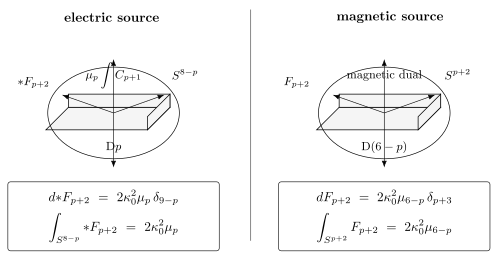
A D-brane is electrically charged under , while the magnetic source for the same field strength is a D-brane. Electric charge is measured by on ; magnetic charge is measured by on .
The most important dual pairs are
The D3-brane is special: it is self-dual under this electric/magnetic pairing. This is one of the reasons the D3-brane is central in type IIB string theory and in the gauge/gravity duality.
The BPS bound
Section titled “The BPS bound”A BPS object is not merely a stable soliton. It is a state or extended object whose energy is fixed by a charge appearing in the supersymmetry algebra. The simplest schematic form is
where is the energy and is a central or tensorial charge. Since the left-hand side is a positive operator, one obtains
A BPS state saturates the inequality:
Saturation implies that some linear combination of supercharges annihilates the state. Those supercharges are preserved; the remaining ones are broken.
For an extended -brane in ten dimensions, the relevant charge is not an ordinary scalar central charge. It is a -form charge, or equivalently a charge density carried by a spatial -volume. Schematically, the type II superalgebra contains terms of the form
For a static flat D-brane extended along , the relevant component is
Per unit spatial -volume, the BPS inequality becomes
A supersymmetric D-brane saturates it:
In the DBI/WZ conventions above, this equality is the statement that the tension source strength and Ramond—Ramond charge source strength are equal after canonical normalization:
The orientation of the brane determines the sign of the charge. A D-brane has charge ; an anti-D-brane has charge . Both have positive tension.
Preserved supersymmetry
Section titled “Preserved supersymmetry”A flat D-brane imposes a projection condition on the type II supersymmetry parameters. Up to signs and convention-dependent factors of , the condition has the form
This equation relates the left- and right-moving supersymmetry parameters, so it cuts the number of independent supercharges in half. Therefore an isolated flat D-brane is half-BPS:
The broken supercharges generate fermionic zero modes on the brane. The preserved supercharges organize the massless open-string fields into a maximally supersymmetric vector multiplet on the D-brane worldvolume.
A brane and an antibrane impose opposite projections:
The only simultaneous solution is . Hence a brane—antibrane pair preserves no supersymmetry. This is the supersymmetry-algebra reason that the brane—antibrane force does not cancel and that a tachyon can appear at sufficiently small separation.
Why the static force cancels
Section titled “Why the static force cancels”Consider two parallel D-branes separated by a transverse distance . At large separation, the interaction is dominated by exchange of massless closed-string fields. The relevant transverse Green function is
For ,
The NS—NS fields sourced by the DBI action are the graviton and the dilaton, and in more general backgrounds also the -field. Between two identical static branes, the graviton/dilaton exchange gives an attractive contribution. The R—R potential gives a repulsive contribution between equal charges.
With a standard normalization of the exchanged massless fields, the long-distance amplitude has the schematic but very useful form
The first term is the NS—NS contribution and the second is the R—R contribution. A BPS D-brane has
so
This is the spacetime version of the abstruse theta-function cancellation in the annulus amplitude. The open-string one-loop vacuum energy vanishes because the brane system is supersymmetric. In the closed-string channel, the same statement is that NS—NS attraction and R—R repulsion cancel exactly.
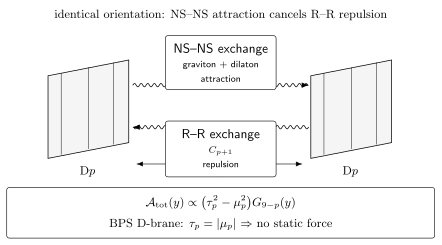
Two identical parallel BPS D-branes have equal tension and R—R charge. The NS—NS attraction is exactly cancelled by R—R repulsion, giving zero static force.
For a brane—antibrane pair, the tension is unchanged but the R—R charge reverses sign:
Then the R—R contribution changes sign and becomes attractive rather than repulsive. The force no longer cancels:
This explains why brane—antibrane systems are unstable at short distance and attractive at long distance.
The exact D-brane tension and charge
Section titled “The exact D-brane tension and charge”The elementary D-brane charge is fixed by several mutually consistent requirements:
- T-duality must map D-brane tensions into D-brane tensions.
- The annulus amplitude must factorize correctly onto massless closed-string exchange.
- The R—R charge must obey Dirac quantization with the magnetic dual brane.
- Supersymmetry requires the BPS equality between tension and charge.
The result is
Equivalently,
To check the equivalence, use
Then
A useful recursion relation follows immediately:
This is precisely what T-duality requires. If a D-brane wraps a circle of radius , its mass per unit unwrapped volume is
After T-duality along the circle,
and the dual object is an unwrapped D-brane with tension
Thus the exact tension formula is not an isolated normalization convention; it is part of the T-duality structure of the full theory.
Dirac quantization for D-branes
Section titled “Dirac quantization for D-branes”Ordinary electric and magnetic charges obey the Dirac quantization condition
in units where the gauge field kinetic term is canonically normalized. For higher-form gauge fields, the same logic applies, but the electric and magnetic objects are extended branes.
Let a D-brane be the electric object for and a D-brane be the magnetic object. Around the magnetic brane, choose a linking sphere . The magnetic flux is
Now transport the electrically charged D-brane around the magnetic brane in configuration space. The Wess—Zumino coupling gives an Aharonov—Bohm phase
Changing the spanning surface shifts this phase by
Quantum mechanics requires the phase to be single-valued, so
This is the generalized Dirac quantization condition for R—R charges.
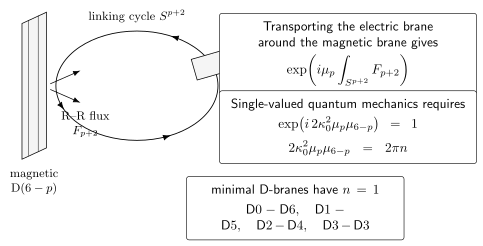
Transporting an electrically charged D-brane around its magnetic dual D-brane gives an Aharonov—Bohm phase. Single-valuedness imposes .
Using the elementary D-brane charge formula, the left-hand side becomes
Therefore a single D-brane and a single D-brane carry minimal mutually allowed R—R charges:
This is a deep consistency check. The same objects whose tension is inferred from open-string dynamics carry precisely the minimal R—R charge allowed by quantum mechanics.
Orientation, charge, and stacks
Section titled “Orientation, charge, and stacks”A stack of coincident D-branes has total charge
and physical tension
The open strings ending on the stack carry Chan—Paton indices, and the low-energy gauge symmetry is . The overall couples to the center-of-mass brane position, while the nonabelian sector describes relative positions and strings stretched between different branes.
An anti-D-brane has
Therefore brane—antibrane annihilation can conserve total R—R charge while releasing positive energy. In the open-string description, the instability is represented by the brane—antibrane tachyon. In the spacetime description, it is the absence of a BPS bound protecting the pair.
What has been established
Section titled “What has been established”D-branes are not optional boundary conditions added to string theory by hand. They are the R—R charged BPS objects required by the consistency of type II theory. The equality
explains the no-force condition. The formula
makes D-branes the minimally charged objects in the R—R charge lattice. The generalized Dirac condition
then identifies the D—D pair as the natural electric/magnetic pair of type II string theory.
These facts will be used repeatedly: in annulus force computations, intersecting brane systems, dissolved brane charges on worldvolumes, S-duality, supergravity brane solutions, and ultimately the D3-brane route to AdS/CFT.
Exercises
Section titled “Exercises”Exercise 1
Section titled “Exercise 1”Use
to show that a D-brane and a D-brane obey the minimal Dirac quantization condition.
Solution
The generalized Dirac product is
Substituting the charge formula gives
The powers of give
The powers of give
Therefore
Thus the Dirac integer is . Elementary D-branes carry the minimal mutually allowed R—R charge.
Exercise 2
Section titled “Exercise 2”Assume the long-distance interaction between two parallel D-branes is proportional to
Show that identical BPS branes have no force, while a brane—antibrane pair is attractive.
Solution
For two identical BPS branes,
Therefore
The static force vanishes.
For a brane—antibrane pair, the tension is unchanged but the charge of the antibrane is reversed:
Then
The NS—NS and R—R effects add instead of canceling. With the usual sign convention for the potential energy, this corresponds to an attractive interaction.
Exercise 3
Section titled “Exercise 3”In ten dimensions, determine the magnetic dual of a D-brane by counting form degrees.
Solution
A D-brane couples electrically to
The field strength is
In ten dimensions, the Hodge dual has degree
Thus
is locally the field strength of a dual potential of degree :
An object that couples electrically to has worldvolume dimension , hence spatial dimension
Therefore the magnetic dual of a D-brane is a D-brane.
Exercise 4
Section titled “Exercise 4”Show that the exact tension formula is consistent with T-duality along a circle. A D-brane wraps a circle of radius . After T-duality it becomes an unwrapped D-brane. Use
Solution
The wrapped D-brane has mass per unit unwrapped spatial volume
After T-duality, the object is an unwrapped D-brane. Its physical tension is
Substitute the T-duality rules:
Thus
The exact D-brane tension formula transforms correctly under T-duality.
Exercise 5
Section titled “Exercise 5”For a D-brane with , use the transverse Green function to determine the power-law falloff of the long-distance potential between two non-BPS objects with uncancelled source strength.
Solution
The number of transverse spatial dimensions is
The massless Green function in dimensions behaves as
Substituting gives
Therefore any uncancelled long-distance force mediated by massless closed strings has potential-energy density scaling as
For example, for D3-branes the transverse dimension is , so the potential behaves as when the BPS cancellation is spoiled.
Exercise 6
Section titled “Exercise 6”Use the supersymmetry projection
to explain why a brane—antibrane pair preserves no supersymmetry.
Solution
A D-brane imposes
An anti-D-brane imposes the opposite projection:
If both projections are to hold simultaneously, then
Thus
Since is invertible, this implies
and then also
There is no nonzero preserved supersymmetry parameter. Hence a brane—antibrane pair is non-BPS, its long-distance force does not cancel, and its open-string spectrum may contain a tachyon.
Exercise 7
Section titled “Exercise 7”Suppose coincident D-branes and coincident anti-D-branes are placed together. What are the total R—R charge and the total physical tension before tachyon condensation?
Solution
Each D-brane contributes charge and physical tension . Each anti-D-brane contributes charge and the same positive physical tension .
Therefore the total R—R charge is
The total physical tension is
The difference between these two expressions is the energetic reason brane—antibrane annihilation can release energy while preserving the conserved R—R charge. If , the net R—R charge vanishes, and complete annihilation to the closed-string vacuum is allowed by charge conservation.