
Modern CFT for AdS/CFT
Why this course exists
Section titled “Why this course exists”The AdS/CFT correspondence is often introduced as a striking equality between two theories,
but this equation is only useful once the left-hand side is understood with some maturity. The boundary theory is not merely a source of examples. It is the definition of the quantum-gravity problem in asymptotically AdS spacetime. The bulk metric, fields, particles, black holes, strings, and semiclassical expansion are all encoded in CFT quantities: operator dimensions, OPE coefficients, correlation functions, Ward identities, thermal states, global symmetries, supersymmetry, and large- factorization.
This course is therefore a course on conformal field theory with a deliberately holographic bias. We will learn CFT not as an isolated subject, but as the language in which AdS/CFT is written.
More explicitly, the basic CFT data are
where is the scaling dimension, is the spin, denotes global-symmetry quantum numbers, and are OPE coefficients. In a holographic CFT, this same data is reorganized as the spectrum and interactions of fields in AdS.
The slogan is simple, but its content is deep:
The purpose of this course is to make every line of this dictionary feel inevitable rather than mysterious.
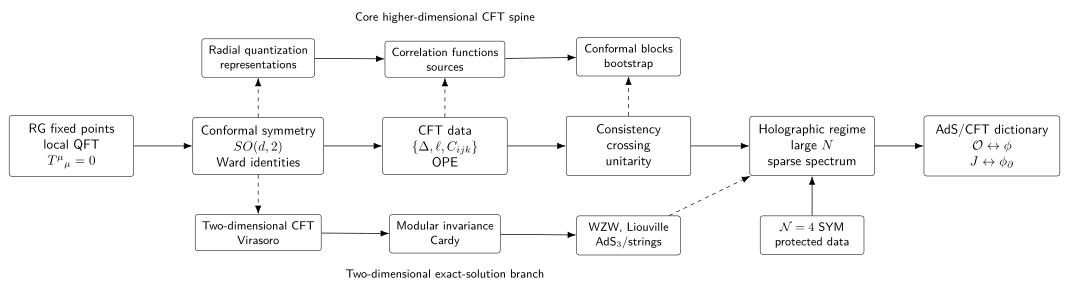
The course follows a higher-dimensional CFT spine from RG fixed points to conformal data, crossing, large , and finally the pre-AdS/CFT dictionary. The two-dimensional branch gives the exact-solution technology needed for strings, AdS/CFT, modular invariance, and worldsheet CFT.
What makes this different from a standard CFT course
Section titled “What makes this different from a standard CFT course”A traditional two-dimensional CFT course usually begins with holomorphic maps, the stress tensor , the Virasoro algebra, minimal models, modular invariance, and WZW models. That is a beautiful subject, and part of this course will treat it seriously. But AdS/CFT usually requires a different first emphasis.
For holography, the most important CFT concepts are the ones that survive in general dimension:
- conformal symmetry as ,
- the state-operator correspondence,
- primary operators and conformal multiplets,
- stress-tensor and current Ward identities,
- two-, three-, and four-point functions,
- the OPE and conformal blocks,
- unitarity and crossing,
- thermal CFT and entanglement,
- supersymmetric shortening,
- large- factorization,
- single-trace and multi-trace operator structure.
The two-dimensional theory then enters twice. First, it is the most powerful exactly solvable laboratory for CFT. Second, it is indispensable for string theory and AdS/CFT. But the main line of the course is higher-dimensional and operator-algebraic, because that is the shortest path to AdS/CFT.
Prerequisites
Section titled “Prerequisites”The expected background is graduate quantum field theory at the level of path integrals, symmetries, Noether currents, canonical quantization, and basic renormalization. Familiarity with general relativity and string theory is helpful but not required for the CFT part. The course will repeatedly point toward AdS/CFT, but it will not assume that the reader already knows the holographic dictionary.
The minimum technical toolkit is:
When a tool is essential, we will derive it. When a tool is merely convenient, we will isolate it in an appendix.
The conceptual spine
Section titled “The conceptual spine”The course is built around five transitions.
1. From RG fixed points to conformal symmetry
Section titled “1. From RG fixed points to conformal symmetry”A CFT is first of all a local QFT at an RG fixed point. In a theory deformed by local operators,
the beta functions describe how couplings change with scale:
At a fixed point, . In a local relativistic theory, this is closely tied to the trace of the stress tensor,
At the fixed point in flat space, after suitable improvement and in the absence of explicit anomalies, one expects
This condition is the seed of conformal invariance.
2. From conformal symmetry to representation theory
Section titled “2. From conformal symmetry to representation theory”The conformal group in -dimensional Lorentzian spacetime is . Its generators are translations , Lorentz transformations , dilatations , and special conformal transformations .
Local operators are organized into conformal multiplets. A primary operator obeys
and descendants are obtained by acting with translations:
The scaling dimension is the eigenvalue of . Under radial quantization, becomes the Hamiltonian on the cylinder :
This is the first major bridge to AdS/CFT: CFT scaling dimensions become energies of states on global AdS.
3. From symmetry to correlators
Section titled “3. From symmetry to correlators”Conformal symmetry fixes two- and three-point functions almost completely. For scalar primary operators,
after a convenient normalization, and
Four-point functions are different. They depend on conformal cross-ratios and therefore contain dynamical information. For identical scalar primaries,
where
The function is where the theory starts to breathe. In AdS/CFT, its singularities, OPE limits, and large- expansion know about bulk particles, interactions, locality, and causality.
4. From OPE associativity to bootstrap
Section titled “4. From OPE associativity to bootstrap”The operator product expansion says that nearby local operators can be replaced by a convergent sum of local operators:
Associativity of this operator algebra is the conformal bootstrap. In a four-point function, performing the OPE in different channels must give the same answer. Schematically,
Here are conformal blocks. In a holographic CFT, the block expansion has a particularly sharp interpretation: single-trace exchanges are single-particle exchanges in AdS, and double-trace towers are multi-particle states.
5. From large to semiclassical AdS
Section titled “5. From large NNN to semiclassical AdS”A generic CFT is not holographic in the Einstein-gravity sense. The key additional condition is not simply conformal symmetry, but a special organization of the operator algebra.
The most important features are:
In matrix large- theories, a common normalization gives
for single-trace operators normalized so that their two-point functions are . This is the CFT origin of the classical bulk expansion:
Course structure
Section titled “Course structure”The course is organized into fourteen parts. The plan below makes the Lorentzian, large-, and holographic-locality themes explicit while keeping the reading sequence clean.
| Part | Main purpose |
|---|---|
| 01 | Why CFT is the boundary language of AdS/CFT; observables, sources, signatures, and the map from CFT data to bulk interpretation. |
| 02 | Wilsonian RG, critical phenomena, stress-tensor trace, beta functions, improvements, and CFT data. |
| 03 | Conformal transformations, , compactification, cylinder, causal structure, and embedding space. |
| 04 | Primary operators, currents, stress tensor, generating functionals, source dependence, and Ward identities. |
| 05 | Scalar and spinning correlators, cross-ratios, Lorentzian correlators, analyticity, and prescriptions. |
| 06 | State-operator correspondence, reflection positivity, unitarity bounds, shortening, and conformal Casimirs. |
| 07 | OPE convergence, conformal blocks, crossing equations, numerical bootstrap, lightcone bootstrap, and causality constraints. |
| 08 | Complex coordinates, local conformal symmetry, , Virasoro, central charge, highest-weight modules, and free fields. |
| 09 | Minimal models, modular invariance, Cardy formula, current algebras, WZW models, Liouville theory, and AdS/strings. |
| 10 | CFT on curved spaces, Weyl anomaly, thermal CFT, modular Hamiltonians, entanglement, and black-hole preparation. |
| 11 | Global symmetries, flavor currents, anomalies, superconformal algebras, BPS multiplets, and conformal manifolds. |
| 12 | Generalized free fields, single- and multi-trace operators, planar expansion, large- OPE, and CFT signals of bulk locality. |
| 13 | SYM, chiral primaries, Wilson loops, defects, spin chains, and the pre-dictionary for AdS/CFT. |
| 14 | Notation, Lie algebra reference, embedding-space formulas, supersymmetry cheatsheets, problems, glossary, and bibliography. |
Each lecture page contains a short “AdS/CFT checkpoint.” This is not decoration. It is the main guardrail of the course: every major CFT concept should eventually answer the question, “What does this become in the bulk?”
The source viewpoint
Section titled “The source viewpoint”One of the most important habits in AdS/CFT is to think of a QFT through sources. Given local operators , define a source-dependent generating functional
The connected generating functional is
Connected correlation functions are obtained by functional differentiation:
This formula is the CFT side of the basic AdS/CFT prescription. The bulk boundary condition says that the boundary value of a bulk field is the source for the dual CFT operator.
Thus, even before learning any bulk gravity, one should become fluent with the CFT meaning of sources, contact terms, Ward identities, and functional derivatives.
Euclidean and Lorentzian thinking
Section titled “Euclidean and Lorentzian thinking”Most of the course will begin in Euclidean signature because conformal symmetry, OPE convergence, radial quantization, and reflection positivity are cleanest there. But AdS/CFT is also profoundly Lorentzian. Black holes, causality, horizons, chaos, scattering, and real-time response all require Lorentzian correlators.
A useful mental division is:
We will move among these viewpoints repeatedly. The same CFT data controls all of them, but different physics becomes visible in each frame.
Normalizations and conventions
Section titled “Normalizations and conventions”Unless otherwise stated, denotes the spacetime dimension of the CFT. Euclidean coordinates are written as , with . Lorentzian signature will be introduced explicitly when needed.
For scalar primary operators, we often choose the two-point normalization
With this convention, the coefficients appearing in three-point functions are physical CFT data, up to choices of operator basis in degenerate sectors.
The stress tensor is normalized by its Ward identity. Its two-point function defines a central-charge-like coefficient in any dimension:
where is the tensor structure fixed by conformal symmetry. In a holographic theory, scales like the inverse bulk Newton constant:
What success looks like
Section titled “What success looks like”By the end of the course, a reader should be able to do the following without treating AdS/CFT as a black box:
- identify the CFT data contained in two-, three-, and four-point functions;
- use Ward identities to constrain correlators involving and conserved currents;
- explain the state-operator map and its relation to global AdS energies;
- decompose four-point functions into conformal blocks and state the crossing equations;
- understand why large- factorization suggests a weakly coupled bulk theory;
- distinguish single-trace, double-trace, and multi-trace operators;
- explain why SYM is the canonical CFT in AdS/CFT;
- read basic holographic formulas such as with confidence.
The goal is not memorization. The goal is to make the structure of AdS/CFT feel forced by the structure of CFT.
Exercises
Section titled “Exercises”Exercise 1. Dimensions and bulk masses
Section titled “Exercise 1. Dimensions and bulk masses”For a scalar operator in a -dimensional CFT, the corresponding scalar field in AdS obeys
Show that the two possible dimensions solving this equation are
What happens when ?
Solution
The equation is quadratic in :
Solving gives
For , the two roots are
The solution is the standard dimension for a massless bulk scalar dual to a nontrivial scalar operator. The behavior corresponds to the non-normalizable constant mode, interpreted as a source or coupling rather than an ordinary fluctuating operator in the standard quantization.
Exercise 2. Why connected correlators matter
Section titled “Exercise 2. Why connected correlators matter”Suppose single-trace operators are normalized so that
and connected correlators scale as
Explain why this resembles a weakly coupled classical theory in the bulk.
Solution
A weakly coupled classical bulk theory has tree-level interactions controlled by a small coupling. In AdS/CFT, the role of the small coupling is played by or, more precisely in many matrix theories, by .
The two-point function is order one, so single-particle states have finite norm. The three-point connected function scales like
which means cubic interactions are weak. The four-point connected function scales like
which is the same order as tree-level exchange or contact interactions built from two cubic vertices or one quartic vertex.
Meanwhile, disconnected pieces dominate. That is the boundary version of a Fock-space description: multi-particle states are approximately products of single-particle states. Interactions are suppressed by powers of .
Exercise 3. Sources and one-point functions
Section titled “Exercise 3. Sources and one-point functions”Let
Show that
where means expectation value in the presence of the source .
Solution
Differentiate :
The derivative of brings down the operator:
Therefore
This is the precise CFT statement behind the holographic rule that varying the on-shell bulk action with respect to the boundary value of a field gives the expectation value of the dual operator.
Reading guide
Section titled “Reading guide”The first reading path is the core higher-dimensional path:
The second path is the two-dimensional exact-solution path:
The third path is the AdS/CFT bridge:
A reader focused on AdS/CFT should prioritize the first and third paths. A reader focused on strings or AdS/CFT should also follow the second path carefully.
AdS/CFT checkpoint
Section titled “AdS/CFT checkpoint”The first checkpoint is the most important one:
The CFT knows its Hilbert space, symmetries, operator algebra, correlation functions, thermal states, and entanglement structure. AdS/CFT does not replace these ideas. It geometrizes them.