
Entanglement Wedge and Subregion Duality
The main idea
Section titled “The main idea”The Ryu—Takayanagi and HRT prescriptions tell us how to compute the entropy of a boundary region . The next question is more ambitious:
Given only the reduced density matrix , what part of the bulk can be regarded as encoded by the boundary region ?
The modern answer is not the causal wedge, but the entanglement wedge. Very schematically,
This statement is called subregion duality. It is one of the places where the slogan “radial direction equals scale” becomes insufficient. A boundary subregion does not merely see the bulk points with which it can exchange classical signals. It also contains quantum information encoded nonlocally in , and that information generally reaches deeper into the bulk.
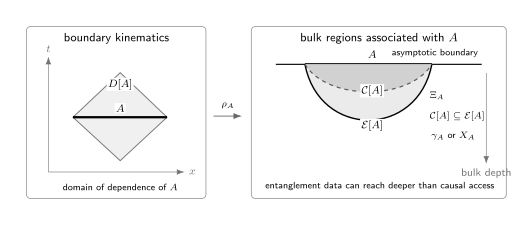
A boundary region determines a domain of dependence . The causal wedge is the bulk region that can both send signals to and receive signals from . The entanglement wedge is bounded by and the HRT surface , or by the quantum extremal surface once bulk quantum corrections are included. Generically .
The conceptual leap is this: causal access is not the same thing as reconstructability. A bulk point may be outside the causal wedge of but still be reconstructible from the density matrix by a highly nonlocal boundary operator. That is not paradoxical, because reconstruction is not a classical signal sent from the point to the boundary. It is a statement about how the bulk code subspace is embedded into the boundary Hilbert space.
Boundary regions and domains of dependence
Section titled “Boundary regions and domains of dependence”Let the CFT live on a Lorentzian spacetime , and let be a spatial region on a boundary Cauchy slice. Its complement on the same slice is denoted . The reduced density matrix is
In an ordinary local QFT, the algebra of operators associated with can be evolved causally to its domain of dependence . This is the set of boundary points such that every inextendible causal curve through intersects . Equivalently, specifying the fields on fixes the physics in .
This is why the natural boundary object is not just the spatial set , but the causal diamond . A source supported inside couples to operators whose action is determined by the same reduced density matrix . A source outside is not part of the data of .
This point is small but crucial. The bulk dual of a subregion should be invariant under the boundary causal development of the region:
So all wedge constructions should be associated with , even when we draw them using a convenient spatial slice.
The causal wedge
Section titled “The causal wedge”The most conservative guess for the bulk dual of is the region that can communicate causally with . Define the causal wedge by
where and denote the bulk causal future and past of a set on the asymptotic boundary. A point lies in precisely when it can receive a signal from and send a signal back to .
The boundary of the causal wedge contains a codimension-two surface called the causal information surface,
Its area defines the causal holographic information,
In early discussions of subregion duality, it was natural to expect to be the answer. After all, if a bulk event cannot communicate with , how could know about it?
The answer is that is not just a device for sending and receiving classical signals. It is a quantum state containing equal-time correlations, modular-flow data, and nonlocal operator information. The causal wedge is therefore a lower bound on the reconstructible bulk region, not the full answer.
A useful hierarchy is
but not conversely. Entanglement-wedge reconstruction is usually more nonlocal and more state-dependent than causal-wedge reconstruction.
The classical entanglement wedge
Section titled “The classical entanglement wedge”For a boundary region , let be the HRT surface anchored on and homologous to . Choose a bulk achronal codimension-one region satisfying
The classical entanglement wedge is the bulk domain of dependence of :
In a static time-reflection-symmetric spacetime, this reduces to a simple picture: draw the RT surface on a spatial slice, and take the bulk region between and . In a genuinely time-dependent geometry, this spatial intuition is not enough. The entanglement wedge is a Lorentzian domain of dependence, and the HRT surface is an extremal surface in spacetime, not necessarily a minimal surface on any preferred time slice.
The homology constraint is essential. Without it, one could choose surfaces that have the right boundary anchor but do not separate the bulk degrees of freedom in the way the reduced density matrix does. Homology is also what makes thermal horizons and black-hole interiors enter entanglement calculations correctly.
A compact classical dictionary is:
| Boundary object | Bulk object |
|---|---|
| spatial region | anchoring boundary for |
| causal diamond | boundary domain associated with |
| reduced density matrix | bulk effective data in |
| entropy | at leading order |
| modular Hamiltonian | bulk modular physics in , plus area term |
| inclusion | entanglement-wedge nesting |
The quantum entanglement wedge
Section titled “The quantum entanglement wedge”The previous definition is the leading classical approximation. Once bulk quantum fields contribute to entropy, the HRT surface is replaced by a quantum extremal surface . It extremizes the generalized entropy
where is a bulk region bounded by . The quantum entanglement wedge is then
At leading order in large , reduces to the classical HRT surface . At subleading order, two things happen at once:
- the surface location shifts, because contributes to the extremization problem;
- the bulk region contains quantum information, so the statement “ encodes the wedge” must be interpreted as an operator-algebra or code-subspace statement.
The quantum version is not cosmetic. It is the structure behind islands and Page curves, but even before black-hole evaporation it is already needed for a precise statement of bulk reconstruction.
Causal wedge versus entanglement wedge
Section titled “Causal wedge versus entanglement wedge”Under standard classical assumptions, especially suitable energy conditions and global hyperbolicity assumptions for the bulk, one expects
This inclusion means that anything causally accessible from is also in the entanglement wedge, but the entanglement wedge can contain more.
There are special cases where the two wedges coincide. For example, for a ball-shaped region in the CFT vacuum dual to pure AdS, the entanglement wedge is the AdS-Rindler wedge, and the causal and entanglement wedges agree. This special equality is pedagogically useful, but it is not representative. In less symmetric states, for disconnected regions, in black-hole geometries, or after quantum corrections, the entanglement wedge is the more robust concept.
The causal wedge is determined by light cones. The entanglement wedge is determined by extremal surfaces and entropy. This difference is why the entanglement wedge can jump discontinuously as the region changes: HRT surfaces can undergo phase transitions, while causal wedges vary more directly with causal propagation.
Entanglement-wedge nesting
Section titled “Entanglement-wedge nesting”One of the most important consistency conditions is entanglement-wedge nesting:
This is the bulk expression of the fact that a larger boundary region should have access to at least as much bulk information as a smaller one. If contains , then reconstructing a bulk operator from should imply that the same operator can also be reconstructed from .
Nesting is not merely intuitive. It is tied to deep entropy inequalities and causality constraints. In the classical HRT setting, maximin arguments make this inclusion precise under appropriate assumptions. In the quantum setting, nesting is closely related to quantum focusing and the monotonicity of relative entropy.
Nesting also gives a clean way to see why the HRT surface moves “deeper” as the boundary region grows. If is enlarged to , the wedge must expand, so the new extremal surface cannot cut off bulk points that were already reconstructible from .
Subregion duality as a code-subspace statement
Section titled “Subregion duality as a code-subspace statement”A tempting but imprecise slogan is:
This is too literal. Gravity has constraints, gauge redundancies, edge-mode subtleties, and no exact local tensor factorization of the bulk Hilbert space. The better statement is operational:
For states in a suitable semiclassical code subspace, every bulk operator in the entanglement wedge of has a representation as a boundary operator supported in .
More explicitly, if is a bulk operator with , then there exists a boundary operator such that
This equality is not an equality of microscopic operators on the entire CFT Hilbert space. It is an equality of their action on a restricted set of states around a semiclassical bulk background. This restriction is not a bug. It is how local effective field theory works in quantum gravity.
The representation is also not unique. If a bulk operator lies in the overlap of the entanglement wedges of different boundary regions, it can have different boundary reconstructions. This redundancy is the hallmark of quantum error correction.
JLMS and the modular reason reconstruction works
Section titled “JLMS and the modular reason reconstruction works”The sharpest modern explanation of entanglement-wedge reconstruction uses modular Hamiltonians and relative entropy. Let
be the boundary modular Hamiltonian. In the semiclassical bulk, the JLMS relation says roughly that, within a code subspace,
where is the bulk entanglement wedge region and is the bulk modular Hamiltonian for quantum fields in that region. The ellipsis hides terms and qualifications associated with gauge constraints, centers of algebras, higher-order corrections, and the choice of code subspace.
For two nearby states and in the same semiclassical code subspace, the corresponding relative entropies obey the schematic relation
This is powerful because relative entropy measures distinguishability. If two bulk states differ inside , then the boundary reduced states on must be able to distinguish them. Conversely, if a bulk excitation is outside the entanglement wedge, should not contain that information in the same code-subspace sense.
The JLMS relation is the bridge between three ideas that otherwise look unrelated:
- the area term in holographic entropy,
- modular flow and relative entropy in QFT,
- quantum error correction in the bulk-to-boundary map.
This is why entanglement-wedge reconstruction is not merely a geometric guess. It follows from the compatibility between the entropy formula and the information-theoretic structure of quantum states.
Example 1: one interval in vacuum AdS/CFT
Section titled “Example 1: one interval in vacuum AdS3_33/CFT2_22”Take the vacuum of a two-dimensional CFT on the line, dual to Poincaré AdS,
Let be the interval
at . The RT geodesic is the semicircle
The deepest point of the wedge is . This is a particularly clean realization of the UV/IR relation: a larger interval probes deeper radial scales. The entanglement wedge is the domain of dependence of the bulk disk bounded by the interval and the semicircle.
In this symmetric vacuum example, the wedge is also an AdS-Rindler wedge. The modular flow of the interval is geometric, and the causal wedge and entanglement wedge coincide. This coincidence is why this example is often used to teach subregion reconstruction. But it is dangerous to extrapolate too quickly: for generic regions or states, modular flow is not geometric and the entanglement wedge is larger than the causal wedge.
Example 2: two disjoint intervals and wedge phase transitions
Section titled “Example 2: two disjoint intervals and wedge phase transitions”Let
be two disjoint boundary intervals. In AdS/CFT, there are competing RT candidates:
- a disconnected candidate, where each interval has its own geodesic;
- a connected candidate, where the geodesics pair the endpoints differently.
The entropy is determined by the smaller total geodesic length. As the cross ratio changes, the dominant surface can jump. When the connected surface dominates, the entanglement wedge of is connected; when the disconnected surface dominates, it is disconnected at leading classical order.
This transition has a boundary interpretation in terms of mutual information:
At leading order in holographic large , the disconnected phase often gives
while the connected phase gives an mutual information. This sharp large- transition is smoothed by quantum corrections, but it remains one of the clearest examples of how entanglement determines bulk connectivity.
Example 3: black holes and one-sided wedges
Section titled “Example 3: black holes and one-sided wedges”For an eternal two-sided AdS black hole, the thermofield-double state lives on two CFTs. The entanglement wedge of the union of both complete boundaries contains the two-sided exterior and, on suitable slices, the Einstein-Rosen bridge. The entanglement wedge of only one complete boundary is different: it is associated with the exterior region of that side and does not simply include the other exterior.
This is a useful warning. The phrase “the boundary encodes the bulk” is true globally, but a subregion encodes only the bulk region assigned by the relevant wedge. Which wedge appears depends on the chosen boundary region, the state, and whether the problem is classical or quantum.
The island formula, studied later in this course, is an even sharper version of this lesson: after quantum extremization, the entanglement wedge of a non-gravitating radiation region can include an island inside a gravitational region. That is subregion duality in its most dramatic form.
What exactly is reconstructed?
Section titled “What exactly is reconstructed?”The cleanest statement is about bulk operator algebras, not individual coordinate points. In a fixed semiclassical background, it is convenient to say that a local field in can be reconstructed from . But several subtleties are hiding in that sentence.
First, a gravitationally dressed local operator is not strictly local. To make a bulk operator diffeomorphism-invariant, one must specify it relationally or attach a gravitational dressing. Whether the dressing can be chosen to end on is part of the reconstruction problem.
Second, gauge theories and gravity have constraints. A bulk region may have edge modes or center variables associated with its boundary, especially the extremal surface. The algebraic version of subregion duality keeps track of which operators are included and which central data are fixed.
Third, reconstruction is approximate. It is controlled by large , the bulk effective field theory cutoff, and the size of the code subspace. A reconstruction that works for small perturbations around one semiclassical geometry need not work uniformly over all CFT states.
A practical rule is:
provided that all quantities are interpreted inside the appropriate code subspace and to the appropriate order in .
Relation to HKLL and AdS-Rindler reconstruction
Section titled “Relation to HKLL and AdS-Rindler reconstruction”Earlier bulk-reconstruction methods, often called HKLL reconstruction, express a bulk free field as a smeared boundary operator:
For global AdS, the smearing region may involve the full boundary. For AdS-Rindler wedges, one can reconstruct fields in a wedge from operators supported in the corresponding boundary domain of dependence.
This type of reconstruction is closest to causal-wedge reconstruction. It is explicit and field-theoretic, but it does not by itself explain the full entanglement wedge in generic states. Entanglement-wedge reconstruction is more general and more abstract: it says a representation exists because of the information-theoretic structure of the holographic code, even when an elementary local smearing kernel is not available.
In practice, both viewpoints are useful:
| Method | Strength | Limitation |
|---|---|---|
| HKLL/global smearing | explicit perturbative bulk fields | often requires large boundary support |
| AdS-Rindler reconstruction | explicit subregion reconstruction in symmetric wedges | closely tied to causal/geometric modular flow |
| modular reconstruction | naturally targets entanglement wedges | technically difficult for generic modular flow |
| quantum-error-correction argument | explains redundancy and wedge reconstruction | usually proves existence rather than giving a simple formula |
Common mistakes
Section titled “Common mistakes”Mistake 1: “The causal wedge is the dual of .”
Section titled “Mistake 1: “The causal wedge is the dual of ρA\rho_AρA.””The causal wedge is reconstructible by relatively direct causal methods, but it is generally smaller than the region encoded in . The entanglement wedge is the natural dual of the reduced density matrix.
Mistake 2: “The entanglement wedge is just a spatial region.”
Section titled “Mistake 2: “The entanglement wedge is just a spatial region.””On a static slice, it looks like a spatial region bounded by and . Covariantly, it is a bulk domain of dependence. The distinction matters in time-dependent spacetimes.
Mistake 3: “A point outside cannot be known by .”
Section titled “Mistake 3: “A point outside C[A]\mathcal C[A]C[A] cannot be known by AAA.””It cannot exchange classical signals with , but quantum information is not limited to causal signaling. A nonlocal operator supported in can reconstruct data beyond the causal wedge.
Mistake 4: “Reconstruction is unique.”
Section titled “Mistake 4: “Reconstruction is unique.””The same bulk operator can have multiple boundary representations on different regions. This redundancy is not an inconsistency; it is the error-correcting nature of holography.
Mistake 5: “The classical HRT surface is always enough.”
Section titled “Mistake 5: “The classical HRT surface is always enough.””At order , the bulk entropy term shifts the surface and changes the wedge. For black-hole information questions, the quantum extremal surface is not optional.
Exercises
Section titled “Exercises”Exercise 1: Causal wedge definition
Section titled “Exercise 1: Causal wedge definition”Let be a boundary spatial region with domain of dependence . Explain why the definition
captures the idea of bulk points that are operationally accessible by causal probes from .
Solution
A point is in if some signal from can reach . It is in if a signal from can reach . Therefore lies in the intersection precisely when an observer using sources and detectors in can both influence and receive information back from it. This is the natural causal notion of accessibility.
The definition uses , not just , because local QFT data on can be evolved within its boundary domain of dependence. Boundary operators supported on different Cauchy slices with the same domain of dependence describe the same local algebra.
Exercise 2: RT surface for a vacuum interval
Section titled “Exercise 2: RT surface for a vacuum interval”In Poincaré AdS,
consider the interval at . Show that the RT geodesic has maximal depth .
Solution
On the static slice , geodesics in the hyperbolic plane with endpoints on the boundary are semicircles orthogonal to the boundary. The geodesic anchored at and is therefore
Its deepest point occurs at , giving
Thus a larger interval reaches deeper into the bulk. This is the simplest geometric version of the UV/IR relation.
Exercise 3: A two-interval RT transition
Section titled “Exercise 3: A two-interval RT transition”Take two equal intervals in a holographic CFT vacuum,
Using the vacuum entropy formula
compare the disconnected candidate and the connected candidate for . Show that the connected wedge dominates when
Solution
The disconnected candidate is
The connected candidate pairs the outer endpoints and the two inner endpoints, so
The connected candidate dominates when
The cutoff dependence cancels, leaving
Let . Then
or
The positive root is
so the connected wedge dominates for
Exercise 4: Entanglement-wedge nesting
Section titled “Exercise 4: Entanglement-wedge nesting”Assume . Explain why the failure of
would be problematic for subregion duality.
Solution
If , then the boundary region contains at least the operator information available in . If a bulk operator is reconstructible from , it should also be reconstructible from .
If but , subregion duality would say that is reconstructible from the smaller region but not from the larger region. That contradicts the monotonicity of accessible boundary information. In the geometric theory, entanglement-wedge nesting prevents this contradiction.
Exercise 5: From JLMS to distinguishability
Section titled “Exercise 5: From JLMS to distinguishability”Suppose two nearby semiclassical states differ only by a small bulk excitation inside . Use the schematic JLMS relation
to explain why must be able to distinguish the two states.
Solution
Relative entropy is a measure of distinguishability. If the two bulk states differ inside the wedge region , then generally
The JLMS relation then implies
Therefore the reduced density matrices on are distinguishable. This is the information-theoretic content of entanglement-wedge reconstruction: bulk differences inside the wedge must be visible in the boundary reduced state.
Further reading
Section titled “Further reading”- V. E. Hubeny and M. Rangamani, Causal Holographic Information.
- B. Czech, J. L. Karczmarek, F. Nogueira, and M. Van Raamsdonk, The Gravity Dual of a Density Matrix.
- A. C. Wall, Maximin Surfaces, and the Strong Subadditivity of the Covariant Holographic Entanglement Entropy.
- M. Headrick, V. E. Hubeny, A. Lawrence, and M. Rangamani, Causality & Holographic Entanglement Entropy.
- D. L. Jafferis, A. Lewkowycz, J. Maldacena, and S. J. Suh, Relative Entropy Equals Bulk Relative Entropy.
- X. Dong, D. Harlow, and A. C. Wall, Reconstruction of Bulk Operators within the Entanglement Wedge in Gauge-Gravity Duality.
- A. Almheiri, X. Dong, and D. Harlow, Bulk Locality and Quantum Error Correction in AdS/CFT.