
Wilsonian RG
The Wilsonian renormalization group is the cleanest way to say what a quantum field theory is at long distances. It is also the cleanest way to understand why conformal field theories are the natural boundary theories in AdS/CFT.
The basic idea is simple: physics observed with finite resolution should not depend on microscopic variables that we cannot resolve. If the theory has a UV cutoff , we integrate out modes with momenta near , then rewrite the result as another theory with the same cutoff but different couplings. Repeating this step gives a flow in the space of theories.
The slogan is:
A CFT is a fixed point of this flow. Near a fixed point, the directions in theory space are classified as relevant, marginal, or irrelevant. In AdS/CFT language, this classification becomes the classification of bulk boundary conditions and radial falloffs.
This page is not about doing loop integrals efficiently. It is about the conceptual machine that turns microscopic theories into CFT data.
Cutoffs and effective actions
Section titled “Cutoffs and effective actions”Start with a Euclidean QFT regulated at a momentum cutoff . Schematically,
The cutoff is not necessarily a literal sharp momentum cutoff. It may be a lattice spacing , a smooth regulator, Pauli-Villars fields, dimensional regularization plus a subtraction scale, or something else. The Wilsonian idea is independent of this choice:
The Wilsonian action is the action that reproduces observables at scales much longer than . Because every local interaction allowed by symmetries is generated by coarse graining, the correct Wilsonian action is not usually a short expression with two or three terms. It is an expansion in local operators:
Here the index runs over all local operators compatible with the symmetries. For a scalar theory with a symmetry , this includes operators such as
This infinite expansion looks terrifying at first. Wilson’s key insight is that near a long-distance fixed point, most of these couplings become irrelevant. The infinite-dimensional theory space remains real, but the long-distance physics is controlled by a finite or small set of important directions.
One Wilsonian RG step
Section titled “One Wilsonian RG step”Let . Split the field into slow and fast momentum modes,
where
The first step is to integrate out the fast modes:
This produces an effective action with a lower cutoff . The second step is to rescale momenta and positions,
so that the cutoff is restored to . Finally, rescale the fields so that the chosen normalization convention is preserved. The result is a new Wilsonian action with new couplings .
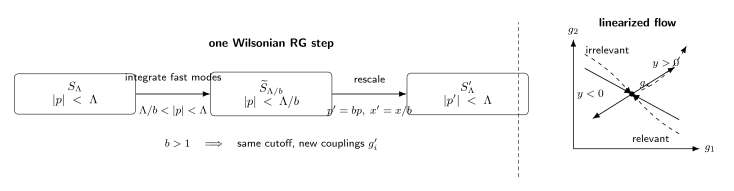
A Wilsonian RG step integrates out fast modes in the shell , rescales and , and produces new couplings . Near a fixed point , the flow is approximately linear: relevant directions have and move away under coarse graining, while irrelevant directions have and flow toward the fixed point.
The word “group” is slightly cheeky. Coarse graining throws away microscopic information, so the operation is usually not invertible. Mathematically it is closer to a semigroup. Physicists still say renormalization group because the infinitesimal flow is generated by beta functions and because the terminology is now immovable, like “canonical” in a context where nothing is canonical.
Dimensionless couplings
Section titled “Dimensionless couplings”A coupling with dimensions is not a good coordinate on theory space. Suppose an operator has scaling dimension at some fixed point. The deformation
is dimensionless, so the engineering dimension of is
A dimensionless coupling at scale is therefore
Equivalently, in a Wilsonian step with scale factor , the leading linearized transformation is
This equation is the first appearance of the relevance criterion:
Relevant deformations grow at long distances. Irrelevant deformations die away at long distances. Marginal deformations require more care: quantum corrections can make them marginally relevant, marginally irrelevant, or exactly marginal.
The language is physical. Relevant deformations matter in the IR. Irrelevant deformations become invisible in the IR. Marginal deformations sit at the border and make everyone work harder.
Beta functions
Section titled “Beta functions”Let denote dimensionless coordinates on theory space. A Wilsonian flow can be written as
where increases as we coarse grain toward the IR. This is the convention used in this page. Another common convention uses an energy scale and writes ; the signs then look reversed because moving to the IR means decreasing . When comparing formulas across books, always check the arrow of the RG flow.
A fixed point is a point in theory space such that
At a fixed point, coarse graining followed by rescaling gives back the same theory. This is scale invariance. Under suitable assumptions of locality, unitarity, Poincare invariance, and a well-behaved stress tensor, the fixed points of interest in this course are conformal field theories.
Near a fixed point, expand
The beta function becomes
Diagonalize . If is an eigen-coordinate, then
The eigenvalue is the RG exponent. The corresponding operator dimension is
Thus the RG classification can be restated as
At an interacting fixed point, the eigen-operators are usually not the naive monomials in the microscopic fields. They are particular linear combinations that diagonalize the dilatation operator. This is one of the first conceptual shifts from Lagrangian QFT to CFT: the important objects are not bare terms in a Lagrangian but scaling operators.
Universality
Section titled “Universality”Universality is the reason the Wilsonian RG is powerful.
Different microscopic Hamiltonians can flow to the same fixed point. For example, many very different lattice systems can have the same long-distance Ising CFT. Their lattice spacings, short-distance interactions, and irrelevant couplings differ, but those differences are washed out under coarse graining.
Near a fixed point, theory space decomposes into directions:
The irrelevant directions flow into the fixed point. The relevant directions flow away from it. The set of points that flow into the fixed point under coarse graining is the critical surface. To reach the fixed point in the IR, one must tune the relevant couplings to land on this surface.
This explains why critical phenomena are robust. A microscopic model has many couplings, but near a fixed point the long-distance behavior is controlled by the relevant directions and the fixed-point data. Critical exponents, scaling dimensions, and universal ratios do not care about most microscopic details.
For a fixed point with one relevant temperature-like perturbation , the flow is
The correlation length obeys
because one unit of length in the rescaled theory corresponds to units of length in the original theory. Choose so that is order one:
Then
This is how an RG eigenvalue becomes a measurable critical exponent.
Example: the Gaussian fixed point
Section titled “Example: the Gaussian fixed point”The simplest fixed point is the free massless scalar in dimensions:
At this fixed point, the scalar has dimension
The operator has engineering dimension
at the free fixed point, ignoring operator mixing and normal-ordering subtleties. The coupling of therefore has RG exponent
In ,
So is relevant, is classically marginal, and is irrelevant. Quantum corrections decide what happens to the marginal interaction.
In ,
Now is relevant at the Gaussian fixed point. This is one reason the three-dimensional Ising critical point is not described by the free scalar fixed point. The long-distance fixed point is the interacting Wilson-Fisher fixed point, whose operator dimensions are not the Gaussian engineering dimensions.
Example: near four dimensions
Section titled “Example: ϕ4\phi^4ϕ4 near four dimensions”A standard perturbative example is the scalar theory in :
Classically, the quartic coupling has dimension
Thus is relevant near the Gaussian fixed point when . Quantum corrections can produce a beta function of the schematic form
This has two fixed points:
The first is the Gaussian fixed point. The second is the Wilson-Fisher fixed point. In , this perturbative expansion becomes an approximation to the interacting fixed point governing the Ising universality class, after imposing the appropriate symmetry.
The important lesson is not the numerical value of . The lesson is that a classically relevant coupling can grow until it reaches a new interacting fixed point. Many CFTs arise exactly this way.
Wilsonian RG and the stress tensor
Section titled “Wilsonian RG and the stress tensor”The local diagnostic of scale dependence is the trace of the stress tensor. In a theory deformed away from a fixed point by operators , one expects schematically
This formula is schematic because the precise operator equation depends on conventions, curved-space counterterms, and operator mixing. But the message is essential:
At a fixed point, . If the theory is a genuine CFT and the stress tensor is properly improved, then in flat space
up to possible anomalies in curved backgrounds. The next page will focus on this trace equation more carefully.
This is why RG fixed points and CFTs are tied together. The RG says the theory looks the same after changing scale. The stress tensor says the same thing locally.
Relevant, marginal, irrelevant: physical interpretation
Section titled “Relevant, marginal, irrelevant: physical interpretation”The relevance classification is so important for AdS/CFT that it is worth saying three times in different languages.
First, in RG language:
Second, in CFT language:
Third, in effective field theory language:
The word “irrelevant” does not mean “unimportant for everything.” Irrelevant operators control corrections to scaling, encode microscopic details, and can be essential in UV completions. It means only that they become less important along the IR flow near the fixed point.
Scheme dependence and universal data
Section titled “Scheme dependence and universal data”A Wilsonian RG step is not unique. We can choose different regulators, different field redefinitions, different normalizations of operators, and different coordinates on theory space. Therefore beta functions away from fixed points are scheme-dependent.
But the following are universal:
| Quantity | Universal meaning |
|---|---|
| Fixed-point existence | There is a scale-invariant long-distance theory. |
| Scaling dimensions | Eigenvalues of the dilatation operator at the fixed point. |
| Critical exponents | RG eigenvalues rewritten as observable scaling laws. |
| OPE coefficients | Local operator algebra of the fixed-point CFT. |
| Symmetry and anomaly data | Constraints shared by all descriptions in the universality class. |
This distinction matters constantly in AdS/CFT. Coordinates in theory space are not sacred. CFT data are sacred.
The holographic checkpoint
Section titled “The holographic checkpoint”The Wilsonian RG prepares one of the deepest pieces of the AdS/CFT dictionary:
In Poincare AdS,
where the boundary is at . Small corresponds to UV boundary physics. Larger corresponds to longer-distance, more IR boundary physics. This is the UV/IR relation:
A scalar operator of dimension is dual to a bulk scalar with mass
Near the boundary, the bulk field behaves schematically as
The coefficient is the source for . If , then the source term grows as we move inward from the boundary. That is the bulk reflection of a relevant deformation growing toward the IR.
The correspondence is not “RG is literally the radial coordinate” in a regulator-independent way. Wilsonian RG has scheme dependence, and radial coordinates have gauge dependence. The invariant statement is more subtle and more powerful: holographic radial evolution geometrizes the scale dependence of CFT data.
At a CFT fixed point, the dual geometry is exactly AdS, at least in the simplest semiclassical cases. An RG flow between fixed points is often represented by a domain-wall geometry that approaches one AdS space in the UV and another in the IR:
This is why we begin the CFT course with Wilsonian RG. The radial direction of holography is already hiding inside the question: what remains after coarse graining?
Common pitfalls
Section titled “Common pitfalls”Pitfall 1: thinking that a QFT is only its classical Lagrangian
Section titled “Pitfall 1: thinking that a QFT is only its classical Lagrangian”A classical Lagrangian is a coordinate chart on theory space, not the whole theory. Quantum corrections generate all operators allowed by symmetries. A Wilsonian action should be understood as an effective action at a scale.
Pitfall 2: confusing cutoff dependence with physical dependence
Section titled “Pitfall 2: confusing cutoff dependence with physical dependence”Bare couplings depend on the cutoff. Physical observables should not depend on arbitrary regulator choices after parameters are fixed. RG flow describes how descriptions change with scale, not how nature changes because we changed our notation.
Pitfall 3: saying irrelevant means negligible in the UV
Section titled “Pitfall 3: saying irrelevant means negligible in the UV”Irrelevant operators are suppressed in the IR near a fixed point. They may dominate UV sensitivity and encode the microscopic completion.
Pitfall 4: assuming every scale-invariant theory is automatically conformal
Section titled “Pitfall 4: assuming every scale-invariant theory is automatically conformal”For the unitary, local, Poincare-invariant theories relevant in this course, fixed points of interest are CFTs. But the implication from scale invariance to conformal invariance has assumptions and subtleties. The stress tensor and its possible improvement terms are the right language for those subtleties.
Summary
Section titled “Summary”A Wilsonian RG transformation integrates out short-distance degrees of freedom, rescales, and produces new couplings. A fixed point is a theory unchanged by this operation. Near a fixed point, perturbations are eigen-directions with exponents , or equivalently operator dimensions .
The main chain is:
This is the first bridge from ordinary QFT to the CFT language of AdS/CFT.
Exercises
Section titled “Exercises”Exercise 1 — Relevance from rescaling
Section titled “Exercise 1 — Relevance from rescaling”Let be a scalar operator of dimension at a fixed point in dimensions. Consider
Under the Wilsonian rescaling with , show that
Classify the deformation for , , and .
Solution
Under , the measure transforms as
A scaling operator of dimension transforms as
Therefore
Thus
If , then grows under coarse graining, so the deformation is relevant. If , it is marginal at linear order. If , it is irrelevant.
Exercise 2 — Gaussian power counting
Section titled “Exercise 2 — Gaussian power counting”At the free massless scalar fixed point in dimensions,
For the deformation
compute the RG exponent at the Gaussian fixed point. Classify , , and in and .
Solution
At the Gaussian fixed point,
The RG exponent is
In ,
Thus
So is relevant, is marginal at tree level, and is irrelevant.
In ,
Thus
So and are relevant at the Gaussian fixed point in , while is marginal at tree level.
Exercise 3 — Correlation length exponent
Section titled “Exercise 3 — Correlation length exponent”Suppose a fixed point has one relevant temperature-like perturbation with
Use RG to derive
Solution
After a coarse-graining step by , lengths measured in the original units scale by . The correlation length therefore satisfies
if is measured in the rescaled theory’s microscopic units. Choose so that the renormalized perturbation is order one:
This gives
At this scale, is order one, so
Hence
Exercise 4 — A simple interacting fixed point
Section titled “Exercise 4 — A simple interacting fixed point”Consider a one-coupling beta function in the IR-oriented convention
Find the fixed points and determine the linearized RG exponent at each fixed point.
Solution
The fixed points obey
Thus
The linearized exponent is
At the Gaussian fixed point,
so is relevant. At the interacting fixed point,
so this direction is irrelevant there. The coupling grows away from the Gaussian fixed point and approaches the interacting fixed point in the IR.
Exercise 5 — Relevant deformations and AdS falloff
Section titled “Exercise 5 — Relevant deformations and AdS falloff”A scalar operator in a -dimensional CFT is dual to a bulk scalar with near-boundary behavior
Assume . Explain why the source term represents a relevant deformation from the radial viewpoint.
Solution
For , the exponent is positive. Near the AdS boundary, , the source term behaves as
for fixed , but as one moves inward to larger , the same term grows like . This mirrors the Wilsonian statement that a relevant coupling grows toward the IR.
The precise map between and an RG scale is scheme-dependent, but the scaling is the important point: