
CFT Data: Spectrum and OPE Coefficients
The previous pages explained how CFTs arise as fixed points of RG flow. We now describe what a CFT is once we have arrived at the fixed point.
A generic quantum field theory is often introduced by a Lagrangian. A CFT is more cleanly described by its operator algebra. The central claim of this page is:
This is the language of the conformal bootstrap. It is also the language that AdS/CFT uses most directly. Bulk fields, particle masses, cubic couplings, Newton’s constant, gauge couplings, and locality diagnostics are encoded in boundary CFT data.
The goal of this page is to make the phrase “CFT data” precise enough that, when the holographic dictionary appears later, it will feel like a translation rather than a magic trick.
The operator-algebra viewpoint
Section titled “The operator-algebra viewpoint”Let denote local operators in a -dimensional CFT. A first-pass description of the data is
Here is the scaling dimension of , denotes its spin or Lorentz representation, denotes its representation under global symmetries, and are OPE coefficients. For spinning operators, usually means a finite list of coefficients multiplying the allowed tensor structures.
In a fixed normalization convention, much of the Ward data can be viewed as special OPE data involving conserved currents and the stress tensor. We nevertheless list it separately because and are not generic operators: they generate spacetime and global symmetries.
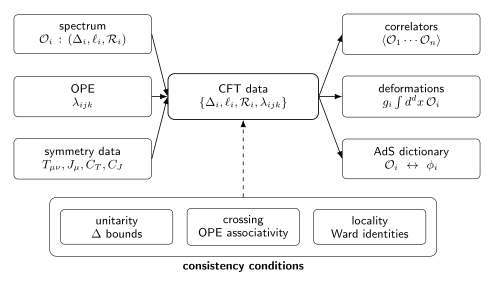
The basic CFT data consists of the primary spectrum , OPE coefficients , and symmetry data such as , conserved currents, and normalization constants . This data reconstructs separated-point correlators and relevant deformations, and it becomes the input for the AdS dictionary. Not every formal choice of numbers is allowed: unitarity, locality, Ward identities, and crossing symmetry impose strong consistency conditions.
The figure is not a definition by itself, but it captures the workflow of modern CFT. The theory is not primarily a list of fields in a Lagrangian. It is a consistent algebra of local observables.
Local operators and conformal primaries
Section titled “Local operators and conformal primaries”A CFT has infinitely many local operators. Even a free scalar theory contains
The conformal symmetry organizes these operators into families. Each family starts from a primary operator. Descendants are obtained by acting with translations, equivalently derivatives:
The primary is the irreducible seed. Descendants are not independent CFT data: their correlation functions are fixed by conformal symmetry once the primary data are known.
Thus the spectrum means the list
There are always some special entries:
The identity operator has
The stress tensor has
and a conserved current has
These dimensions are exact because conservation equations shorten the conformal multiplets:
Shortening is one of the cleanest ways symmetry protects operator dimensions.
Scaling dimensions are physical observables
Section titled “Scaling dimensions are physical observables”At an RG fixed point, a scalar local operator has a definite response to scale transformations:
up to possible mixing among degenerate operators. The number controls power laws. With the common scalar normalization
we can read directly from the falloff of the two-point function.
This is why anomalous dimensions are not a secondary detail in modern CFT. The full scaling dimension is the observable:
At an interacting fixed point, is generally part of the nonperturbative data of the theory.
Deformations are encoded by CFT data
Section titled “Deformations are encoded by CFT data”The RG relevance of a deformation is determined by the dimension of the operator being added to the CFT action:
Since the action is dimensionless, the coupling has dimension
Therefore:
At the Ising fixed point, the continuum description near criticality has the schematic form
The operators and are relevant if
The correlation-length exponent is related to by
The reason is that the temperature-like coupling has RG eigenvalue , while a coupling to an operator of dimension has RG eigenvalue
Similarly, the critical exponent is related to the spin-field dimension by
This is a good example of the CFT viewpoint replacing critical exponents by operator dimensions.
Two-point functions and normalization
Section titled “Two-point functions and normalization”For scalar primaries in a unitary CFT, one often chooses an orthonormal basis such that
This convention is useful, but it is not mandatory. If we rescale an operator by
then its two-point function and OPE coefficients change. The raw numerical value of is meaningful only after normalization conventions are fixed.
For spinning operators, the two-point function also contains tensor structures. A conserved current has the schematic form
up to convention-dependent overall factors.
The stress-tensor two-point function is similarly fixed up to one number, usually called :
where is fixed by conformal symmetry, conservation, and tracelessness.
The coefficient is an important measure of degrees of freedom. In holographic CFTs with an Einstein-like gravity dual, it scales as
up to a convention-dependent numerical factor.
Three-point functions and OPE coefficients
Section titled “Three-point functions and OPE coefficients”For scalar primaries, conformal symmetry fixes the position dependence of the three-point function:
where
The number is genuine dynamical data. Symmetry fixes the shape; dynamics fixes the coefficient.
For spinning operators, there can be several independent tensor structures. Then one writes schematically
where the allowed structures are fixed by conformal symmetry, spin, parity, and global symmetry, while the coefficients are CFT data.
The OPE as a multiplication table
Section titled “The OPE as a multiplication table”The operator product expansion says that when two local operators approach each other, their product can be expanded in local operators at one point:
This formula is schematic. The precise expression includes spin-dependent tensor structures and differential operators acting on descendants. The crucial point is that the descendant terms are fixed by conformal symmetry once the primary operator and coefficient are known.
Thus the primary OPE coefficients are the multiplication constants of the CFT operator algebra:
The identity contribution is especially important. In an orthonormal scalar basis,
Taking the vacuum expectation value reproduces the two-point function.
The OPE is not merely a vague asymptotic expansion. In Euclidean CFT, radial quantization gives a powerful reason for its convergence inside correlation functions whenever one operator insertion is closer to another than to the rest. This convergence property is what makes the bootstrap precise.
All correlators from CFT data
Section titled “All correlators from CFT data”Suppose we know the full spectrum and all OPE coefficients. Then, in principle, we can compute any local correlation function by repeatedly applying the OPE.
For a four-point function,
we can first fuse :
The four-point function becomes a sum over conformal families:
where is a conformal block. The block is fixed by symmetry. The coefficients and exchanged dimensions are the dynamical data.
But we could also fuse or . Equality of the different decompositions is crossing symmetry. Schematically,
This is the bootstrap equation. It says that the OPE must be associative.
Consistency conditions
Section titled “Consistency conditions”Not every formal list of dimensions and OPE coefficients defines a CFT. The data must satisfy strong consistency conditions.
The most important are:
- Conformal symmetry. Correlators must transform correctly under the conformal group.
- OPE associativity. Different OPE channels of the same correlator must agree.
- Unitarity or reflection positivity. In Euclidean signature, inner products obtained by reflection must be positive.
- Locality. Operator products must have the correct permutation and monodromy properties.
- Ward identities. Correlators involving and must implement spacetime and global symmetries.
- Anomaly matching. If the theory has ‘t Hooft anomalies or Weyl anomalies, they must be consistently represented in correlation functions and background-source dependence.
The conformal bootstrap takes this seriously: it studies the space of all possible CFT data obeying these constraints.
Special role of the stress tensor
Section titled “Special role of the stress tensor”The stress tensor is both an operator and a generator of symmetry. Its correlation functions encode universal information.
The Ward identity for translations schematically says
away from operator insertions, with contact terms at insertions. Those contact terms tell us that generates translations of local operators.
Likewise, the trace condition
is the flat-space statement of conformal invariance, up to anomalies and contact terms.
The stress-tensor OPE with a scalar primary has the schematic form
The detailed tensor expression will come later. For now the key lesson is this: once is part of the CFT data, its Ward identities know the dimensions and spins of all local operators.
Global symmetries and charged operators
Section titled “Global symmetries and charged operators”If the CFT has a global symmetry group , local operators fall into representations of :
The OPE must respect symmetry selection rules. If
then only operators in representations contained in the tensor product may appear:
For example, if a theory has a symmetry and is odd while is even, then
while
This is how symmetry reduces the space of possible OPEs.
Continuous global symmetries come with conserved currents . Their Ward identities determine how charged operators transform. Their two-point coefficient is a CFT observable and, in holography, is related to the bulk gauge coupling.
Large- CFT data
Section titled “Large-NNN CFT data”For AdS/CFT, an especially important class of CFTs has a large parameter and a sparse low-dimension spectrum. The basic pattern is
for suitably normalized single-trace operators in a gauge-theory-like large- limit. Connected -point functions are suppressed by powers of .
This factorization makes the boundary theory look like a weakly coupled bulk theory. A single-trace primary corresponds to a single-particle bulk field. Multi-trace operators correspond to multi-particle states.
The CFT data then have a bulk interpretation:
For a scalar field in AdS, the mass-dimension relation is
This is the first hard dictionary entry. The boundary scaling dimension is the bulk mass in AdS units.
CFT data in two dimensions
Section titled “CFT data in two dimensions”Two-dimensional CFT has extra structure because local conformal transformations form two copies of the Virasoro algebra. The spectrum is often organized by left and right conformal weights:
The stress tensor splits into holomorphic and antiholomorphic components:
with central charges
In rational CFT, the number of primary fields under an extended chiral algebra can be finite. Then additional data such as fusion rules, modular and matrices, and torus partition functions become central.
For this AdS/CFT-oriented course, two-dimensional CFT is important for three reasons. It gives exact examples where the operator-algebra philosophy can be solved completely. It is the worldsheet language of perturbative string theory. And it is the boundary language of AdS/CFT, where Virasoro symmetry and modular invariance are exceptionally powerful.
But the general idea remains the same: the theory is specified by spectra, operator products, symmetries, and consistency.
Examples
Section titled “Examples”The two-dimensional Ising CFT has three Virasoro primaries:
with
and central charge
The fusion rules are
Together with OPE coefficients and Virasoro symmetry, this data determines the local correlators of the model.
The canonical AdS/CFT example is four-dimensional super-Yang-Mills theory. Its CFT data depend on and the exactly marginal ‘t Hooft coupling
Protected BPS operators have dimensions fixed by representation theory. Unprotected operators have dimensions that depend on . At large and large , the data organize into weakly curved type IIB string theory on
What is not independent data?
Section titled “What is not independent data?”It is useful to separate independent data from derived data.
Descendants are not independent once primary data are known. Their dimensions are fixed:
Their OPE contributions are fixed by conformal symmetry in terms of primary OPE coefficients.
Two- and three-point coordinate dependence is not independent. Conformal symmetry fixes it, up to finite sets of constants and tensor structures.
Many Ward-identity coefficients are not independent. The stress tensor generates translations and conformal transformations, so its coupling to operators is constrained by their dimensions and spins.
The microscopic regulator is not CFT data. Two different lattice models may have the same continuum CFT data. Conversely, the same CFT may admit several different UV descriptions.
The Lagrangian is not fundamental CFT data either. It may be a beautiful and useful way of defining the theory, but the CFT itself is the equivalence class of local correlation functions satisfying the conformal axioms and consistency conditions.
AdS/CFT checkpoint
Section titled “AdS/CFT checkpoint”The CFT data are the boundary form of the bulk theory:
This is the conceptual transition from RG fixed points to holography: the boundary CFT data are the nonperturbative definition of the AdS quantum gravity theory.
Common pitfalls
Section titled “Common pitfalls”Pitfall 1: thinking the spectrum alone defines the CFT. The spectrum is not enough. Two theories can have the same operator dimensions but different OPE coefficients. Dynamics lives in the OPE.
Pitfall 2: forgetting normalization conventions. Numbers like depend on the normalization of operators. Before comparing OPE coefficients, fix the two-point functions.
Pitfall 3: treating descendants as independent. Descendants are part of conformal multiplets. Once a primary and its OPE coefficient are known, conformal symmetry fixes the descendant contributions to conformal blocks.
Pitfall 4: assuming all marginal operators are exactly marginal. An operator with is marginal at the fixed point. It may be marginally relevant or marginally irrelevant once conformal perturbation theory is included. Exactly marginal operators are special and generate conformal manifolds.
Pitfall 5: confusing boundary global symmetry with bulk global symmetry. In AdS/CFT, a global symmetry of the boundary CFT corresponds to a gauge symmetry in the bulk. The CFT current is dual to a bulk gauge field.
Summary
Section titled “Summary”A CFT is most efficiently specified by its operator algebra. The basic data are
Two-point functions define the operator metric. Three-point coefficients define the OPE. Higher-point functions are reconstructed by repeated OPEs and decomposed into conformal blocks:
Different OPE channels must agree. This is crossing symmetry, or associativity of the operator algebra.
For AdS/CFT, the same data are bulk physics:
The next module begins the systematic study of conformal symmetry in dimensions. We will derive the conformal group, its generators, and its relationship to the isometry group of AdS.
Exercises
Section titled “Exercises”Exercise 1: Dimension of a coupling
Section titled “Exercise 1: Dimension of a coupling”Let be a scalar primary of dimension , and deform the CFT by
Find the engineering dimension of and classify the deformation as relevant, marginal, or irrelevant.
Solution
The action is dimensionless. Since
the coupling must have dimension
Therefore is relevant, is marginal, and is irrelevant.
Exercise 2: Identity term in the OPE
Section titled “Exercise 2: Identity term in the OPE”Suppose a scalar primary is normalized by
Show that the identity contribution in the OPE must be
Solution
Take the vacuum expectation value of the OPE. Since , and one-point functions of non-identity primaries vanish in flat space when not allowed by symmetries, the leading identity term must reproduce the two-point function:
Thus the identity coefficient is fixed by the two-point normalization.
Exercise 3: OPE coefficient from a three-point function
Section titled “Exercise 3: OPE coefficient from a three-point function”Assume scalar primaries are orthonormal:
Use the OPE
to recover the leading behavior of
Solution
Insert the OPE into the three-point function:
Using orthonormality,
Thus
This matches the short-distance limit of the conformal three-point function.
Exercise 4: Crossing for identical scalars
Section titled “Exercise 4: Crossing for identical scalars”For identical scalar primaries of dimension , define
Show that exchanging implies
Solution
Under , the cross-ratios exchange:
The same four-point function can be written as
Equating this with the original expression gives
or equivalently
Exercise 5: Scalar mass in AdS
Section titled “Exercise 5: Scalar mass in AdS”A scalar primary in a -dimensional CFT is dual to a scalar field in AdS with
For which range of is ? Does a negative automatically mean an instability?
Solution
The product is negative when
So scalar operators with dimensions in this range correspond to bulk scalars with negative mass squared.
A negative in AdS does not automatically imply an instability. AdS has the Breitenlohner-Freedman stability bound
Using
we see that any real automatically satisfies the bound. The minimum occurs at .