
Momentum Relaxation and Strange-Metal Transport
The main idea
Section titled “The main idea”At finite density, electric current can carry momentum. If the theory is translationally invariant, momentum cannot decay. A constant electric field then accelerates the charged fluid forever, so the DC conductivity is infinite even when the microscopic dynamics is strongly interacting.
This is the first lesson of finite-density transport:
unless the electric current has no overlap with momentum. To model an ordinary material, one must give momentum somewhere to go: a lattice, impurities, disorder, umklapp, a pinned density wave, or an explicit translation-breaking source. Holographically, this means that the bulk theory must break boundary spatial translations.
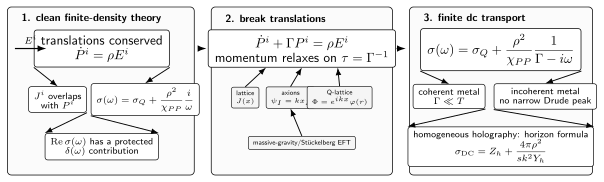
At finite density, current overlaps with momentum. If is conserved, the optical conductivity contains a protected zero-frequency contribution. Translation-breaking sources introduce a relaxation rate and replace the pole by a Drude-like factor. Homogeneous holographic models such as linear axions and Q-lattices keep the bulk geometry solvable by ODEs while producing finite DC conductivities determined by horizon data.
The central hydrodynamic formula is
Here is the charge density, is the static momentum susceptibility, and is the momentum relaxation rate. For a relativistic CFT,
The term proportional to is the part of the electric current that moves by dragging the total momentum. The term is the incoherent conductivity: the part of charge transport that does not require momentum flow.
This page explains three related ideas:
- why translation-invariant finite-density theories have infinite DC conductivity;
- how holography breaks translations while keeping calculations controlled;
- how these models are used, carefully, in discussions of strange-metal transport.
Why conserved momentum makes infinite
Section titled “Why conserved momentum makes σDC\sigma_{\mathrm{DC}}σDC infinite”The Kubo formula for the electrical conductivity is
up to contact terms and convention-dependent diamagnetic pieces. The important point is not the precise contact convention. It is the existence of a protected low-frequency contribution when overlaps with a conserved operator.
At finite density, a boost of the fluid produces both momentum and electric current. In relativistic hydrodynamics,
where is the local velocity and is the part of the current not tied to the fluid velocity. Thus
If is exactly conserved, an electric field accelerates the fluid:
In frequency space,
so the convective contribution to the current is
Therefore
Using
the real part contains a delta function:
This is not a weak-coupling statement. It is a consequence of symmetry and finite density. Interactions can rapidly degrade quasiparticles, but if the total momentum is conserved and the current overlaps with momentum, the DC conductivity is still infinite.
This is why translation breaking is not a decorative complication in finite-density holography. It is necessary if the goal is to model ordinary finite resistivity.
The incoherent current
Section titled “The incoherent current”The convective part of the current is not the whole story. Define the current component orthogonal to momentum by
It has no static overlap with momentum:
The conductivity associated with this current can remain finite even in a perfectly clean system. This is the quantity often denoted in relativistic hydrodynamics. It measures charge diffusion in the local rest frame of the fluid.
A particularly clean example occurs at particle-hole symmetry. If
then the electric current does not overlap with momentum, and the conductivity can be finite even without momentum relaxation. At nonzero density, however, the convective part normally dominates the low-frequency DC response unless momentum relaxes.
This separation is conceptually important:
| Quantity | Physical meaning |
|---|---|
| coherent momentum-drag contribution | |
| incoherent charge diffusion contribution | |
| rate at which total momentum relaxes | |
| inertia of the charged fluid | |
| current combination orthogonal to momentum |
In a clean strongly coupled finite-density CFT, is a genuine transport coefficient, but it is not the full DC conductivity. The full DC conductivity is infinite because the fluid can move without friction.
Slow momentum relaxation: hydrodynamics with
Section titled “Slow momentum relaxation: hydrodynamics with Γ\GammaΓ”Suppose translations are weakly broken. Momentum is no longer exactly conserved, but it is long-lived. The simplest effective equation is
Solving in frequency space gives
Thus
At zero frequency,
This is a Drude formula, but it is not necessarily a quasiparticle formula. The long-lived object is total momentum, not an electron quasiparticle. A strongly interacting fluid with no quasiparticles can still have a narrow Drude peak if translations are only weakly broken.
The distinction is useful:
| Regime | Condition | Optical conductivity |
|---|---|---|
| clean finite-density fluid | delta function at | |
| coherent metal | narrow Drude peak | |
| incoherent metal | or larger | no sharp momentum peak |
| particle-hole symmetric plasma | finite even when clean |
The word coherent here means that momentum is a long-lived transport carrier. The word incoherent means that charge and heat flow mainly by diffusion of locally equilibrated densities rather than by the slow decay of momentum.
Translation breaking from Ward identities
Section titled “Translation breaking from Ward identities”In QFT, translations are generated by the stress tensor. If the action is deformed by a spacetime-dependent source,
then the stress tensor Ward identity becomes
For spatially homogeneous sources , translations remain unbroken. For spatially dependent sources , momentum is not conserved. The external sources can absorb momentum.
A periodic lattice source has the schematic form
A disordered source is a random function . Umklapp in a microscopic lattice also relaxes continuum momentum because momentum is conserved only modulo a reciprocal lattice vector. In holography, the cleanest implementation depends on how hard a gravitational boundary value problem one is willing to solve.
Holographic mechanisms for momentum relaxation
Section titled “Holographic mechanisms for momentum relaxation”There are several common holographic ways to break translations. They differ in physical realism, calculational complexity, and microscopic interpretation.
| Mechanism | Boundary interpretation | Bulk advantage | Main warning |
|---|---|---|---|
| explicit lattice | periodic source | most literal | usually PDEs |
| disorder | random spatial source | closer to impurities | hard numerically and statistically |
| Q-lattice | spatial phase of a complex scalar | ODEs from internal symmetry | homogeneous trick, not a literal ionic lattice |
| linear axions | scalar sources | analytic homogeneous black branes | very coarse effective translation breaking |
| massive gravity | graviton mass/Stückelberg fields | simple effective momentum relaxation | microscopic dual may be obscure |
| probe-brane disorder or impurities | flavor-sector momentum loss | useful in probe limits | often neglects full backreaction |
The fundamental problem is that a generic lattice makes the bulk solution inhomogeneous. For example, if a boundary source depends on , the metric, gauge field, and matter fields typically depend on both the radial coordinate and :
One then must solve coupled nonlinear PDEs. This is possible and important, but it is not the simplest way to build intuition.
Homogeneous translation-breaking models exploit a loophole. They break translations in the boundary theory, but preserve enough combined symmetry that the bulk stress tensor is homogeneous. The background equations reduce to ODEs in the radial coordinate.
Linear axion models
Section titled “Linear axion models”The simplest homogeneous model uses massless neutral scalar fields. In a bulk theory with boundary spatial directions, introduce scalars
with the background profile
The source is spatially dependent, so translations are explicitly broken. But the stress tensor built from gradients is homogeneous:
A common Einstein-Maxwell-axion model is
Here is often a neutral dilaton. The simplest case has constant and and no running scalar. A standard homogeneous ansatz is
The parameter controls the strength of explicit translation breaking. It is not always identical to the momentum relaxation rate . In weak breaking one often finds
but at strong breaking the notion of a single relaxation rate may cease to be useful.
Why the axion model is so useful
Section titled “Why the axion model is so useful”The linear axion model is popular because it combines three features that rarely coexist:
- it explicitly breaks translations;
- it keeps the background homogeneous and isotropic;
- it often gives analytic DC transport formulas.
For a large class of Einstein-Maxwell-dilaton-axion theories, the DC conductivities are determined entirely by horizon data. In a common convention for isotropic boundary theories,
Here
and is the scalar value at the horizon. The entropy density is the horizon area density divided by .
The thermal conductivity at zero electric current is
The two terms in have distinct meanings:
In the simplest four-dimensional bulk model with , this reduces schematically to
in standard units. The constant term is the particle-hole symmetric contribution. The second term becomes large when momentum relaxation is weak.
How horizon DC formulas work
Section titled “How horizon DC formulas work”DC transport in black-hole backgrounds has a special simplification. To compute , one applies a constant boundary electric field and studies time-independent linearized perturbations that are regular at the future horizon. The bulk Maxwell equation implies the existence of a radially conserved electric flux,
where the dots denote possible mixing with metric and matter perturbations. Since
at zero frequency and zero spatial momentum, the boundary current can be evaluated at the horizon:
The horizon regularity condition then relates to the applied electric field and temperature gradient . This yields DC conductivities without solving the full radial perturbation problem.
For fully inhomogeneous holographic lattices, the same idea generalizes: the DC conductivities are found by solving forced Stokes equations on the black-hole horizon. The homogeneous axion formula is the simplest avatar of a broader principle:
This does not mean AC transport is trivial. Optical conductivity at finite requires solving the radial fluctuation equations with infalling boundary conditions, exactly as in the previous module.
Q-lattices
Section titled “Q-lattices”A Q-lattice uses a complex scalar field with a spatially dependent phase:
If the bulk action has a global symmetry
then the explicit -dependence can be absorbed into the internal phase. The stress tensor depends on and derivatives in a way that keeps the background homogeneous. Again, the gravitational problem reduces to ODEs.
The boundary interpretation is a spatially modulated source for a scalar operator. The modulation wave number is , and the amplitude is controlled by the leading near-boundary coefficient of . Q-lattices are useful for constructing holographic metallic and insulating phases because the lattice deformation can become relevant or irrelevant in the IR.
The essential lesson is not that real crystals are Q-lattices. It is that Q-lattices give a controlled way to study finite-density transport without a protected momentum delta function.
Massive gravity and Stückelberg language
Section titled “Massive gravity and Stückelberg language”Another effective approach gives the graviton a mass in the spatial directions. In the boundary theory, a massless bulk graviton is tied to conservation of the boundary stress tensor. If the graviton acquires suitable spatial mass terms, the dual stress tensor no longer has conserved momentum.
A more transparent version introduces Stückelberg scalar fields,
which is closely related to the linear axion construction. In this language, the graviton mass comes from spatial scalar profiles. The lesson is that massive-gravity models are often effective descriptions of homogeneous translation breaking.
One should be cautious: not every massive-gravity action has a clean microscopic CFT dual. But as low-energy effective holographic models, they are valuable because they isolate the role of momentum relaxation.
Weak lattices and the memory-matrix formula
Section titled “Weak lattices and the memory-matrix formula”When translations are weakly broken by a small periodic source,
momentum relaxation can be computed in perturbation theory around the translation-invariant theory. A memory-matrix estimate gives the schematic scaling
This formula is extremely useful conceptually. It says that momentum relaxation is efficient only if the clean theory has low-energy spectral weight at the lattice wavevector .
For a conventional Fermi liquid, finite-momentum low-energy spectral weight is controlled by the Fermi surface and leads to familiar powers of temperature. For a locally critical holographic IR region, such as an throat, momenta do not scale but frequencies do. The finite- spectral density can then remain important at low energies, leading to nontrivial power laws for resistivity.
This is one route by which holography can produce strange-metal-like power-law transport. The logic is:
But the exponent is model-dependent. Holography gives controlled examples, not a universal explanation of all strange metals.
Coherent versus incoherent metals
Section titled “Coherent versus incoherent metals”A clean finite-density fluid has a delta function in . Weak translation breaking broadens it into a narrow peak:
This is the coherent regime. The low-frequency current is mostly the motion of the conserved densities.
As translation breaking becomes strong, the peak may disappear. Then there is no useful separation between a narrow momentum mode and the rest of the spectrum. Transport is governed by diffusion of charge and energy, by IR critical scaling, and by horizon data. This is the incoherent regime.
A useful diagnostic is the optical conductivity:
| Optical feature | Interpretation |
|---|---|
| sharp Drude peak | momentum is long-lived |
| broad low-frequency bump | intermediate relaxation |
| featureless low-frequency response | strongly incoherent transport |
| scaling | possible quantum critical control |
| hard gap or suppressed low- weight | insulating or ordered response, depending on context |
The absence of a Drude peak does not automatically imply a strange metal. It only says that momentum is not a long-lived carrier of current. One must still identify the charge carriers, scaling regime, entropy, susceptibilities, and relaxation mechanisms.
Strange metals: what holography tries to capture
Section titled “Strange metals: what holography tries to capture”The phrase strange metal is used for metallic states whose transport is hard to explain using long-lived Landau quasiparticles. Common phenomenological features include large resistivity, broad optical conductivity, short relaxation times, and resistivity approximately linear in temperature over broad ranges.
Holography is attractive here because classical black holes naturally describe strongly interacting thermal states without quasiparticles. Horizons absorb perturbations. Transport is dissipative. Many holographic models produce relaxation times of order
in units with . Restoring units, this is the so-called Planckian scale
But this slogan needs discipline. A holographic model does not prove that every strange metal has a universal Planckian bound. Rather, it gives examples in which strong interactions and horizons make the only available local equilibration scale of order .
A modern holographic strange-metal model usually combines:
- finite charge density;
- an IR scaling geometry, often with dynamical exponent and hyperscaling violation exponent ;
- translation breaking by axions, a Q-lattice, disorder, or umklapp;
- horizon formulas for DC transport;
- careful matching between model parameters and field-theory observables.
In Einstein-Maxwell-dilaton-axion models, the couplings and can run in the IR. The DC conductivity
then acquires temperature dependence through the horizon value and entropy density . By choosing IR exponents and couplings, one can engineer many power laws:
The valuable part is not that any desired exponent can be engineered. That is also a warning. The valuable part is that holography gives a controlled strongly coupled framework in which one can ask which scaling laws follow from which IR fixed points and which translation-breaking deformations.
Metallic, insulating, and bad-metal behavior
Section titled “Metallic, insulating, and bad-metal behavior”A holographic metal is often diagnosed by the low-temperature behavior of its DC conductivity. Very roughly,
is metallic-like, while
is insulating-like. But this diagnostic is crude. A better analysis examines charge susceptibility, heat transport, entropy, optical spectral weight, and the IR geometry.
In holographic scaling models, an insulating phase may arise because the charge sector decouples in the IR, the lattice deformation becomes relevant, the horizon conductivity vanishes, or charge transport is suppressed by the geometry. A metallic phase may arise because charge remains mobile at the horizon, because an incoherent conductivity stays finite, or because momentum relaxation is weak.
The term bad metal refers to a metal whose resistivity exceeds what would be expected from quasiparticle mean-free-path reasoning. Since holographic models often lack quasiparticles from the outset, they naturally produce bad-metal-like transport. However, matching a holographic conductivity to a real material requires a choice of units, normalization, number of degrees of freedom, and microscopic current.
Momentum relaxation versus charge relaxation
Section titled “Momentum relaxation versus charge relaxation”Momentum relaxation does not mean charge relaxation. Charge is still conserved:
Energy is usually also conserved in a time-independent background:
What is broken is spatial momentum conservation:
This distinction matters because hydrodynamic modes change. In a clean charged fluid, one has sound modes controlled by energy and momentum conservation. With momentum relaxation, sound can cross over to diffusion or become a damped pseudo-hydrodynamic mode. At strong translation breaking, the late-time dynamics may be governed by charge and energy diffusion alone.
A minimal hydrodynamic pole structure is:
| Conservation law | Clean system | With momentum relaxation |
|---|---|---|
| charge | diffusion or coupled sound/charge modes | diffusion remains |
| energy | sound/heat modes | energy diffusion can dominate |
| momentum | hydrodynamic sound/shear | pole shifts by |
In holography, these poles are quasinormal modes. Momentum relaxation moves the hydrodynamic poles in the complex frequency plane and can create a crossover from propagating to diffusive behavior.
Spontaneous versus explicit translation breaking
Section titled “Spontaneous versus explicit translation breaking”Not all translation breaking produces finite DC resistivity by itself. If translations are broken spontaneously, as in a clean charge-density wave or crystal, total momentum may still be conserved. The system has phonons, and a uniform electric current can still drag the whole crystal unless there is also pinning, impurities, a lattice, or another explicit relaxation mechanism.
The distinction is:
| Breaking pattern | Momentum conservation | Transport consequence |
|---|---|---|
| explicit translations broken | not conserved | finite DC possible |
| spontaneous translations broken | conserved | phonons, but DC may remain infinite |
| weak explicit + spontaneous | pseudo-phonons | pinned collective mode |
| strong explicit breaking | no long-lived momentum | incoherent transport |
Holographic models of pinned density waves, helical lattices, and spatially modulated phases enrich this story, but the basic lesson is simple: a finite DC resistivity requires an explicit sink for momentum or a situation where the electric current has no momentum overlap.
What is universal?
Section titled “What is universal?”Some statements are robust:
- At finite density, conserved momentum produces an infinite DC conductivity if overlaps with .
- Weak momentum relaxation broadens the protected pole into a Drude-like peak.
- The incoherent current orthogonal to momentum can have finite conductivity even in a clean theory.
- In many two-derivative holographic theories, DC conductivities can be expressed in terms of horizon data.
Other statements are model-dependent:
- whether the resistivity is linear in ;
- whether the phase is metallic or insulating;
- whether optical conductivity shows a power law;
- whether a proposed Planckian time controls the measured conductivity;
- whether a bottom-up translation-breaking model has a UV-complete string embedding.
This distinction is crucial for using holography honestly. The strongest conclusions are symmetry and hydrodynamic statements. The most phenomenological conclusions require explicit model assumptions.
A practical workflow
Section titled “A practical workflow”When computing a holographic finite-density conductivity with momentum relaxation, use the following checklist.
Step 1: Identify the conserved quantities
Section titled “Step 1: Identify the conserved quantities”Ask which of the following are conserved:
If momentum is conserved and , expect a delta function in .
Step 2: Identify the translation-breaking source
Section titled “Step 2: Identify the translation-breaking source”Is the source explicit or spontaneous? Is it homogeneous in the bulk? Is it periodic, random, linear, helical, or Q-lattice-like?
For axions,
For a Q-lattice,
For a literal lattice,
and the bulk solution is usually inhomogeneous.
Step 3: Choose the ensemble
Section titled “Step 3: Choose the ensemble”Finite-density transport depends on whether one fixes charge density or chemical potential. For thermoelectric transport, state the convention for
The physical thermal conductivity at zero electric current is
Step 4: For DC transport, look for radially conserved fluxes
Section titled “Step 4: For DC transport, look for radially conserved fluxes”At , the Maxwell and Einstein equations often imply conserved radial quantities. Evaluate them at the horizon using regularity.
Step 5: For AC transport, solve the fluctuation equations
Section titled “Step 5: For AC transport, solve the fluctuation equations”At finite , impose infalling boundary conditions at the horizon and extract the source and response at the boundary. Momentum relaxation couples gauge, metric, and scalar perturbations, so gauge-invariant variables are often helpful.
Step 6: Interpret the result hydrodynamically
Section titled “Step 6: Interpret the result hydrodynamically”Ask whether the low-frequency response is coherent:
or incoherent:
Do not call every finite conductivity a strange metal. First identify the scaling regime and the mechanism that controls the relaxation.
Common mistakes
Section titled “Common mistakes”Mistake 1: forgetting the momentum delta function
Section titled “Mistake 1: forgetting the momentum delta function”A finite-density translation-invariant holographic black brane usually has infinite DC conductivity. A finite value obtained by numerics may be an artifact of taking limits incorrectly, omitting the metric perturbation, or confusing with the full conductivity.
Mistake 2: treating and as identical
Section titled “Mistake 2: treating kkk and Γ\GammaΓ as identical”In linear axion models, is the source strength or wave number of translation breaking. The relaxation rate is a physical pole location. For weak breaking, is often proportional to , but at strong breaking there may be no single narrow relaxation pole.
Mistake 3: calling homogeneous axions a literal lattice
Section titled “Mistake 3: calling homogeneous axions a literal lattice”The source breaks translations, but it is not a periodic ionic lattice. It is a homogeneous effective way to relax momentum.
Mistake 4: ignoring thermoelectric mixing
Section titled “Mistake 4: ignoring thermoelectric mixing”At finite density, electric, heat, and momentum transport mix. The measured thermal conductivity depends on whether the electric current is set to zero.
Mistake 5: overclaiming Planckian universality
Section titled “Mistake 5: overclaiming Planckian universality”Holography often produces timescales of order , but a model-specific relaxation time is not automatically a universal bound for all materials.
Exercises
Section titled “Exercises”Exercise 1: The conductivity delta function
Section titled “Exercise 1: The conductivity delta function”Assume a clean relativistic finite-density fluid with
and
Derive the pole in and show that contains a delta function.
Solution
Fourier transforming the momentum equation gives
so
The convective current is therefore
Thus
Using
one obtains
The delta function is protected by momentum conservation.
Exercise 2: Drude peak from momentum relaxation
Section titled “Exercise 2: Drude peak from momentum relaxation”Now replace momentum conservation by
Show that
Solution
In frequency space,
so
The current is
If the incoherent part contributes , then
Taking gives
Exercise 3: Why linear axions are homogeneous
Section titled “Exercise 3: Why linear axions are homogeneous”Consider two scalar fields in a -dimensional boundary theory with sources
Show why translations are broken, but the scalar contribution to the bulk stress tensor can remain homogeneous and isotropic.
Solution
The sources depend explicitly on spatial coordinates, so under a boundary translation the source values change:
Thus translations are explicitly broken by the sources.
However, the stress tensor of shift-symmetric massless scalars depends on derivatives, not on the absolute values of . The gradients are constants:
Therefore scalar invariants such as
are independent of and rotationally invariant. The boundary sources break translations, but the bulk stress tensor sourcing the background geometry is homogeneous and isotropic.
Exercise 4: Interpreting the axion DC formula
Section titled “Exercise 4: Interpreting the axion DC formula”For a simple isotropic axion model, suppose
Explain the behavior at , at weak translation breaking , and at strong translation breaking.
Solution
At ,
This is the incoherent or particle-hole symmetric contribution. It does not require momentum drag.
At weak translation breaking, with , the second term diverges:
This reproduces the infinite DC conductivity of the translation-invariant finite-density system.
At strong translation breaking, the second term can become small, and the conductivity may be controlled by and the IR behavior of the couplings. In that regime the response need not have a narrow Drude peak, so interpreting as a simple relaxation rate can be misleading.
Exercise 5: Source strength versus relaxation rate
Section titled “Exercise 5: Source strength versus relaxation rate”A linear axion model has parameter . Explain why is not always the same as the physical momentum relaxation rate .
Solution
The parameter appears in the boundary source:
It measures the strength or gradient of explicit translation breaking. The physical relaxation rate is extracted from a pole of a retarded Green function, for example from the low-frequency conductivity:
For weak translation breaking, perturbation theory or hydrodynamics often gives
At stronger breaking, there may be no isolated Drude pole, so no unique controls the response. Thus is a Lagrangian/source parameter, while is an emergent dynamical quantity.
Further reading
Section titled “Further reading”- S. A. Hartnoll, Lectures on holographic methods for condensed matter physics, arXiv:0903.3246.
- S. A. Hartnoll and D. M. Hofman, Locally critical umklapp scattering and holography, arXiv:1201.3917.
- G. T. Horowitz, J. E. Santos, and D. Tong, Optical Conductivity with Holographic Lattices, arXiv:1204.0519.
- D. Vegh, Holography without translational symmetry, arXiv:1301.0537.
- M. Blake and D. Tong, Universal Resistivity from Holographic Massive Gravity, arXiv:1308.4970.
- A. Donos and J. P. Gauntlett, Holographic Q-lattices, arXiv:1311.3292.
- T. Andrade and B. Withers, A simple holographic model of momentum relaxation, arXiv:1311.5157.
- A. Donos and J. P. Gauntlett, Thermoelectric DC conductivities from black hole horizons, arXiv:1406.4742.
- R. A. Davison and B. Goutéraux, Momentum dissipation and effective theories of coherent and incoherent transport, arXiv:1411.1062.
- R. A. Davison, B. Goutéraux, and S. A. Hartnoll, Incoherent transport in clean quantum critical metals, arXiv:1507.07137.