
Closed Superstring Sectors and Type II Theories
The open superstring taught us how the NS and R sectors combine with the GSO projection to produce a supersymmetric spectrum. A closed superstring has two independent chiral halves, so the Hilbert space is a tensor product
Each side may be NS or R. Before imposing the final GSO choice, this gives four sectors:
The first and last sectors are spacetime bosonic; the mixed sectors are spacetime fermionic. Type IIA and Type IIB differ only in how the two Ramond chiralities are chosen.
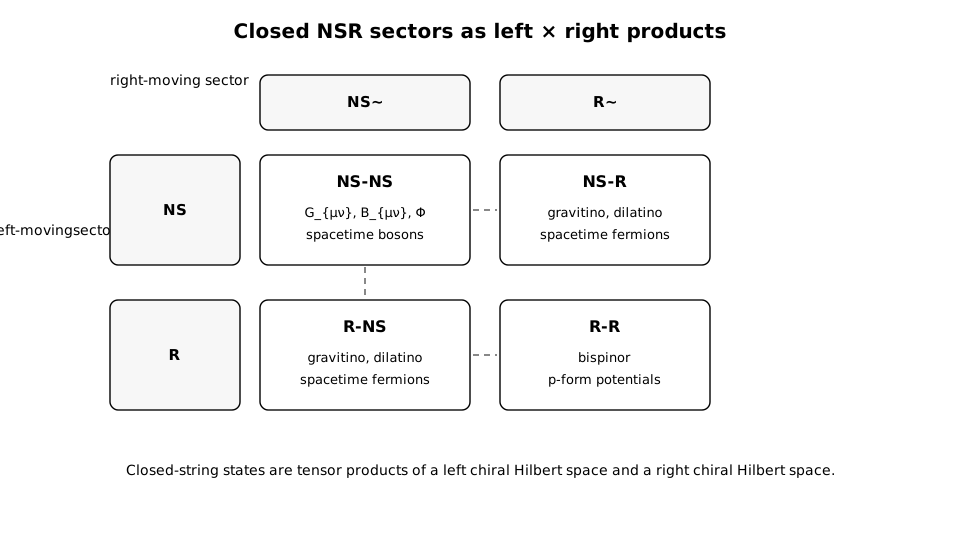
A closed NSR state is a tensor product of a left-moving state and a right-moving state. The four sectors are NS-NS, NS-R, R-NS, and R-R.
Mass formula and level matching
Section titled “Mass formula and level matching”Let and . For a closed string, the physical conditions include
and the positive-mode constraints
together with the corresponding supercurrent constraints in the NS or R sector. Since
we get
Thus there are two requirements:
The second equation is level matching. It says that the left and right chiral excitations must carry equal worldsheet energy after the zero-point shifts are included.
For example, in the NS-NS sector the massless level is
and a representative state is
The NS-NS sector: , , and
Section titled “The NS-NS sector: GμνG_{\mu\nu}Gμν, BμνB_{\mu\nu}Bμν, and Φ\PhiΦ”The NS-NS polarization tensor decomposes into irreducible spacetime fields:
where denotes the transverse projector. These three pieces are interpreted as
and
So every Type II theory contains the same NS-NS massless fields:
Here is the spacetime metric, is the antisymmetric two-form gauge field, and is the dilaton. At low energies these are the fields of the NS-NS sector of ten-dimensional supergravity.
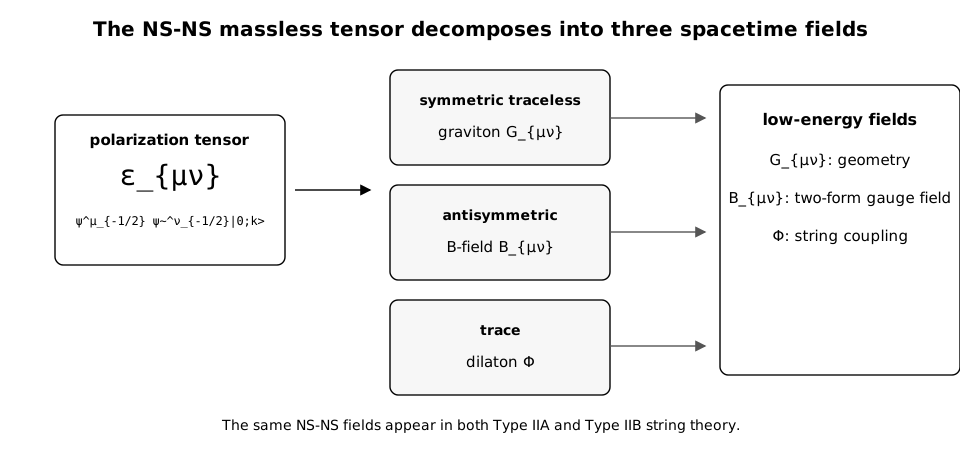
The massless NS-NS tensor splits into a symmetric traceless graviton, an antisymmetric two-form, and a scalar dilaton.
The gauge redundancies are the linearized versions of spacetime gauge symmetries:
and
The first is linearized diffeomorphism invariance; the second is the gauge symmetry of a two-form potential.
The mixed sectors: gravitini and dilatini
Section titled “The mixed sectors: gravitini and dilatini”The NS-R and R-NS sectors contain spacetime fermions. Schematically, a massless NS-R state has the form
and a massless R-NS state is obtained by exchanging left and right. These are vector-spinor states. The physical constraints remove unphysical components and split the result into gravitini and dilatini.
In field-theory language, the mixed sectors provide the fermionic superpartners of the NS-NS and R-R bosons. Type II strings have real spacetime supercharges, twice as many as the open Type I superstring.
The R-R sector: bispinors become forms
Section titled “The R-R sector: bispinors become forms”The R-R ground state is a tensor product of two spinor ground states,
Thus a general R-R polarization is a bispinor . Gamma matrices translate this bispinor into a sum of antisymmetric tensors:
The massless Dirac equations on the left and right imply the free equations for these differential forms,
with the appropriate self-duality condition in Type IIB.
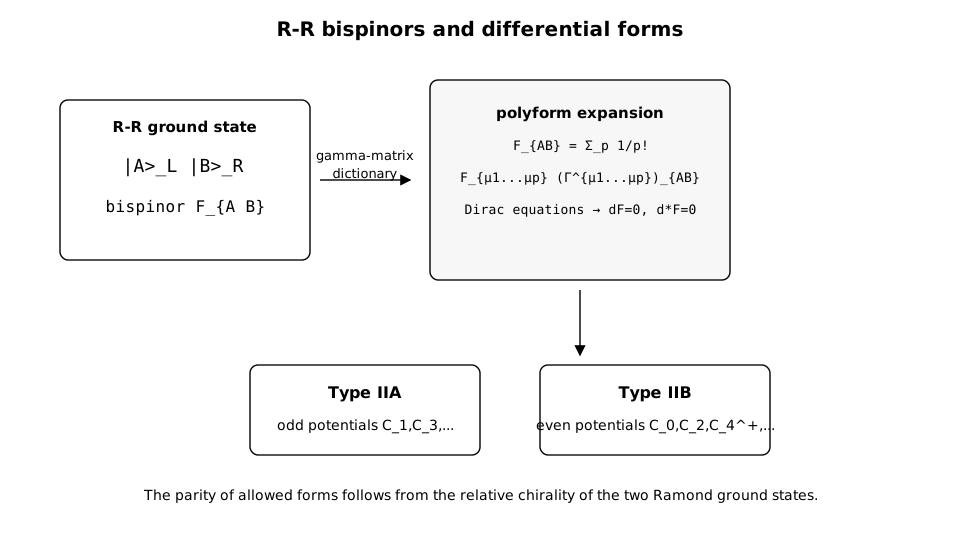
The R-R sector naturally produces a polyform. The chirality of the two Ramond ground states determines which form degrees are allowed.
It is often cleaner to discuss R-R field strengths in the worldsheet vertex-operator language and R-R potentials in the spacetime effective action. D-branes couple electrically to the potentials ; this is why R-R forms will become central in the D-brane section.
Type IIA versus Type IIB
Section titled “Type IIA versus Type IIB”The NS projection is the same in Type IIA and Type IIB: it removes the NS tachyon and keeps the massless NS excitation. The distinction is the relative chirality of the two Ramond ground states.
In a common convention,
while
Equivalently, Type IIA has opposite left/right Ramond chiralities, while Type IIB has the same left/right Ramond chirality. Reversing every chirality label changes notation but not the physics.
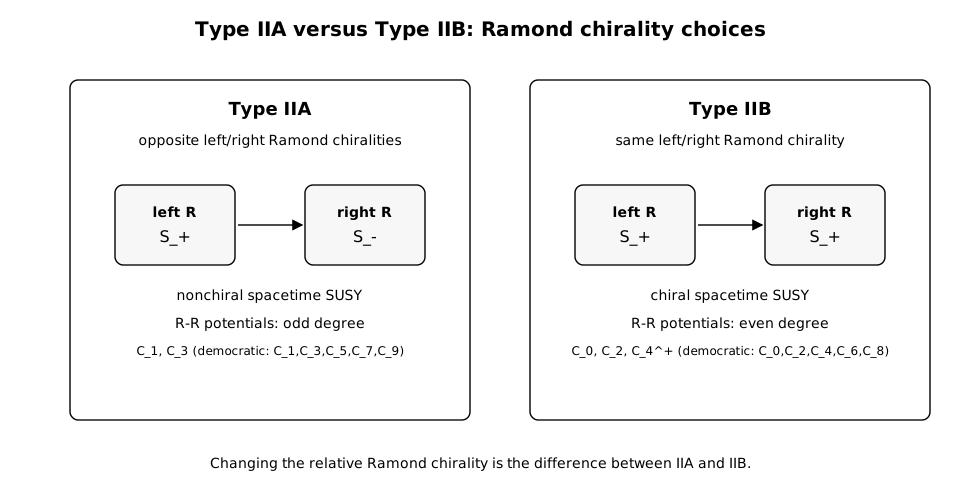
The relative chirality of the two Ramond sectors distinguishes Type IIA from Type IIB.
The consequences are substantial:
The R-R potentials also have different degrees:
whereas
The superscript on is a reminder that its field strength is self-dual:
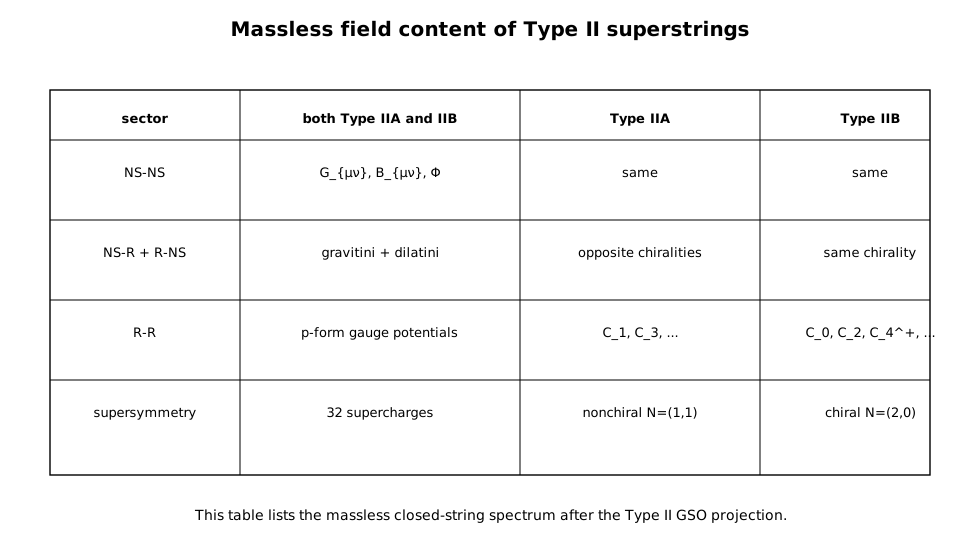
Type IIA and Type IIB share the same NS-NS fields but differ in fermion chiralities and R-R form degrees.
Strong-coupling preview: Type IIA and eleven dimensions
Section titled “Strong-coupling preview: Type IIA and eleven dimensions”The nonchiral structure of Type IIA is not an accident. At strong coupling, Type IIA develops an extra circular dimension. The relation is schematically
so the eleventh dimension is invisible at weak coupling and opens up as grows. This is the first hint of M-theory. In this course the main use of the statement is conceptual: Type IIA is naturally connected to an eleven-dimensional theory, while Type IIB is chiral and behaves differently.
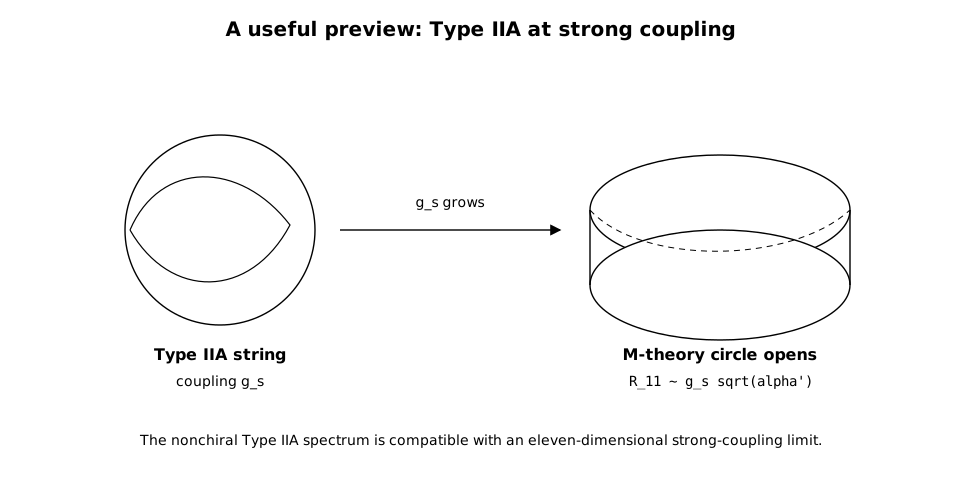
The strong-coupling limit of Type IIA is naturally interpreted as an eleven-dimensional limit with circle radius proportional to .
Exercises
Section titled “Exercises”Exercise 1. Level matching in the NS-R sector
Section titled “Exercise 1. Level matching in the NS-R sector”Show that a massless NS-R state must have on the NS side and on the R side, assuming and .
Solution
The closed-string mass formula is
For an NS-R state, and . Masslessness means , so
Thus
The left state has one NS fermion oscillator , while the right state is a Ramond ground state.
Exercise 2. Counting the NS-NS decomposition
Section titled “Exercise 2. Counting the NS-NS decomposition”In light-cone gauge, the NS-NS massless polarizations transform as under the little group . Decompose this tensor product into symmetric traceless, antisymmetric, and trace parts, and count dimensions.
Solution
The tensor product has dimension
The symmetric part has dimension
Removing one trace gives the symmetric traceless part of dimension
The antisymmetric part has dimension
The trace has dimension . Hence
These are the graviton, -field, and dilaton polarizations.
Exercise 3. Why Type IIB is chiral
Section titled “Exercise 3. Why Type IIB is chiral”Explain why taking the same Ramond chirality on the left and right gives a chiral ten-dimensional theory, while taking opposite chiralities gives a nonchiral theory.
Solution
The spacetime supersymmetry charges come from the Ramond sectors. If the two Ramond sectors have the same ten-dimensional chirality, then the two supersymmetry generators have the same chirality. This is a chiral theory: it treats the two ten-dimensional spinor chiralities asymmetrically.
If the two Ramond sectors have opposite chirality, then the supersymmetry generators come in opposite-chirality pairs. The theory is nonchiral. This is the Type IIA case.
Exercise 4. R-R potentials and D-brane dimensions
Section titled “Exercise 4. R-R potentials and D-brane dimensions”Using the fact that a D-brane couples electrically to , determine which D-brane dimensions are allowed in Type IIA and Type IIB from the R-R potential degrees listed above.
Solution
Type IIA has odd-degree R-R potentials,
Since a D-brane couples to , we get
so
Type IIB has even-degree R-R potentials,
The electrically coupled D-branes have
so
and the potential is naturally associated with the D instanton.
Exercise 5. The self-dual five-form
Section titled “Exercise 5. The self-dual five-form”Why can Type IIB not have a standard covariant action with an unconstrained five-form field strength ?
Solution
The Type IIB five-form field strength satisfies the self-duality constraint
A conventional kinetic term would have the schematic form
But if is self-dual, the equations obtained from an unconstrained variation would double the degrees of freedom. The usual supergravity treatment either imposes self-duality after deriving equations from a pseudo-action, or uses a more elaborate formalism that incorporates the constraint directly.