
Entanglement Entropy in QFT
The main idea
Section titled “The main idea”Entanglement entropy is the entropy of a region, not the entropy of a whole closed system. Given a quantum state on a spatial slice and a subregion , we trace out the complement and ask how mixed the remaining state is:
This definition is almost embarrassingly simple. The surprise is what it becomes in quantum field theory. Even the vacuum state has enormous entanglement between degrees of freedom on opposite sides of the entangling surface . Because arbitrarily short-distance modes exist in a continuum QFT, is UV divergent. With a cutoff , the leading term for a smooth region in a CFT is schematically
Here is the spacetime dimension of the boundary CFT, so has dimension . The coefficients of power-law divergences are not universal; they depend on the regulator. The universal term is the part that survives changes of short-distance scheme: a logarithmic coefficient in even-dimensional CFTs, a finite constant in some odd-dimensional cases, or a shape-dependent finite observable after suitable subtraction.
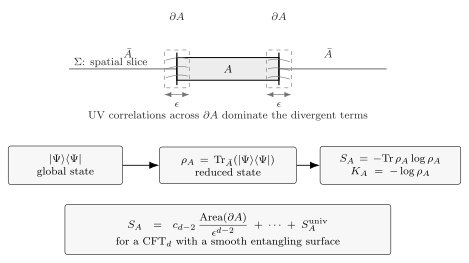
For a region on a spatial slice , the reduced density matrix is obtained by tracing out . In a local QFT, short-distance correlations across the entangling surface generate UV-divergent contributions to , with leading scaling for a smooth entangling surface in CFT.
This page builds the QFT side of the entanglement dictionary. The next page turns these ideas into geometry through the Ryu-Takayanagi and Hubeny-Rangamani-Takayanagi prescriptions. But the geometric formula is not a replacement for the QFT definitions. It is a remarkable way of computing them in a special class of large- theories.
Reduced density matrices
Section titled “Reduced density matrices”In ordinary quantum mechanics, suppose the Hilbert space factorizes as
For a pure state , the density matrix is
The reduced density matrix on is
The von Neumann entropy of is
If factorizes as , then is pure and . If the state is entangled, is mixed and .
For a globally pure state,
This equality is elementary in finite-dimensional quantum mechanics: and have the same nonzero eigenvalues. In QFT it remains conceptually correct, but both sides may be divergent. One should compare them using the same regulator and the same spatial slice.
The simplest example is a Bell pair,
Tracing out gives
and therefore
Vacuum entanglement in QFT is not a single Bell pair. It is more like an infinite collection of correlated short-distance oscillators near , plus long-distance correlations controlled by the state, the CFT data, and the shape of the region.
The entangling surface and the cutoff
Section titled “The entangling surface and the cutoff”Let the CFT live on a Lorentzian spacetime with a chosen Cauchy slice . A spatial region has a boundary inside the slice:
In spacetime language, is a codimension-two surface. For example:
| CFT spacetime dimension | Spatial slice dimension | Region | Entangling surface |
|---|---|---|---|
| interval | two points | ||
| disk | circle | ||
| ball | sphere |
The leading divergence of entanglement entropy is local near . A crude but useful way to see this is to imagine a lattice cutoff with spacing . The modes that contribute most strongly to the divergence are those with support within distance of . The number of such local cells scales like
Therefore a local QFT vacuum usually has an area-law divergence,
This is an area law in space, not an entropy-extensivity law in the volume of . Thermal entropy behaves differently. A thermal state at temperature has an extensive contribution
when is much larger than the thermal correlation length. Thus the entropy of a region in a finite-temperature QFT contains both boundary-sensitive entanglement terms and volume-sensitive thermal terms.
This distinction becomes geometrically sharp in holography: near the AdS boundary, RT/HRT surfaces reproduce UV entanglement divergences; in black-brane geometries, large regions also receive a contribution from the horizon, reproducing thermal entropy.
Rényi entropies and the replica trick
Section titled “Rényi entropies and the replica trick”The von Neumann entropy can be accessed through Rényi entropies,
with
Equivalently,
because .
The replica trick computes by gluing copies of the Euclidean path integral cyclically along the region . The result is a QFT path integral on an -sheeted space branched over . Symbolically,
Then
This is more than a computational trick. It is the origin of many geometric entropy formulas. In gravity, the replica construction leads to conical defects, cosmic branes, and eventually to the RT/HRT and quantum extremal surface prescriptions. The conical angle near the entangling surface is
so differentiating at measures the response to an infinitesimal conical excess or deficit.
There is a subtlety. The replica trick gives first for positive integers . The entropy requires analytic continuation to real near . In many CFT calculations this continuation is controlled, but it is not a purely automatic operation.
The interval in a two-dimensional CFT
Section titled “The interval in a two-dimensional CFT”The cleanest exact result is the vacuum entanglement entropy of one interval in a two-dimensional CFT. Let
on the infinite line. Conformal symmetry fixes the two-point function of replica twist operators. One finds
where is the central charge, is a UV cutoff, and is a nonuniversal normalization. Then
The constant is nonuniversal. The coefficient of the logarithm is universal.
This formula is one of the most useful benchmarks for holographic entanglement. In AdS/CFT, the RT surface for an interval is a bulk geodesic, and the Brown-Henneaux relation
turns its regularized length into precisely the same logarithmic scaling.
Divergences and universal terms
Section titled “Divergences and universal terms”For a smooth entangling surface in a CFT, the divergent structure has the general form
where is a characteristic size of the region. The coefficients are local geometric functionals of and background sources. They may involve the area, extrinsic curvature, intrinsic curvature, and background fields.
The power divergences are not universal because one can change them by changing the cutoff scheme or adding local counterterms localized near the entangling surface. Universal terms are more valuable:
| Setting | Universal information |
|---|---|
| , interval | coefficient of |
| , disk in a CFT | finite constant related to the sphere free energy |
| , sphere in a CFT | logarithmic coefficient controlled by the anomaly |
| general , deformed shapes | shape-dependent universal data related to stress-tensor correlators |
For holography, this structure is not optional bookkeeping. The RT surface area is also divergent near the AdS boundary. Holographic renormalization of entanglement entropy mirrors ordinary holographic renormalization of on-shell actions: subtract local geometric counterterms to isolate meaningful finite data.
Mutual information: a finite entanglement observable
Section titled “Mutual information: a finite entanglement observable”A useful combination is the mutual information between two separated regions and :
It satisfies
and measures total correlations between the two regions. If and are separated by a finite distance, the UV divergences cancel because the entangling surfaces of , , and are locally the same. Thus is finite in a continuum QFT for separated regions.
In holographic large- CFTs, mutual information has a striking classical-geometric behavior. At leading order in , the RT surface for can switch topology. Consequently can jump from an value to zero at the classical level. At finite , the transition is smoothed by bulk quantum corrections and the exact mutual information is not literally discontinuous.
This is an early hint of a recurring theme: leading classical holography computes the dominant saddle, while subleading terms restore features expected of exact quantum systems.
Entropy inequalities
Section titled “Entropy inequalities”Entanglement entropy is constrained by powerful inequalities. The most important are:
and strong subadditivity,
Strong subadditivity is one of the deepest structural properties of quantum entropy. In holography, the RT formula gives a beautifully geometric proof at leading classical order: one cuts and reglues minimal surfaces to compare areas. This is not just a nice picture. It is a consistency test for any proposed holographic entropy functional.
Another important inequality is the Araki-Lieb inequality,
For a thermal state, taking allows and to differ because the global state is mixed. Holographically, this difference is often controlled by whether the relevant extremal surface includes a horizon component.
Modular Hamiltonians
Section titled “Modular Hamiltonians”The modular Hamiltonian of region is defined by
so that
This looks like a thermal density matrix, but is usually a highly nonlocal operator. It is not generally the physical Hamiltonian restricted to .
There are two crucial exceptions. For the vacuum of a relativistic QFT and the half-space
the Bisognano-Wichmann theorem gives
up to an additive constant fixed by . The modular flow is a Lorentz boost.
For the vacuum of a CFT and a ball of radius centered at the origin,
a conformal transformation maps the causal development of the ball to a Rindler wedge. The modular Hamiltonian is local:
This formula is one of the workhorses of modern holography. It connects the entanglement first law to stress-tensor one-point functions, and it is a key ingredient in derivations of linearized Einstein equations from CFT entanglement.
The entanglement first law
Section titled “The entanglement first law”Consider a one-parameter family of density matrices
with
Let
The first variation of the entropy is
This is called the entanglement first law. It resembles the ordinary first law of thermodynamics,
but it is an exact first-order identity for density matrices. The modular Hamiltonian plays the role of an entanglement energy.
For a ball in the vacuum of a CFT, this becomes
If is approximately constant over the ball, then
where is the area of the unit -sphere.
In holography, the left-hand side is computed by a variation of an extremal area, while the right-hand side is computed by the asymptotic metric coefficient that gives the boundary stress tensor. Requiring equality for all balls is powerful enough, under appropriate assumptions, to imply the linearized Einstein equations in the bulk.
Relative entropy
Section titled “Relative entropy”The relative entropy between two density matrices and on the same region is
Writing
one obtains
where
Relative entropy is nonnegative:
Therefore
This inequality is a rigorous information-theoretic statement. In holography it becomes a positivity condition on bulk gravitational energy, often called canonical energy in perturbative settings. This is one of the cleanest bridges between quantum information inequalities and gravitational dynamics.
Relative entropy also avoids some UV problems. Although and are separately divergent, their difference can be finite when the two states have the same UV structure. For CFT vacuum-relative quantities on a fixed region, relative entropy is often a better-behaved observable than entropy itself.
The algebraic subtlety in gauge theories
Section titled “The algebraic subtlety in gauge theories”In a scalar field theory regulated on a lattice, one often writes
Gauge theories are subtler. Gauss constraints tie the two sides of an entangling surface together. The physical Hilbert space of gauge-invariant states does not factorize naively across .
There are two common ways to discuss entanglement in gauge theories:
- Extended Hilbert space approach: introduce edge degrees of freedom on the entangling surface so that a factorization can be defined, then impose gauge constraints carefully.
- Algebraic approach: specify the operator algebra associated with region and define entropy for that algebra, including possible choices of center.
In holography this subtlety is not cosmetic. The bulk theory is gravitational and gauge-redundant; subregion duality is naturally formulated in terms of algebras, constraints, and edge terms. Later pages on JLMS and quantum error correction will revisit this point. The slogan “trace out ” remains useful, but in gauge theories and gravity it must be interpreted with care.
Entanglement versus thermodynamics
Section titled “Entanglement versus thermodynamics”Because is an entropy, it is tempting to interpret it thermodynamically. Sometimes this is correct; often it is not.
For the vacuum of a CFT, is not thermal entropy. It is entanglement entropy. The reduced density matrix may look thermal with respect to a modular Hamiltonian,
but is generally not the physical Hamiltonian.
For a ball in the CFT vacuum, the modular Hamiltonian is local and related to a conformal transformation. This is why the ball is special. For a generic region, there is no local temperature profile that reproduces .
For an actual thermal state,
large regions have an extensive entropy contribution. If the region is much larger than , then
Holographically, the volume term arises when the extremal surface runs close to a black-hole horizon. This is the entanglement version of the same thermal physics studied in the black-brane chapters.
The large- perspective
Section titled “The large-NNN perspective”In a holographic CFT, the number of degrees of freedom is measured by a central quantity such as , which scales like
For matrix large- theories,
The leading universal part of entanglement entropy for a geometric region is therefore often in a deconfined or conformal large- theory. In the bulk this becomes the classical area term
Quantum bulk fields contribute at :
This formula is not yet the RT/HRT prescription; it is a preview of the quantum-corrected story. The point for now is the hierarchy:
| CFT order | Bulk interpretation |
|---|---|
| or | classical area term |
| bulk entanglement and one-loop effects | |
| smaller powers | higher quantum corrections, depending on the theory |
This scaling is one reason entanglement is so central to holography. It knows about the same large number of degrees of freedom that controls black-hole entropy.
A dictionary for later pages
Section titled “A dictionary for later pages”The following table summarizes the QFT concepts that will become geometric in the rest of Module 12.
| QFT concept | Definition | Holographic role |
|---|---|---|
| Region | subregion of a boundary spatial slice | boundary anchor for an extremal surface |
| Entangling surface | boundary of inside the slice | anchoring locus of RT/HRT surface |
| Reduced state | encoded in an entanglement wedge | |
| Entanglement entropy | area plus quantum corrections | |
| Rényi entropy | cosmic branes and replica geometries | |
| Modular Hamiltonian | modular flow, JLMS relation | |
| Relative entropy | bulk canonical energy and positivity | |
| Mutual information | connected versus disconnected surfaces |
The lesson is simple: holographic entanglement is not merely “entropy equals area.” It is a whole dictionary relating density matrices, modular flow, relative entropy, and subregion reconstruction to bulk geometry.
Common mistakes
Section titled “Common mistakes”Mistake 1: Treating the leading area-law coefficient as universal.
The leading divergence
depends on the regulator. Universal information is usually found in logarithmic terms, finite terms after a precise subtraction, mutual information, relative entropy, or derivatives that remove cutoff dependence.
Mistake 2: Confusing boundary area laws with the RT area.
The QFT area law refers to the area of on the boundary spatial slice. The RT formula involves the area of a codimension-two bulk surface . The bulk area divergence near the AdS boundary reproduces the boundary UV divergence, but the two areas live in different geometries.
Mistake 3: Calling the Hamiltonian.
The modular Hamiltonian is the logarithm of the reduced density matrix. It equals a geometric Hamiltonian only in special cases such as Rindler wedges and balls in the CFT vacuum.
Mistake 4: Forgetting the state.
depends on the region and the state. Vacuum entanglement, thermal entropy, coherent excitations, and black-hole microstates can have very different entanglement structures.
Mistake 5: Ignoring gauge constraints.
Gauge theories and gravity do not factorize across spatial regions in the simplest way. A precise treatment requires edge modes or operator algebras. This is essential for understanding subregion duality beyond leading classical geometry.
Exercises
Section titled “Exercises”Exercise 1: Entropy of a Bell pair
Section titled “Exercise 1: Entropy of a Bell pair”Let
Compute and .
Solution
The density matrix is
Tracing over removes the off-diagonal terms because
Thus
Its eigenvalues are and , so
Exercise 2: Dimensional estimate of the area divergence
Section titled “Exercise 2: Dimensional estimate of the area divergence”In a CFT, explain why the leading entanglement divergence for a smooth region has the form
Solution
The entangling surface has dimension . A cutoff divides this surface into roughly
cells. Locality implies that the strongest UV contribution comes from short-distance correlations between degrees of freedom on opposite sides of . If each cell contributes an order-one amount of entropy, then
The coefficient is not universal because the notion of an order-one contribution per cutoff cell depends on the regulator.
Exercise 3: Entropy of an interval from Rényi entropies
Section titled “Exercise 3: Entropy of an interval from Rényi entropies”Suppose a two-dimensional CFT gives
Assuming contributes only a nonuniversal additive constant to , derive the universal logarithmic term in .
Solution
The entropy is
The logarithm is
Differentiating the universal part gives
Therefore
where comes from and is not universal.
Exercise 4: First law for a ball with constant energy density
Section titled “Exercise 4: First law for a ball with constant energy density”For a ball in the vacuum of a CFT, the modular Hamiltonian is
Assume a small perturbation with constant
Show that
Solution
The entanglement first law gives
With constant ,
Let . Then
The radial integral is
Therefore
Using gives
and . Hence
Exercise 5: Relative entropy and the first law
Section titled “Exercise 5: Relative entropy and the first law”Let with . Show that relative entropy begins at second order in .
Solution
Relative entropy can be written as
The entanglement first law says that, to first order around ,
Therefore the first-order part cancels:
Since relative entropy is nonnegative, this second-order term defines a positive quadratic form on perturbations of the density matrix. In holography, this positivity is related to positivity of bulk canonical energy.
Exercise 6: Why mutual information is finite
Section titled “Exercise 6: Why mutual information is finite”Let and be two separated regions in a continuum QFT. Explain why
is free of leading UV divergences.
Solution
The UV divergences of entanglement entropy are local near entangling surfaces. For separated regions,
Therefore the divergent local terms in are the sum of the divergent local terms near and near . These are exactly the terms appearing in . Hence the local UV divergences cancel in
The remaining mutual information depends on correlations between separated regions and is finite.
Further reading
Section titled “Further reading”- H. Casini and M. Huerta, Lectures on entanglement in quantum field theory, arXiv:2201.13310.
- H. Casini and M. Huerta, Entanglement entropy in free quantum field theory, arXiv:0905.2562.
- P. Calabrese and J. Cardy, Entanglement entropy and conformal field theory, arXiv:0905.4013.
- M. Srednicki, Entropy and Area, arXiv:hep-th/9303048.
- J. Eisert, M. Cramer, and M. B. Plenio, Area laws for the entanglement entropy — a review, arXiv:0808.3773.
- H. Casini, M. Huerta, and R. C. Myers, Towards a derivation of holographic entanglement entropy, arXiv:1102.0440.
- T. Faulkner, M. Guica, T. Hartman, R. C. Myers, and M. Van Raamsdonk, Gravitation from Entanglement in Holographic CFTs, arXiv:1312.7856.
- N. Lashkari, Relative Entropies in Conformal Field Theory, arXiv:1404.3216.