
Hawking-Page Transition and Confinement
The main idea
Section titled “The main idea”The previous page introduced AdS-Schwarzschild black holes and planar black branes as thermal states of the dual field theory. We now study a sharper question: which Euclidean bulk geometry dominates the canonical ensemble at a fixed boundary temperature?
For a CFT on the spatial sphere , the Euclidean thermal boundary is
There are two especially important smooth bulk fillings of this same boundary:
- Thermal AdS, which is Euclidean global AdS with periodically identified time. It has no horizon. The thermal circle is noncontractible in the bulk.
- Euclidean AdS-Schwarzschild, where the thermal circle smoothly shrinks at the horizon. Its Euclidean geometry has a cigar-like part.
The Hawking-Page transition is the transition between these two saddles. In the dual large- gauge theory it is interpreted as a confinement/deconfinement transition, or more precisely as a transition from a phase with only thermal entropy above the vacuum to a phase with entropy.
In classical gravity, the rule is simple:
The dominant phase is the saddle with smaller renormalized Euclidean action.
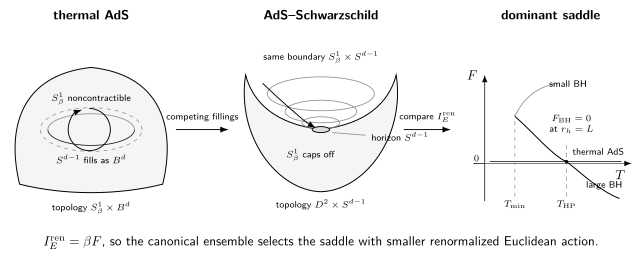
The Hawking-Page transition compares two bulk fillings of the same boundary . Thermal AdS has topology , while the Euclidean black hole has topology . The transition occurs at , or for spherical AdS Schwarzschild black holes.
This page has one central lesson: a black hole is not automatically the dominant thermal saddle just because it exists. One must compare free energies.
The canonical ensemble in global AdS
Section titled “The canonical ensemble in global AdS”Consider Einstein gravity with negative cosmological constant in bulk dimensions,
Here is the AdS radius, is the induced metric at the cutoff boundary, is the trace of the extrinsic curvature, and denotes the standard local counterterms. The Euclidean path integral with boundary metric computes the thermal partition function of the boundary theory on ,
At large and large ‘t Hooft coupling, the gravitational path integral is approximated by classical saddles,
The boundary data specify the temperature and the spatial geometry, but they do not uniquely specify the bulk topology. Different smooth fillings can contribute to the same ensemble. This is why the Hawking-Page transition is possible.
The physical interpretation depends on the boundary spatial manifold. For global AdS, the dual theory lives on . This is a compact space, so strictly speaking one should not expect ordinary finite-volume phase transitions at finite . At , however, the number of degrees of freedom scales like , and the large- limit supplies a genuine thermodynamic limit even on a compact sphere.
Thermal AdS
Section titled “Thermal AdS”Thermal AdS is obtained by taking Euclidean global AdS and identifying the Euclidean time coordinate,
The Lorentzian global AdS metric is
After , the Euclidean metric is
There is no horizon, so smoothness imposes no special value of . Any temperature is allowed. Topologically,
The Euclidean time circle is noncontractible. The sphere shrinks smoothly in the center of AdS, just as the boundary sphere of a ball shrinks in the interior of the ball.
From the CFT point of view, thermal AdS describes a low-temperature phase in which the leading large- entropy is absent:
The phrase “above the vacuum contribution” matters. A CFT on can have a Casimir energy, and in holographic CFTs that vacuum energy may scale like . But the thermal entropy of the thermal-AdS saddle is not at leading classical order. The first thermal corrections come from a gas of bulk supergravity or string modes and are suppressed relative to a classical black-hole entropy.
The spherical AdS-Schwarzschild black hole
Section titled “The spherical AdS-Schwarzschild black hole”The Euclidean AdS-Schwarzschild metric with spherical horizon is
with
The horizon radius is the largest positive root of , so
Near , the Euclidean geometry is smooth only if has the correct period. The general formula is
Using the expression for gives
The Euclidean geometry is a cigar in the directions: the thermal circle shrinks smoothly at . Topologically,
This topology difference is not decorative. It controls the Polyakov loop, the dominant saddle, and the deconfinement interpretation.
Temperature branches and local stability
Section titled “Temperature branches and local stability”The temperature function
has a minimum for . Differentiating with respect to gives
Thus
For , no smooth spherical AdS-Schwarzschild black hole with that boundary temperature exists. For , there are two black-hole branches:
- a small black hole with , negative specific heat, and local thermodynamic instability;
- a large black hole with , positive specific heat, and local thermodynamic stability.
This is already different from asymptotically flat Schwarzschild thermodynamics. AdS acts like a gravitational box. Large AdS black holes can be in stable equilibrium with their Hawking radiation because the AdS boundary reflects radiation back into the bulk.
Local stability, however, is not the same as dominance. A locally stable black hole can still have larger free energy than thermal AdS.
Free energy and the Hawking-Page point
Section titled “Free energy and the Hawking-Page point”The ADM mass of the spherical AdS-Schwarzschild solution is
where is the volume of the unit . The Bekenstein-Hawking entropy is
In the canonical ensemble the relevant thermodynamic potential is
Substituting the formulas above gives the remarkably simple result
where the zero of free energy is chosen so that thermal AdS has vanishing thermal free energy after the vacuum subtraction.
Therefore
and
The Hawking-Page transition occurs at
The corresponding temperature is
For , thermal AdS dominates the canonical ensemble. For , the large AdS black hole dominates.
The transition is first order for because the entropy jumps at leading large . At the transition,
which is of order in a matrix large- holographic CFT. Thermal AdS has no such classical horizon entropy.
The CFT interpretation: confinement and deconfinement
Section titled “The CFT interpretation: confinement and deconfinement”The thermal phases are most cleanly distinguished by the large- scaling of the free energy and entropy.
In a matrix large- gauge theory, the deconfined plasma has order gluonic degrees of freedom:
A confined phase has only color-singlet excitations, so its thermal entropy is order one at fixed temperature:
The Hawking-Page dictionary is then
| Bulk saddle | Boundary phase | Leading thermal entropy | Geometry |
|---|---|---|---|
| thermal AdS | confined-like phase | no horizon | |
| large AdS black hole | deconfined phase | horizon | |
| small AdS black hole | unstable saddle | but negative specific heat | horizon |
This is the gravitational origin of the statement that black-hole formation in global AdS is dual to deconfinement in the large- gauge theory.
One must read this statement carefully. The canonical example, SYM on , is not QCD on flat space. It is a conformal gauge theory on a compact sphere. The word “confinement” here means that the low-temperature phase has the large- counting, center-symmetry behavior, and color-singlet spectrum characteristic of confinement. It does not mean that the conformal theory on flat has a mass gap or a linear quark potential.
The Polyakov loop and the contractible thermal circle
Section titled “The Polyakov loop and the contractible thermal circle”A useful diagnostic of deconfinement in gauge theory is the Polyakov loop,
In a pure gauge theory with center symmetry, in the confined phase and in the deconfined phase. With adjoint matter, the center symmetry is not explicitly broken by dynamical fundamentals, so this remains a natural large- diagnostic.
In holography, a Polyakov loop is computed by a Euclidean fundamental string worldsheet whose boundary wraps the thermal circle at the AdS boundary:
Now the topology matters.
In thermal AdS, the thermal circle is noncontractible. A disk-shaped fundamental string worldsheet ending on a single thermal circle at the boundary cannot smoothly fill the loop in the bulk. At leading classical order this gives
In Euclidean AdS-Schwarzschild, the thermal circle contracts at the horizon. A disk worldsheet can end on the boundary thermal circle and cap off smoothly in the interior. This gives
This is one of the cleanest geometric translations of deconfinement: the thermal circle becomes contractible in the dominant Euclidean geometry.
There is a small caveat. In a finite-volume system at finite , symmetries are not truly spontaneously broken. The sharp order parameter appears after taking first.
AdS/CFT specialization
Section titled “AdS5_55/CFT4_44 specialization”For the canonical AdS/CFT example, set . The spherical AdS black hole has
The minimum temperature is
while the Hawking-Page temperature is
The free energy is
since . It changes sign at .
Using
we see that the black-hole entropy scales as
At the transition this is already . The dual transition is therefore a large- deconfinement transition of SYM on at strong coupling.
Why there is no Hawking-Page transition for the planar black brane
Section titled “Why there is no Hawking-Page transition for the planar black brane”The spherical Hawking-Page transition is often confused with the planar black-brane thermodynamics used for SYM on . These are different ensembles.
The planar black brane has metric
Its boundary is
or a large torus approximation to it. For a conformal theory in infinite flat space, there is no dimensionless parameter like built from a sphere radius. Once , the black brane gives the deconfined plasma saddle with free-energy density
There is no finite-temperature Hawking-Page transition in the strict planar conformal case. The black brane dominates over the corresponding thermal Poincare AdS saddle for any nonzero temperature, after comparing densities.
This is not a contradiction. The global transition uses the finite sphere radius as an additional scale. The planar plasma is the high-temperature, large-volume limit of the global black hole.
Confining geometries and Hawking-Page-like transitions
Section titled “Confining geometries and Hawking-Page-like transitions”The global Hawking-Page transition is not the only holographic route to confinement. In QCD-like holographic models, the low-temperature geometry often has an IR cap. A common Euclidean topology story is this:
- In the confined phase, a spatial circle contracts smoothly in the bulk. The thermal circle is noncontractible.
- In the deconfined phase, the thermal circle contracts at a horizon. The spatial circle remains finite.
This exchange of contractible cycles is the geometric core of many confinement/deconfinement transitions in holography.
For example, in Witten’s model of a confining large- gauge theory, one compactifies a spatial direction with supersymmetry-breaking boundary conditions. At low temperature, the spatial circle caps off smoothly; at high temperature, a black-hole geometry dominates. The phase transition is Hawking-Page-like, but it is not the same as the spherical AdS transition above.
The diagnostic Wilson loops also know about the geometry. In a confining background, a spatial Wilson loop can have an area law because the string worldsheet is forced to sit near the IR cap. In a deconfined black-hole background, temporal Wilson loops are allowed because the thermal circle caps off at the horizon.
What exactly jumps?
Section titled “What exactly jumps?”At leading classical order, the transition is a jump between two geometries with different topology. The most important quantities behave as follows.
Entropy
Section titled “Entropy”Thermal AdS has no horizon, so
above the vacuum piece. A large AdS black hole has
Thus the entropy jumps by at .
Energy
Section titled “Energy”The energy also jumps by . In the CFT this is the latent heat of the first-order deconfinement transition.
Polyakov loop
Section titled “Polyakov loop”At leading large ,
Spectrum
Section titled “Spectrum”Thermal AdS corresponds to a gas of color-singlet states. The black-hole phase corresponds to a deconfined plasma with a continuous-looking spectrum in the large-volume or high-temperature limit. On the gravity side, the difference is between normal modes in a horizonless spacetime and dissipative quasinormal modes in a black-hole spacetime.
Relation to large- matrix models
Section titled “Relation to large-NNN matrix models”The same physics can be described in the CFT using the holonomy around the thermal circle. Define the thermal holonomy
The Polyakov loops are moments of the eigenvalue distribution,
A center-symmetric confined phase has an approximately uniform eigenvalue distribution on the unit circle, so
A deconfined phase has a gapped or clumped eigenvalue distribution, giving
At weak coupling on , this matrix-model language gives a useful perturbative picture of deconfinement. At strong coupling and large , the gravitational Hawking-Page transition is the dual description.
The details of the weak-coupling and strong-coupling transitions need not match quantitatively. Protected quantities are special; thermal free energies and deconfinement temperatures are generally not protected.
Common mistakes
Section titled “Common mistakes”Mistake 1: “Every AdS black hole dominates at its temperature.”
Section titled “Mistake 1: “Every AdS black hole dominates at its temperature.””No. The black-hole solution may exist but fail to dominate the canonical ensemble. For , the large black hole is locally stable but still has higher free energy than thermal AdS.
Mistake 2: “The small black hole is the confined phase.”
Section titled “Mistake 2: “The small black hole is the confined phase.””No. The small black hole has a horizon and entropy, but it is thermodynamically unstable in the canonical ensemble. The confined-like phase is thermal AdS, not the small black hole.
Mistake 3: “The Hawking-Page transition is the same as the black-brane plasma at any .”
Section titled “Mistake 3: “The Hawking-Page transition is the same as the black-brane plasma at any TTT.””No. The Hawking-Page transition for global AdS depends on the boundary sphere radius. The planar black brane describes a CFT on flat space and has no finite-temperature confinement/deconfinement transition in the conformal case.
Mistake 4: “Confinement means the same thing in every holographic model.”
Section titled “Mistake 4: “Confinement means the same thing in every holographic model.””No. In SYM on , the confined-like phase is defined by large- counting and center-symmetry diagnostics on a compact space. In QCD-like holographic models, confinement may also mean a mass gap, area-law spatial Wilson loops, and an IR cap in the geometry.
Mistake 5: “The free energy of thermal AdS is literally zero.”
Section titled “Mistake 5: “The free energy of thermal AdS is literally zero.””Only after a choice of subtraction. The physical comparison is between renormalized Euclidean actions with the same boundary geometry. The CFT on a sphere can have a vacuum Casimir energy; the key point is the absence of leading thermal entropy in the low-temperature saddle.
Exercises
Section titled “Exercises”Exercise 1: Derive the black-hole temperature
Section titled “Exercise 1: Derive the black-hole temperature”For the spherical AdS-Schwarzschild metric
use to show that
Solution
The horizon condition gives
Differentiate :
At ,
Therefore
and Euclidean smoothness gives
Exercise 2: Find and
Section titled “Exercise 2: Find TminT_{\min}Tmin and THPT_{\mathrm{HP}}THP”For , show that the black-hole temperature has a minimum at
and find . Then show that the Hawking-Page transition occurs at
Solution
Write
Then
Setting this to zero gives
Thus
Substituting into gives
The Hawking-Page transition is where the black-hole free energy changes sign,
Therefore . Substituting into gives
Exercise 3: Derive the free energy from
Section titled “Exercise 3: Derive the free energy from M−TSM-TSM−TS”Using
and
show that
Solution
First compute
Thus
Subtracting from gives
The bracket simplifies to
Therefore
Exercise 4: Polyakov loops and topology
Section titled “Exercise 4: Polyakov loops and topology”Explain why the topology of the Euclidean thermal circle implies in thermal AdS but allows in the AdS black-hole phase.
Solution
In holography, a Polyakov loop is represented by a Euclidean fundamental string worldsheet ending on the thermal circle at the boundary.
In thermal AdS, the boundary thermal circle is noncontractible in the bulk. A disk-shaped string worldsheet cannot end on a single noncontractible loop and close smoothly in the interior. Thus there is no classical disk saddle for a single Polyakov loop, giving at leading large .
In the Euclidean black-hole geometry, the thermal circle shrinks smoothly at the horizon. The string worldsheet can form a disk: its boundary is the thermal circle at infinity, and its interior caps off at the horizon. Thus a finite-action worldsheet exists and can be nonzero.
This is the geometric version of deconfinement.
Exercise 5: Why the planar brane has no finite-temperature Hawking-Page transition
Section titled “Exercise 5: Why the planar brane has no finite-temperature Hawking-Page transition”Use dimensional analysis to explain why a conformal theory on should have free-energy density
in the deconfined plasma phase, and why there is no special finite temperature analogous to .
Solution
On , a CFT at temperature has no scale other than . The free-energy density has dimension , so dimensional analysis gives
for some positive constant in the deconfined phase. There is no sphere radius or confinement scale with which to form a dimensionless quantity such as or .
The global Hawking-Page transition occurs because the boundary sphere supplies a scale , and the spherical black-hole free energy can change sign as varies. For the planar brane, the corresponding black-brane free-energy density is negative for every . Thus the conformal plasma on flat space has no finite-temperature Hawking-Page transition.
Further reading
Section titled “Further reading”- S. W. Hawking and D. N. Page, “Thermodynamics of Black Holes in Anti-de Sitter Space,” Communications in Mathematical Physics 87 (1983) 577.
- E. Witten, “Anti-de Sitter Space, Thermal Phase Transition, And Confinement In Gauge Theories,” arXiv:hep-th/9803131.
- O. Aharony, S. S. Gubser, J. Maldacena, H. Ooguri, and Y. Oz, “Large N Field Theories, String Theory and Gravity,” arXiv:hep-th/9905111.
- B. Sundborg, “The Hagedorn Transition, Deconfinement and SYM Theory,” arXiv:hep-th/9908001.
- O. Aharony, J. Marsano, S. Minwalla, K. Papadodimas, and M. Van Raamsdonk, “The Hagedorn/Deconfinement Phase Transition in Weakly Coupled Large N Gauge Theories,” arXiv:hep-th/0310285.