
Holographic Fermions and Fermi Surfaces
The main idea
Section titled “The main idea”A finite-density CFT can have fermionic operators. To study them holographically, introduce a charged bulk spinor dual to a fermionic single-trace operator . Then solve the bulk Dirac equation in the charged black-brane background with two boundary conditions:
- near the AdS boundary, fix the coefficient that acts as the source for ;
- at the horizon, impose the infalling condition appropriate to a retarded Green function.
The answer is a matrix-valued retarded correlator
up to the conventional spinor matrix factors and local contact terms. The fermionic spectral function is then
or, in conventions where one inserts a boundary gamma matrix, the corresponding positive spectral density for the chosen spinor components.
A holographic Fermi surface is not defined by filling weakly interacting electron states. It is defined more generally by a singularity of the retarded fermion Green function at zero frequency:
The previous page explained the universal infrared ingredient: the extremal charged black brane develops an throat. For fermions this throat gives a momentum-dependent IR scaling exponent . But the existence and location of a Fermi momentum are not determined by the throat alone. They are determined by a full radial matching problem from the UV boundary to the IR horizon.
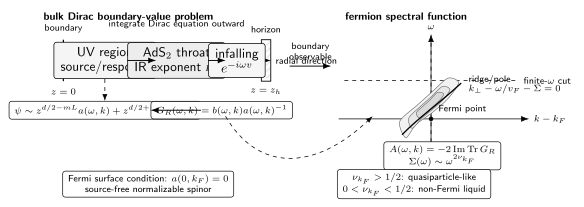
A charged bulk spinor in a charged black-brane background computes a fermionic retarded Green function. The boundary expansion gives source coefficients and response coefficients , while horizon regularity selects the infalling solution. A Fermi surface appears when a source coefficient vanishes at and , producing a pole or sharp ridge in .
This page explains the calculation. The punchline is the low-energy form
where
is the Green function of the emergent IR CFT associated with the throat. Depending on , this can describe a Fermi-liquid-like pole, a marginal Fermi liquid, or a genuinely non-Fermi-liquid singularity.
What is the boundary object?
Section titled “What is the boundary object?”Let be a fermionic operator in a finite-density state of a -dimensional CFT. The retarded Green function is
After Fourier transform,
At zero chemical potential in a relativistic CFT, symmetry strongly constrains this correlator. At finite chemical potential, the density matrix picks a preferred rest frame. Lorentz boosts are broken, and depends separately on and . Rotations still allow us to set
in an isotropic background.
The spectral function is the object most directly analogous to what one plots in angle-resolved photoemission spectroscopy:
A sharp quasiparticle in an ordinary Fermi liquid gives a narrow peak near
with width much smaller than the energy. Holographic systems may have a sharp Fermi momentum without having long-lived Landau quasiparticles. This distinction is one of the main lessons of the fermion calculation.
The bulk spinor dictionary
Section titled “The bulk spinor dictionary”The simplest bulk model is a charged Dirac spinor in a fixed Einstein-Maxwell black-brane background:
where
Here is the bulk spinor mass, is the bulk charge, and is a boundary term chosen so that the variational problem fixes the appropriate half of the boundary spinor. The dual operator has charge under the boundary global symmetry.
In standard quantization, for , the conformal dimension of the fermionic operator in the UV CFT is
For a spinor, the near-boundary Dirac equation is first order. One may not fix all spinor components at the boundary; half of them are sources and half are responses. In the mass window
an alternate quantization is also possible, with
This is the fermionic cousin of alternate quantization for scalars near the Breitenlohner-Freedman window.
The basic dictionary is:
| Bulk quantity | Boundary meaning |
|---|---|
| charged spinor | fermionic operator |
| mass | UV dimension in standard quantization |
| charge | charge of under the global |
| boundary source coefficient | source for |
| response coefficient | expectation-response coefficient |
| horizon infalling condition | retarded Green function |
| pole at , | Fermi surface of |
The operator is usually a gauge-invariant composite operator of the boundary CFT, not automatically the microscopic electron of a laboratory material. Bottom-up models often use the word “electron” as motivation, but the precise holographic statement is about the spectral function of the chosen fermionic operator.
The charged black-brane background
Section titled “The charged black-brane background”Use the finite-density background from the previous pages:
The boundary is at , and the horizon is at . Regularity requires
while the near-boundary value is the chemical potential:
For a spinor mode with time dependence , the local gauge-invariant energy is shifted by the background electric potential:
This radial dependence is crucial. Near the boundary , while near the horizon in the regular gauge. The spinor therefore probes the entire electrostatic potential profile between the UV and the IR.
Removing the spin connection
Section titled “Removing the spin connection”A useful field redefinition removes most of the spin connection from the radial Dirac equation. Take momentum along :
Then the Dirac equation becomes
This equation is first order in . Its coefficients are real for real and , except for the retarded prescription imposed at the horizon. In practice one chooses a gamma-matrix basis that decomposes the spinor into two smaller blocks. For an isotropic background in boundary dimensions, the Green function often becomes diagonal in two spinor channels, usually denoted and , related by .
One can rewrite the first-order system as a Riccati flow equation for a ratio of spinor components. Schematically,
where labels a spinor block. The advantage is numerical: one integrates a ratio from the horizon to the boundary, instead of separately evolving two linearly dependent solutions.
The boundary Green function is then extracted as the boundary limit of this ratio, multiplied by the appropriate power of and by conventional gamma-matrix factors.
Near-boundary data and the Green function
Section titled “Near-boundary data and the Green function”Near , the geometry is asymptotically AdS and the gauge field approaches a constant. The spinor has the expansion
where the two coefficients obey opposite radial chirality conditions,
up to a convention-dependent choice of signs. In standard quantization with , is the source and is the response.
The renormalized on-shell variation has the schematic form
so the one-point function in the presence of a fermionic source is
In momentum space, linearity of the Dirac equation gives
again up to conventional matrices and local terms. Thus
A more invariant way to say the same thing is: choose a basis of boundary spinor sources , solve the radial Dirac equation with retarded horizon conditions, and read the corresponding response coefficients . Then
When the Green function diagonalizes into channels, this reduces to
The horizon condition
Section titled “The horizon condition”For retarded correlators in a black-brane background, impose infalling boundary conditions at the future horizon. At nonzero temperature, near the horizon
and the spinor behaves as
where is a constant spinor constrained by the near-horizon Dirac equation. This is the same causal prescription as for scalar and vector perturbations: nothing comes out of the future horizon in the retarded problem.
In ingoing Eddington-Finkelstein coordinates,
the infalling solution is simply regular at the future horizon. This is usually the cleanest way to understand the prescription.
At zero temperature the extremal horizon is an Poincaré horizon. The infalling condition becomes the retarded boundary condition in the AdS throat. This is the origin of the nonanalytic factor in the low-energy Green function.
The practical algorithm
Section titled “The practical algorithm”A typical holographic fermion computation proceeds as follows.
Step 1: choose the background. Usually this is RN-AdS or a deformation of it:
Step 2: choose the probe spinor. Specify , , quantization, and possible additional couplings. The minimal model uses only the covariant Dirac operator. More general bottom-up models may include a Pauli coupling
which can strongly affect spectral weight and produce zeros or gap-like features. Such terms are useful phenomenologically, but they are additional model data.
Step 3: Fourier transform and reduce the Dirac equation. Use rotational symmetry to set , choose a gamma-matrix basis, and reduce the equation to radial first-order equations.
Step 4: impose the retarded IR condition. At finite temperature impose infalling behavior at . At extremality impose the retarded condition in the AdS throat.
Step 5: integrate to the boundary. Read off source and response coefficients from the asymptotic expansion.
Step 6: construct and analyze . Plot , search for poles, locate , and extract the low-energy scaling.
This is a clean calculation because the bulk Dirac equation is linear in the probe approximation. The complicated physics is not numerical difficulty; it is interpretation.
What counts as a holographic Fermi surface?
Section titled “What counts as a holographic Fermi surface?”For a diagonal spinor channel, write the near-boundary source and response coefficients as
A Fermi momentum is a zero of the source coefficient at zero frequency:
Then
near , before including the low-frequency self-energy.
This definition is deliberately analytic. It does not require weak coupling or quasiparticles. A Fermi surface is identified by a zero-frequency singularity in a gauge-invariant fermionic response function.
In numerical practice one scans over and solves the radial equation. Poles appear as sharp peaks in at small , or equivalently as zeros of the source coefficient. Multiple Fermi momenta can occur for one bulk spinor, especially at large charge .
The AdS matching calculation
Section titled “The AdS2_22 matching calculation”Near an extremal charged horizon, the geometry is
with a near-horizon electric field
Since the flat spatial directions do not scale in the AdS region, the boundary momentum behaves like a parameter that shifts the effective AdS mass. In a minimal isotropic model,
The corresponding IR scaling exponent is
The operator in the emergent IR CFT has dimension
Therefore the IR retarded Green function scales as
for real , with the phase and coefficient depending on charge and gamma-matrix conventions. The essential point is robust:
The full Green function comes from matching this IR solution onto the UV region. Near a Fermi momentum, the matched result takes the universal form
Here , , and are real UV matching data in simple time-reversal-invariant cases. The nonanalytic dependence on comes from the IR throat; the location and the constants come from the full bulk geometry.
This UV/IR factorization is one of the nicest examples of holography doing controlled many-body physics. The near-horizon region determines the universality class, but the whole spacetime determines whether a Fermi surface exists.
Fermi-liquid-like, marginal, and non-Fermi-liquid regimes
Section titled “Fermi-liquid-like, marginal, and non-Fermi-liquid regimes”At a Fermi momentum, the inverse Green function is approximately
The competition between the analytic term and the nonanalytic AdS term determines the nature of the excitation.
: Fermi-liquid-like pole
Section titled “νkF>1/2\nu_{k_F}>1/2νkF>1/2: Fermi-liquid-like pole”If
then dominates over at low frequency. The pole has approximately linear dispersion,
and its width scales as
Thus
This is quasiparticle-like in the sense of being long-lived. It need not be an ordinary weakly coupled Landau Fermi liquid; the residue, operator content, and surrounding continuum are still holographic.
: marginal behavior
Section titled “νkF=1/2\nu_{k_F}=1/2νkF=1/2: marginal behavior”At
the analytic term and the IR self-energy compete at the same order. Logarithms often appear after careful matching:
This resembles the phenomenological marginal Fermi liquid form often invoked in strange-metal discussions.
: non-Fermi liquid
Section titled “νkF<1/2\nu_{k_F}<1/2νkF<1/2: non-Fermi liquid”If
the nonanalytic term dominates over the linear term. The pole, if one tracks it, has a nonlinear dispersion,
and its width is of the same order as its energy. The spectral function can still have a clear singular structure at , but it does not describe a long-lived Landau quasiparticle.
This is the basic holographic non-Fermi liquid.
Imaginary : the oscillatory region
Section titled “Imaginary νk\nu_kνk: the oscillatory region”If
then
and the IR Green function contains log-periodic behavior:
This is the “oscillatory region.” Physically, it is related to the electric field in the AdS throat making the charged spinor effectively unstable against pair production. It is not a conventional Fermi surface regime, and it is usually a signal that the background may want to reorganize once charged matter backreaction is included.
What is universal, and what is model-dependent?
Section titled “What is universal, and what is model-dependent?”The following features are robust in the minimal RN-AdS probe-spinon calculation:
| Feature | Origin | Robustness |
|---|---|---|
| source/response extraction | AdS spinor dictionary | universal |
| infalling horizon condition | retarded real-time prescription | universal for black-brane backgrounds |
| exponent | extremal throat | robust when the IR is |
| UV/IR matching near | robust near simple Fermi-surface poles | |
| number and location of values | full radial Dirac problem | model-dependent |
| Pauli-induced gaps or zeros | extra bulk couplings | model-dependent |
| relation to laboratory electrons | embedding of the boundary operator | model-dependent |
The most common overstatement is: “The charged black hole has a Fermi surface.” A better statement is:
A chosen charged bulk spinor can have boundary spectral functions with zero-frequency poles at one or more momenta. These poles are controlled in the IR by the AdS throat of the charged black brane.
The black hole itself carries charge behind the horizon. Whether the boundary charge is carried by visible Fermi surfaces, fractionalized horizon degrees of freedom, charged condensates, or a bulk fermion fluid is a further dynamical question.
Probe limit, Luttinger count, and fractionalized charge
Section titled “Probe limit, Luttinger count, and fractionalized charge”In an ordinary Fermi liquid with gauge-invariant fermions, the volume enclosed by the Fermi surface is tied to the charge density by Luttinger’s theorem. Holographic finite-density states are subtler.
In the probe-fermion calculation, the background charge density is already present in the charged black brane. The spinor is used to diagnose spectral functions, but it does not necessarily carry all of the background charge. The horizon can carry charge that is invisible to a simple sum over gauge-invariant Fermi-surface volumes. This is often described as fractionalized charge.
More elaborate phases change this accounting:
- In an electron star, a finite density of charged bulk fermions backreacts and carries charge outside the horizon.
- In a hairy black hole, charged bosonic condensates carry part of the charge.
- In a confining or cohesive phase, horizon charge may be reduced or absent.
- In top-down compactifications, the spectrum of fermions and their charges are fixed rather than chosen by hand.
Thus a holographic spectral peak is a real diagnostic, but it is not by itself a complete microscopic charge count.
Relation to ordinary Fermi liquids
Section titled “Relation to ordinary Fermi liquids”It is useful to compare three Green functions.
An ordinary Landau Fermi liquid has
A marginal Fermi liquid has a self-energy roughly of the form
The holographic Fermi surface near an AdS throat has
This formula looks simple, but it is conceptually unusual. The fermion near the Fermi surface mixes with an emergent continuum of locally critical degrees of freedom. In semi-holographic language, one can think of a fermionic excitation coupled to an IR CFT operator :
Integrating out produces the self-energy
This is the cleanest field-theoretic interpretation of the matching formula.
Finite temperature
Section titled “Finite temperature”At nonzero temperature, the extremal AdS throat is cut off by an AdS black hole. The branch cut in the zero-temperature IR Green function becomes a set of thermal poles. The scaling form is
where is a universal function determined by the charged spinor equation in the AdS black hole.
This gives a characteristic scaling near the locally critical regime. Away from the strict near-horizon and low-frequency limit, the full UV geometry again matters.
Common mistakes
Section titled “Common mistakes”Mistake 1: calling every spectral peak a quasiparticle. A Fermi surface is a zero-frequency singularity. A quasiparticle requires a pole whose width is parametrically smaller than its energy.
Mistake 2: forgetting that the fermion is a probe. Unless the spinor backreacts, the spectral function does not determine the background charge density by itself.
Mistake 3: treating as an IR number. The exponent is IR data, but is found by solving the full radial problem.
Mistake 4: ignoring spinor quantization. Standard and alternate quantization exchange source and response in the allowed mass window. This can turn poles into zeros.
Mistake 5: overidentifying bottom-up fermions with electrons. The bulk spinor is dual to a definite boundary operator. Whether that operator is the physical electron requires a microscopic embedding or a phenomenological assumption.
Mistake 6: forgetting contact terms and basis conventions. Spinor Green functions are matrices. Different gamma-matrix bases, boundary terms, and quantizations change presentation, not the pole structure.
Exercises
Section titled “Exercises”Exercise 1: Near-boundary spinor powers
Section titled “Exercise 1: Near-boundary spinor powers”Consider a Dirac spinor in pure AdS with metric
Ignoring boundary momentum, show that the two independent near-boundary behaviors are
Solution
Near the boundary, the Dirac equation reduces to
Take
Then
For ,
For ,
Thus the two leading behaviors are
where and have opposite radial chirality. For , the first term is the standard source and the second is the response.
Exercise 2: Source zero and Fermi momentum
Section titled “Exercise 2: Source zero and Fermi momentum”Suppose a diagonal spinor channel has
Assume and , with
Show that has a pole at .
Solution
Near ,
while
Therefore
The Green function has a zero-frequency pole at , which is the holographic definition of a Fermi momentum.
Exercise 3: Classifying the low-energy pole
Section titled “Exercise 3: Classifying the low-energy pole”Assume near that
where is complex and is real. Explain why gives a long-lived quasiparticle-like pole, while gives a non-Fermi-liquid pole.
Solution
If , then as ,
The pole is therefore controlled first by
so
The imaginary part of produces a width
Thus
The excitation is long-lived.
If , then
at low frequency. The nonanalytic self-energy dominates the inverse Green function, and the pole satisfies roughly
so
Because the coefficient is complex for a retarded IR Green function, the real and imaginary parts are of the same order. There is no parametrically long-lived quasiparticle.
Exercise 4: Momentum-dependent IR dimension
Section titled “Exercise 4: Momentum-dependent IR dimension”In the extremal throat
explain why a boundary spatial momentum contributes to the effective AdS mass of the spinor.
Solution
The spatial directions are spectators in the AdS throat. A Fourier mode has fixed spatial momentum, and the Dirac equation contains the term
From the two-dimensional perspective, this term behaves like an additional mass matrix. Squaring the near-horizon Dirac operator gives an effective contribution
to the AdS mass squared. Thus, in the minimal isotropic case,
The charged AdS electric field shifts the exponent in the opposite direction, leading schematically to
Therefore each boundary momentum labels a different IR scaling dimension
Exercise 5: Does a holographic Fermi surface prove a Landau Fermi liquid?
Section titled “Exercise 5: Does a holographic Fermi surface prove a Landau Fermi liquid?”A numerical holographic calculation shows a sharp zero-frequency pole in at . Does this by itself prove the state is a Landau Fermi liquid?
Solution
No. A zero-frequency pole identifies a Fermi momentum, but a Landau Fermi liquid requires long-lived quasiparticles near the Fermi surface. In the holographic AdS matching formula,
the lifetime depends on .
For , the pole is quasiparticle-like because . For , the width is of the same order as the energy, so the excitation is not a Landau quasiparticle. The spectral function can still have a Fermi surface in the analytic sense.
Further reading
Section titled “Further reading”- Sung-Sik Lee, “A Non-Fermi Liquid from a Charged Black Hole”.
- Hong Liu, John McGreevy, and David Vegh, “Non-Fermi liquids from holography”.
- Mihailo Cubrovic, Jan Zaanen, and Koenraad Schalm, “String Theory, Quantum Phase Transitions and the Emergent Fermi-Liquid”.
- Thomas Faulkner, Hong Liu, John McGreevy, and David Vegh, “Emergent quantum criticality, Fermi surfaces, and AdS”.
- Thomas Faulkner, Nabil Iqbal, Hong Liu, John McGreevy, and David Vegh, “Holographic non-Fermi-liquid fixed points”.
- Nabil Iqbal, Hong Liu, and Mark Mezei, “Lectures on holographic non-Fermi liquids and quantum phase transitions”.