
The GKPW Prescription
The main idea
Section titled “The main idea”The previous pages built the ingredients of the local operator dictionary:
The GKPW prescription turns this dictionary into a calculational rule. In its most compact form,
The left-hand side is the CFT generating functional with sources for local operators. The right-hand side is the full string-theory path integral over bulk fields whose asymptotic boundary values are fixed by those sources. In the regime where the bulk is well described by classical supergravity, the string path integral is approximated by a saddle point:
in Euclidean signature. Equivalently, if
then
This is the practical heart of the dictionary. To compute CFT correlators at large and strong coupling, solve a classical boundary-value problem in AdS, evaluate the renormalized on-shell action, and differentiate with respect to boundary sources.
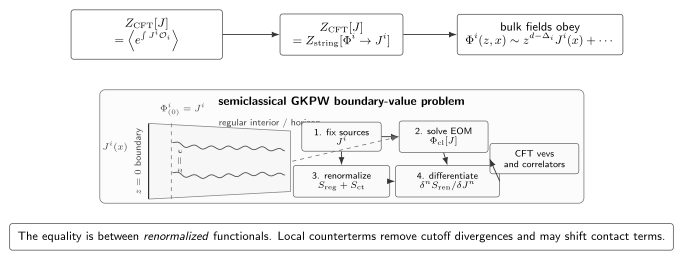
The GKPW prescription identifies the CFT generating functional with the string partition function with asymptotic boundary condition . In the classical supergravity limit, the bulk path integral is dominated by a solution of the bulk equations of motion, and is computed by the renormalized on-shell action.
Three warnings should be kept visible from the beginning.
First, the exact statement is an equality of partition functions, not an equality between a classical field and a quantum operator. A classical bulk field appears only after taking a semiclassical limit.
Second, the object that appears in the saddle formula is not the naive on-shell action. It is the renormalized on-shell action. Near the AdS boundary, the bulk volume diverges, and the on-shell action contains divergences. These are removed by local covariant counterterms on cutoff surfaces.
Third, boundary conditions contain physics. The same asymptotic source can lead to different CFT states depending on the bulk interior condition: Euclidean regularity, Lorentzian normalizability, black-hole horizon infalling behavior, or a more general Schwinger-Keldysh contour.
Source convention used on this page
Section titled “Source convention used on this page”Sign conventions in this subject are famously slippery. The safest approach is to state the source convention explicitly.
On this page, for a scalar operator , define the Euclidean CFT generating functional by
so that
With this convention, the Euclidean classical GKPW relation is
Therefore
Some papers instead define the source by deforming the Euclidean action as
Then , and the sign of the variational formula changes. This is not physics. It is bookkeeping. The invariant rule is: differentiate the generating functional in the convention in which you defined the source.
In Lorentzian signature, the analogous saddle relation is schematically
but the word “schematically” is important: real-time correlators require a choice of contour and state. Retarded correlators, for example, are obtained by imposing infalling boundary conditions at a black-hole horizon. We postpone the systematic real-time story to the correlator and finite-temperature chapters.
The exact statement and the classical limit
Section titled “The exact statement and the classical limit”Let be a set of single-trace CFT operators, and let be sources. The CFT generating functional is
The dual bulk theory contains fields whose asymptotic boundary data are determined by . The exact GKPW statement is
where denotes all bulk fields, not only the fields explicitly sourced. The condition means that the leading non-normalizable part of is fixed by the source. For a scalar operator of dimension in standard quantization,
Here is a Fefferman-Graham radial coordinate, with the conformal boundary at . The coefficient is specified externally. The coefficient is determined dynamically by the bulk equations and by the interior condition. After holographic renormalization, gives the nonlocal part of .
The classical supergravity approximation consists of two simplifications:
and then
The first step uses a saddle-point approximation. The second step is holographic renormalization.
In the canonical AdS/CFT example, this limit is controlled by
Large suppresses bulk loops, while large suppresses stringy corrections. The leading classical action scales as
for matrix large- theories with Einstein-like duals. Thus the saddle approximation is also the statement that the CFT generating functional is large:
The regulated bulk problem
Section titled “The regulated bulk problem”The boundary of AdS lies at infinite proper distance, so the on-shell action is usually divergent. The regulated problem has three steps.
Step 1: introduce a cutoff surface
Section titled “Step 1: introduce a cutoff surface”In Fefferman-Graham coordinates,
introduce a cutoff surface
The induced metric on is
For a scalar field dual to an operator of dimension , the Dirichlet data on the cutoff surface are chosen as
where the omitted terms include local derivative corrections required by the equations of motion.
Step 2: solve the bulk equations
Section titled “Step 2: solve the bulk equations”Solve
with the specified boundary behavior. In Euclidean vacuum calculations, one usually demands smoothness or regularity in the interior. In global AdS, regularity at the center selects the vacuum response. In Euclidean black-hole geometries, smoothness at the contractible thermal circle selects the thermal state.
In Lorentzian signature, specifying boundary data near is not enough. One must also specify a state. For retarded finite-temperature correlators, the correct black-hole prescription is infalling behavior at the future horizon. For time-ordered correlators, one should use an appropriate real-time contour. The Euclidean formula is cleanest, but it is not a substitute for the Lorentzian state problem.
Step 3: evaluate and renormalize the on-shell action
Section titled “Step 3: evaluate and renormalize the on-shell action”The regulated on-shell action is
For gravity, includes the Gibbons-Hawking-York term. For matter fields, boundary terms may also be needed for a well-posed variational principle, especially for gauge fields, fermions, higher-derivative actions, alternate quantization, or mixed boundary conditions.
The regulated action has an asymptotic expansion of the form
The divergent terms are local functionals of the induced fields at the cutoff surface. One cancels them with local counterterms:
The renormalized action is
The finite local part is a renormalization-scheme choice. It changes contact terms in correlators, not separated-point nonlocal physics.
Scalar example: the on-shell action is a boundary term
Section titled “Scalar example: the on-shell action is a boundary term”Take a scalar field in Euclidean AdS,
Integrating by parts gives
where is the outward-pointing unit normal to the boundary of the regulated region. On a classical solution,
so the regulated on-shell action reduces to
This is why the boundary behavior of fields is so powerful. Once the classical solution is known as a functional of the source, the entire quadratic generating functional is encoded in its near-boundary canonical momentum.
Define the regulated radial momentum by
Then the variation of the regulated on-shell action is
up to possible variations of explicit boundary terms. The renormalized momentum is obtained by adding the counterterm contribution and taking the limit:
The phrase “appropriate power of ” is not a nuisance; it reflects the fact that the source is not the cutoff value itself but the rescaled coefficient in the asymptotic expansion.
For a scalar with noninteger
the near-boundary solution in standard quantization has the schematic form
The coefficients are local functionals of fixed by the near-boundary equations. The coefficient is nonlocal in and depends on the interior condition. In the common normalization where the source convention is adjusted so that the one-point function is positive, one writes
With the explicit convention of this page, this means that the nonlocal variation of the renormalized action is
The local terms are scheme-dependent contact terms. The nonlocal dependence of on is the physical content of the correlator.
Two-point functions from the quadratic action
Section titled “Two-point functions from the quadratic action”For a free scalar in Euclidean Poincare AdS,
the scalar wave equation in momentum space is solved by
where regularity in the interior selects the bulk-to-boundary mode
The small- expansion of contains both the source falloff and the response falloff . After renormalization, the nonlocal part of the quadratic action is of the form
with
for noninteger , up to the normalization of the bulk kinetic term and the normalization chosen for .
Since , the connected two-point function is
In position space, conformal invariance fixes the separated-point answer to be
The holographic calculation determines the normalization in terms of the bulk kinetic coefficient. Different normalizations of correspond to rescaling the bulk field and its action.
Higher-point functions and Witten diagrams
Section titled “Higher-point functions and Witten diagrams”The GKPW prescription also explains why Witten diagrams compute CFT correlators.
Suppose the bulk scalar has interactions,
The classical solution can be expanded perturbatively in the source:
Substituting this solution into the on-shell action produces an expansion
Functional differentiation gives connected correlators. Diagrammatically:
| bulk contribution | CFT object | large- order |
|---|---|---|
| quadratic on-shell action | two-point function | leading planar order |
| cubic contact vertex | three-point OPE coefficient | tree level in bulk |
| exchange diagram | four-point function with single-trace exchange | tree level in bulk |
| bulk loop diagram | correction | quantum gravity correction |
| stringy higher-derivative term | finite- correction | correction |
At tree level, the external legs of Witten diagrams are bulk-to-boundary propagators, while internal lines are bulk-to-bulk propagators. The statement “Witten diagrams compute CFT correlators” is simply the perturbative expansion of the classical and quantum bulk path integral with fixed asymptotic boundary conditions.
One-point functions and states
Section titled “One-point functions and states”A source is not the same thing as a state. This distinction becomes crucial after the first few computations.
For a scalar in standard quantization,
The source deforms the CFT Lagrangian or background. The response encodes the expectation value in the state selected by the bulk interior condition. In the vacuum with no source, one normally has
for an operator not forced to have a vev by symmetry breaking or anomalies. But a normalizable bulk mode can have
which corresponds to a state with a nonzero expectation value, not to a deformation of the Hamiltonian.
For the metric, the analogous statement is even more familiar. A black brane can have a flat boundary metric but a nonzero stress tensor:
The boundary metric is the source; the subleading normalizable coefficient contains the energy density, pressure, and other state data.
The gravitational part of the prescription
Section titled “The gravitational part of the prescription”For correlators involving the stress tensor, the bulk action must include the gravitational boundary terms needed for a Dirichlet variational principle. For Einstein gravity,
The signs depend on Euclidean conventions, but the structural point is fixed: the Gibbons-Hawking-York term makes the variational problem well posed when the induced metric is held fixed.
The boundary metric is the source for the CFT stress tensor:
Therefore
in the Euclidean source convention used here.
For gauge fields, the analogous formula is
The radial Hamiltonian constraints of the bulk theory become the CFT Ward identities. For example, if scalar sources are present, the diffeomorphism Ward identity has the schematic form
The trace Ward identity has the schematic form
where is the conformal anomaly in even boundary dimension. These identities are not optional checks; they are consequences of the bulk constraints plus correct counterterms.
What is fixed, what is solved for?
Section titled “What is fixed, what is solved for?”A common source of confusion is whether the boundary value of a bulk field is fixed or dynamical. The answer depends on which coefficient one is discussing.
For a scalar in standard quantization:
| quantity | bulk meaning | CFT meaning | status in GKPW |
|---|---|---|---|
| leading non-normalizable coefficient | source for | fixed boundary data | |
| normalizable response coefficient | determines | solved for | |
| renormalized on-shell action | in this convention | generating functional | |
| response to boundary data | connected -point function | observable |
For gauge fields:
| quantity | bulk meaning | CFT meaning |
|---|---|---|
| boundary value of bulk gauge field | background gauge field source | |
| radial electric flux | canonical momentum | current expectation value |
| gauge transformation nonzero at boundary | background symmetry transformation | Ward identity |
For the metric:
| quantity | bulk meaning | CFT meaning |
|---|---|---|
| conformal boundary metric | source for | |
| plus local terms | normalizable metric data | stress-tensor expectation value |
| radial Einstein constraints | bulk constraint equations | stress-tensor Ward identities |
The key lesson is simple: fix sources, solve for responses, differentiate the renormalized action.
Alternate quantization and Legendre transforms
Section titled “Alternate quantization and Legendre transforms”The previous statements assumed standard quantization. For scalars with mass in the Breitenlohner-Freedman window
both falloffs are normalizable. The two possible dimensions are
In standard quantization, is the coefficient of the falloff and the operator has dimension . In alternate quantization, the roles of source and response are exchanged: the operator has dimension , and the generating functional is related to the standard one by a Legendre transform.
This is not a small technicality. It is the simplest example showing that the phrase “the boundary value of the field is the source” must be interpreted through the variational principle. The source is the coefficient held fixed in the chosen quantization.
Mixed boundary conditions describe multi-trace deformations. For a double-trace deformation
the bulk boundary condition relates the two asymptotic coefficients schematically as
or the inverse relation, depending on the quantization. The correct statement is again variational: add the boundary functional corresponding to the multi-trace deformation, then impose that the total variation vanish under the allowed boundary variations.
Contact terms and scheme dependence
Section titled “Contact terms and scheme dependence”Holographic counterterms are local functionals of boundary sources. Therefore finite counterterms can change local terms in correlation functions.
For example, adding a finite scalar counterterm
changes the two-point function in momentum space by a polynomial:
up to signs determined by the source convention. In position space, this is a contact term proportional to derivatives of .
This is why separated-point correlators and nonanalytic momentum dependence are more invariant than the full distributional answer. In even dimensions, logarithmic counterterms encode conformal anomalies, and the coefficient of the logarithm is universal. But finite local terms remain scheme-dependent.
A good practical rule is:
Large- counting in the prescription
Section titled “Large-NNN counting in the prescription”The GKPW prescription packages the large- expansion geometrically. Suppose the bulk action has the form
after choosing fields of order one. Then
If single-trace operators are normalized so that their two-point functions scale as , one usually includes corresponding powers of in the definition of the source or operator. Different communities use different normalizations. The invariant content is the hierarchy:
For canonically normalized single-trace operators in a matrix large- theory, connected correlators often scale as
If instead one normalizes so that , then all formulas shift by powers of . The GKPW prescription does not remove the need to state operator normalization. It makes the normalization calculable once the bulk kinetic terms are fixed.
Euclidean, Lorentzian, and thermal prescriptions
Section titled “Euclidean, Lorentzian, and thermal prescriptions”The Euclidean prescription is the cleanest starting point:
- choose Euclidean boundary geometry and sources;
- find a smooth Euclidean bulk saddle with those boundary conditions;
- evaluate ;
- differentiate.
This computes Euclidean correlators in the state or ensemble prepared by the Euclidean path integral.
For Lorentzian correlators, the prescription is richer. One must specify both boundary sources and a state. At zero temperature in the vacuum, the prescription selects the desired Green function. At finite temperature, the bulk geometry often contains a horizon. Then:
| CFT correlator | bulk prescription |
|---|---|
| Euclidean thermal correlator | smooth Euclidean black-hole saddle |
| retarded Green function | infalling boundary condition at future horizon |
| advanced Green function | outgoing boundary condition |
| time-ordered correlator | appropriate Lorentzian contour / analytic continuation |
| Schwinger-Keldysh correlators | doubled boundary contour and matching conditions |
The infalling rule for retarded functions is one of the most useful technical tools in holographic transport. But it should not be confused with the Euclidean GKPW formula. They are related by analytic continuation when the continuation is well defined, but the Lorentzian prescription knows about causality and state preparation.
A practical computation checklist
Section titled “A practical computation checklist”A holographic correlator computation should pass the following checklist.
1. Identify the operator and source
Section titled “1. Identify the operator and source”Specify the CFT operator , its source , and the source convention. For the stress tensor and currents, include the factors of , , and possible gauge-group generators.
2. Identify the dual bulk field and normalization
Section titled “2. Identify the dual bulk field and normalization”Write the relevant part of the bulk action, including the kinetic coefficient. This fixes the normalization of the CFT correlator.
3. Choose the background and state
Section titled “3. Choose the background and state”Vacuum AdS, global AdS, thermal AdS, black brane, charged black hole, domain wall, time-dependent geometry, and horizon prescription all compute different physics.
4. Solve the linear or nonlinear boundary-value problem
Section titled “4. Solve the linear or nonlinear boundary-value problem”For two-point functions, solve linearized equations. For higher-point functions, either solve perturbatively in sources or use Witten diagrams.
5. Evaluate the on-shell action
Section titled “5. Evaluate the on-shell action”Do not use the bulk Lagrangian naively. Use the on-shell boundary term plus any necessary gravitational, gauge-field, or fermionic boundary terms.
6. Add counterterms
Section titled “6. Add counterterms”Cancel divergences with local covariant counterterms at . Keep track of finite counterterm choices.
7. Differentiate the renormalized action
Section titled “7. Differentiate the renormalized action”Use
In the Euclidean convention of this page, .
8. Interpret the answer
Section titled “8. Interpret the answer”Separate universal nonlocal terms from contact terms. State the regime of validity: large , large coupling, probe limit, hydrodynamic limit, low frequency, near-boundary expansion, or whatever approximation was used.
Common mistakes
Section titled “Common mistakes”Mistake 1: differentiating the unrenormalized on-shell action
Section titled “Mistake 1: differentiating the unrenormalized on-shell action”The regulated on-shell action contains divergences. Differentiating it before renormalization gives divergent or cutoff-dependent correlators. The correct object is .
Mistake 2: fixing both source and vev
Section titled “Mistake 2: fixing both source and vev”For a second-order bulk equation, the leading and subleading asymptotic coefficients are not both arbitrary after imposing an interior condition. In standard GKPW, the source is fixed and the response is solved for.
Mistake 3: treating all boundary terms as optional
Section titled “Mistake 3: treating all boundary terms as optional”Boundary terms determine the variational principle. For gravity, omitting the Gibbons-Hawking-York term gives the wrong stress-tensor variational problem. For alternate quantization or mixed boundary conditions, additional boundary functionals are essential.
Mistake 4: confusing contact terms with physical disagreement
Section titled “Mistake 4: confusing contact terms with physical disagreement”Finite counterterms shift contact terms. Two calculations that differ by local polynomials in momentum space may agree on all separated-point observables.
Mistake 5: using Euclidean regularity for a retarded correlator
Section titled “Mistake 5: using Euclidean regularity for a retarded correlator”Retarded correlators are causal Lorentzian objects. At black-hole horizons, they require infalling boundary conditions. Euclidean smoothness computes Euclidean thermal correlators; analytic continuation must be handled carefully.
Mistake 6: forgetting operator normalization
Section titled “Mistake 6: forgetting operator normalization”The overall coefficient of a two-point function depends on the normalization of the bulk kinetic term and on the normalization of the CFT operator. Universal ratios may be normalization-independent, but individual , , and values are not.
Exercises
Section titled “Exercises”Exercise 1: Signs in the Euclidean source convention
Section titled “Exercise 1: Signs in the Euclidean source convention”Suppose
and the classical Euclidean bulk saddle gives
Show that
Solution
By definition,
The saddle relation gives
The source convention gives
Combining the two formulas yields
If one instead defines the Euclidean source through , the sign changes because the source appears in as .
Exercise 2: On-shell scalar action
Section titled “Exercise 2: On-shell scalar action”For
show that on a solution of , the action reduces to
Solution
Use
Therefore
Substitute into the action:
On a classical solution, the bulk term vanishes, leaving the boundary term.
Exercise 3: Correlator from a quadratic generating functional
Section titled “Exercise 3: Correlator from a quadratic generating functional”Assume the renormalized Euclidean on-shell action has the nonlocal quadratic part
Using , compute the connected two-point function.
Solution
The generating functional is
Differentiating once gives
assuming and suppressing standard momentum-space delta functions. Differentiating again gives
Thus
plus possible contact terms from finite local counterterms.
Exercise 4: Finite counterterms and contact terms
Section titled “Exercise 4: Finite counterterms and contact terms”Add the finite counterterm
on a flat boundary. Show that it shifts the momentum-space two-point function by a polynomial in . What does this mean in position space?
Solution
Fourier transforming gives
Since in the convention of this page, the contribution to the connected two-point function is
up to the overall sign convention for the source. The important point is not the sign but the analytic dependence on momentum: is a polynomial.
In position space, a polynomial in corresponds to derivatives of a delta function. Thus this finite counterterm changes only contact terms, not the separated-point correlator for .
Exercise 5: Which coefficient is the source?
Section titled “Exercise 5: Which coefficient is the source?”Let a scalar mass lie in the window
The two possible dimensions are
Explain why there can be two admissible quantizations and why the generating functionals are related by a Legendre transform.
Solution
In this mass range both near-boundary falloffs are normalizable. Therefore the variational problem is not forced to hold fixed only the slower falloff. One may choose standard quantization, in which the coefficient of the falloff is the source and the operator has dimension . Or one may choose alternate quantization, in which the conjugate coefficient is treated as the source and the operator has dimension .
Changing which variable is held fixed is precisely what a Legendre transform does. If is the standard-quantization generating functional, the alternate-quantization generating functional is obtained by transforming from the source variable to its conjugate response variable, up to local terms and normalization conventions.
Exercise 6: Diagnose a holographic two-point computation
Section titled “Exercise 6: Diagnose a holographic two-point computation”A student solves a scalar wave equation in Euclidean AdS, substitutes the solution into the bulk action, obtains a divergent answer proportional to , differentiates it twice, and concludes that the CFT two-point function is cutoff-dependent. What went wrong?
Solution
The student differentiated the regulated on-shell action rather than the renormalized on-shell action. The divergence is expected: it comes from the infinite volume near the AdS boundary and corresponds to UV divergences in the source-dependent CFT generating functional.
The correct procedure is to add local covariant counterterms on the cutoff surface, define
and then differentiate . The remaining nonlocal part gives the physical separated-point two-point function. Finite local counterterms may still shift contact terms.
Further reading
Section titled “Further reading”- S. S. Gubser, I. R. Klebanov, and A. M. Polyakov, “Gauge Theory Correlators from Non-Critical String Theory”. The original GKPW correlator prescription from the supergravity side.
- E. Witten, “Anti De Sitter Space And Holography”. The complementary formulation emphasizing boundary behavior, operator dimensions, and CFT observables.
- K. Skenderis, “Lecture Notes on Holographic Renormalization”. The standard technical reference for counterterms, one-point functions, Ward identities, and anomalies.
- I. R. Klebanov and E. Witten, “AdS/CFT Correspondence and Symmetry Breaking”. A classic discussion of vevs, alternate quantization, and Legendre transforms.