
N=4 Super-Yang-Mills
The main idea
Section titled “The main idea”The boundary theory in the canonical AdS/CFT example is four-dimensional super-Yang-Mills theory with gauge group . It is the low-energy interacting theory on coincident D3-branes after the decoupled center-of-mass sector is removed.
This theory is special for three closely related reasons.
First, it is a four-dimensional conformal field theory with a Lagrangian. The coupling does not run, so the theory exists as a continuous family of CFTs labeled by the complexified gauge coupling
Second, it is maximally supersymmetric without gravity. In four-dimensional notation it has Poincare supercharges and, because it is conformal, conformal supercharges. Together with the conformal group and R-symmetry, these generate the superconformal algebra
Third, it is a large- matrix CFT. Gauge-invariant single-trace operators behave like single-particle bulk fields, multi-trace operators behave like multiparticle states, and large- factorization is the field-theory origin of semiclassical bulk physics.
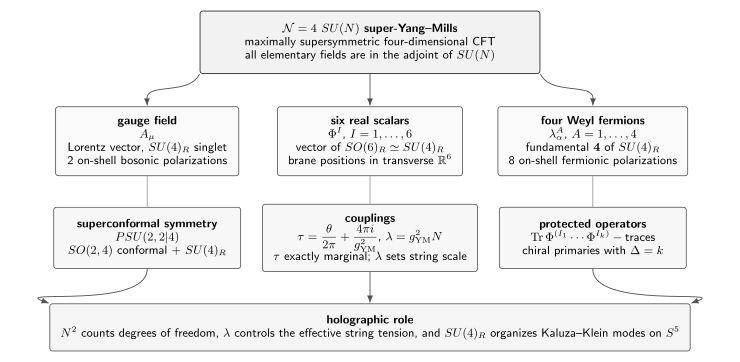
The elementary fields of super-Yang-Mills form one adjoint vector multiplet. The six scalars transform as the vector of , matching the rotations of the six transverse directions to the D3-branes and the isometries of in the dual geometry.
This page is not trying to teach supersymmetric gauge theory from scratch. The goal is to isolate exactly what an AdS/CFT user needs to know about SYM: its fields, action, symmetries, parameters, operator spectrum, and large- dictionary.
The theory from the D3-brane viewpoint
Section titled “The theory from the D3-brane viewpoint”A single D3-brane fills four directions and sits at a point in six transverse directions. The massless open-string modes on the brane are:
| Mode | Four-dimensional field | Meaning |
|---|---|---|
| open-string vector polarization along the brane | gauge field on the D3-brane | |
| transverse oscillations | , | position of the brane in |
| fermionic partners | , | superpartners required by type IIB supersymmetry |
For coincident D3-branes, Chan-Paton labels turn these fields into matrices. The full low-energy gauge group is , but the overall describes the free center-of-mass motion of the brane stack. The interacting theory used in AdS/CFT is usually the part:
The six scalar matrices are especially important. If they acquire mutually commuting expectation values, their eigenvalues describe the positions of the individual D3-branes in the transverse . The conformal point dual to is the point where all scalar expectation values vanish and the branes are coincident.
Field content
Section titled “Field content”In four-dimensional notation, the interacting theory contains the following fields, all in the adjoint representation of :
| Field | Spin | Multiplicity | representation | On-shell degrees of freedom per color |
|---|---|---|---|---|
| Weyl fermions | real fermionic | |||
| real scalars |
The bosonic on-shell count is
and the fermionic on-shell count is
The equality is the first quick check that the fields can form a supersymmetric multiplet. The deeper statement is that this is the unique four-dimensional gauge multiplet with maximal supersymmetry and no spin larger than one.
The R-symmetry has two useful descriptions:
The six real scalars transform as the vector of , or equivalently the antisymmetric representation of . The four Weyl fermions transform as the fundamental of . In the D3-brane construction, this is simply the rotation group of the six directions transverse to the branes. In the gravity dual, it becomes the isometry group of :
The action, without drowning in indices
Section titled “The action, without drowning in indices”A compact way to write the theory is to start from ten-dimensional super-Yang-Mills and dimensionally reduce to four dimensions. Let and let be a ten-dimensional gauge field. Reducing on six flat directions means that the fields do not depend on , so
The ten-dimensional field strength contains
where the factor of depends on whether the Lie-algebra generators are taken Hermitian or anti-Hermitian. This immediately produces the schematic bosonic action
The full theory also contains fermion kinetic terms and Yukawa couplings of the schematic form
The relative coefficients are not optional. Supersymmetry fixes the gauge interactions, scalar quartic interactions, and Yukawa interactions in terms of one coupling .
A useful way to remember the interactions is:
When the scalar matrices commute, they can be diagonalized simultaneously. Their eigenvalues are the separated D3-brane positions.
Convention warning: where the factors of hide
Section titled “Convention warning: where the factors of 2π2\pi2π hide”The D3-brane literature uses several normalizations for . In this course we follow the convention already used in the D3-brane page:
Then the type IIB axio-dilaton and the Yang-Mills coupling combine naturally as
with the identification
Other authors absorb factors of differently. Do not compare formulas for , , or across references unless you first check the normalization of the Yang-Mills action and the trace.
The robust physical statements are:
The next two pages will fix the detailed version of these relations in the conventions of the course.
Conformal invariance
Section titled “Conformal invariance”Classically, the Yang-Mills coupling is dimensionless in four dimensions. Quantum mechanically, most gauge theories develop a scale through renormalization. SYM is exceptional: its beta function vanishes.
At one loop, the coefficient of the Yang-Mills beta function for adjoint matter is proportional to
For SYM,
so
Supersymmetry strengthens this one-loop cancellation into exact conformal invariance. The theory therefore has no intrinsic mass scale on at the conformal point. The only scales in observables come from sources, temperature, chemical potential, compactification radii, operator insertions, or chosen states.
This is why the canonical dual is pure rather than a geometry with a running radial profile. A running coupling would correspond to a nontrivial radial dependence of bulk scalar fields.
Superconformal symmetry
Section titled “Superconformal symmetry”The bosonic conformal group in four-dimensional Minkowski space is
The R-symmetry is
Including supersymmetry, the full superconformal group is
whose bosonic subgroup is
On the gravity side,
and
Thus the spacetime symmetries of the bulk geometry already know about the conformal and R-symmetries of the boundary theory.
This symmetry matching is one of the cleanest first tests of the canonical duality:
while SYM has bosonic global symmetry
The match is not decorative. It determines the representation theory of protected operators and organizes the Kaluza-Klein spectrum on .
The exactly marginal coupling and S-duality
Section titled “The exactly marginal coupling and S-duality”The complex coupling
is exactly marginal. Moving changes the CFT but does not break conformal invariance. In the canonical AdS/CFT example, this continuous conformal manifold maps to the constant type IIB axio-dilaton.
The theory is also expected to have an duality action
together with the appropriate action on line operators and, more carefully, on the global form of the gauge group. The generator
exchanges electric and magnetic descriptions. In type IIB string theory, the same is the nonperturbative duality acting on the axio-dilaton and on fundamental/D-string charges.
For most classical supergravity calculations, S-duality is not the first thing one uses. But conceptually it is a powerful warning: SYM is not merely a weakly coupled gauge theory with many symmetries. It is a nonperturbative quantum theory with multiple equivalent descriptions.
Large and the ‘t Hooft coupling
Section titled “Large NNN and the ‘t Hooft coupling”The two parameters most often used in holography are
The ‘t Hooft large- limit is
In perturbation theory, each planar diagram contributes a function of , and nonplanar diagrams are suppressed by powers of . Holographically,
while
in the canonical background.
The classical Einstein-gravity limit requires both
This is one of the most important lessons of the canonical example. The field theory is easiest at weak coupling , while the bulk gravity description is easiest at strong coupling . The duality is powerful precisely because it relates difficult field-theory questions to easier gravitational ones.
Gauge-invariant local operators
Section titled “Gauge-invariant local operators”The elementary fields , , and are not gauge-invariant local observables. Physical local operators are gauge-invariant combinations, especially traces of adjoint fields.
A basic class is
where the parentheses indicate symmetrization in indices and subtracting traces makes the operator transform in a symmetric traceless representation of .
These are chiral primary operators. Their dimensions are protected:
The lowest nontrivial example is
which transforms in the of and lies in the same supermultiplet as the stress tensor.
The contrast with the Konishi operator is instructive. The schematic operator
is an singlet and is not protected. Its dimension depends on :
while at strong coupling it becomes a stringy excitation whose dimension grows parametrically. This is an early glimpse of the distinction between supergravity modes and massive string modes.
Single-trace, multi-trace, and bulk particles
Section titled “Single-trace, multi-trace, and bulk particles”For matrix fields, single-trace operators are the natural large- building blocks:
Very schematically,
Products of traces correspond to multiparticle states:
At infinite , multi-trace dimensions are approximately additive:
This is the CFT version of the statement that weakly interacting particles in the bulk have energies that add.
The word “single-trace” is most natural for or matrix theories. In a more abstract CFT, one should say “single-particle” or “single-string” operators. But for SYM, the trace language is both literal and useful.
Stress tensor and central charges
Section titled “Stress tensor and central charges”Every CFT has a stress tensor with protected dimension
In SYM, the stress tensor belongs to a protected supermultiplet whose bottom component is the dimension-two chiral primary above.
The four-dimensional Weyl anomaly on a curved background takes the schematic form
where is the Euler density and the dots denote possible background-gauge-field terms and scheme-dependent total derivatives.
For SYM with gauge algebra ,
in the common convention where a free real scalar has
The large- scaling
is the field-theory origin of
In holography, , , , and are different normalizations of the same central idea: the number of stress-tensor degrees of freedom is of order .
The Coulomb branch
Section titled “The Coulomb branch”The scalar potential is proportional to
with the sign chosen so that the energy is nonnegative. Its minima satisfy
For Hermitian scalar matrices, commuting matrices can be diagonalized simultaneously:
up to gauge transformations and subject to the tracelessness condition for . The eigenvalue vector
is the position of the -th D3-brane in the transverse .
For , the classical moduli space is
where the symmetric group permutes identical branes. For , the center-of-mass coordinate is removed:
The conformal vacuum dual to sits at the origin of this moduli space:
Moving onto the Coulomb branch breaks the gauge group and changes the bulk geometry. It should not be confused with changing the state of the same exact background.
Line operators and the global form of the gauge group
Section titled “Line operators and the global form of the gauge group”For many local-operator calculations, it is enough to say “gauge group .” For line operators and S-duality, the global form matters.
The Lie algebra can correspond to different global gauge groups, such as
with different allowed Wilson and ‘t Hooft line operators. In the string dual, Wilson lines are represented by fundamental strings ending on the boundary, while magnetic line operators are related to D-strings. The duality rotates these line operators.
This subtlety is not needed for the first derivation of the correspondence, but it becomes important in serious discussions of S-duality, one-form symmetries, confinement diagnostics, and the precise classification of boundary conditions.
Why SYM is not QCD
Section titled “Why N=4\mathcal N=4N=4 SYM is not QCD”It is tempting to think of SYM as “QCD but supersymmetric.” That slogan is too crude.
| Feature | SYM | QCD-like theory |
|---|---|---|
| Matter | adjoint scalars and fermions | fundamental quarks, gluons |
| Supersymmetry | maximal | none in real QCD |
| Coupling | exactly marginal | runs with scale |
| Vacuum at origin | conformal | confining/chiral symmetry breaking in QCD |
| Degrees of freedom at large | adjoint | gluons , quarks often in the ‘t Hooft limit |
| Best classical gravity regime | large , large | no known exact classical gravity dual for real QCD |
The point of SYM is not realism. It is control. It is an exactly defined interacting CFT that admits a string-theoretic dual and, in a strong-coupling large- regime, a classical gravitational description.
Many later holographic models deform or generalize this example to study confinement, flavor, finite density, hydrodynamics, and condensed-matter-like phenomena. But the canonical example is the calibration point. It teaches which results are universal consequences of gravity, which depend on supersymmetry or conformality, and which are merely model-building assumptions.
The dictionary preview
Section titled “The dictionary preview”The next pages will build the bulk side and the precise parameter map. For now, the basic entries are:
| SYM | Type IIB on |
|---|---|
| rank | units of five-form flux through |
| conformal symmetry | isometry |
| isometry | |
| type IIB axio-dilaton | |
| string tension in AdS units, | |
| bulk quantum-loop expansion | |
| single-trace operators | single-particle/string states |
| chiral primaries | Kaluza-Klein supergravity modes on |
| stress tensor | graviton in |
| R-current | gauge fields from isometries |
This table is deliberately schematic. The exact coefficients and normalization conventions are the subject of the next two pages.
Common mistakes
Section titled “Common mistakes”Mistake 1: Treating SYM as weakly coupled in the gravity regime.
The classical gravity limit requires , where ordinary perturbation theory in is not useful, even though may be small at large .
Mistake 2: Forgetting the decoupled .
The D3-brane worldvolume theory is naturally , but the interacting AdS/CFT dual usually refers to the sector. The overall is a free center-of-mass multiplet.
Mistake 3: Confusing elementary fields with local CFT observables.
The scalar is not a gauge-invariant local operator. Operators like are.
Mistake 4: Thinking all operator dimensions are protected.
Chiral primaries and conserved currents have protected dimensions. Generic single-trace operators, such as the Konishi operator, acquire anomalous dimensions and become heavy at strong coupling.
Mistake 5: Ignoring the global form of the gauge group.
For local single-trace correlators, the Lie algebra often suffices. For line operators, S-duality, one-form symmetries, and precise nonperturbative statements, the global form matters.
Mistake 6: Equating conformality with triviality.
The theory is conformal for all , but it is still interacting. A CFT can have nontrivial anomalous dimensions, OPE coefficients, thermal physics, and transport.
Exercises
Section titled “Exercises”Exercise 1: On-shell degrees of freedom
Section titled “Exercise 1: On-shell degrees of freedom”Show that the vector multiplet has equal bosonic and fermionic on-shell degrees of freedom per generator of the gauge algebra.
Solution
A massless four-dimensional gauge field has two physical polarizations. The six real scalars contribute six bosonic degrees of freedom. Hence
A four-dimensional Weyl fermion has two real on-shell degrees of freedom. There are four Weyl fermions, so
Thus the on-shell bosonic and fermionic degrees of freedom match:
All fields are adjoint-valued, so this count is multiplied by for the interacting theory.
Exercise 2: One-loop beta-function cancellation
Section titled “Exercise 2: One-loop beta-function cancellation”Using
show that the one-loop beta function vanishes for SYM.
Solution
For SYM, all matter fields are in the adjoint representation, so they carry the same group factor as the gauge boson. There are
Therefore
This is
The one-loop cancellation is a quick perturbative signal of conformality. In the full theory, extended supersymmetry implies exact vanishing of the beta function.
Exercise 3: The Coulomb-branch moduli space
Section titled “Exercise 3: The Coulomb-branch moduli space”Assume the scalar fields are Hermitian matrices and the potential is minimized when
Explain why the classical moduli space for the theory is
Solution
If the six Hermitian matrices commute pairwise, they can be diagonalized simultaneously by a unitary gauge transformation. We can write
For each eigenvalue label , the six numbers
define a point in . Thus a generic commuting configuration describes points in .
The remaining Weyl group of permutes the eigenvalues. Since the D3-branes are identical, configurations related by permutations are gauge-equivalent. Therefore
For , one removes the center-of-mass coordinate by imposing
Exercise 4: Central charges from free fields
Section titled “Exercise 4: Central charges from free fields”Use the free-field anomaly coefficients
for a real scalar, Weyl fermion, and vector field, respectively. Show that one vector multiplet has
Then infer the value for gauge algebra .
Solution
One vector multiplet contains one vector, four Weyl fermions, and six real scalars. Therefore
Substituting the given values,
With denominator ,
For gauge algebra , this is multiplied by
Thus
Supersymmetry also gives
Exercise 5: Which operators are light at strong coupling?
Section titled “Exercise 5: Which operators are light at strong coupling?”Classify the following schematic single-trace operators as protected or generally unprotected:
Explain what this means for the bulk dual at .
Solution
The symmetric traceless scalar operators
and more generally
are chiral primaries. Their dimensions are protected, with
The stress tensor is also protected because it is conserved, and every conserved stress tensor in a four-dimensional CFT has
The Konishi operator
is generally unprotected. Its dimension depends on the coupling and becomes large at strong ‘t Hooft coupling.
In the bulk dual, protected operators correspond to light supergravity modes or their Kaluza-Klein excitations on . Unprotected generic single-trace operators correspond to stringy states whose masses in AdS units grow when .
Further reading
Section titled “Further reading”- J. Maldacena, The Large Limit of Superconformal Field Theories and Supergravity.
- O. Aharony, S. Gubser, J. Maldacena, H. Ooguri, and Y. Oz, Large Field Theories, String Theory and Gravity.
- S. Kovacs, Supersymmetric Yang-Mills Theory and the AdS/SCFT Correspondence.
- E. D’Hoker and D. Freedman, Supersymmetric Gauge Theories and the AdS/CFT Correspondence.
- N. Beisert et al., Review of AdS/CFT Integrability: An Overview, for the planar integrability side of SYM.