
Holographic Conductivity
The main idea
Section titled “The main idea”Conductivity is the cleanest holographic transport calculation. It is simple enough to do explicitly, but it already contains the whole real-time AdS/CFT logic:
- identify the boundary source for a conserved current ;
- solve a bulk Maxwell equation for ;
- impose an infalling condition at the future horizon;
- read the boundary current from the radial canonical momentum;
- divide the current by the boundary electric field.
The striking result is that, in a neutral translationally invariant black brane, the DC conductivity can be evaluated entirely at the horizon. The radial electric flux is conserved at , and the infalling condition converts that flux into Ohm’s law. This is the current-sector version of the membrane paradigm.
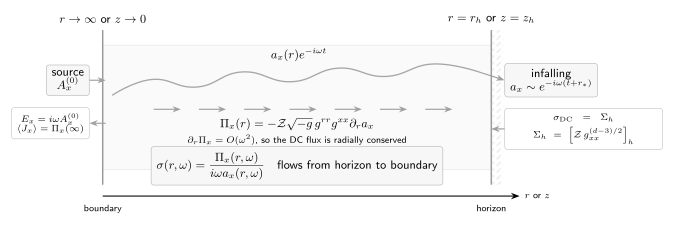
A boundary electric field sources a bulk Maxwell fluctuation . The radial canonical momentum is the holographic current. At small and zero spatial momentum, is radially conserved to leading order, so the DC conductivity can be evaluated at the horizon from the infalling condition.
This page first treats the universal probe-Maxwell calculation at zero charge density. We then explain what changes at finite density, where electric perturbations generally mix with metric perturbations and the clean DC conductivity is infinite unless momentum can relax.
Field-theory definition of conductivity
Section titled “Field-theory definition of conductivity”Let the CFT have a conserved global current,
Couple the theory to a nondynamical background gauge field,
At zero spatial momentum, choose the boundary gauge
The boundary electric field is then
using the Fourier convention . The optical conductivity is defined by
With the retarded correlator convention used in the previous page,
where the minus sign reflects the usual relation between an action source and a Hamiltonian perturbation. Then
up to contact-term conventions. If one defines with the opposite source sign, flips sign but the physical conductivity does not. The dissipative DC conductivity is extracted by the Kubo formula
A quick dimensional check is useful. In boundary spacetime dimensions,
so
Thus conductivity is dimensionless in a -dimensional CFT, proportional to in a -dimensional CFT, and proportional to in a thermal scale-invariant state.
The minimal bulk model
Section titled “The minimal bulk model”The bulk dual of a conserved current is a gauge field. The simplest effective action is
where
Here is an effective gauge coupling. In a minimal Maxwell theory one may write
while in Einstein-Maxwell-dilaton models one often has
The normalization of is physical: it fixes the normalization of the CFT current two-point function. A numerical value of is meaningless until the current normalization is specified.
Take a static isotropic black-brane metric
with horizon at and AdS boundary at . Near a nonextremal horizon,
so
The calculation below does not depend on a special radial coordinate. If one uses the Poincaré coordinate , the boundary is at and the horizon is at ; the same formulas are obtained after the obvious relabeling.
Maxwell equation for the transverse mode
Section titled “Maxwell equation for the transverse mode”Work in radial gauge,
and excite a transverse fluctuation at zero spatial momentum,
At zero background charge density, this mode decouples from metric fluctuations. The Maxwell equation is
For the component, one obtains
Because , this is a radial wave equation in a black-brane potential. The two integration constants are fixed by two physical requirements:
| Radial location | Condition | Boundary meaning |
|---|---|---|
| AdS boundary | source for | |
| future horizon | infalling wave | retarded response |
The quantity conjugate to in the radial Hamiltonian sense is
The minus sign is conventional and depends on whether the outward normal is taken toward increasing or decreasing radial coordinate. The final conductivity is unchanged if all source and response conventions are adjusted consistently.
With this definition, the equation of motion becomes
At , the radial momentum is conserved:
This is the first hint that the DC response can be read off from any radial slice, including the horizon.
Boundary expansion and the Green function
Section titled “Boundary expansion and the Green function”Near the AdS boundary, a massless bulk gauge field has the schematic expansion
when the boundary is at . In coordinates this becomes
The leading term is the source. The subleading term is proportional to the expectation value of the current, after holographic renormalization. More invariantly,
The renormalized on-shell Maxwell action is quadratic in the boundary source,
with the retarded prescription supplied by the horizon condition. Equivalently,
In even boundary dimensions, logarithmic near-boundary terms and counterterms can shift the real analytic part of . This affects the imaginary part of by local terms, but it does not change the dissipative DC limit
Infalling boundary condition
Section titled “Infalling boundary condition”Near the horizon define the tortoise coordinate
The two local wave behaviors are
The retarded Green function is obtained by setting
Equivalently, the fluctuation is regular in the ingoing Eddington-Finkelstein coordinate
For small frequency the infalling condition implies
and hence
near the horizon.
Substituting into the canonical momentum gives
Using ,
so
At leading order in , is radially constant and is radially conserved. Therefore the boundary DC conductivity is
for a neutral isotropic black brane with a decoupled Maxwell fluctuation.
If
then the same formula reads
This last expression makes the dimensional scaling obvious.
The radial flow equation
Section titled “The radial flow equation”The DC formula is a low-frequency simplification of a more general radial-flow viewpoint. Define the radially dependent conductivity
At the boundary,
again up to contact-term conventions. Define also the local membrane conductivity
At zero spatial momentum the Maxwell equation implies the first-order flow equation
with horizon condition
for the retarded solution. The precise sign can move if one changes the sign convention for or the radial orientation, but the structure is robust: the horizon supplies the initial condition and the boundary value is the optical conductivity.
This equation clarifies the slogan:
DC transport is horizon data; optical transport is bulk data.
At , the right-hand side vanishes and the conductivity does not flow. At finite , the geometry between the horizon and the boundary matters. The full optical conductivity is therefore generally not equal to the horizon conductivity.
Example: neutral AdS black brane
Section titled “Example: neutral AdS black brane”For the planar AdS black brane,
with
and constant
the membrane formula gives
for the neutral current sector.
Two special cases are worth remembering.
For a -dimensional CFT, , conductivity is dimensionless:
For the pure Maxwell field in an AdS black brane at zero density, electromagnetic self-duality makes the full optical conductivity frequency independent:
This is a special property of the simplest four-dimensional bulk Maxwell theory. Higher-derivative terms, charged matter, nontrivial , or finite density generally destroy it.
For a -dimensional CFT, ,
For the canonical SYM R-current with the standard normalization
so
The coefficient is normalization dependent, but the scaling is the natural large- and conformal scaling in four boundary dimensions.
Conductivity, diffusion, and susceptibility
Section titled “Conductivity, diffusion, and susceptibility”Conductivity is related to charge diffusion. At zero charge density, hydrodynamics predicts the density-density correlator to contain a diffusive pole,
where
and
is the static susceptibility.
For the AdS black brane, one can compute from a static perturbation. Regularity in Euclidean signature requires
while the boundary value is the chemical potential,
The Maxwell equation gives
and the radial electric flux gives
Since
we get
This is the classic R-charge diffusion result in strongly coupled thermal SYM, up to the normalization chosen for the particular subgroup of the R-symmetry. The diffusion pole and the conductivity Kubo formula are different limits of the same current correlators.
Optical conductivity in practice
Section titled “Optical conductivity in practice”The DC formula is elegant, but many physical questions require the full optical conductivity. The practical algorithm is direct.
First impose the infalling expansion near the horizon,
Then integrate the radial equation to the AdS boundary. Near the boundary extract
The current is obtained from the renormalized canonical momentum,
and the optical conductivity is
In numerical work it is often better to use ingoing Eddington-Finkelstein coordinates. In those coordinates the infalling solution is smooth at the horizon rather than a fractional power, which improves stability and avoids choosing the wrong branch of a logarithm.
Poles of are quasinormal modes in the current channel. The real part of measures absorption. The imaginary part contains reactive response and possible pole terms fixed by Kramers-Kronig relations.
Finite density: why the simple story changes
Section titled “Finite density: why the simple story changes”At nonzero chemical potential the background gauge field is nonzero,
Then usually mixes with metric perturbations such as . The physical reason is simple: an electric field accelerates charge, and a charged fluid carries momentum. If translations are exact, momentum cannot decay.
Hydrodynamics then implies
and
Equivalently, the clean finite-density conductivity has the schematic form
where is the incoherent part of the conductivity. The divergent term is not a pathology. It is the expected consequence of momentum conservation.
To obtain a finite ordinary DC resistivity at finite density, one must do at least one of the following:
| Mechanism | Bulk implementation | Physical meaning |
|---|---|---|
| Momentum relaxation | axions, lattices, Q-lattices, disorder, massive-gravity-like models | momentum decays |
| Probe flavor sector | DBI fields on flavor branes | charge carriers exchange momentum with an adjoint bath |
| Incoherent current | gauge-invariant combination orthogonal to momentum | finite transport despite conserved momentum |
The next finite-density module returns to these mechanisms. For now the warning is enough: do not apply the neutral Maxwell horizon formula to a charged translationally invariant plasma and call it the full DC conductivity.
Probe-brane conductivity
Section titled “Probe-brane conductivity”Probe branes provide another important class of conductivity calculations. Suppose a small number of flavor branes is added to a large- adjoint plasma,
The flavor current is dual to a worldvolume gauge field on the brane. Its action is not merely Maxwell but Dirac-Born-Infeld,
At small field strength this reduces to Maxwell theory on the brane. At finite electric field or finite density, the nonlinear DBI square root matters. Regularity of the brane worldvolume solution can determine the induced current, and an effective worldvolume horizon often controls dissipation.
Probe-brane conductivities are finite in situations where a fully backreacted charge sector would show an infinite clean DC conductivity. The reason is large- bookkeeping: the flavor sector carries degrees of freedom, while the adjoint bath has degrees of freedom. At leading order in , the flavor sector can lose momentum into the bath without changing the bath state.
Gauge invariance and the electric field variable
Section titled “Gauge invariance and the electric field variable”At nonzero spatial momentum, itself is not always the cleanest variable. For longitudinal perturbations propagating along , the gauge-invariant electric field is
up to factors of determined by Fourier convention. The diffusion pole appears in the coupled - system. Using a gauge-dependent field can lead to apparent singularities or spurious modes.
At zero spatial momentum and in the gauge , this reduces to the simple relation
This is why the transverse zero-momentum conductivity calculation is so clean.
What is universal and what is model-dependent?
Section titled “What is universal and what is model-dependent?”The following distinctions are worth keeping sharp.
| Statement | Status |
|---|---|
| A conserved current is dual to a bulk gauge field. | Universal dictionary entry. |
| Retarded correlators require infalling horizon conditions. | Universal in classical black-brane backgrounds. |
| The boundary current is a renormalized radial canonical momentum. | Universal in the GKPW variational problem. |
| The neutral DC conductivity equals a horizon expression. | General for a decoupled Maxwell perturbation under the stated assumptions. |
| in AdS Maxwell theory. | Special consequence of electromagnetic self-duality. |
| Finite-density clean DC conductivity is infinite. | General consequence of momentum conservation when current overlaps with momentum. |
| A finite strange-metal-like resistivity follows automatically from a charged black hole. | False; one needs momentum relaxation or an incoherent observable. |
The point of the calculation is not that all conductivities are universal. The point is that holography turns the computation of real-time transport into a well-posed problem in black-hole perturbation theory.
A compact recipe
Section titled “A compact recipe”For a holographic conductivity calculation:
- Identify the current and its bulk gauge field .
- Fix the normalization of the Maxwell term.
- Choose the thermal background.
- Turn on the appropriate perturbation, usually at .
- Include all fields that mix with .
- Impose infalling regularity at the future horizon.
- Extract the source and the renormalized canonical momentum at the boundary.
- Compute
- Take the appropriate limit for DC transport.
The fourth and fifth steps are where many wrong answers are born. At zero density may decouple. At finite density, anisotropy, magnetic field, parity violation, or translation breaking, it usually does not.
Common mistakes
Section titled “Common mistakes”Mistake 1: dividing by instead of . Conductivity is current divided by electric field. At and ,
Forgetting this factor changes the low-frequency scaling.
Mistake 2: imposing the wrong horizon condition. Euclidean regularity is not the same thing as a Lorentzian retarded prescription. In Schwarzschild coordinates, infalling modes look singular as fractional powers. The regular object is the field in ingoing Eddington-Finkelstein coordinates.
Mistake 3: ignoring counterterms. The dissipative DC conductivity is robust in the simple examples above, but the full complex optical conductivity may contain scheme-dependent contact terms.
Mistake 4: applying the neutral formula at finite density. A charged translationally invariant plasma has a momentum delta function in . The neutral horizon formula does not by itself give the full clean finite-density conductivity.
Mistake 5: hiding normalization in . The Maxwell coupling encodes the current normalization. This is not a minor convention if one wants numerical coefficients.
Exercises
Section titled “Exercises”Exercise 1: Derive the Maxwell fluctuation equation
Section titled “Exercise 1: Derive the Maxwell fluctuation equation”Starting from
consider
Show that
Solution
The Maxwell equation is
For , only the and derivatives contribute:
The nonzero field strengths are
Therefore
and
Taking the time derivative gives another factor of , hence
Removing the common time dependence gives the desired radial equation.
Exercise 2: Horizon formula for the DC conductivity
Section titled “Exercise 2: Horizon formula for the DC conductivity”Use the near-horizon behavior
and
to show that
Solution
Substituting the infalling relation into the canonical momentum gives
Since
we obtain
At , is radially conserved and is constant to leading order. The horizon ratio therefore equals the boundary DC conductivity.
Exercise 3: Dimensional scaling in a neutral CFT
Section titled “Exercise 3: Dimensional scaling in a neutral CFT”For the AdS black brane
show that
Solution
For this metric,
and
With ,
Evaluating at gives the result. Since , this scales as , precisely as required by CFT dimensional analysis.
Exercise 4: Why finite density gives an infinite clean DC conductivity
Section titled “Exercise 4: Why finite density gives an infinite clean DC conductivity”Use hydrodynamics to explain why a translationally invariant finite-density system has an infinite contribution to the electric conductivity. Assume
and that an electric field changes the momentum density according to
Solution
In frequency space,
so
The part of the current overlapping with momentum is therefore
Thus
By the Kramers-Kronig relation, this imaginary pole implies
A finite ordinary DC resistivity therefore requires momentum relaxation or an incoherent current that does not overlap with total momentum.
Further reading
Section titled “Further reading”- D. T. Son and A. O. Starinets, “Minkowski-space correlators in AdS/CFT correspondence”, the standard prescription for retarded correlators from infalling boundary conditions.
- N. Iqbal and H. Liu, “Universality of the hydrodynamic limit in AdS/CFT and the membrane paradigm”, the clean membrane-paradigm derivation of horizon formulas for transport.
- S. A. Hartnoll, “Lectures on holographic methods for condensed matter physics”, a pedagogical introduction to holographic conductivity, finite density, and superconducting phases.
- A. Karch and A. O’Bannon, “Metallic AdS/CFT”, a classic probe-brane treatment of nonlinear conductivity at finite baryon density.
- C. P. Herzog, “Lectures on holographic superfluidity and superconductivity”, for optical conductivity in phases with charged scalar hair.