
AdS-Schwarzschild and Black Branes
The thermal saddle becomes geometry
Section titled “The thermal saddle becomes geometry”The previous page explained why a thermal QFT naturally lives on a Euclidean time circle. In holography the next question is geometric:
Which bulk geometries have conformal boundary ?
At large and strong coupling, the answer is a saddle-point problem. The thermal partition function is approximated by a sum over Euclidean asymptotically AdS saddles,
For , two basic saddles are thermal AdS and the Euclidean AdS-Schwarzschild black hole. For , the corresponding homogeneous black object is the planar AdS black brane. The black hole is not inserted as a metaphor for heat. It is a classical solution whose Euclidean time circle has the same period as the thermal circle of the boundary theory.
The physical dictionary is already visible:
| Boundary object | Bulk object |
|---|---|
| thermal state or thermal ensemble | asymptotically AdS Euclidean saddle |
| temperature | smoothness period of the Euclidean time circle |
| entropy | horizon area |
| energy and pressure | holographic stress tensor of the black geometry |
| deconfined plasma on | planar black brane |
| thermal CFT on | global AdS-Schwarzschild or thermal AdS |
The main task of this page is to derive the first black-hole thermodynamic data carefully.
Einstein gravity with negative cosmological constant
Section titled “Einstein gravity with negative cosmological constant”We work in bulk dimensions. The simplest bulk action is Einstein gravity with negative cosmological constant,
where is the Gibbons-Hawking-York boundary term and is the collection of local holographic counterterms. The equations of motion are
or equivalently
Pure AdS solves these equations, but it is not the only solution with asymptotically AdS boundary conditions. Static black-hole solutions are obtained by allowing a regular event horizon in the interior while preserving a time-translation symmetry.
A useful family of Lorentzian solutions is
with
Here is the metric on a unit -dimensional constant-curvature space:
The most important cases for this course are and :
- gives global AdS-Schwarzschild, whose boundary is in Lorentzian signature and in Euclidean signature.
- gives a translationally invariant black brane, whose boundary is or .
The horizon radius is the largest positive root of :
Therefore
This relation is often more useful than itself, because thermodynamics is naturally expressed in terms of the horizon radius.
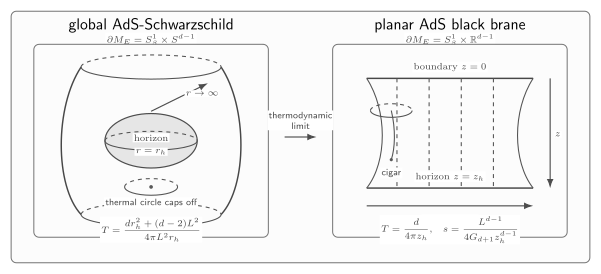
Two basic thermal saddles in AdS/CFT. Global AdS-Schwarzschild has boundary and a compact spherical horizon. The planar black brane has boundary and horizon . In Euclidean signature the thermal circle caps off smoothly at the horizon only if is fixed by the surface gravity.
Temperature from Euclidean smoothness
Section titled “Temperature from Euclidean smoothness”The Hawking temperature of a static black hole is most cleanly derived from Euclidean regularity. Wick rotate
Near the horizon, write
Since ,
The Euclidean part of the metric becomes
Define a proper radial coordinate
Then
Substituting gives
This is flat polar space if
has period . Hence
The temperature is therefore
Using
and eliminating in favor of , we obtain
This formula contains different physics depending on the horizon topology.
For spherical horizons, ,
Small global AdS black holes behave approximately like asymptotically flat Schwarzschild black holes:
Their temperature decreases as the horizon grows, so they have negative specific heat. Large global AdS black holes behave differently:
Their temperature increases with horizon radius. This is one reason large AdS black holes can be thermodynamically stable in the canonical ensemble.
For planar horizons, ,
The planar case has no additional curvature scale on the boundary, so dimensional analysis already suggests . This is the homogeneous thermal plasma geometry used in most finite-temperature holographic calculations.
Global AdS-Schwarzschild
Section titled “Global AdS-Schwarzschild”The global AdS-Schwarzschild solution corresponds to :
with
At large ,
so the conformal boundary metric is
After Euclidean continuation, the boundary is
The horizon area is
and the Bekenstein-Hawking entropy is
The ADM mass, with the pure-AdS vacuum contribution subtracted or treated separately according to the holographic-renormalization scheme, is
Together with the temperature formula,
these quantities satisfy the first law
The canonical free energy is
This last formula foreshadows the Hawking-Page transition. The free energy changes sign at
The corresponding temperature is
We will study this transition on the next page. For now the important lesson is simpler: a thermal CFT on a compact sphere has more than one gravitational saddle with the same boundary thermal circle. Dominance is a free-energy question, not merely a question of which solution exists.
Planar black branes
Section titled “Planar black branes”The planar black brane is the workhorse of finite-temperature AdS/CFT. It describes a homogeneous thermal state on flat space.
A convenient Lorentzian form is
where
The conformal boundary is at
and the horizon is at
The boundary metric is flat:
Euclidean regularity gives
This can be derived directly in coordinates. Near the horizon,
The Euclidean metric near is
The two-dimensional part is smooth polar space only if
Hence .
The same solution can be written in the coordinate with :
where
Then
Both coordinate systems are common. The coordinate is excellent for near-boundary expansions and holographic renormalization; the coordinate makes the large-radius asymptotic region look natural and is common in black-hole thermodynamics.
Entropy density of the black brane
Section titled “Entropy density of the black brane”For the planar brane, the horizon is noncompact. The total entropy is infinite, so the meaningful quantity is entropy density.
At fixed and , the induced spatial metric along the horizon is
Thus the horizon area per unit boundary spatial volume is
The entropy density is therefore
Using
we find
This equation is one of the simplest quantitative holographic predictions. It says that a large- CFT with an Einstein-gravity dual has entropy density
The factor
is proportional to the number of degrees of freedom of the CFT. For the canonical example in ,
and , so
This is the strong-coupling, large- entropy density of the plasma.
Energy density, pressure, and the holographic stress tensor
Section titled “Energy density, pressure, and the holographic stress tensor”For the planar brane, holographic renormalization gives the thermal stress tensor
with
Thus
The free-energy density is
The entropy density computed from thermodynamics agrees with the horizon-area result:
Indeed,
Therefore
These are precisely the thermodynamic identities of a conformal plasma in spacetime dimensions. The equation
is the finite-temperature version of stress-tensor tracelessness:
The fact that the black-brane geometry automatically produces this relation is an early sign that the gravitational solution knows about CFT kinematics, not merely about black-hole mechanics.
The black brane as a large global black hole
Section titled “The black brane as a large global black hole”The planar black brane can be viewed as a local limit of a very large global AdS black hole. When
the horizon radius is much larger than the curvature radius of the boundary sphere. A small patch of then looks like , and the global black-hole metric near that patch approaches the planar black-brane metric.
This is the gravitational version of the thermodynamic limit. A CFT on at high temperature satisfies
so the thermal wavelength is much smaller than the sphere radius. Local observables cannot easily tell whether the spatial manifold is a large sphere or flat space.
However, this approximation misses finite-volume physics. In particular:
- The global theory on has a Hawking-Page transition.
- The planar theory on does not have the same finite-volume transition.
- The global black hole has compact horizon area; the black brane has entropy density.
- The global geometry keeps track of the CFT Casimir energy; the planar geometry does not.
This distinction is not cosmetic. Many mistakes in finite-temperature holography come from using the planar brane while making statements that depend on compact spatial volume or confinement on a sphere.
Euclidean action and saddle dominance
Section titled “Euclidean action and saddle dominance”In the saddle approximation,
so
For the planar black brane,
This is negative for every . The competing thermal-AdS saddle has zero free-energy density in the infinite-volume planar limit, up to scheme-dependent vacuum terms. Therefore the black brane dominates the homogeneous deconfined large- thermal state on flat space.
For the global spherical black hole, the free energy is
This changes sign at . Below the Hawking-Page temperature, thermal AdS dominates. Above it, the large black hole dominates. This finite-volume competition is the bulk version of a large- confinement/deconfinement transition in suitable gauge theories.
A useful warning: the existence of a classical black-hole solution does not mean it dominates the ensemble. One must compare renormalized Euclidean actions with the same boundary geometry and the same ensemble.
Horizons and regular coordinates
Section titled “Horizons and regular coordinates”The Schwarzschild coordinates used above become singular at the horizon. This is a coordinate singularity, not a curvature singularity.
For the planar brane, define a tortoise coordinate by
Then define
Since
the part of the metric becomes
Thus the full metric is
This form is regular at . It is the natural coordinate system for infalling boundary conditions and real-time physics. The previous module introduced the rule that retarded Green functions correspond to infalling behavior at the horizon; this coordinate system shows what “infalling” means geometrically.
In Euclidean signature, by contrast, one does not impose infalling conditions. One demands smoothness at the tip of the cigar. This difference between Euclidean regularity and Lorentzian horizon boundary conditions will return repeatedly in transport, quasinormal modes, and black-hole information.
What the CFT sees
Section titled “What the CFT sees”The black brane represents a thermal state of the boundary CFT with energy density, pressure, entropy density, and correlation functions that decay at long times. The horizon is not a boundary of the CFT; it is a bulk geometric feature that encodes thermal coarse graining and dissipation in the semiclassical limit.
The simplest CFT interpretation is the thermodynamic one:
The deeper interpretation is dynamical. Perturbations of the black brane are perturbations of the thermal state. Their boundary values are sources, and their normalizable components are responses. Their infalling horizon behavior produces retarded Green functions. Their quasinormal frequencies become poles of thermal correlators.
This is why the planar black brane is the central geometry of holographic finite-temperature physics. It is at once:
- a classical solution of Einstein equations,
- a saddle of the thermal path integral,
- a geometric representation of a large- thermal state,
- a thermodynamic object with entropy equal to horizon area,
- and the background on which transport coefficients are computed.
The black brane is not just a black hole with a flat horizon. It is the gravitational avatar of a strongly coupled plasma.
Subtleties and common mistakes
Section titled “Subtleties and common mistakes”Confusing global black holes with planar branes. Global AdS-Schwarzschild describes a CFT on . The planar black brane describes a CFT on . Their high-temperature local physics can agree, but their finite-volume thermodynamics does not.
Forgetting the ensemble. Temperature is fixed by the Euclidean time circle in the canonical ensemble. At finite charge density, angular momentum, or fixed charge instead of fixed chemical potential, the relevant thermodynamic potential changes.
Treating the horizon as part of the boundary data. In Euclidean signature the smooth horizon is an interior cap. In Lorentzian signature the horizon requires regularity or infalling conditions for physical retarded response. It is not an independent CFT source.
Dropping counterterms in free-energy comparisons. The Euclidean action diverges and must be renormalized. Free-energy differences are meaningful only after comparing saddles with the same boundary data and consistent counterterms.
Using without specifying density. A planar horizon has infinite area. One should quote entropy density, not total entropy, unless the spatial directions are regulated by a finite box.
Missing the scaling. In classical Einstein gravity, thermal entropy is proportional to . In matrix large- theories this is typically , signaling deconfined adjoint degrees of freedom.
Exercises
Section titled “Exercises”Exercise 1: Temperature of a static black hole
Section titled “Exercise 1: Temperature of a static black hole”Consider a Euclidean near-horizon metric of the form
where
Show that smoothness requires
Solution
Let
Near the horizon,
The two-dimensional Euclidean metric becomes
Define
Then
Substituting gives
This is smooth polar space if
has period . Therefore
so
Exercise 2: Temperature of the planar black brane
Section titled “Exercise 2: Temperature of the planar black brane”For
show that
Solution
Near , write
Then
After Wick rotation , the two-dimensional Euclidean part is
The constant factor does not affect the required period. Define
Then
Smoothness requires
Therefore
Exercise 3: Planar thermodynamics
Section titled “Exercise 3: Planar thermodynamics”Using
and assuming conformal thermodynamics on flat space, derive
Solution
For a flat-space CFT,
The Gibbs-Duhem relation gives
Combining the two relations gives
Now
so
Integrating with the convention ,
Rewriting in terms of gives
Then conformal tracelessness gives
Exercise 4: Minimum temperature of global AdS-Schwarzschild
Section titled “Exercise 4: Minimum temperature of global AdS-Schwarzschild”For the spherical AdS-Schwarzschild black hole,
Find the minimum temperature and the corresponding horizon radius.
Solution
Differentiate with respect to :
The minimum occurs when
so
Therefore
At this radius,
For , , so small black holes have negative specific heat. For larger , , so large black holes have positive specific heat.
Exercise 5: Regular Eddington-Finkelstein coordinates
Section titled “Exercise 5: Regular Eddington-Finkelstein coordinates”For the planar black brane, define
Show that the metric becomes
which is regular at .
Solution
From
we get
Thus
Substitute this into the part of the metric:
Expanding,
The singular terms cancel, leaving
Therefore
At the horizon , the metric is finite:
The Schwarzschild-coordinate singularity has disappeared.
Further reading
Section titled “Further reading”For the original analysis of AdS black-hole thermodynamics and the stability of large AdS black holes, see Hawking and Page, “Thermodynamics of Black Holes in anti-De Sitter Space”. For the AdS/CFT interpretation of AdS black holes, thermal phase transitions, and confinement/deconfinement, see Witten, “Anti-de Sitter Space, Thermal Phase Transition, and Confinement in Gauge Theories”. For the near-extremal D3-brane thermodynamics that led directly into the black-brane description of the plasma, see Gubser, Klebanov, and Peet, “Entropy and Temperature of Black 3-Branes”. For a broad review of finite-temperature AdS/CFT, see Aharony, Gubser, Maldacena, Ooguri, and Oz, Large N Field Theories, String Theory and Gravity.