
Tree-Level String Amplitudes from Worldsheet Correlators
The path integral formulation turns perturbative string scattering into a problem in two-dimensional conformal field theory. External strings are represented by vertex operators, and a scattering amplitude is a worldsheet correlation function integrated over the moduli of the punctured surface.
At tree level for closed oriented strings, the worldsheet is a Riemann sphere. The special feature of string theory is that a single smooth worldsheet already contains all spacetime channels. What would be several Feynman diagrams in a point-particle field theory becomes one integral over the positions of punctures.
This page develops the general recipe and reduces the closed-string four-tachyon amplitude to a single integral over the complex plane. The evaluation of that integral, its pole structure, and its factorization are treated on the next page.
Sphere amplitudes and punctures
Section titled “Sphere amplitudes and punctures”For closed strings at genus zero, the schematic Polyakov path integral is
After conformal gauge fixing, the worldsheet metric is the round metric on up to a conformal factor, and Weyl invariance removes that conformal factor in the critical string. The remaining finite-dimensional data are the puncture positions , modulo the conformal automorphism group of the sphere:
Thus a convenient first expression for a tree-level closed-string amplitude is
Here denotes the matter part of the vertex operator. For the integral to be conformally invariant, must have weights
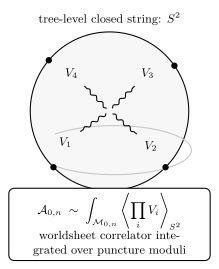
A tree-level closed-string process is a sphere with marked points. The embedding fields fluctuate on the sphere, and each puncture carries a vertex operator for an external string state.
The quotient by means that three complex positions are gauge, not moduli. Equivalently, one fixes three punctures and inserts the corresponding ghost factors. This is the most useful form for computations:
The three insertions soak up the three holomorphic ghost zero modes , and the three insertions do the same in the antiholomorphic sector. The matter vertex has weights , while the unintegrated vertex has weights and ghost number .
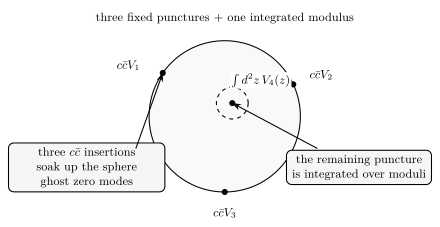
On the sphere, three punctures may be fixed by Möbius symmetry. The corresponding operators are unintegrated vertices. The remaining punctures are integrated over moduli.
The closed-string tachyon vertex
Section titled “The closed-string tachyon vertex”The simplest matter vertex in the bosonic closed string is the tachyon plane wave
We use the free-boson normalization
Then the holomorphic and antiholomorphic weights of are
The integrated closed-string vertex condition gives
With mostly-plus target-space signature, , hence
The unintegrated tachyon vertex is
The full correlator of tachyon matter vertices is fixed by Wick contractions and the zero mode of :
This product is the closed-string version of the Koba-Nielsen factor. The momentum-conserving delta function comes from integrating over the constant mode of .
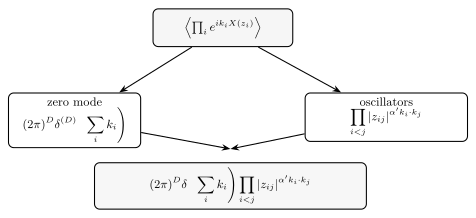
The zero mode of imposes momentum conservation. The nonzero modes produce the product of pairwise powers .
Four punctures and the cross-ratio
Section titled “Four punctures and the cross-ratio”For four closed-string insertions, the sphere has one complex modulus. We fix three positions by a Möbius transformation:
The remaining coordinate is the cross-ratio of the original four points. A symmetric way to write the cross-ratio is
After the above gauge choice, up to the chosen ordering of labels.
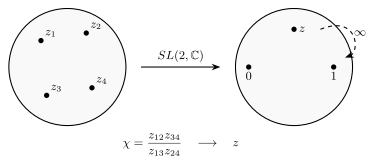
The Möbius group has complex dimension three, so it fixes three punctures. The fourth position is the genuine modulus of the four-punctured sphere.
The operator at infinity is defined by conformal transformation:
For the tachyon , this means multiplying by before taking . The ghost correlator becomes
with the same convention for .
Mandelstam invariants
Section titled “Mandelstam invariants”Take all external momenta incoming. For the ordering chosen above, define
For four identical closed-string tachyons,
The useful dot products are
Indeed,
and similarly for .
The four-tachyon integral
Section titled “The four-tachyon integral”Putting the matter correlator, ghost correlator, and Möbius fixing together gives the tree-level four-tachyon amplitude
The normalization depends on the closed-string coupling and on the normalization of vertex operators. The dependence on is universal.
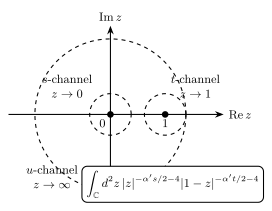
After fixing three punctures, the four-point amplitude is an integral over the complex cross-ratio. The singular regions , , and will become the -, -, and -channel factorization limits.
This formula is the central bridge from worldsheet CFT to spacetime scattering. The next step is to evaluate the complex beta integral and interpret its singularities.
Summary
Section titled “Summary”The tree-level closed-string recipe is:
For tachyons this reduces to the explicit integral above. For massless and massive string states the vertex operators have additional , , ghost, or spin-field structure, but the conceptual recipe is the same.
Exercises
Section titled “Exercises”Exercise 1. Why an integrated closed-string vertex has weights
Section titled “Exercise 1. Why an integrated closed-string vertex has weights (1,1)(1,1)(1,1)”Show that is invariant under holomorphic coordinate changes if has weights .
Solution
Under ,
A primary field of weights transforms as
For ,
so
Thus is coordinate invariant.
Exercise 2. Tachyon on-shell condition from the vertex dimension
Section titled “Exercise 2. Tachyon on-shell condition from the vertex dimension”Using , derive the mass of the closed-string tachyon.
Solution
An integrated closed-string matter vertex must have
Therefore
With mostly-plus signature, , so
Exercise 3. The Koba-Nielsen factor
Section titled “Exercise 3. The Koba-Nielsen factor”Starting from
show that
Solution
For Gaussian fields,
up to the zero-mode delta function. Since
we get
The missing overall factor is from the zero mode.
Exercise 4. Dot products and Mandelstam variables
Section titled “Exercise 4. Dot products and Mandelstam variables”For four identical closed-string tachyons, prove
Solution
Since , we have
Solving gives
For four particles of equal mass with all momenta incoming,
Because , this becomes