
Unoriented Strings, Orientifolds, and Type I Theory
The type IIA and type IIB strings are oriented closed-string theories. Every closed-string state has a left-moving part and a right-moving part, and the orientation of the worldsheet tells us which is which. But string theory also allows a more subtle possibility: we may identify configurations that differ by a reversal of worldsheet orientation. The resulting theory is unoriented. In modern language this is an orientifold projection.
The most important example is type I string theory. It is obtained, perturbatively, by starting with type IIB and quotienting by worldsheet parity. The quotient by itself is not yet consistent: it creates an orientifold plane with negative Ramond—Ramond charge, so one must add open strings ending on D9-branes. Tadpole cancellation then fixes the number of D9-branes to be and the gauge group to be .
This page explains that statement carefully. The central points are:
- worldsheet parity exchanges left and right movers of type IIB;
- the orientifold projection removes the NS—NS two-form but keeps the R—R two-form ;
- open-string Chan—Paton labels turn unoriented open strings into gauge bosons in the adjoint of or ;
- consistency of the one-loop unoriented vacuum amplitudes requires , giving type I supergravity coupled to super-Yang—Mills.
Worldsheet parity
Section titled “Worldsheet parity”For a closed string, let and be worldsheet coordinates with
The orientation-reversal operator is usually denoted by . A convenient representative is
This exchanges the left- and right-moving coordinates:
At the oscillator level,
and similarly for the RNS fermions, up to sector-dependent signs fixed by the requirement that on physical states. The orientifold projection keeps only states invariant under :
The word orientifold is used in two closely related ways. On the worldsheet it means quotienting by orientation reversal, possibly combined with a spacetime symmetry. In spacetime it means the fixed locus of that quotient: an orientifold plane, or O-plane. Type I is the special case with no spacetime reflection, so the fixed locus fills all ten dimensions. It is an O9-plane.
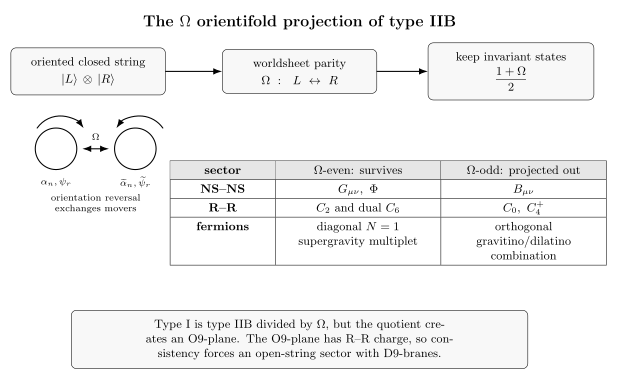
Worldsheet parity exchanges left and right movers. In type IIB, the -even closed-string fields are , , and , together with one ten-dimensional supersymmetry multiplet.
The closed-string projection of type IIB
Section titled “The closed-string projection of type IIB”The massless NS—NS states of type IIB have the form
The polarization tensor decomposes into irreducible spacetime fields:
These are, respectively, the graviton , the dilaton , and the Kalb—Ramond two-form . Since exchanges and in the left-right tensor product, the symmetric part is even while the antisymmetric part is odd:
Therefore the unoriented type I closed-string spectrum contains and , but not the NS—NS two-form .
The R—R sector is more delicate because R—R states are spinor bilinears. Type IIB contains even-degree R—R potentials
where means that the five-form field strength is self-dual. Under , the parity of a R—R -form potential may be written as
For the IIB potentials this gives
Thus the type I closed-string theory keeps the R—R two-form and removes and . Equivalently, in a democratic formulation one also has the dual six-form potential , which couples magnetically to the same charge.
For the fermions, type IIB has two supersymmetry generators of the same ten-dimensional chirality. The projection identifies them and leaves one linear combination. Hence type I has supersymmetry in ten dimensions, with real supercharges.
The closed-string massless bosonic spectrum is therefore
This is the bosonic content of ten-dimensional supergravity, in the version naturally coupled to gauge fields.
Crosscaps and O9-planes
Section titled “Crosscaps and O9-planes”The quotient by allows worldsheet surfaces that are not orientable. A useful local object is a crosscap. Topologically, inserting a crosscap means identifying antipodal points on a boundary circle. A sphere with one crosscap is the real projective plane .
In perturbation theory the worldsheet amplitude is weighted by the Euler characteristic. For a surface with handles, boundaries, and crosscaps,
Thus
The projective plane contribution is the unoriented analogue of a disk tadpole. In spacetime language, the crosscap behaves as a source for closed strings. For the quotient of type IIB, this source is an O9-plane. It fills all of spacetime and carries negative R—R charge and negative tension.
This already suggests a problem. A net R—R charge in noncompact space cannot simply disappear; it appears as a tadpole divergence in the closed-string channel. The cure is to add D9-branes, which carry positive R—R charge and support open strings.
Open strings and Chan—Paton factors
Section titled “Open strings and Chan—Paton factors”For an open string with , orientation reversal acts by
An oriented open string has distinguishable endpoints. If the endpoints carry Chan—Paton labels , a basis state is written schematically as
The orientation reversal swaps the endpoints:
where is the oscillator parity of the state. For the massless NS vector,
the standard type I convention gives an extra minus sign from the oscillator part. If the state is weighted by a Chan—Paton matrix , then invariance imposes
Here is the matrix implementing on Chan—Paton indices. There are two basic choices.
If is symmetric, one may take . Then
so the gauge bosons are antisymmetric matrices. They generate
If is antisymmetric, which requires even , the invariant matrices generate a symplectic algebra . The supersymmetric type I theory selected by tadpole cancellation uses the symmetric choice and becomes .
There is a small but important lesson here. Without Chan—Paton labels, the unoriented projection would remove the open-string gauge boson. The endpoint labels rescue the vector by allowing it to be antisymmetric in Chan—Paton space. Gauge symmetry is not an optional decoration; it is required by the consistency of the unoriented closed-string background.
The type I open-string multiplet
Section titled “The type I open-string multiplet”The open-string spectrum before the orientifold projection is the familiar GSO-projected RNS open-string spectrum. In the NS sector the first massless state is a vector,
and in the Ramond sector the massless ground state is a ten-dimensional Majorana—Weyl spinor,
After the Chan—Paton projection both transform in the same Lie algebra. With the symmetric orientifold choice this Lie algebra is . Thus the massless open sector is
Here is the ten-dimensional gaugino. Together and form the vector multiplet of ten-dimensional super-Yang—Mills theory. The matching of the vector and spinor polarizations is the same light-cone matching encountered earlier:
with the chirality chosen so that the open-string multiplet is compatible with the surviving type I supersymmetry.
This is also the cleanest way to remember the Chan—Paton result. The orientifold projection acts on the whole supermultiplet, not just on the vector. Once the vector is antisymmetric in Chan—Paton space, supersymmetry places the gaugino in the same adjoint representation.
The annulus, Möbius strip, and Klein bottle
Section titled “The annulus, Möbius strip, and Klein bottle”The one-loop vacuum amplitudes of unoriented open plus closed strings are
and
with the GSO projection and ghost contributions understood. Here or depending on the channel convention; the precise power is less important than the topology. The three surfaces are:
- the Klein bottle, a closed-string loop with an insertion;
- the annulus, an open-string loop with two boundaries;
- the Möbius strip, an open-string loop with an insertion.
Each of these admits a second interpretation after a modular transformation. In the transverse channel, the same amplitudes describe tree-level propagation of a closed string:
Here is a boundary state representing a D-brane, is a crosscap state representing an orientifold plane, and is the closed-string propagator.
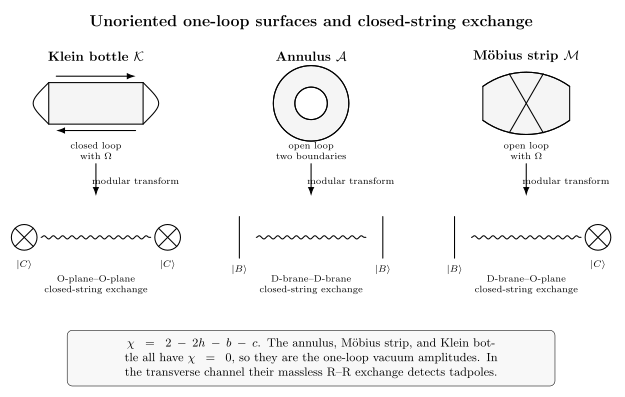
The one-loop unoriented surfaces have dual tree-channel descriptions. The annulus is D-brane—D-brane exchange, the Klein bottle is O-plane—O-plane exchange, and the Möbius strip is D-brane—O-plane exchange.
This open/closed reinterpretation is powerful because divergences are easier to diagnose in the transverse channel. A massless tadpole is a one-point source for a massless closed-string field. In a consistent flat background the total R—R tadpole must vanish. If it does not, Gauss’s law for the R—R flux is violated in noncompact spacetime.
The NS—NS tadpole is also physically important: it signals a net tension and therefore a failure of the assumed flat-space equations of motion. In a supersymmetric orientifold such as type I, NS—NS and R—R tadpole cancellation are tied together by supersymmetry.
Tadpole cancellation and
Section titled “Tadpole cancellation and SO(32)SO(32)SO(32)”Let be the number of D9-branes. In the transverse channel, the massless R—R exchange is proportional to the square of the total R—R charge. Schematically,
The D9-branes contribute units of D9 charge. The O9-plane produced by the projection contributes units. Thus
The same result is seen directly from the one-loop surfaces. With conventional normalizations, the R—R tadpole coefficient is proportional to
The condition for vanishing tadpoles is therefore
For the symmetric Chan—Paton projection, the massless open-string vectors are antisymmetric matrices, so the gauge group is
This is one of the sharpest consistency checks in perturbative string theory. The unoriented closed-string projection creates an O9-plane; the O9-plane forces us to introduce D9-branes; the D9-branes carry Chan—Paton labels; tadpole cancellation fixes their number; the Chan—Paton projection then fixes the gauge group.
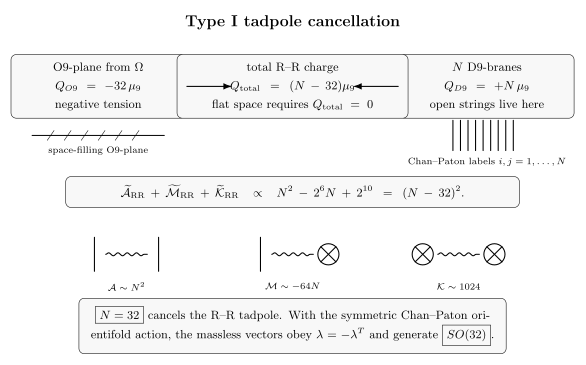
The O9-plane carries units of D9-brane charge. Adding D9-branes gives a tadpole proportional to , so consistency requires and the symmetric orientifold projection gives .
Tadpoles, Gauss’s law, and anomaly cancellation
Section titled “Tadpoles, Gauss’s law, and anomaly cancellation”The statement is sometimes presented as a one-loop calculation, but its physical content is simple. A R—R tadpole means that the vacuum has a source for a massless R—R field. Since the O9-plane and D9-branes fill all noncompact spacetime directions, the relevant flux cannot spread into transverse noncompact space; the total charge must vanish globally. The one-loop formula is the worldsheet way of imposing the spacetime Gauss-law constraint.
The same number appears again in low-energy anomaly cancellation. Ten-dimensional supergravity coupled to super-Yang—Mills is chiral and therefore potentially anomalous. The Green—Schwarz mechanism works only for very special gauge groups. For the perturbative type I construction, the Chan—Paton group is , and tadpole cancellation fixes
The dimension is not an aesthetic accident; it is the dimension that allows the twelve-form anomaly polynomial to factorize in the form needed for Green—Schwarz cancellation. Thus the worldsheet tadpole calculation and the spacetime anomaly calculation are two complementary diagnostics of the same consistency condition.
There is also a useful sign lesson. The annulus contribution is quadratic in the number of D-branes, the Klein bottle contribution is quadratic in the O-plane charge, and the Möbius strip contribution is the interference term. The fact that the three terms assemble into a perfect square is the signature that we are computing the square of a total charge.
The low-energy type I action
Section titled “The low-energy type I action”The low-energy field theory is ten-dimensional supergravity coupled to super-Yang—Mills. In string frame, the bosonic terms have the schematic form
The three-form field strength is associated with the surviving R—R two-form . In the full theory it is modified by Chern—Simons terms,
up to convention-dependent signs and normalizations. This modification is part of the ten-dimensional Green—Schwarz anomaly-cancellation mechanism.
The powers of are worth noticing. Closed-string sphere terms scale as , while disk terms scale as . The Yang—Mills kinetic term comes from disk amplitudes of open strings on D9-branes, so it has the disk dilaton factor. Expanding the D9-brane DBI action gives
where . With the standard convention
this gives
for D9-branes, up to the normalization of the trace over Chan—Paton generators.
What has been achieved?
Section titled “What has been achieved?”The type I construction is a beautiful example of string theory’s internal rigidity. The unoriented projection looks like a simple quotient, but it is only consistent after adding precisely the right open-string sector. The final theory has
Its massless fields are
The next natural step is to understand the one-loop modular integrals more systematically. The same modular logic that makes torus amplitudes finite also organizes the Klein bottle, annulus, and Möbius strip, and it is the backbone of perturbative string consistency.
Exercises
Section titled “Exercises”Exercise 1: parity of the NS—NS fields
Section titled “Exercise 1: Ω\OmegaΩ parity of the NS—NS fields”Start from the massless NS—NS state
Assuming exchanges and , show that the graviton and dilaton are even while the two-form is odd.
Solution
Under , the left and right fermion oscillators are exchanged, so the polarization transforms as
Decompose
Then is even and is odd. The symmetric tensor splits into its traceless part, the graviton, and its trace, the dilaton. Therefore and survive, while is projected out.
Exercise 2: Chan—Paton projection and
Section titled “Exercise 2: Chan—Paton projection and SO(N)SO(N)SO(N)”Let the open-string vector state be weighted by a Chan—Paton matrix . Suppose the orientifold action on the vector imposes
Show that the surviving gauge algebra is and compute its dimension.
Solution
The Lie algebra consists of real antisymmetric matrices. The condition is exactly this condition. An antisymmetric matrix has vanishing diagonal entries and independent off-diagonal components for . Hence
For , this gives
The number is also the famous dimension required for ten-dimensional Green—Schwarz anomaly cancellation.
Exercise 3: Euler characteristics of unoriented one-loop surfaces
Section titled “Exercise 3: Euler characteristics of unoriented one-loop surfaces”Using
compute for the annulus, Möbius strip, and Klein bottle. What is the corresponding power of for the vacuum amplitude?
Solution
For the annulus, , so
For the Möbius strip, , so
For the Klein bottle, , so
Since a vacuum worldsheet is weighted by , all three surfaces contribute at order . They are the one-loop vacuum amplitudes of the unoriented open-plus-closed theory.
Exercise 4: The tadpole square
Section titled “Exercise 4: The tadpole square”Suppose the transverse-channel R—R tadpole coefficient has the schematic form
Factor it and interpret the result in terms of D9-brane and O9-plane charge.
Solution
We have
This is the square of the total R—R charge measured in units of one D9-brane charge. The term is boundary—boundary exchange, the term is crosscap—crosscap exchange, and the term is boundary—crosscap exchange. Therefore
Tadpole cancellation requires , so .
Exercise 5: Dilaton scaling of the gauge coupling
Section titled “Exercise 5: Dilaton scaling of the gauge coupling”The D9-brane DBI action contains
Expand to quadratic order in and derive the scaling .
Solution
Use
For an antisymmetric field strength, the linear trace vanishes, and the quadratic term gives the Yang—Mills kinetic term. Up to trace conventions,
With
we obtain
or
The important point is the scaling , appropriate for a ten-dimensional gauge coupling.
Exercise 6: Why type I keeps but not
Section titled “Exercise 6: Why type I keeps C2C_2C2 but not B2B_2B2”Both and are spacetime two-forms. Explain why the orientifold projection removes one and keeps the other.
Solution
The two fields come from different worldsheet sectors. The NS—NS two-form comes from the antisymmetric part of
Worldsheet parity exchanges left and right, so the antisymmetric tensor is odd. Hence is projected out.
The R—R two-form comes from a Ramond spinor bilinear. Its parity is not determined by ordinary tensor symmetry alone; it includes the action of on spin fields and superghosts. The result for a R—R -form is
For , this sign is , so survives. Thus type I has a R—R two-form but no NS—NS two-form.