Correlation functions are where CFT becomes concrete. The previous module developed the language of primaries, stress tensors, sources, and Ward identities. We now begin using that machinery to determine actual correlators.
The first miracle is that conformal symmetry almost completely fixes the simplest scalar correlators. For scalar primary operators in flat space,
⟨O1(x1)O2(x2)⟩
is fixed up to a normalization matrix, and
⟨O1(x1)O2(x2)O3(x3)⟩
is fixed up to one constant, or a finite set of constants if global-symmetry tensor structures are present. These constants are not decorative. After choosing a normalization for two-point functions, the three-point constants are the first genuinely dynamical entries of the CFT data.
For AdS/CFT, this page is one of the first places where the dictionary becomes visible:
Δi⟨OiOj⟩Cijk⟷bulk mass of ϕi,⟷bulk quadratic action,⟷bulk cubic couplings and Witten diagrams.
The important lesson is not merely that symmetry fixes powers of distances. The deeper lesson is this: a CFT is an operator algebra, and two- and three-point functions are the first entries of that algebra.
The operators Oi are scalar primaries with scaling dimensions Δi. Under an infinitesimal conformal transformation generated by a conformal Killing vector ξμ(x),
∂μξν+∂νξμ=2σξ(x)δμν,σξ(x)=d1∂μξμ,
a scalar primary transforms as
δξOi(x)=−[ξμ(x)∂μ+Δiσξ(x)]Oi(x).
Equivalently, under a finite conformal map x↦x′ satisfying
∂xμ∂x′ρ∂xν∂x′σδρσ=Ω(x)2δμν,
correlators of scalar primaries transform covariantly as
For a dilatation x′=λx, one has Ω=λ, so this becomes the familiar scaling law
⟨i=1∏nOi(λxi)⟩=λ−∑iΔi⟨i=1∏nOi(xi)⟩.
All formulas below are statements about separated points. Contact terms supported at xi=xj are important in Ward identities and holographic renormalization, but they do not affect the separated-point power laws.
Differential constraints from conformal Ward identities
The first two equations say that scalar correlators depend only on relative distances. The last two impose scaling weights and special-conformal covariance.
A useful counting slogan is:
there are no conformal cross-ratios for n≤3.
That is why scalar one-, two-, and three-point functions are fixed up to constants. The first truly functional dependence appears at four points.
Let O be a scalar primary of dimension Δ. Translation invariance says
⟨O(x)⟩=constant.
Dilatation invariance then requires
⟨O(λx)⟩=λ−Δ⟨O(x)⟩.
A nonzero constant can obey this only if Δ=0. In a unitary CFT, the only scalar primary of dimension 0 is usually the identity operator 1. Thus, for non-identity primaries on flat space,
⟨O(x)⟩=0.
This statement is special to the vacuum on flat space. On a sphere, at finite temperature, in the presence of a boundary, or in a state created by another operator, scalar one-point functions can be nonzero.
If there are several scalar primaries with the same dimension and the same global-symmetry quantum numbers, the constants C12 form a matrix, often called the two-point metric on the space of operators of that dimension.
In a unitary theory, for Hermitian scalar primaries, reflection positivity makes this two-point metric positive definite. We can therefore choose an orthonormal basis:
⟨Oi(x)Oj(0)⟩=∣x∣2Δiδij.
This normalization is convenient but not compulsory. The transformation
Oi↦λiOi
rescales correlators. Consequently, the numerical value of a three-point coefficient is meaningful only after a convention for two-point normalization has been chosen.
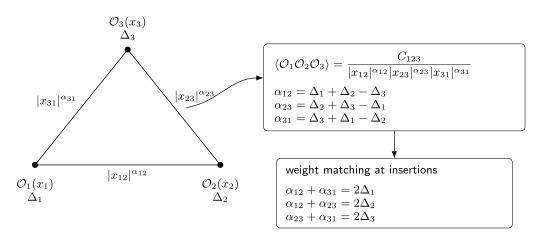
For three scalar primaries, conformal symmetry fixes the correlator to be a product of powers of the three pairwise distances. The powers are determined by matching the scaling weight Δi at each insertion. The only remaining information is the coefficient C123.
A few comments are worth making.
First, the exponents need not all be positive. If, for example, Δ3>Δ1+Δ2, then Δ1+Δ2−Δ3 is negative, and the corresponding factor appears in the numerator. This is not a problem at separated points.
Second, conformal symmetry fixes the shape but not the coefficient C123. Different CFTs can have the same spectrum of dimensions but different three-point coefficients.
Third, for identical scalar primaries O of dimension Δ,
⟨O(x1)O(x2)O(x3)⟩=∣x12∣Δ∣x23∣Δ∣x31∣ΔCOOO.
If the theory has a Z2 symmetry under which O↦−O, then COOO=0.
The descendant terms are fixed by conformal symmetry once the primary term is known. More precisely, conformal symmetry determines a tower of derivative corrections of the schematic form
Oi(x)Oj(0)∼k∑Cijk∣x∣Δk−Δi−Δj[Ok(0)+fixed powers of xμ∂μOk(0)+⋯].
Taking the expectation value with Ok(x3) and using the two-point function reproduces the three-point function above. This is why the slogan
CFT data={Δi,ℓi,global reps,Cijk}
starts with spectra and three-point coefficients.
In a non-orthonormal basis, the OPE coefficient with one index raised is
Cijk=CijℓGℓk,
where
⟨Oi(x)Oj(0)⟩=∣x∣2ΔiGij
inside a subspace of equal dimension and compatible quantum numbers.
If the CFT has a global symmetry group G, local operators transform in representations of G. Scalar here means scalar under spacetime rotations; it does not mean singlet under internal symmetry.
Suppose Oiai carries a global-symmetry index ai. The two-point function has the form
⟨Oia(x)Ojb(0)⟩=∣x∣2ΔiGijIab,
where Iab is an invariant tensor pairing the representation of Oi with that of Oj. If no invariant pairing exists, the two-point function vanishes.
Here IAa1a2a3 runs over independent invariant tensors in the tensor product of the three representations. The constants C123(A) are independent CFT data.
For example, if a Z2 symmetry assigns parities pi=±1 to scalar primaries, then
C123=0unlessp1p2p3=+1.
This is the conformal-field-theory version of an ordinary selection rule.
Position-space formulas are simplest, but AdS/CFT calculations often produce momentum-space correlators after evaluating the on-shell bulk action. The Fourier transform of a scalar two-point function is fixed by scaling.
For separated points,
G(x)=(x2)Δ1.
As a distribution, its Fourier transform is
∫ddxeip⋅x(x2)Δ1=πd/22d−2ΔΓ(Δ)Γ(2d−Δ)(p2)Δ−d/2,
up to contact terms and analytic continuation in Δ. The scaling is the main point:
G(p)∝(p2)Δ−d/2.
When Δ−d/2 is a nonnegative integer, the transform develops logarithmic behavior after renormalization:
G(p)∼(p2)Δ−d/2logp2+local terms.
Those local terms are scheme-dependent contact terms. In holography, this is the boundary manifestation of holographic counterterms and, in even dimensions, conformal anomalies.
A scalar primary Oi in a d-dimensional CFT is dual, in the simplest case, to a scalar bulk field ϕi in AdSd+1. Near the boundary in Poincare coordinates,
ds2=z2L2(dz2+dxμdxμ),z→0,
the scalar behaves schematically as
ϕi(z,x)∼zd−ΔiJi(x)+zΔiAi(x).
The coefficient Ji(x) is the source for Oi. The dimension is related to the bulk mass by
mi2L2=Δi(Δi−d).
Equivalently,
Δ±=2d±4d2+mi2L2.
The standard quantization usually takes Δ=Δ+. In the Breitenlohner-Freedman window, alternate quantization may take Δ=Δ−.
The CFT two-point function comes from the quadratic bulk action. Roughly,
Sbulk(2)∼21∫ϕiKijϕj⟹⟨OiOj⟩.
The power ∣x∣−2Δi is fixed by boundary conformal symmetry. The coefficient depends on the normalization of the bulk kinetic term and on the normalization chosen for Oi.
The CFT three-point function comes from cubic bulk interactions. A term such as
Sbulk(3)⊃∫AdSdd+1Xggijkϕiϕjϕk
produces a Witten diagram whose boundary dependence is precisely
The coefficient is proportional to the bulk cubic coupling gijk, multiplied by known normalization factors from bulk-to-boundary propagators. Thus, for scalar fields,
The most common mistake is to forget normalization dependence. If
Oi↦λiOi,
then
Cijk↦λiλjλkCijk.
So the raw number Cijk is meaningful only after two-point functions have been fixed.
A second common mistake is to confuse vanishing by conformal symmetry with vanishing by internal symmetry. Conformal symmetry says two scalar primaries of different dimensions have zero two-point function. Internal symmetry can force additional vanishings, including three-point selection rules.
A third common mistake is to ignore contact terms. At separated points,
⟨O(x)O(0)⟩∝∣x∣−2Δ.
As a distribution, this expression may require regularization at x=0, and local contact terms can be added. These contact terms matter in momentum space and in curved-space Ward identities.
Let O1 and O2 be scalar primaries of dimensions Δ1 and Δ2. Use translations, rotations, dilatations, and inversion to derive the separated-point two-point function.
For global conformal constraints on two- and three-point functions, see Di Francesco, Mathieu, and Sénéchal, Chapter 4.3. For a modern higher-dimensional treatment, see Rychkov’s CFT notes and Simmons-Duffin’s TASI lectures on the conformal bootstrap. For the holographic interpretation, these formulas become the boundary limit of bulk two-point and three-point Witten diagrams.