
Supersymmetry Algebras
Supersymmetry is the first major enlargement of spacetime symmetry that is compatible with an interacting relativistic quantum field theory. It is not an internal symmetry in the ordinary sense, because its generators carry spinor indices. It is also not merely a new spacetime symmetry, because it relates bosonic and fermionic operators. In a CFT, supersymmetry and conformal symmetry combine into a superconformal algebra. This algebra is one of the main pieces of technology behind modern AdS/CFT.
The basic physical slogan is
For the canonical example,
the CFT superconformal algebra is
Its bosonic part is
where is the four-dimensional conformal algebra and is the -symmetry algebra. On the gravity side, is the isometry group of , while is the isometry group of . Supersymmetry unifies these into one supergroup.
This page explains the algebraic structure needed for AdS/CFT. The next page will use it to discuss BPS multiplets and protected operator data.
Graded symmetry algebras
Section titled “Graded symmetry algebras”An ordinary Lie algebra has generators and commutators
A supersymmetry algebra is a graded Lie algebra. Its generators split into even and odd parts:
The even part contains bosonic generators such as translations, Lorentz transformations, dilatations, conformal transformations, and internal -symmetries. The odd part contains fermionic generators, usually denoted by and, in a superconformal algebra, also .
The bracket is graded:
The last line is the new feature. Two supersymmetry transformations compose into an ordinary bosonic transformation. In Poincare supersymmetry, the fundamental anticommutator has the schematic form
Thus supersymmetry is a square root of translations. This is the algebraic reason that supersymmetric theories have strong constraints on spectra, scattering, anomalies, and correlation functions.
Because the odd generators carry spinor indices, acting with changes the spin of a state or operator by . A supermultiplet therefore contains both bosonic and fermionic operators. The supercharges do not commute with the Lorentz group; they transform as spinors under it.
Poincare supersymmetry in four dimensions
Section titled “Poincare supersymmetry in four dimensions”The four-dimensional Poincare algebra is generated by translations and Lorentz transformations . In two-component spinor notation, a four-dimensional supersymmetry algebra with independent supersymmetries contains supercharges
where are left- and right-handed Weyl spinor indices. In a common Lorentzian convention,
The remaining basic commutators say that transforms as a spinor:
and that the supercharges commute with translations,
For extended supersymmetry, one may also allow central charges in the Poincare algebra:
Central charges are important for massive BPS particles, solitons, and branes. In an ordinary superconformal algebra of local operators, however, such Poincare central charges are not part of the conformal algebra. Conformal symmetry does not allow a fixed dimensionful central charge in the local operator algebra.
Positivity and the meaning of a supersymmetric vacuum
Section titled “Positivity and the meaning of a supersymmetric vacuum”The anticommutator
is a positivity statement. In a frame where the spatial momentum vanishes, the right-hand side is proportional to the energy. For any state ,
This is the simplest way to see why supersymmetry implies nonnegative energy, up to convention-dependent shifts. A supersymmetric vacuum obeys
If the vacuum is not annihilated by the supercharges, supersymmetry is spontaneously broken. Then the theory has massless Goldstone fermions, called goldstini. In this course we mainly care about unbroken superconformal symmetry, where the vacuum on flat space is invariant under the full superconformal algebra and the cylinder Hilbert space organizes into superconformal multiplets.
Internal symmetry versus R-symmetry
Section titled “Internal symmetry versus R-symmetry”A supersymmetric theory may have ordinary flavor symmetries, but it also has a special type of internal symmetry called R-symmetry. An R-symmetry acts nontrivially on the supercharges themselves:
This is the defining distinction between a flavor symmetry and an R-symmetry. A flavor symmetry commutes with the supercharges. An R-symmetry rotates the supercharges.
For four-dimensional superconformal theories, the common cases are:
| Supersymmetry | R-symmetry | Superconformal algebra |
|---|---|---|
| $\mathfrak{su}(2,2 | ||
| $\mathfrak{su}(2,2 | ||
| $\mathfrak{psu}(2,2 |
The case is special. The algebra is projective, hence rather than simply . Physically, the bosonic part is the product of the four-dimensional conformal algebra and the algebra.
In AdS/CFT, R-symmetry is often geometric. For ,
is the rotation group of the five-sphere. Thus CFT R-charge becomes angular momentum on the internal space.
Why conformal symmetry forces S-supercharges
Section titled “Why conformal symmetry forces S-supercharges”Poincare supersymmetry has and . A superconformal theory has more: it also has fermionic generators and , called superconformal charges.
The reason is algebraic. In an ordinary CFT, translations and special conformal transformations are paired by radial quantization. Since supersymmetry satisfies
closure of the algebra under conformal transformations requires a fermionic partner of :
Equivalently, the conformal commutator cannot vanish in an interacting superconformal algebra. It produces a new spinor generator:
Similarly,
The mixed anticommutator has the schematic form
This equation is the source of many superconformal unitarity bounds. Since is the radial-quantization adjoint of , positivity of implies inequalities involving the scaling dimension, spin, and R-charges of operators.
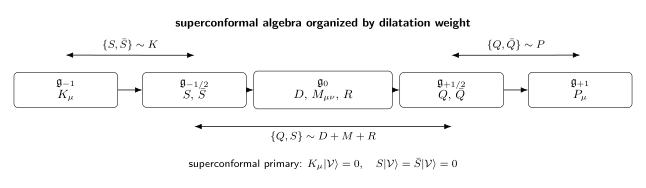
A superconformal algebra is naturally graded by dilatation weight. Translations and Poincare supercharges raise the scaling dimension of states on the cylinder. Special conformal generators and superconformal charges lower it. A superconformal primary is annihilated by all lowering generators .
This five-step grading is one of the cleanest ways to remember the algebra:
with
and
The grading means that
In particular,
Thus raises scaling dimension by , raises it by , lowers it by , and lowers it by .
Superconformal primaries and descendants
Section titled “Superconformal primaries and descendants”In an ordinary CFT, a conformal primary is annihilated by at the origin:
In radial quantization, this becomes
A superconformal primary is stronger. It must be annihilated by all bosonic and fermionic lowering operators:
Starting from , one builds the supermultiplet by acting with , , and :
Acting with or changes the scaling dimension by . Acting with changes it by . Since the supercharges anticommute, there are only finitely many independent ways to act with the fermionic generators. A supermultiplet contains finitely many conformal families.
This is an important organizational principle. In an SCFT, one does not study operators one by one. One studies supermultiplets. For example, a single superconformal multiplet may contain scalar operators, spinor operators, vector currents, the stress tensor, and fermionic supercurrents.
The stress-tensor multiplet
Section titled “The stress-tensor multiplet”Every ordinary CFT contains a stress tensor . Every CFT with continuous global symmetry contains conserved currents . A superconformal theory also contains conserved supercurrents. These objects are not independent in a supersymmetric theory. They belong to a common multiplet.
Schematic examples are
They satisfy conservation equations
and in a superconformal theory they also obey appropriate tracelessness or gamma-tracelessness conditions. The stress tensor, R-current, and supercurrent are therefore short operators. Their dimensions are protected:
For SYM, the stress-tensor multiplet is especially important. Its superconformal primary is a scalar operator in the of ,
It has protected dimension
By acting with the supercharges, one obtains the currents, the supersymmetry currents, and the stress tensor. In the bulk, this multiplet is dual to part of the type IIB supergravity multiplet on .
This is a recurring AdS/CFT theme:
Long multiplets, by contrast, are not protected. Their dimensions can depend on coupling and, in the holographic regime, often correspond to massive string states rather than low-energy supergravity fields.
Superspace as a useful language
Section titled “Superspace as a useful language”Supersymmetry can be represented geometrically using superspace. For four-dimensional supersymmetry, superspace has coordinates
where and are Grassmann variables. The supercharges may be represented as differential operators:
These obey
up to the conventional relation between and .
A superfield is a function
Because Grassmann variables square to zero, the Taylor expansion in and terminates. A superfield therefore packages finitely many ordinary component fields into one object. For example, a chiral superfield obeys
where is a supersymmetry-covariant derivative. Chiral operators and chiral rings will become important when discussing BPS data.
For SYM, a fully off-shell superspace description preserving all supersymmetries is not as simple as in theories. Nevertheless, the algebraic idea survives: operators are organized into supermultiplets, and protected subsectors are best understood through shortening conditions.
Superconformal algebras in various dimensions
Section titled “Superconformal algebras in various dimensions”Superconformal algebras are highly constrained. The bosonic conformal algebra in dimensions is in Lorentzian signature. A superconformal algebra must contain this as a bosonic subalgebra, together with an R-symmetry algebra and fermionic generators transforming as spinors.
Common examples in holography include:
| CFT dimension | Superconformal algebra | Bosonic subalgebra | Example context |
|---|---|---|---|
| super-Virasoro or finite global subalgebras | conformal R-symmetry | strings, AdS/CFT | |
| $\mathfrak{osp}(\mathcal N | 4)$ | ||
| $\mathfrak{su}(2,2 | \mathcal N)\mathfrak{psu}(2,2 | 4)\mathcal N=4$ | |
| exceptional | 5D SCFTs | ||
| $\mathfrak{osp}(8^* | 2\mathcal N)$ |
The table is not meant as a classification theorem for the course. Its purpose is to show why superconformal symmetry is so rigid. Once the spacetime dimension and number of supercharges are specified, the possible R-symmetries and representation theory are strongly constrained.
For AdS/CFT, the most important lesson is this:
This is why spectrum matching in AdS/CFT is a representation-theory problem before it is a dynamical problem.
The special role of SYM
Section titled “The special role of N=4\mathcal N=4N=4 SYM”Four-dimensional SYM has the maximal amount of supersymmetry compatible with an interacting four-dimensional gauge theory without gravity. Its field content consists of
where transforms in the fundamental of , and transforms in the vector of .
The supercharges are
Counting real components gives Poincare supercharges. Superconformal symmetry adds more -type charges. Thus the full algebra has fermionic generators.
The AdS/CFT interpretation is direct:
This is why SYM is not merely one example among many. It is the cleanest CFT laboratory where conformal symmetry, supersymmetry, large , R-symmetry, and string theory all meet.
Supermultiplets and CFT data
Section titled “Supermultiplets and CFT data”A nonsupersymmetric CFT is specified by its operator spectrum and OPE coefficients:
In an SCFT, these data are organized into supermultiplets. A superconformal primary has quantum numbers such as
where are Lorentz spins in four dimensions and denotes an R-symmetry representation. The rest of the multiplet is generated by acting with the supercharges.
Therefore, SCFT data are more efficiently described as
The ordinary conformal blocks used in the bootstrap are then grouped into superconformal blocks. Instead of summing over individual conformal primaries, one sums over supermultiplets. This often makes the bootstrap equations much more powerful.
In holographic CFTs, this organization is essential. Bulk fields also come in supermultiplets. A scalar, a spinor, a vector, and a graviton may all belong to one bulk supergravity multiplet. The CFT knows this because the dual local operators belong to one superconformal multiplet.
AdS/CFT checkpoint
Section titled “AdS/CFT checkpoint”The superconformal algebra is not decorative symmetry. It is part of the holographic dictionary.
For SYM,
This statement contains several pieces of the dictionary:
| CFT structure | Bulk interpretation |
|---|---|
| conformal symmetry | isometry of |
| isometry of | |
| and supercharges | Killing spinor symmetries of the background |
| short multiplets | protected supergravity states |
| long multiplets | generically massive string states |
| R-charge | angular momentum on the internal space |
| stress-tensor multiplet | graviton supermultiplet |
A good practical rule is:
AdS/CFT spectrum matching starts with the superconformal algebra. Dynamics then determines which long multiplets appear and what their dimensions are.
Common pitfalls
Section titled “Common pitfalls”A few distinctions prevent many confusions.
First, the gauge group of a CFT Lagrangian is not an ordinary global symmetry. In SYM, is a gauge redundancy. It is not the symmetry, and it is not the isometry of the .
Second, -symmetry is not just another flavor symmetry. It acts on the supercharges. This is why R-charges appear in superconformal unitarity bounds.
Third, a conformal primary need not be a superconformal primary. A supermultiplet contains many ordinary conformal primaries. The superconformal primary is the one annihilated by and as well as by .
Fourth, supersymmetry alone does not imply conformal symmetry. A massive supersymmetric theory has supercharges but no generators. An SCFT has the full superconformal algebra.
Fifth, protected does not mean free. BPS dimensions can be fixed by representation theory even in a strongly coupled interacting theory. This is precisely why protected sectors are so useful in AdS/CFT.
Exercises
Section titled “Exercises”Exercise 1 — Dilatation weights of and
Section titled “Exercise 1 — Dilatation weights of QQQ and PPP”Assume
Use the graded Jacobi identity to show that has dilatation weight , consistent with
Solution
Using the graded derivation property of ,
Substitute the assumed weights:
Thus has dilatation weight . Since translations obey
this is consistent with .
Exercise 2 — Superconformal descendants
Section titled “Exercise 2 — Superconformal descendants”Let be a superconformal primary of dimension . What are the dimensions of
Assume the states do not vanish.
Solution
Since
acting with raises dimension by , while acting with raises dimension by .
Therefore,
and
The last state may vanish if the multiplet is shortened or if the two supercharges are not independent, but if it is nonzero its dimension is .
Exercise 3 — Positivity from the supersymmetry algebra
Section titled “Exercise 3 — Positivity from the supersymmetry algebra”In a simplified rest-frame algebra, suppose
Show that on all states, and that a state with is annihilated by and .
Solution
For any normalized state ,
The right-hand side is
Thus . If , both norms must vanish:
This is the algebraic meaning of an unbroken supersymmetric zero-energy state.
Exercise 4 — Why is required in an SCFT
Section titled “Exercise 4 — Why SSS is required in an SCFT”Suppose a theory has conformal symmetry and Poincare supersymmetry with
Explain why closure under the conformal algebra naturally requires a fermionic generator satisfying
Solution
In a conformal algebra, and are linked by commutators such as
Since appears as a bilinear in the supercharges,
acting with on this relation should produce a consistent relation involving and . The graded Jacobi identity schematically gives
The left-hand side is nonzero because . Therefore and cannot both vanish. They define new fermionic generators, called and :
These are the superconformal charges.
Exercise 5 — Matching to
Section titled “Exercise 5 — Matching psu(2,2∣4)\mathfrak{psu}(2,2|4)psu(2,2∣4) to AdS5×S5\mathrm{AdS}_5\times S^5AdS5×S5”Identify the bosonic pieces of and explain their geometric interpretation in the dual background.
Solution
The bosonic part is
equivalently
The factor is the conformal group of a four-dimensional CFT. In the bulk, it is the isometry group of .
The factor is the -symmetry group of SYM. In the bulk, it is the isometry group of .
Thus
matches the bosonic isometry group of
The fermionic generators of are the supersymmetries of this maximally supersymmetric background.
Further reading
Section titled “Further reading”For the representation-theory viewpoint, review the earlier pages on radial quantization, unitarity bounds, conformal families, and conserved currents. For four-dimensional supersymmetry, standard supersymmetry texts introduce the Poincare algebra, superspace, and superfields. For AdS/CFT, the essential next step is to understand how short superconformal multiplets, especially the stress-tensor multiplet and chiral primary multiplets, map to Kaluza-Klein supergravity modes on .